Complete Powder Coating Solutions for Metal Products
Professional electrostatic powder coating equipment and integrated production lines. From pretreatment to curing—we deliver superior finish quality, energy efficiency, and reliable performance for metal furniture, shelving, cabinets, and industrial components.

Why Choose Ketu for Your Metal Powder Coating
Proven expertise, complete solutions, and dedicated support across 10+ industries
Complete Integrated Solutions
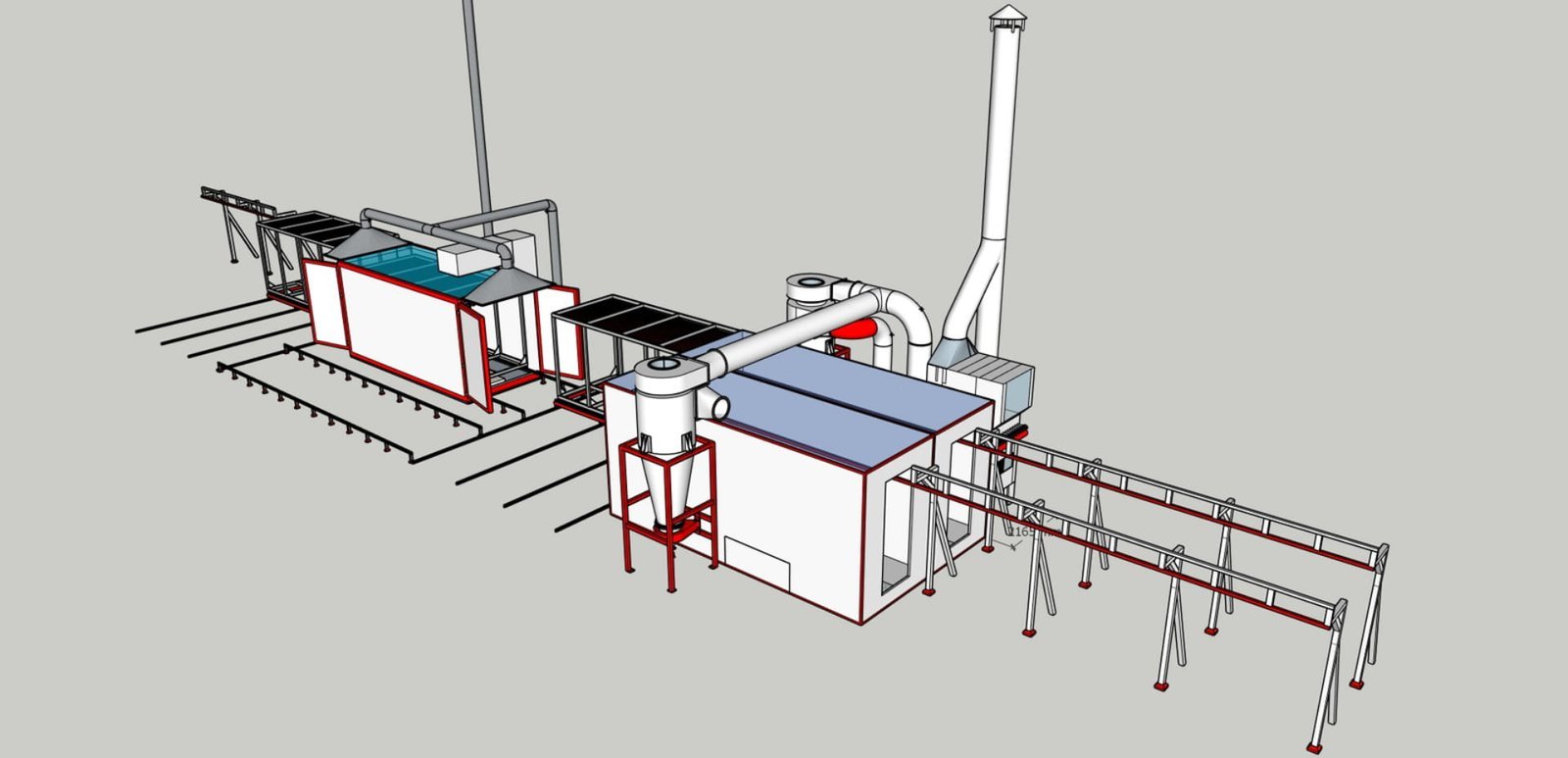
End-to-end powder coating lines connecting pretreatment, spray booth, curing oven, and conveyor. No compromise on integration or efficiency.
View Complete Lines →Professional Powder Coating Expertise
20+ years refining powder coating processes for steel, aluminum, stainless steel, and specialty metals across diverse industries.
Explore Applications →Reliable Factory & Manufacturing Capability
Multiple production facilities with CNC machining, welding, assembly, and rigorous quality testing—100% in-house control.
Schedule Factory Tour →Global Installation & Support
On-site commissioning, training, remote diagnostics, and 24/7 technical support. Your success is our priority.
Support Services →Proven Project Track Record
500+ successful installations across metal furniture, shelving, electrical cabinets, appliances, and industrial sectors. High customer retention and repeat business.
View Case Studies →What's Included in Our Metal Powder Coating Line
A complete system with five essential stages—from surface preparation to final curing
Stage 1: Pretreatment
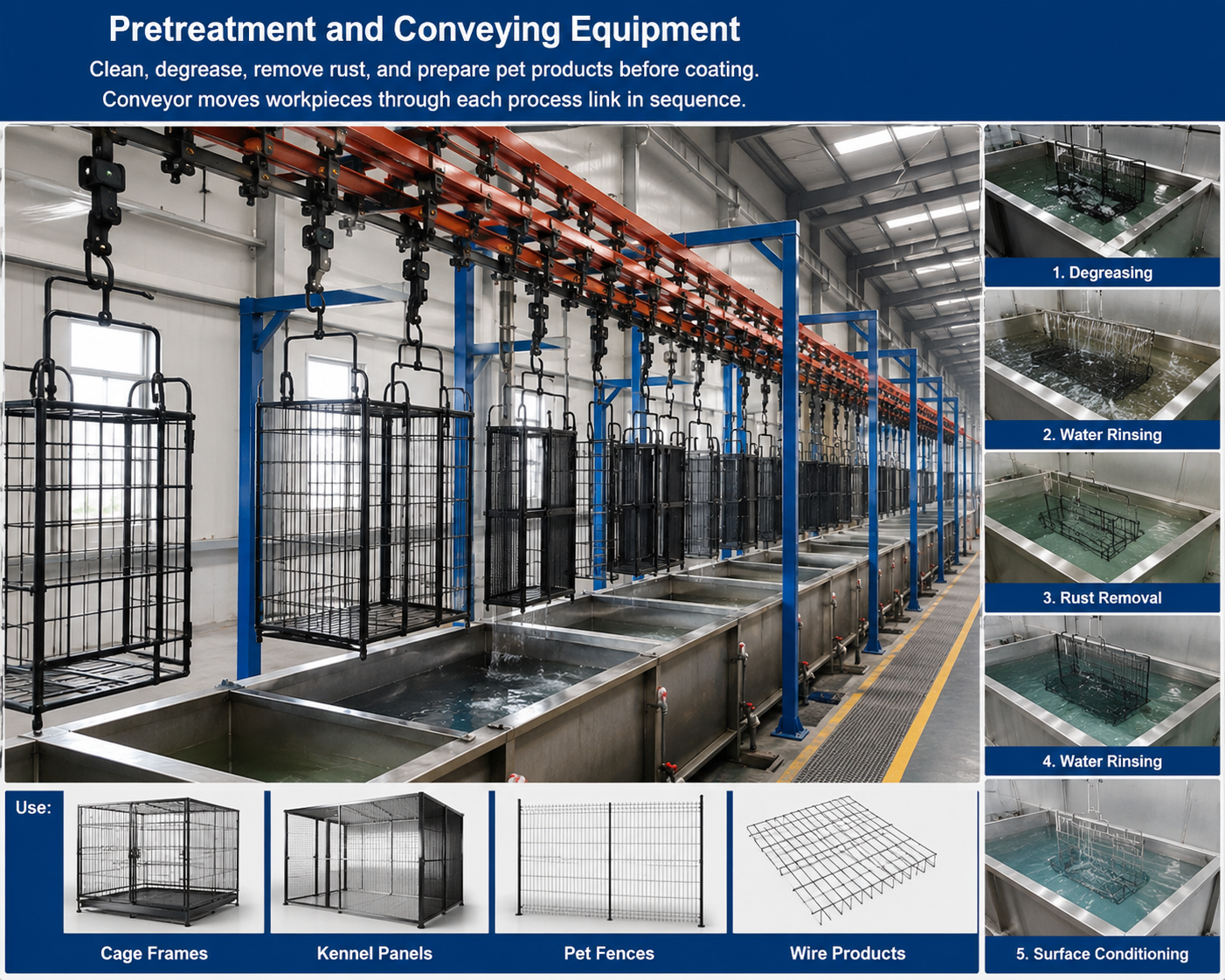
Spray cleaning, degrease, phosphate coating—prepares metal surface for optimal adhesion
Stage 2: Spray Booth
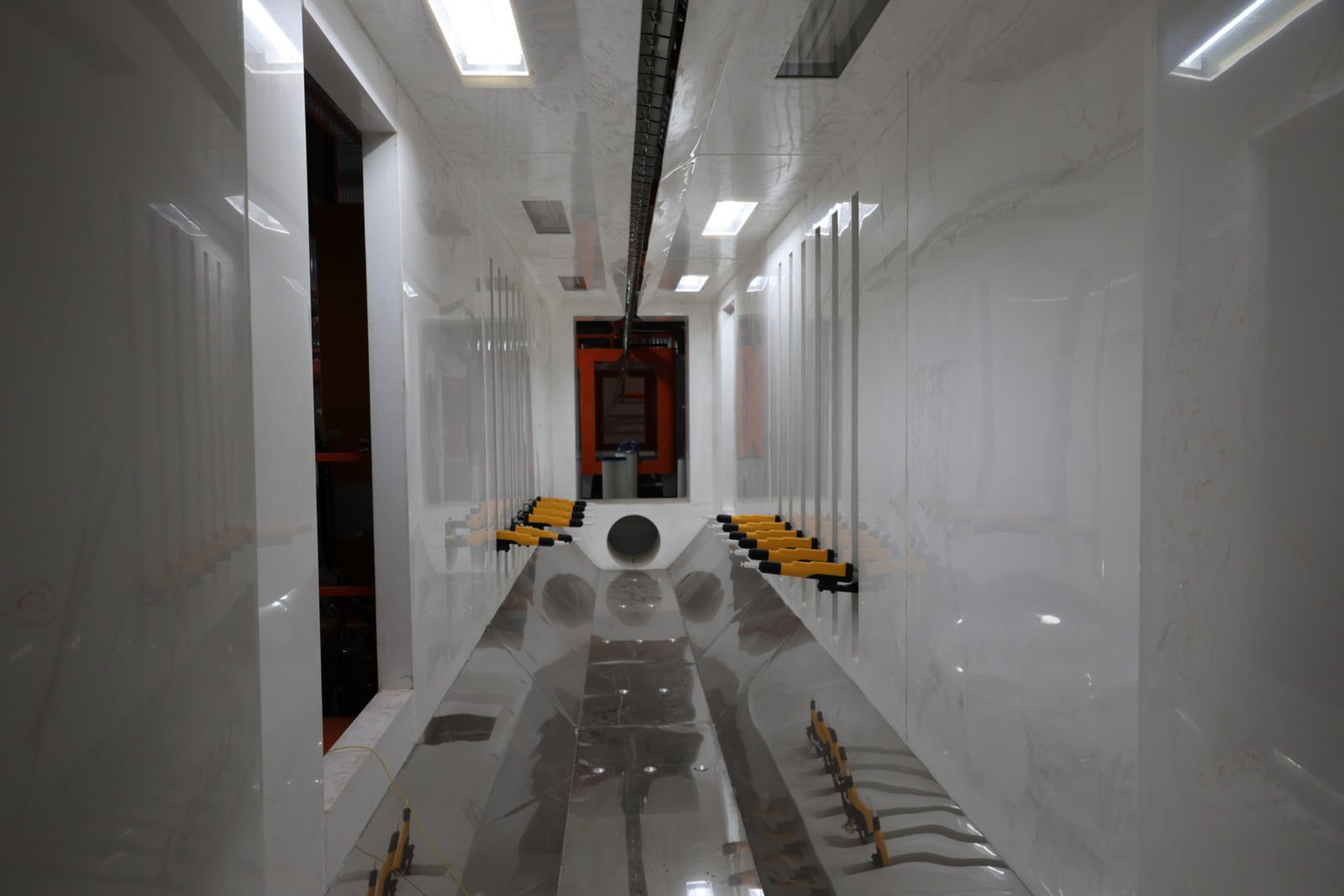
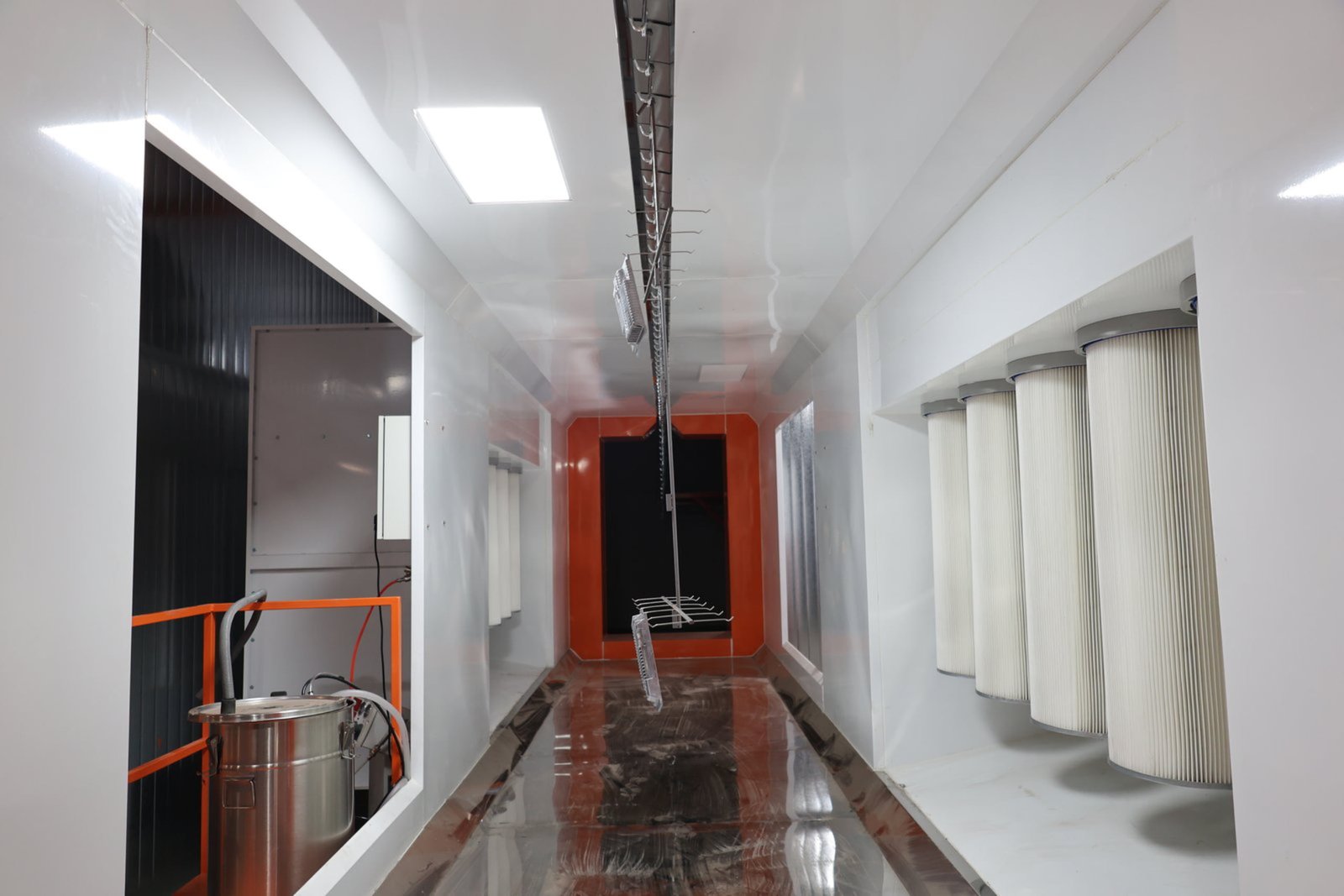
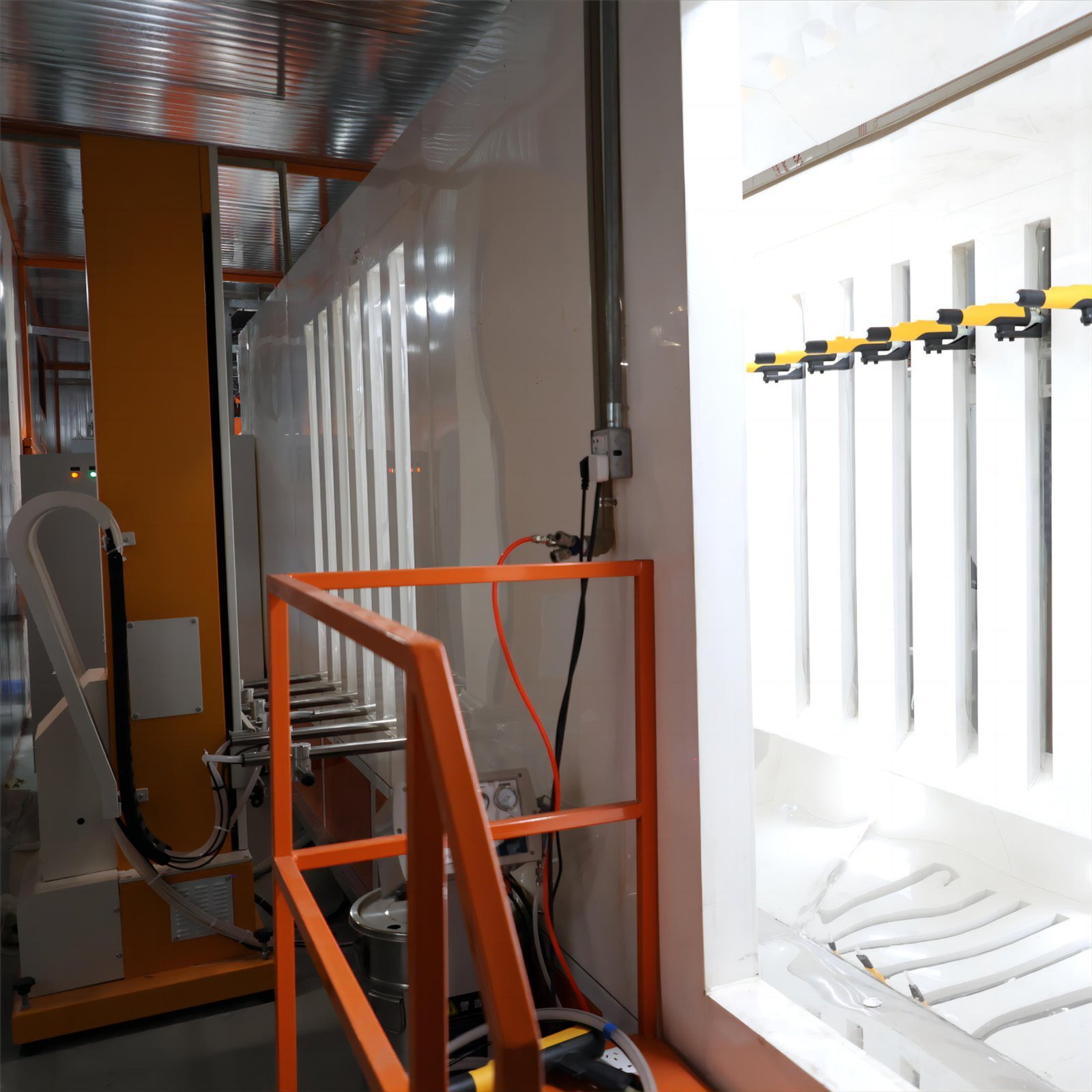
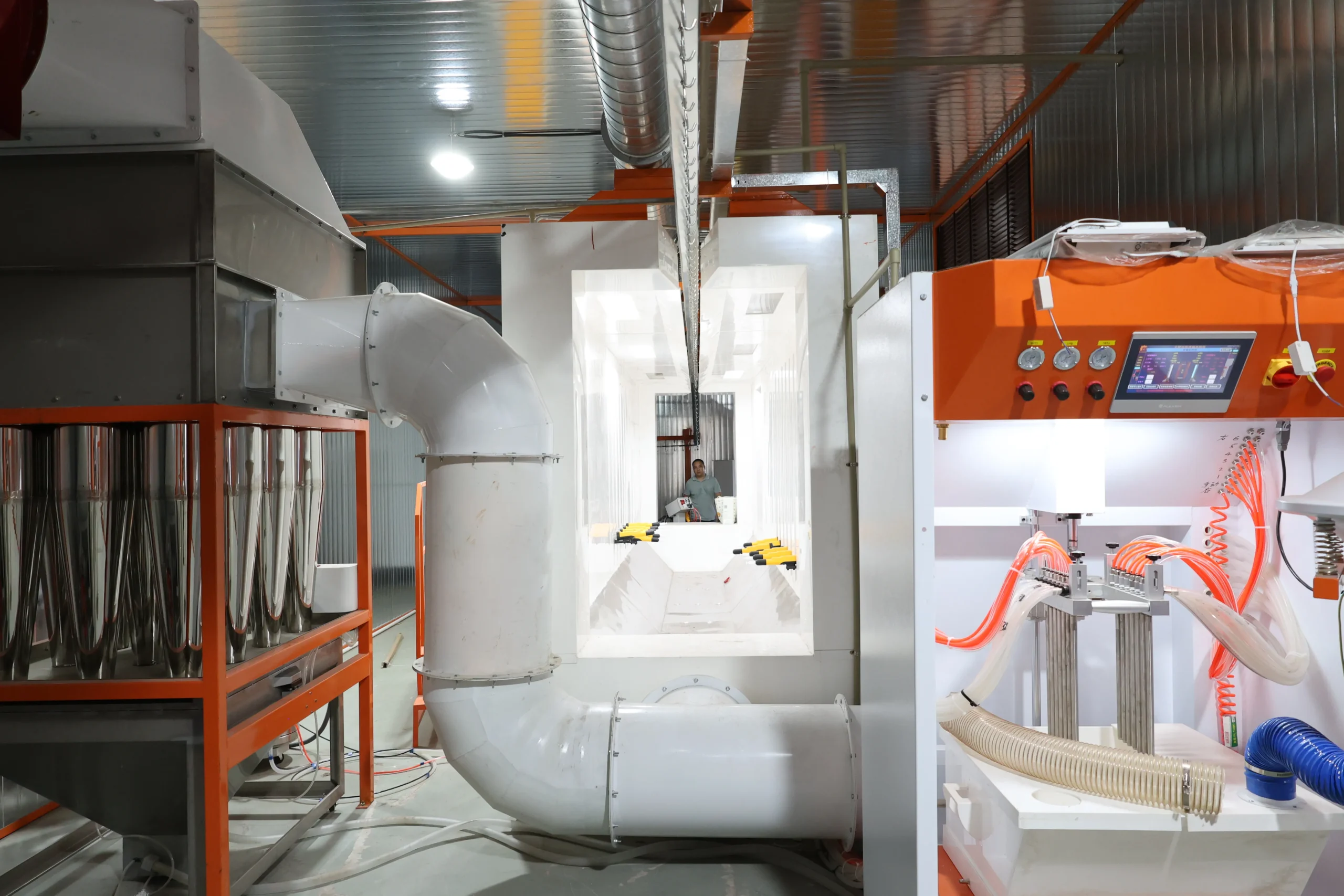
Electrostatic powder application with recycling system—uniform coverage with minimal waste
Stage 3: Curing Oven
High-temperature chamber for powder fusion—strong, durable, long-lasting finish
Stage 4: Conveyor System
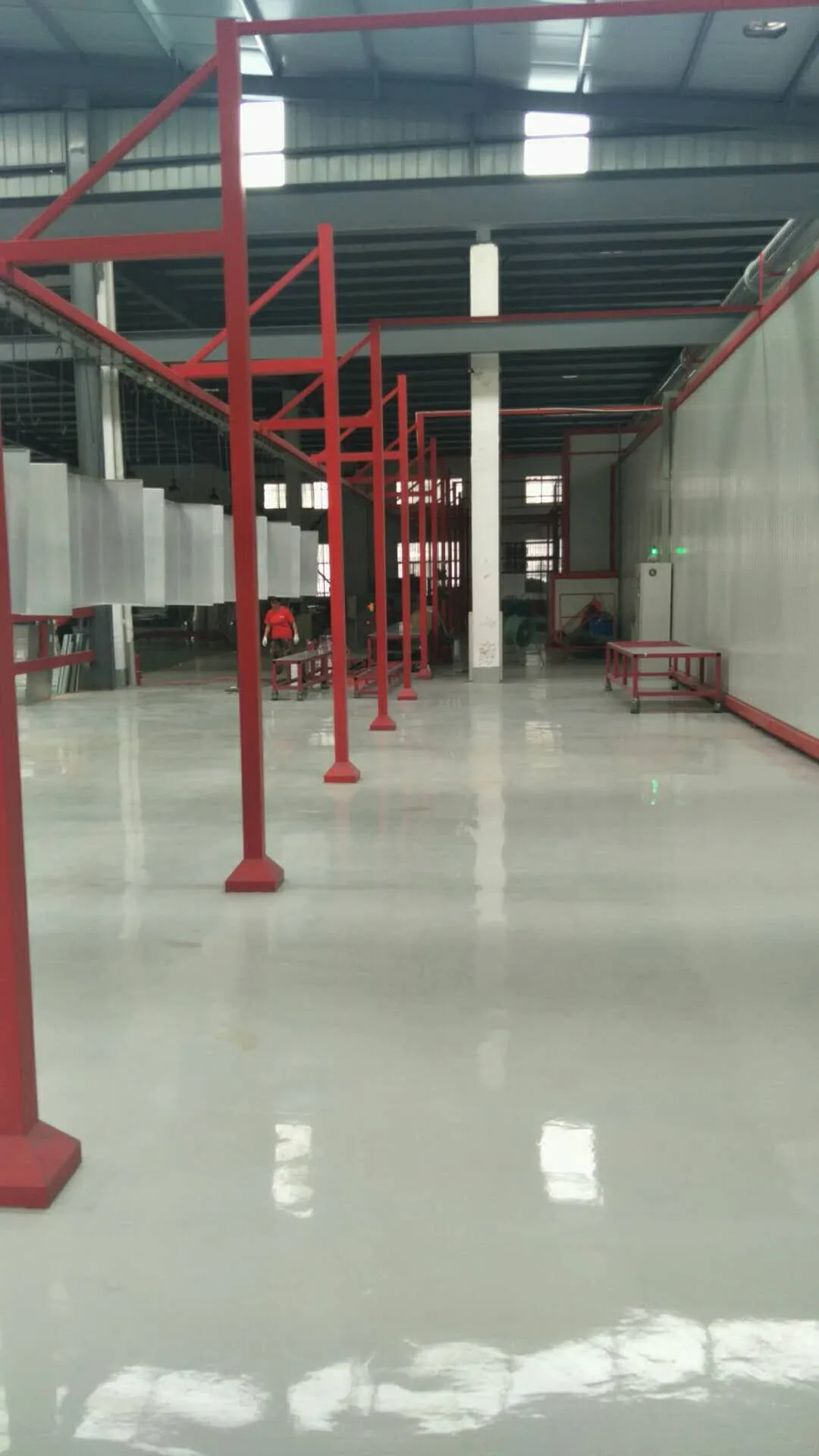
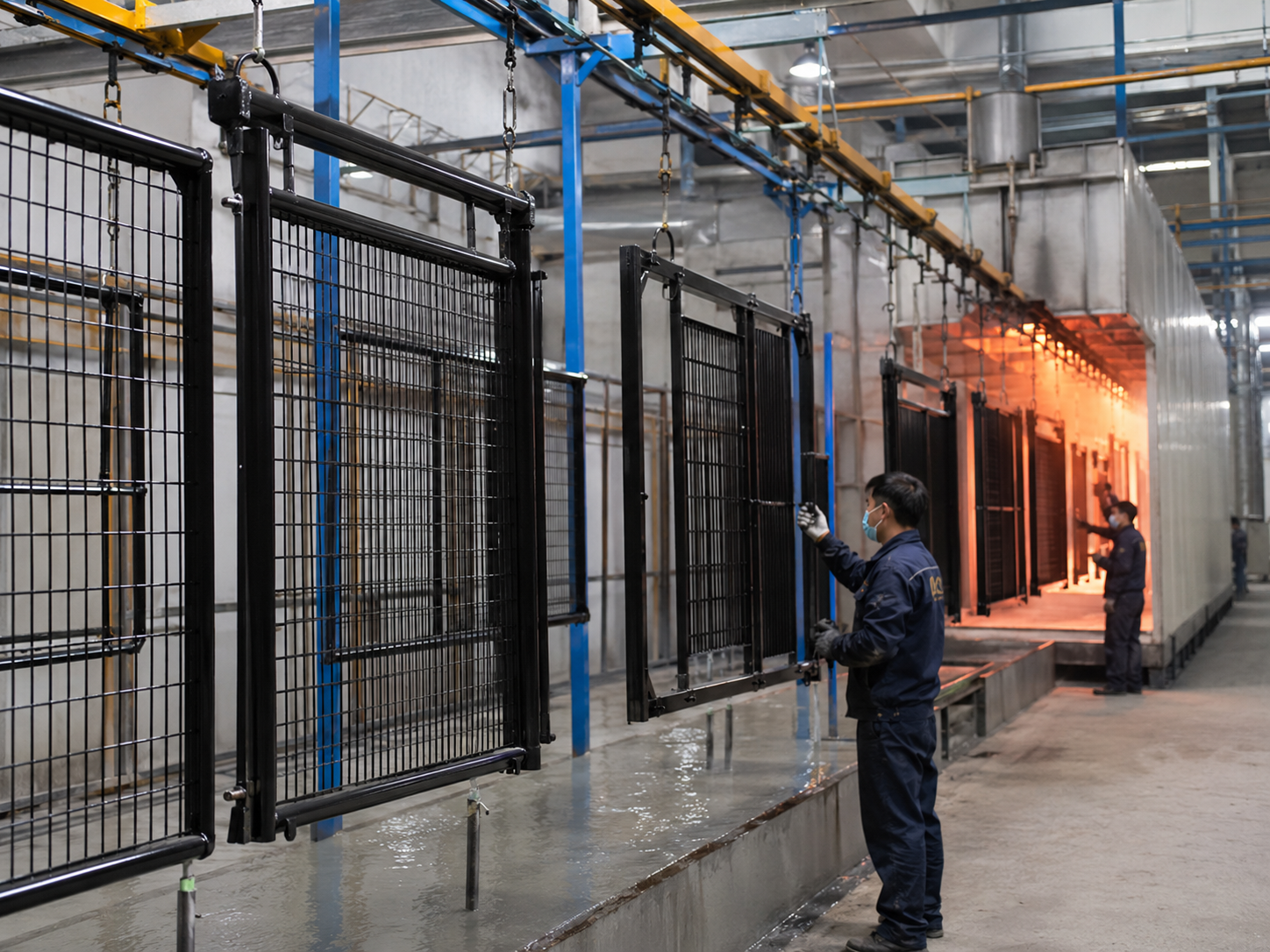
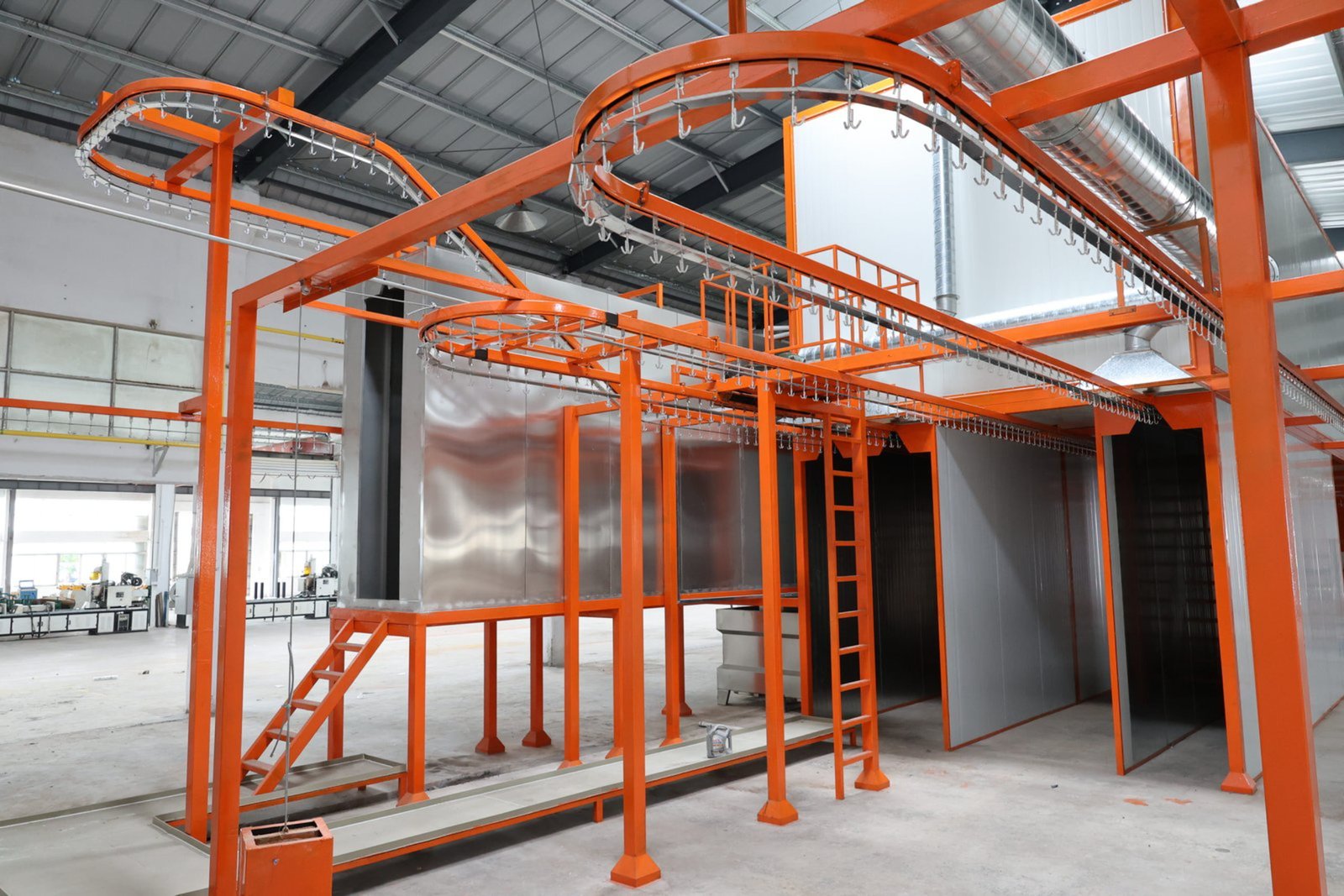
Hanging chain conveyor with adjustable speed—seamless workpiece transport
Stage 5: Recovery System
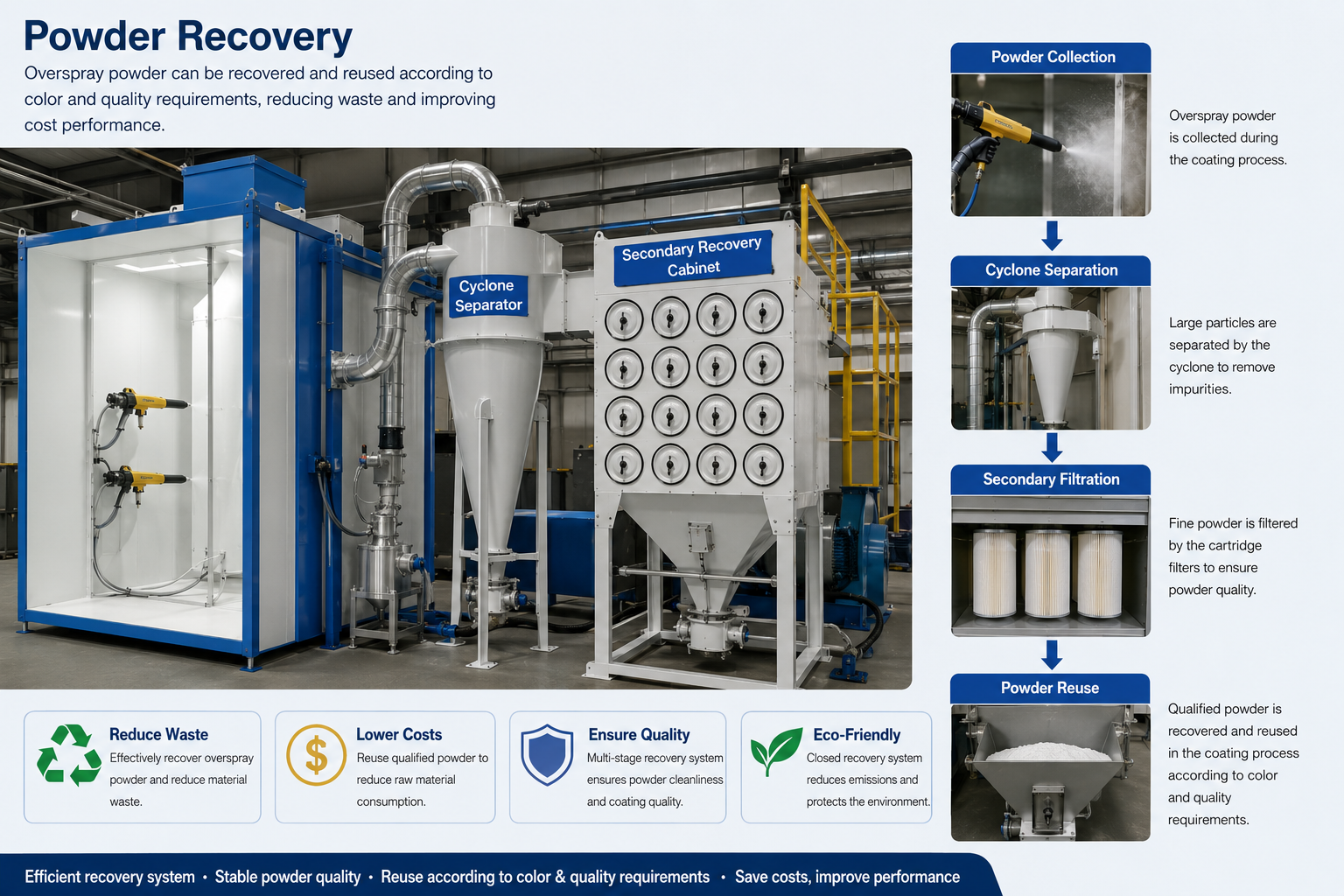
Cyclone collector with 95%+ recovery—eco-friendly and cost-effective

Pretreatment
Spray Booth

Curing Oven

Conveyor

Recovery
Core Powder Coating Equipment
Premium-quality machines manufactured in-house for reliability and performance
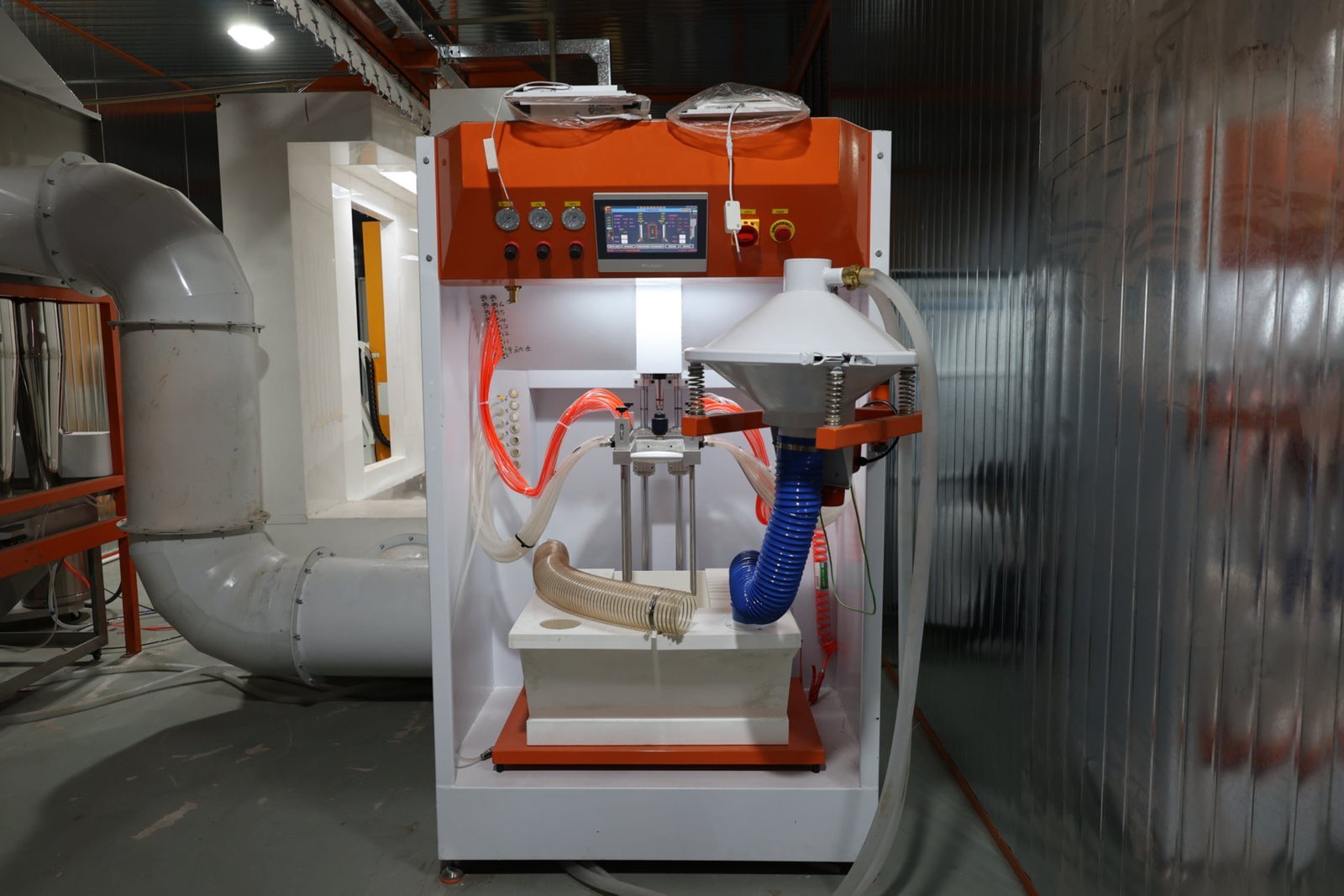
Large Cyclone Collector Line
95%+ separation rate • Corrosion-resistant • Compact structure
View Specs →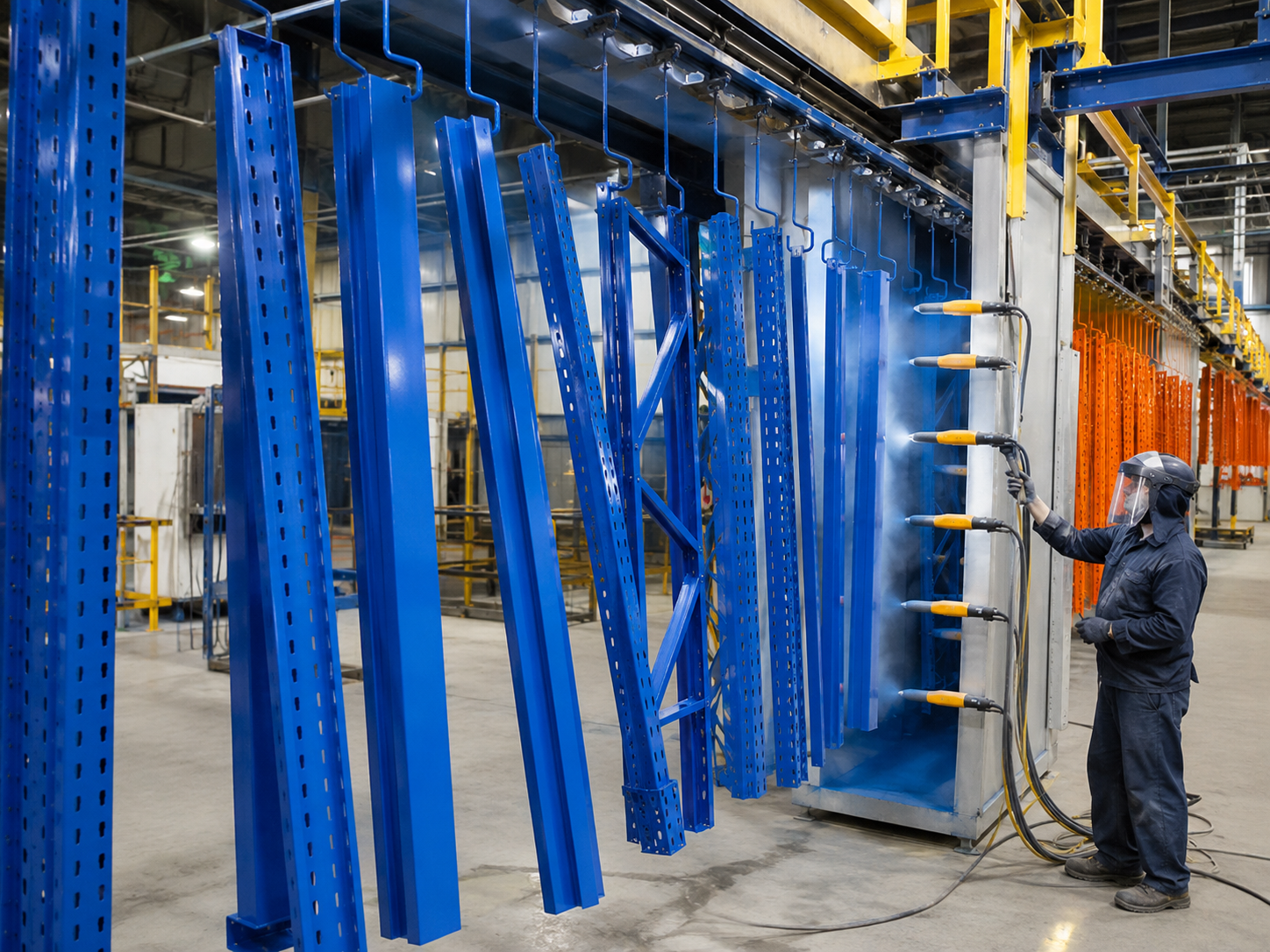
Small Cyclone Collector
Multi-barrel design • High efficiency • Wear-resistant materials
View Specs →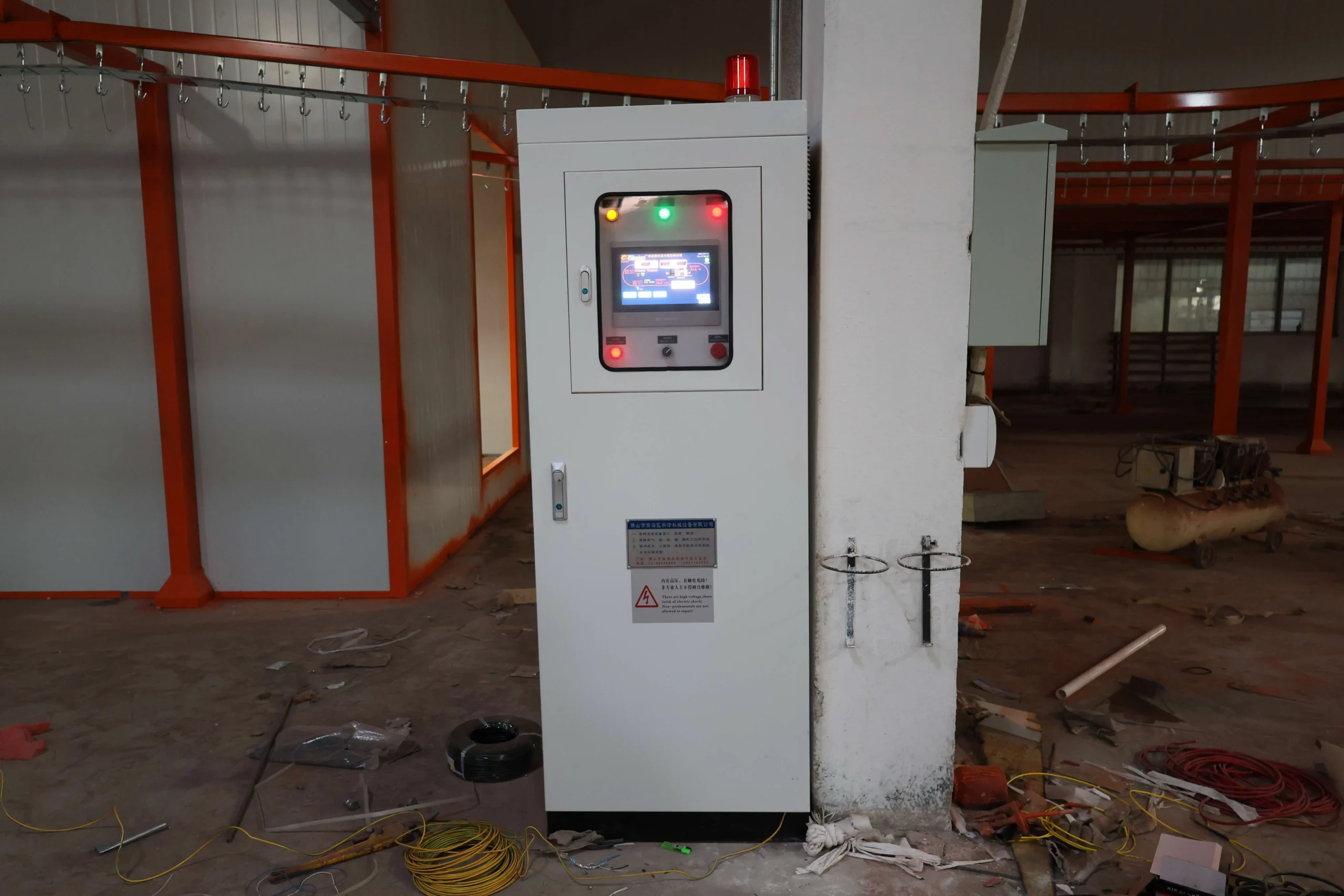

Electric Curing Oven
High thermal efficiency • Precise temperature • Even heat distribution
View Specs →
Metal Industries We Serve
Proven solutions across 10+ industries for diverse metal product coating needs
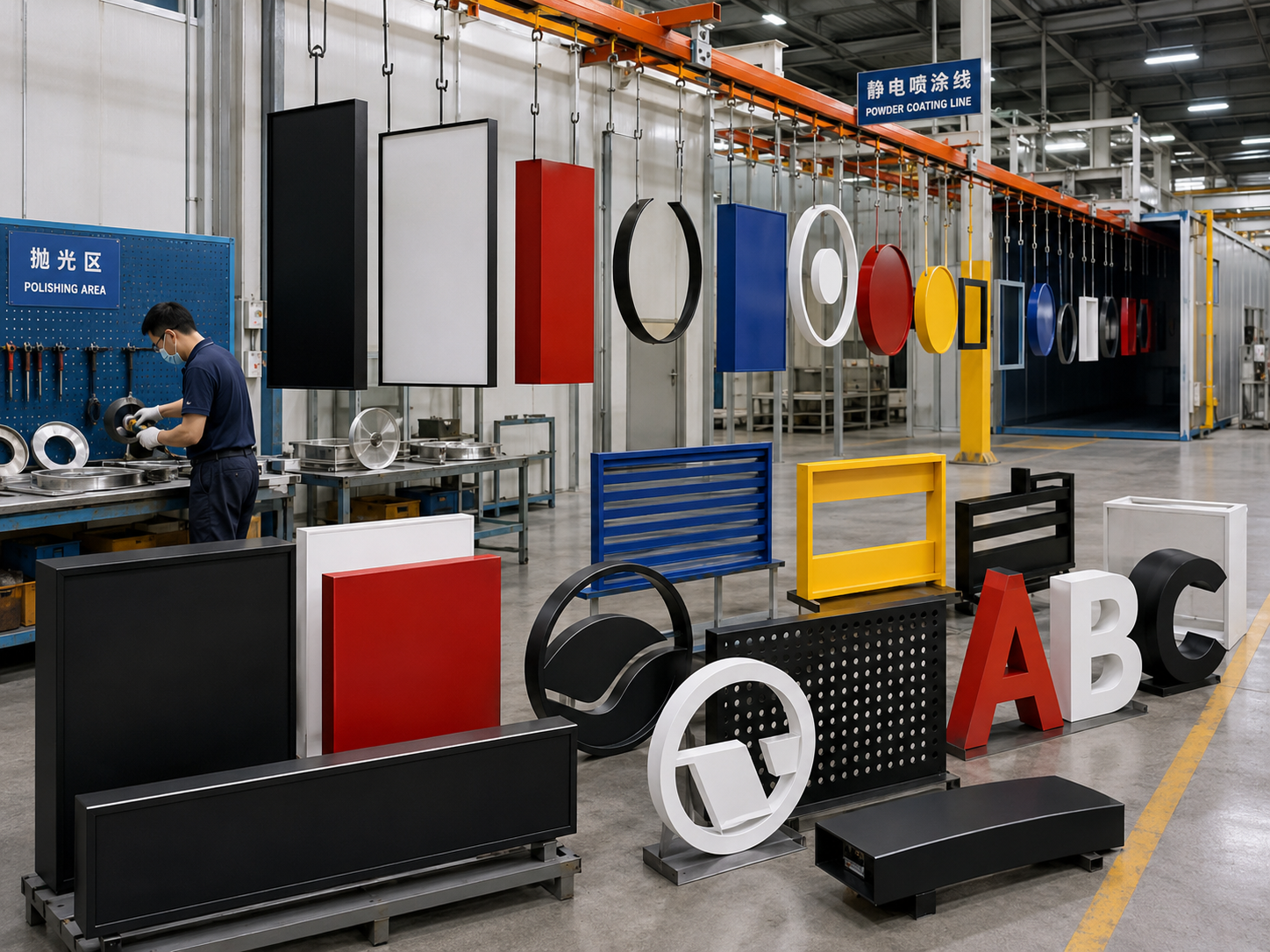
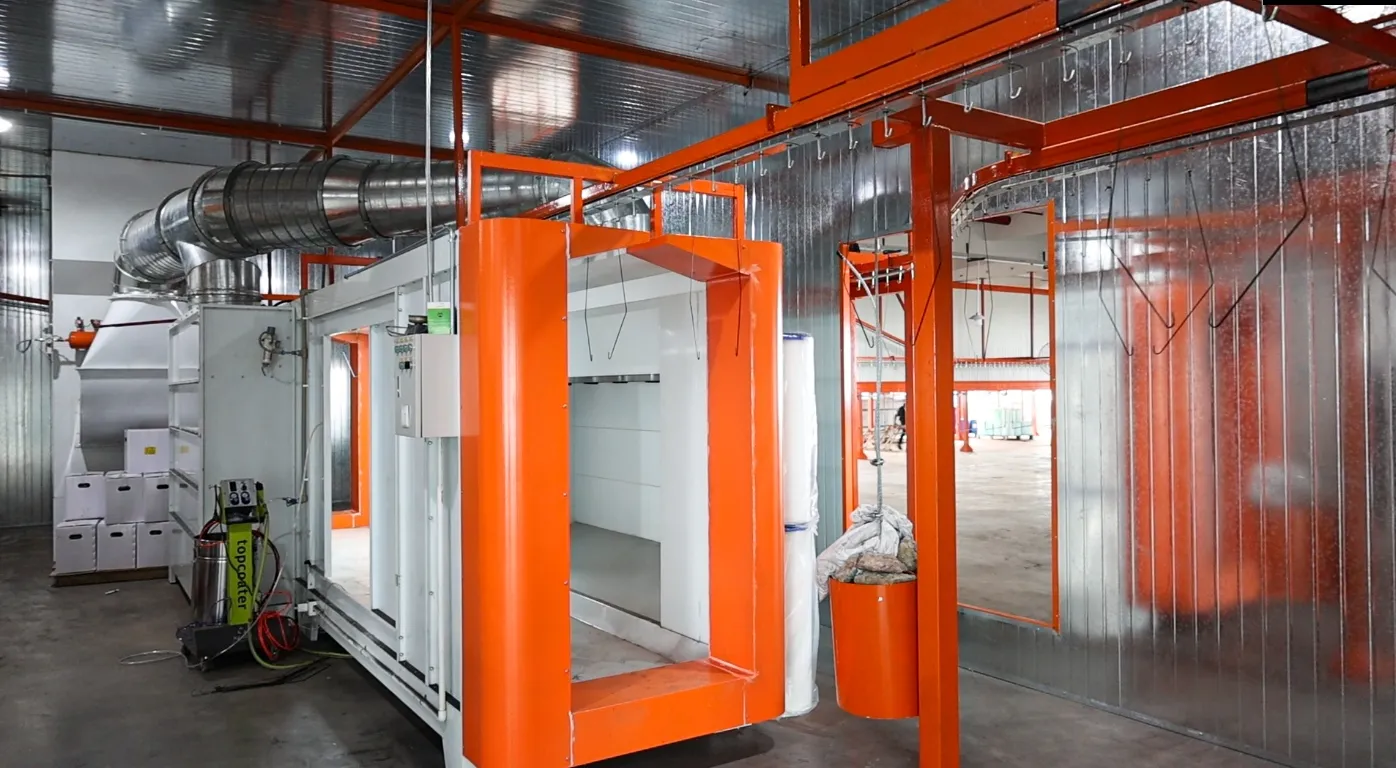
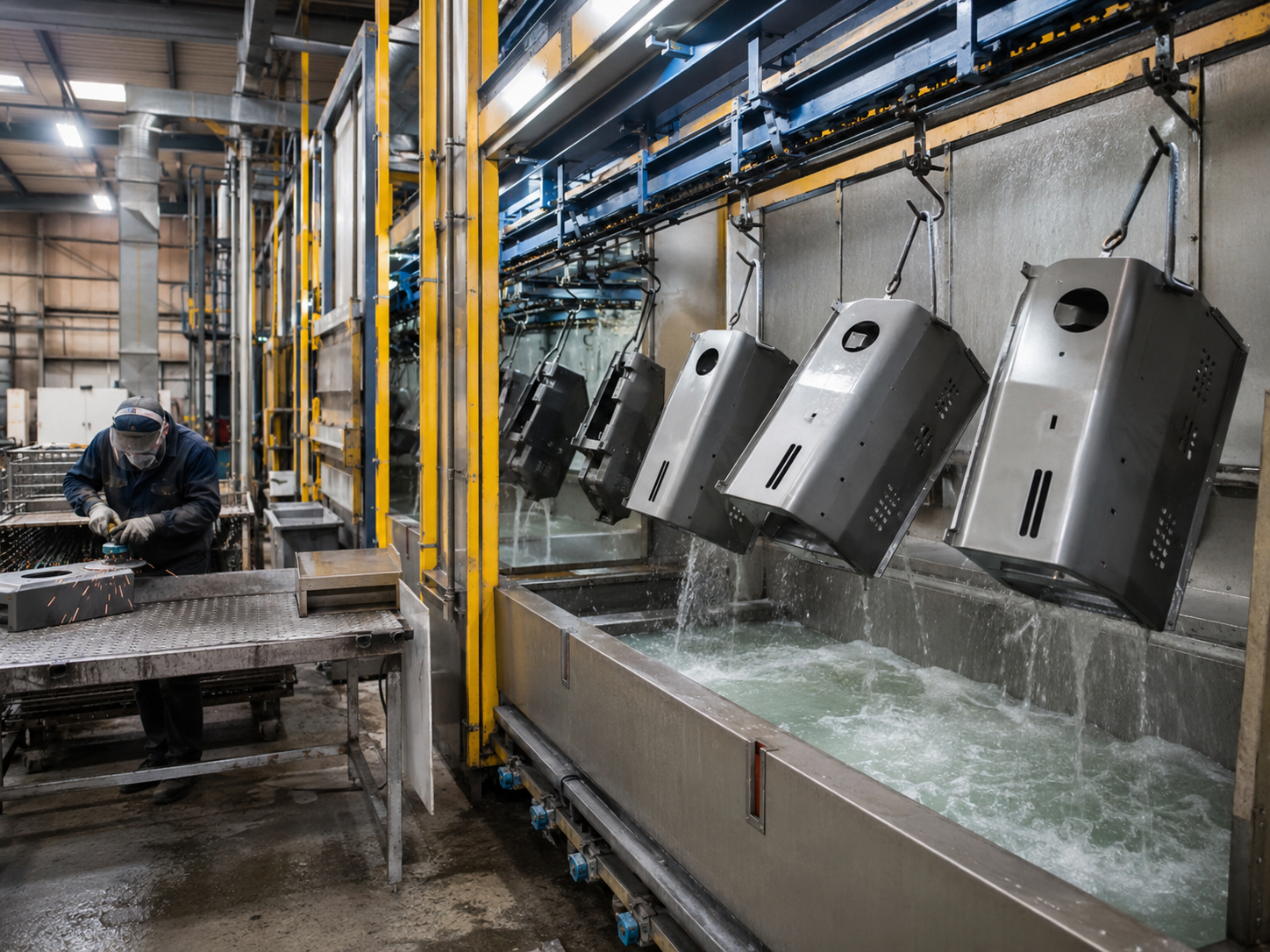
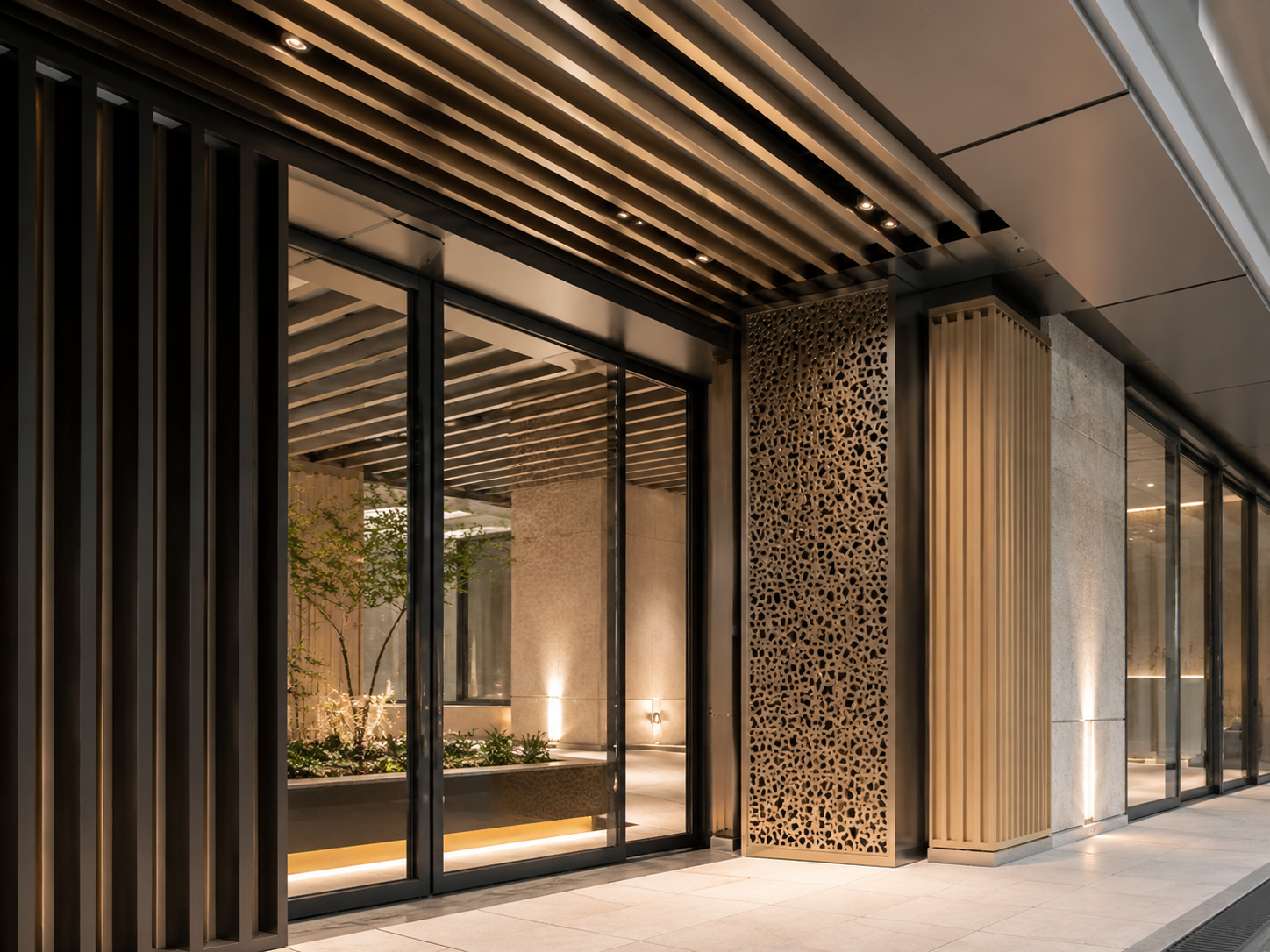
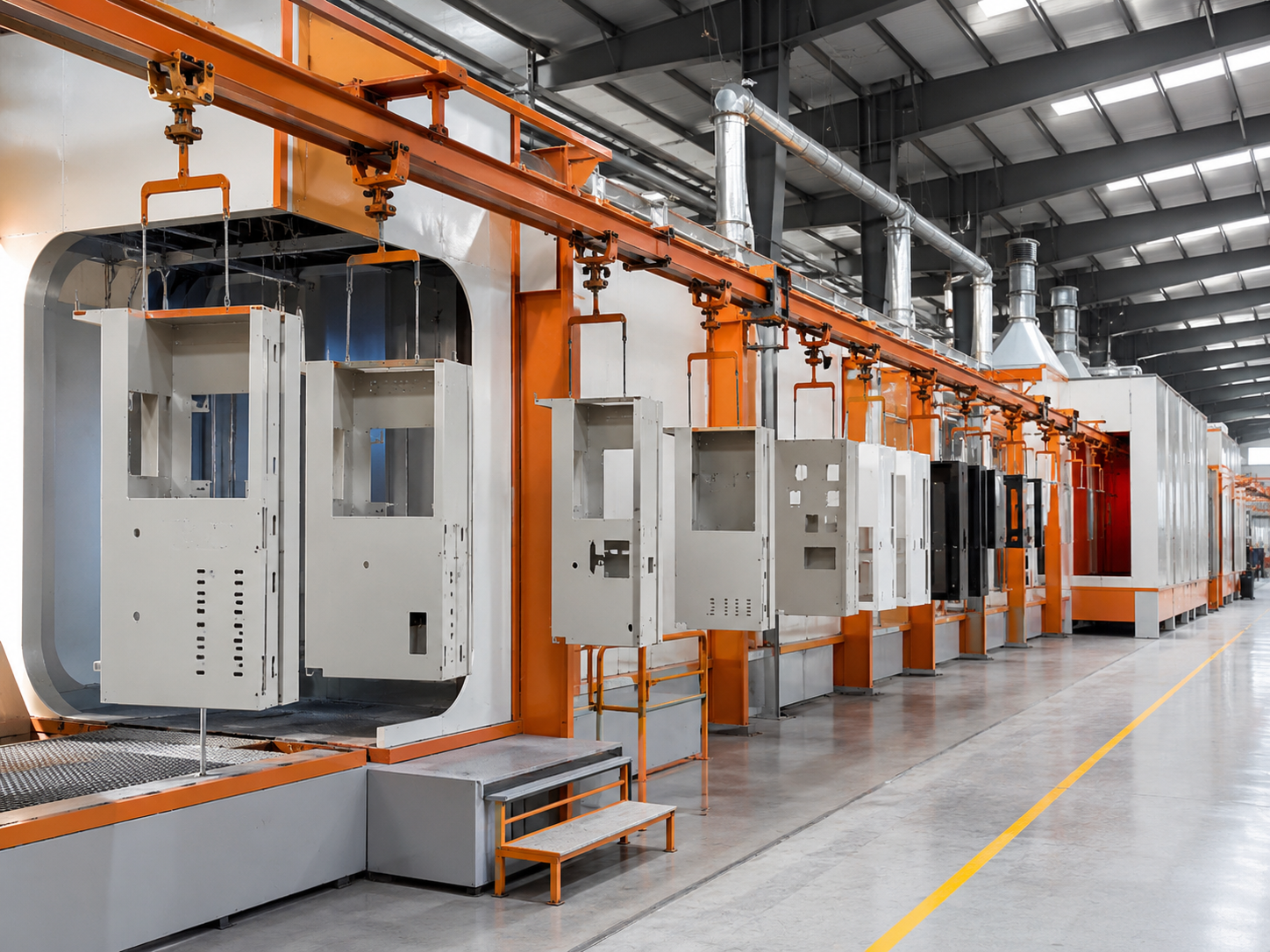
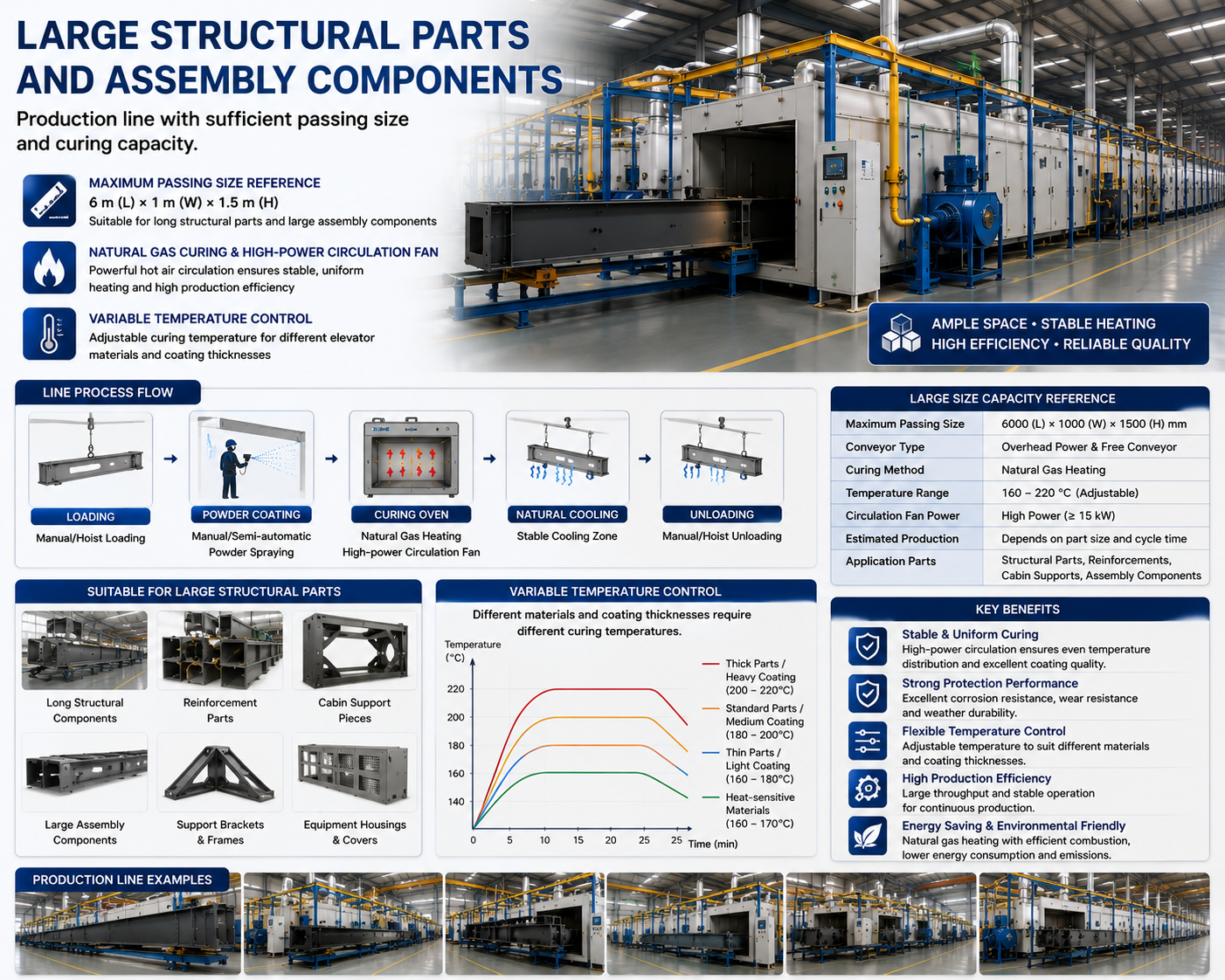
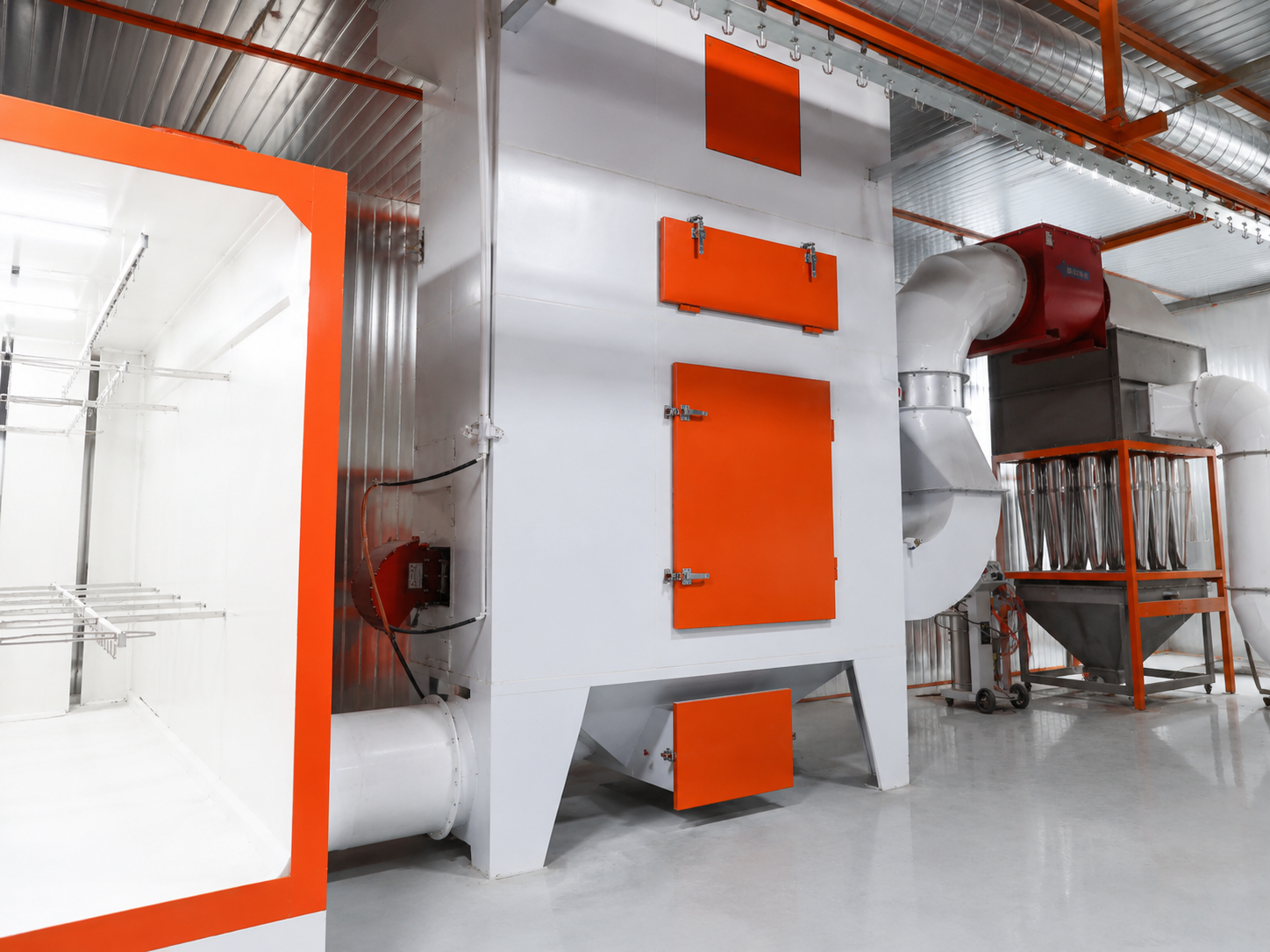
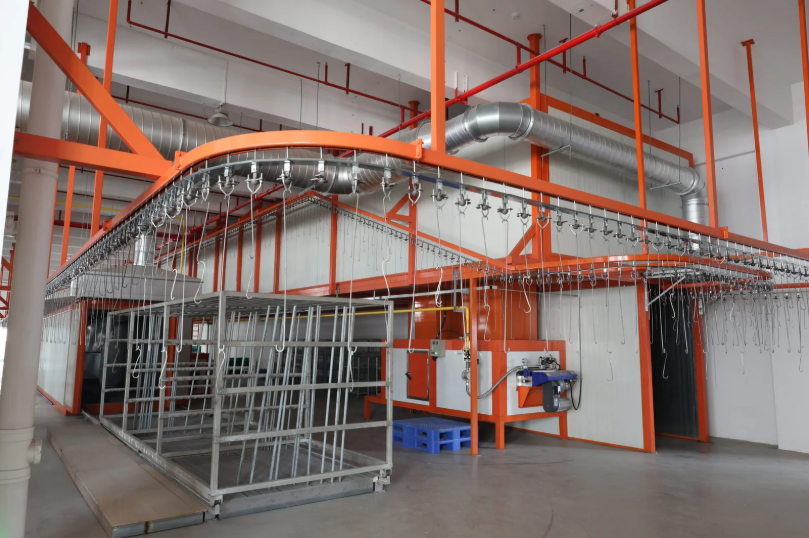
Don't see your industry? Let's discuss a custom solution for your specific needs.
Our Manufacturing Capability
State-of-the-art production facilities with proven capacity to design, manufacture, and deliver premium powder coating equipment lines worldwide.
Production Facilities
Strategically located factories in Guangdong
Skilled Employees
Engineers, technicians, and quality specialists
Annual Output (Tons)
Capacity for custom coating line manufacturing
Years Experience
Proven expertise in coating equipment design
Full Production Control & Quality Assurance
Advanced Welding & Fabrication
In-house welding, CNC machining, and metal fabrication capabilities ensure precision manufacturing and structural integrity in every equipment unit.
Rigorous Quality Control
Each equipment undergoes multi-stage inspection: component testing, assembly verification, functional testing, and pre-shipment quality assurance.
100% Virgin Raw Materials
All structural and functional components use premium virgin materials—no recycled or substandard parts—guaranteeing durability and long service life.
Fast Customization & Delivery
With multiple production lines and experienced teams, we deliver custom-made coating equipment within 8-16 weeks, depending on complexity and specifications.
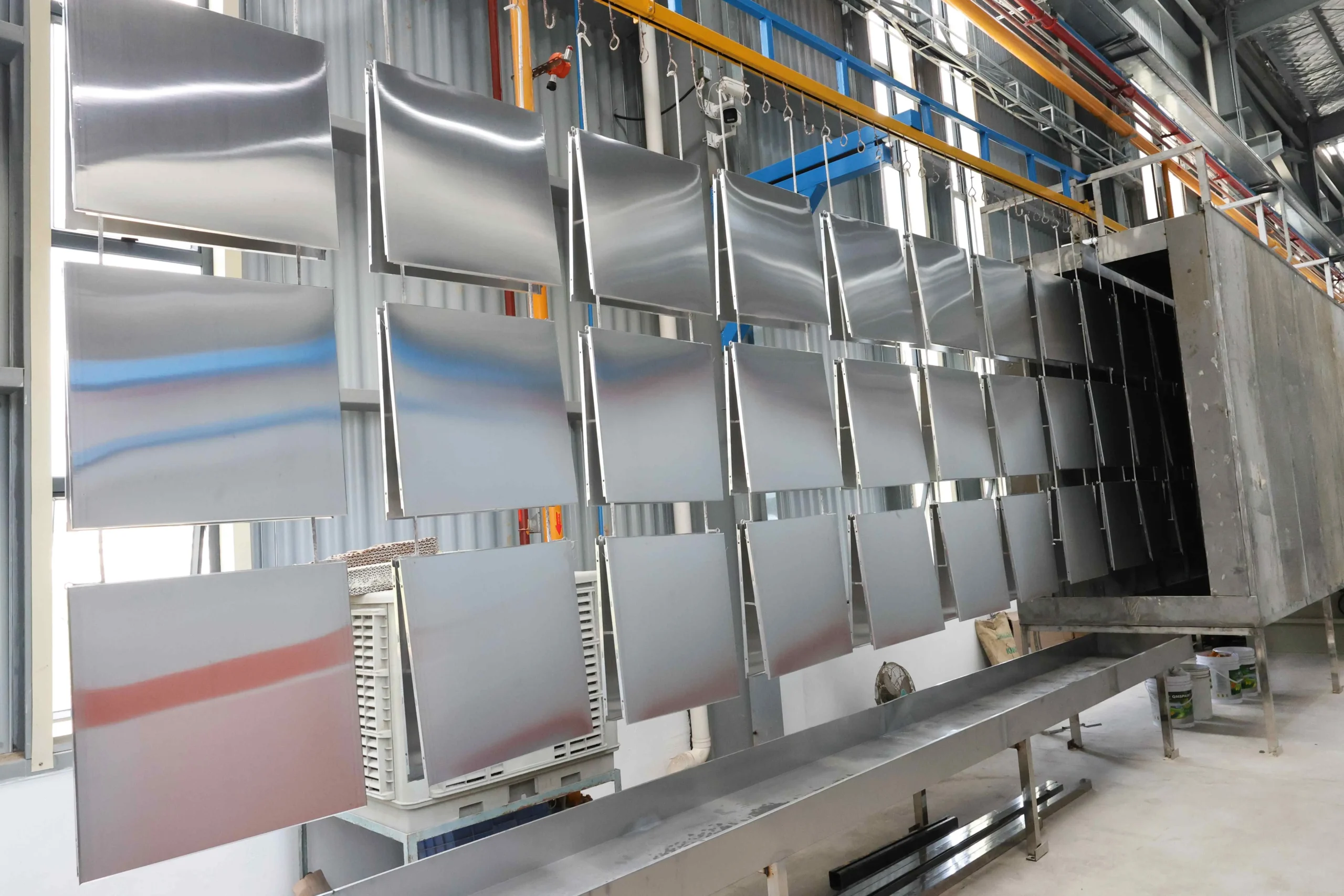
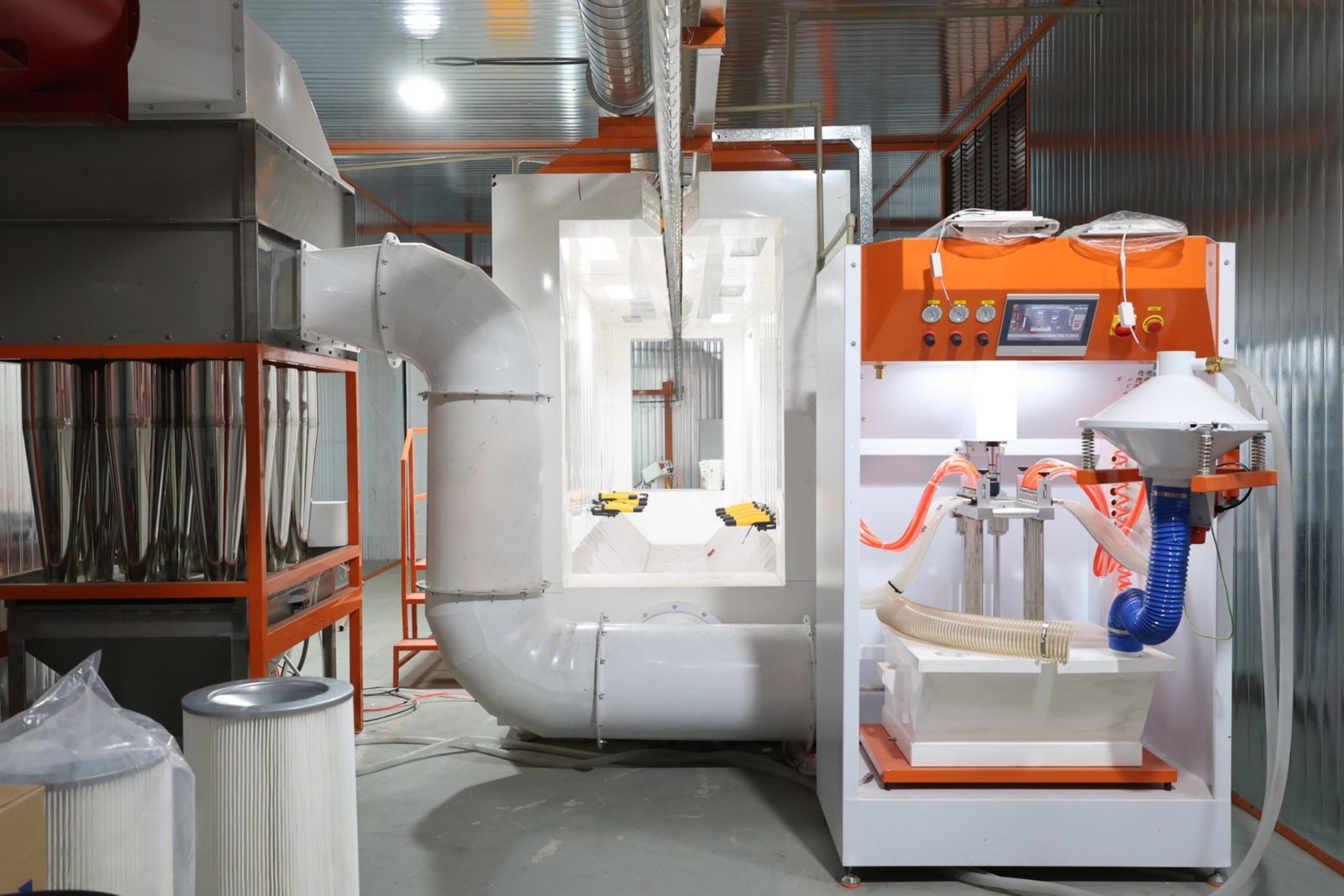
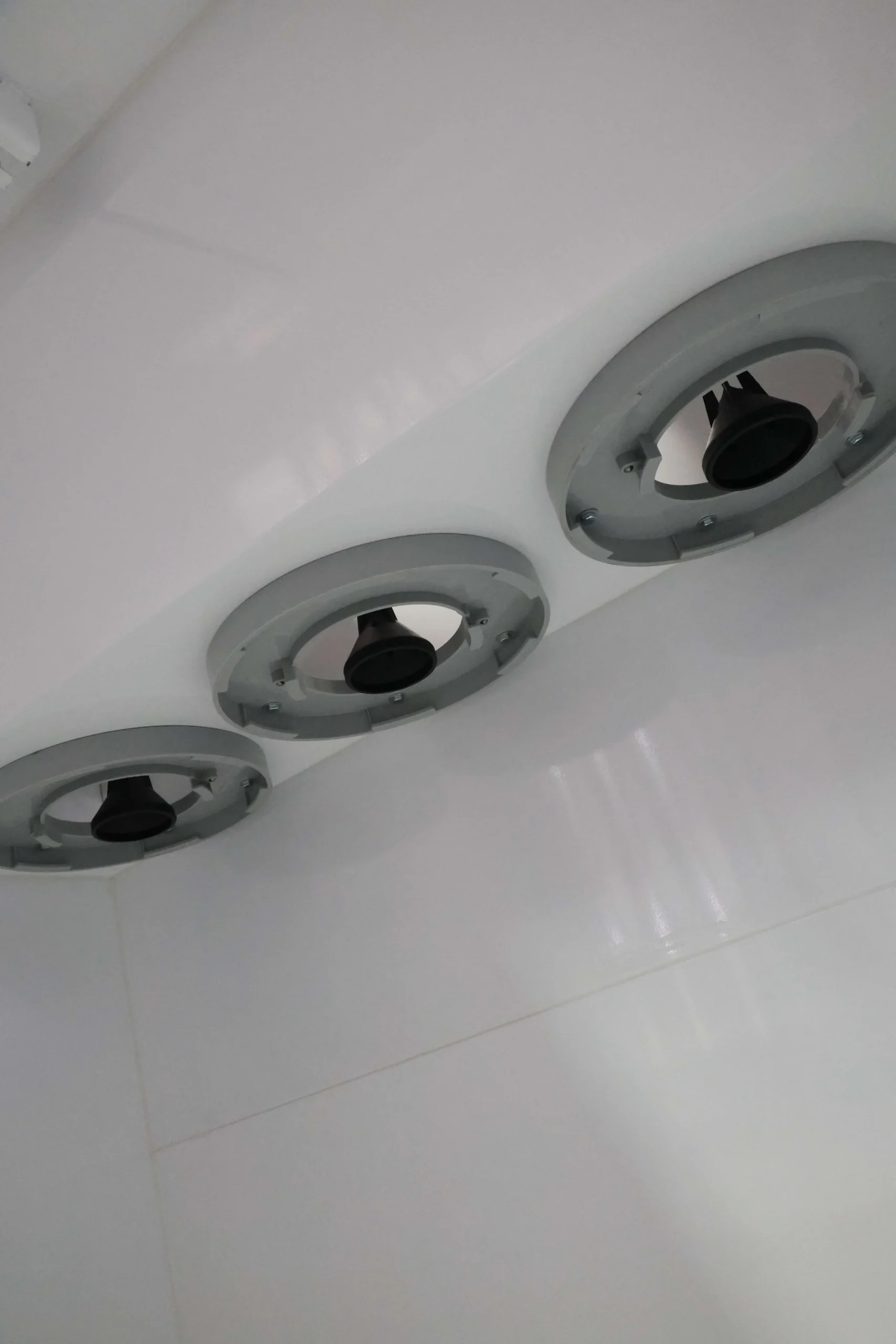
Complete Manufacturing Capabilities
Design & Engineering
CAD design, technical drawings, 3D modeling, process optimization, and custom layout planning for every project.
Manufacturing & Assembly
Full-scale manufacturing including welding, machining, component assembly, electrical integration, and system testing.
Logistics & Installation
Professional packaging, global shipping arrangements, on-site installation, commissioning, and technical training support.
From Consultation to Installation
A transparent, structured process that ensures your metal coating line is delivered on time and meets all specifications.
Initial Consultation
Understand your product, production capacity, factory layout, budget, and specific coating requirements.
Solution Design
Create custom line layout, select equipment configuration, and prepare technical drawings and proposals.
Technical Discussion
Confirm specifications, discuss technical details, finalize quotation, and agree on delivery timeline.
Manufacturing
Full production begins with component fabrication, assembly, testing, and quality control checkpoints.
Quality Inspection
Comprehensive pre-shipment inspection, functional testing, and equipment verification before packing.
Packaging & Shipping
Professional packaging, logistics arrangements, and international shipping to your factory location.
On-site Installation
Our technical team arrives for equipment assembly, electrical connection, system testing, and operator training.
After-Sales Support
Warranty coverage, remote support, spare parts availability, and long-term technical assistance.
Initial Consultation
Understand requirements and project scope
Solution Design
Custom layout and technical drawings
Technical Discussion & Quote
Finalize specifications and pricing
Manufacturing & Testing
Full production with quality checkpoints
Shipping & Installation
Global logistics and on-site setup
After-Sales Support
Warranty and ongoing technical support
Trusted by Manufacturers Worldwide
We've successfully designed and installed powder coating lines for 500+ metal manufacturers across 20+ countries and diverse industries.
Some of Our Trusted Partners
Xuanjin Technology
Mingjie Group
Xunheng Fire Protection
Yongye Metal
Changjiang Furniture
Zhentai Shelf Systems
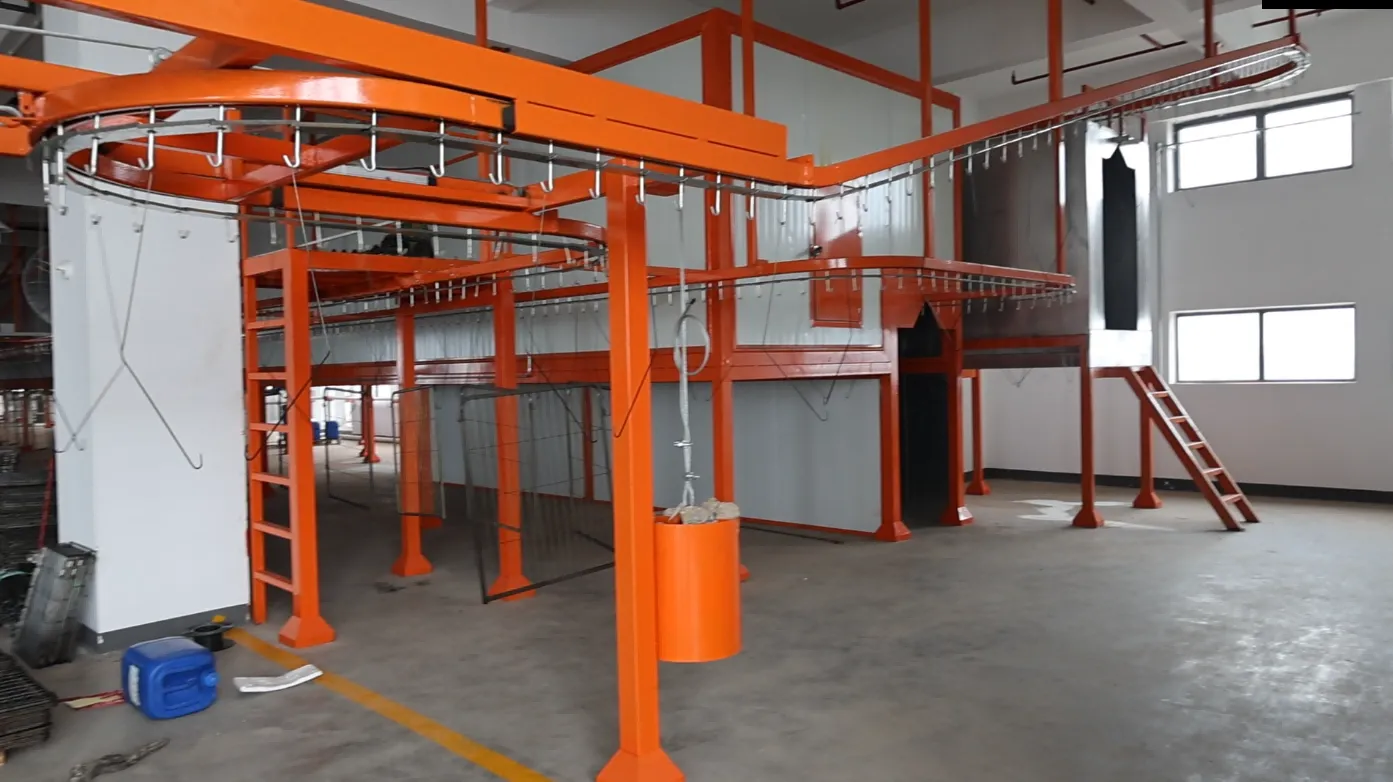
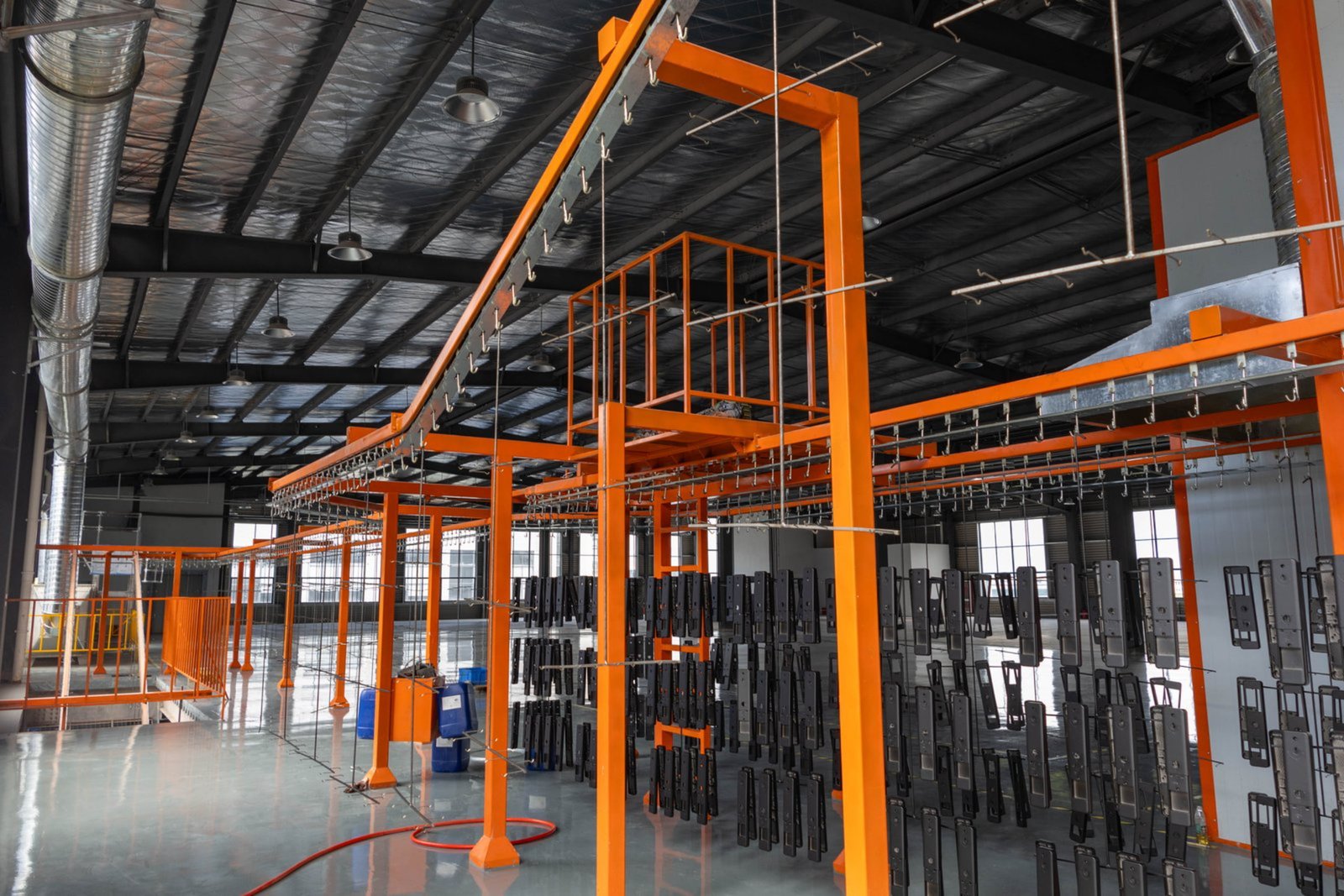
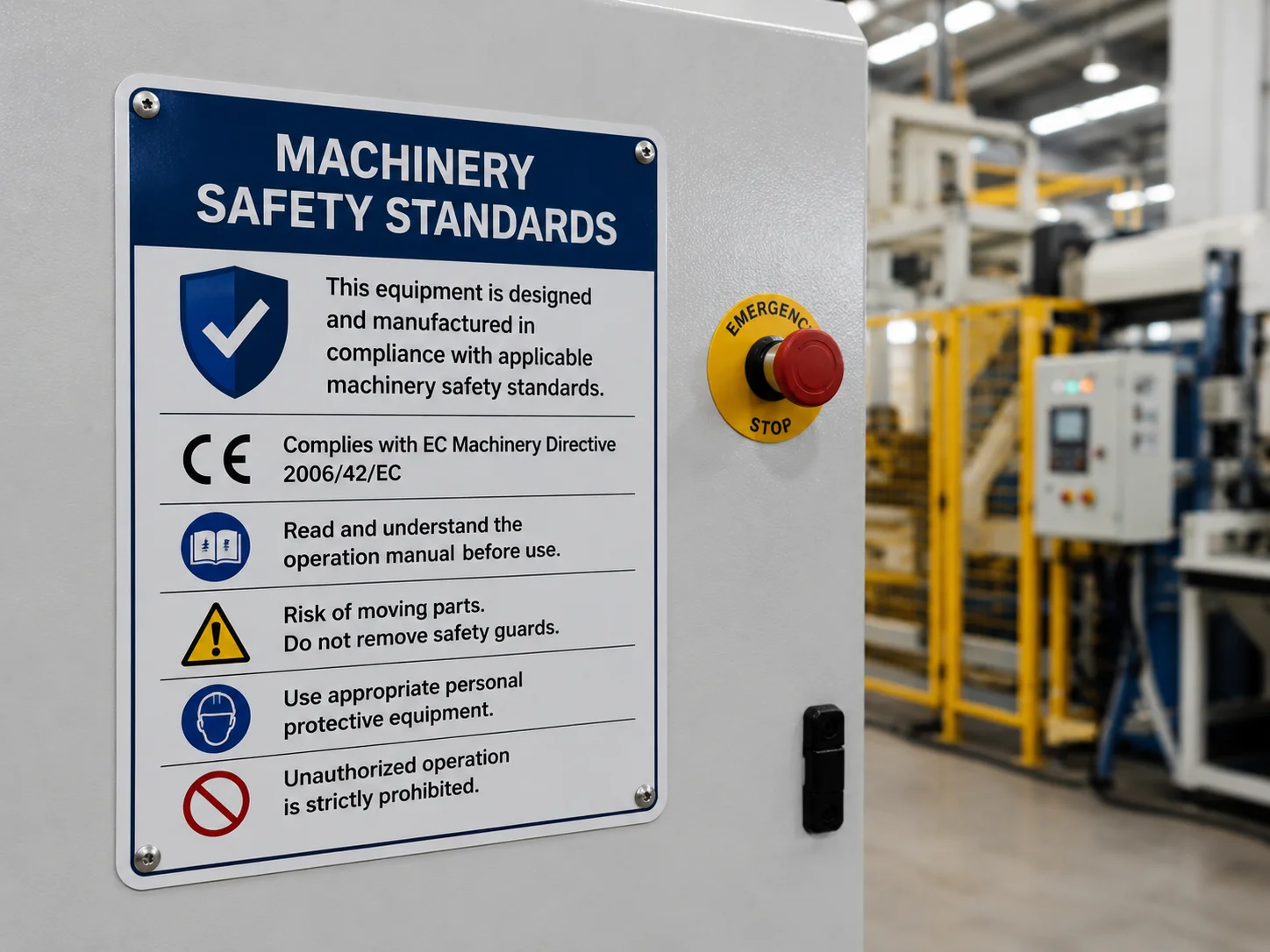
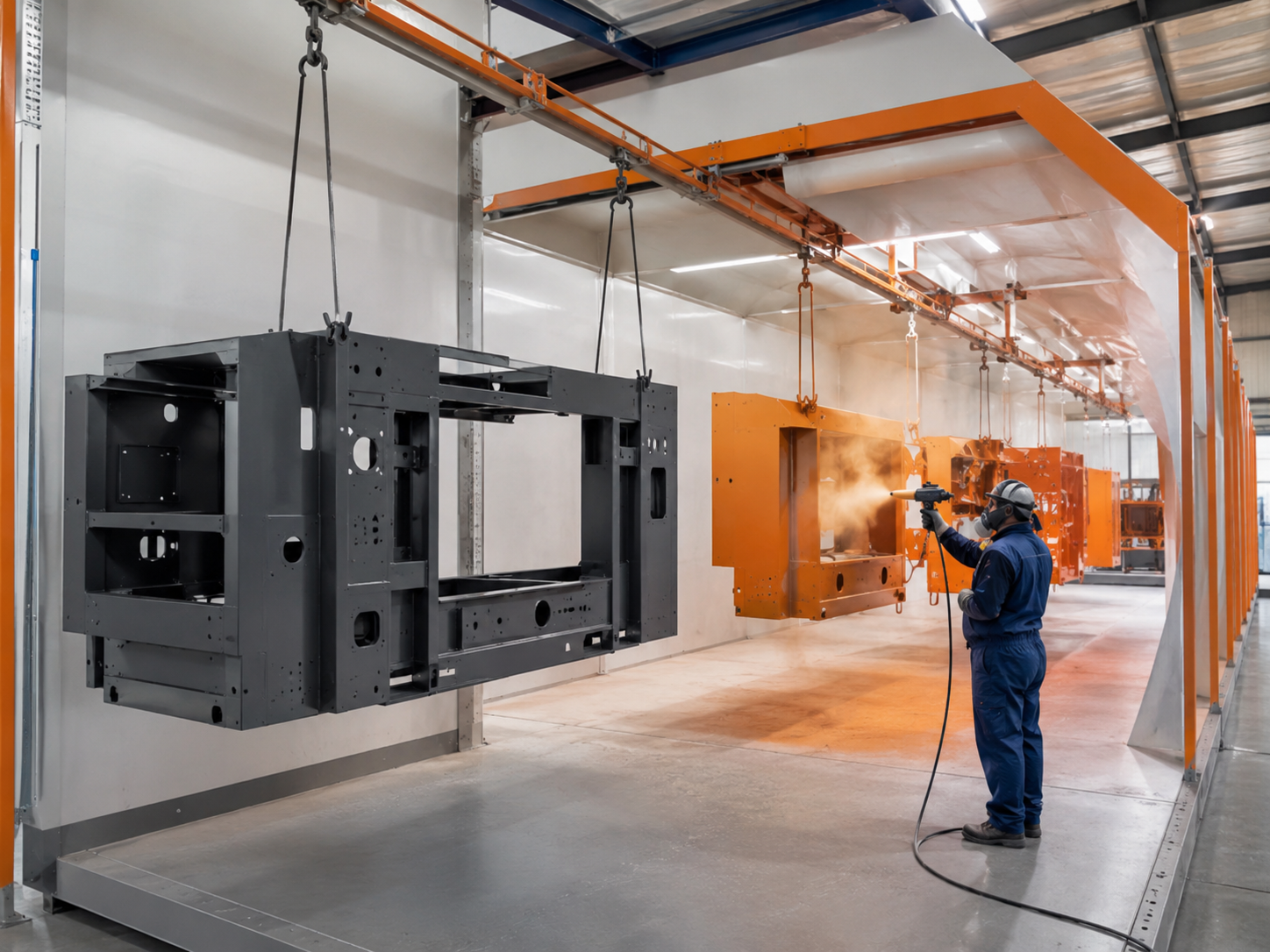
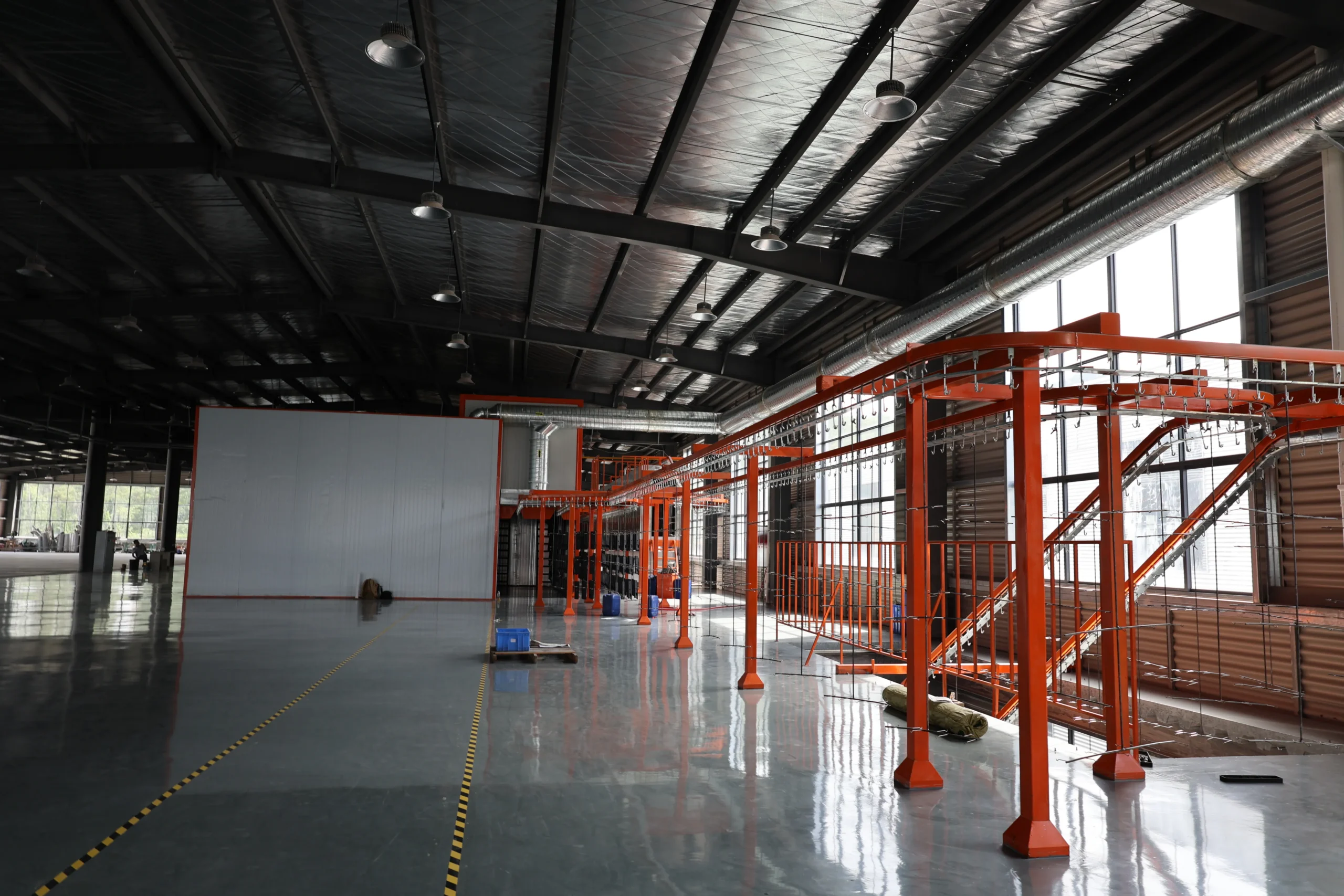
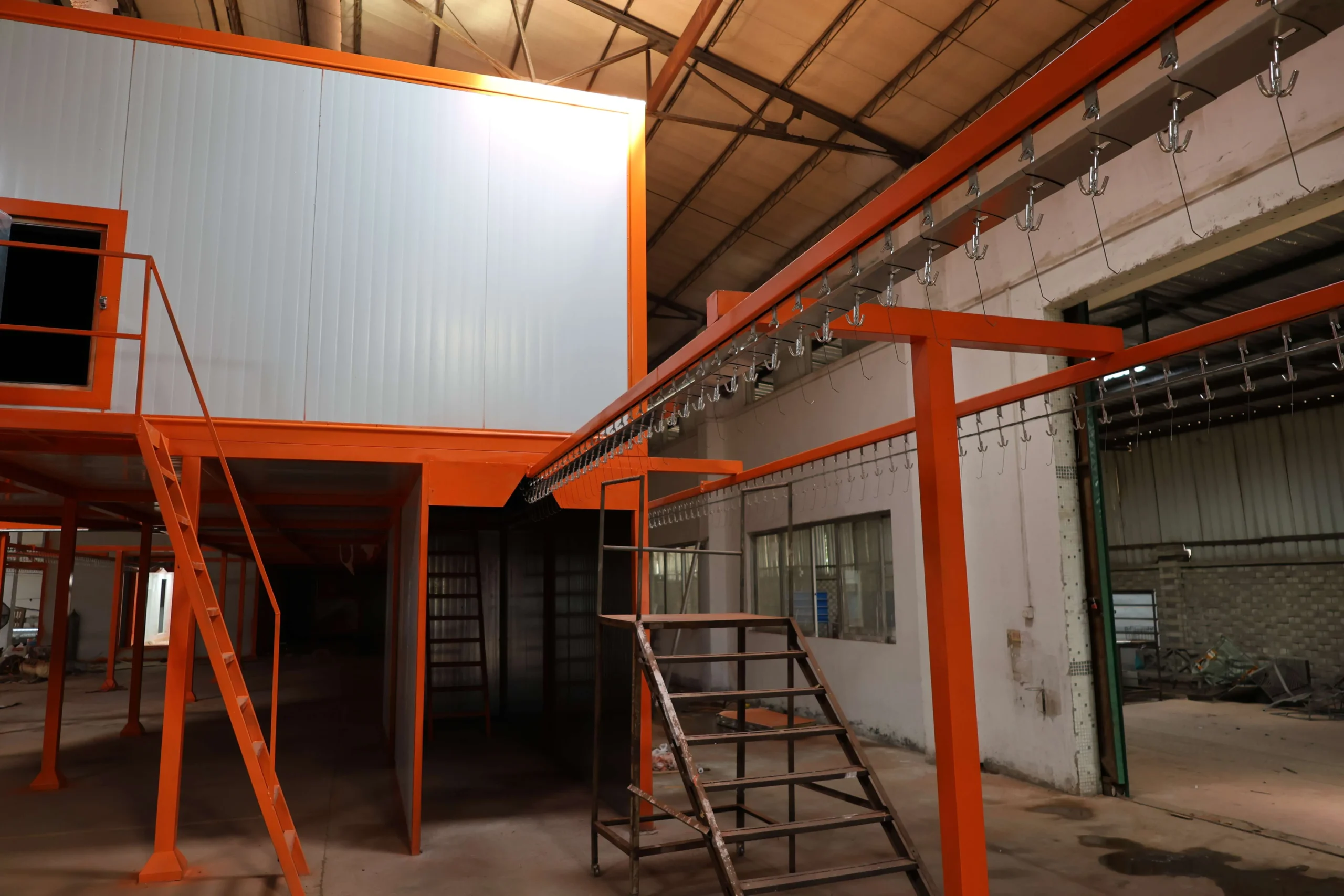
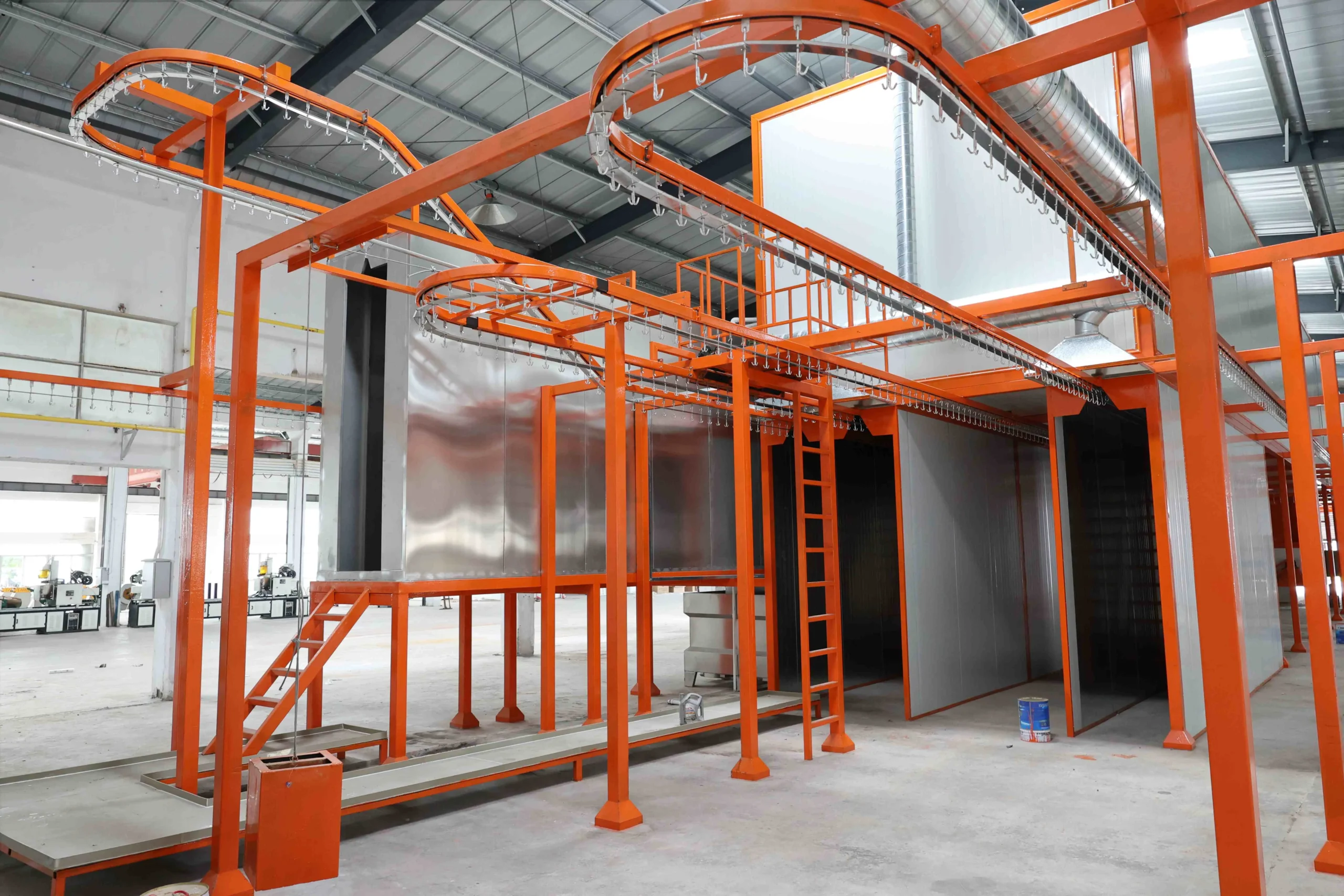
Real Installation & Operation Scenes
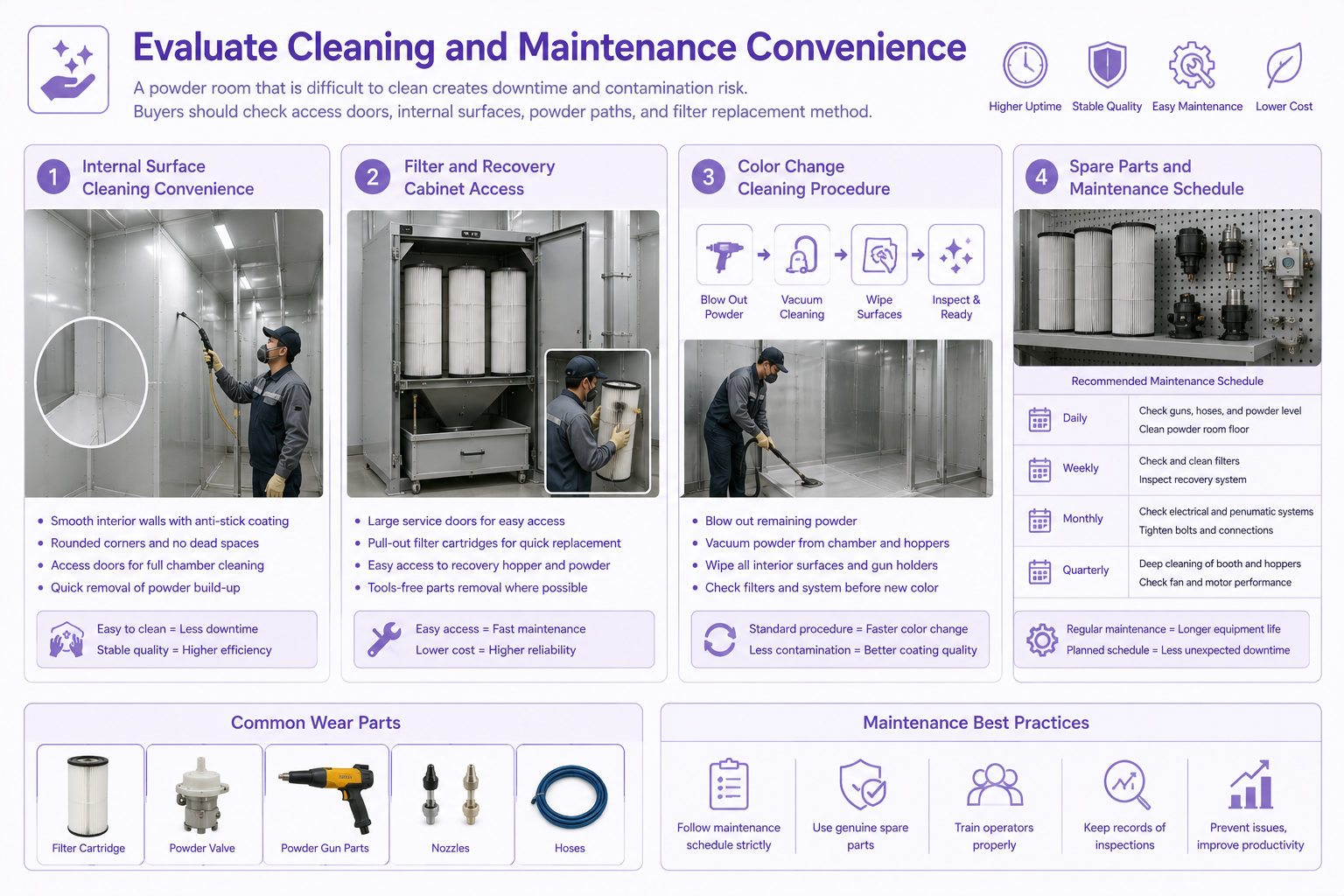
What Our Customers Say
"The quality and color of the products sprayed with their equipment are exceptional. When our customers inspected our products, the superior coating quality was immediately recognized, keeping us at the forefront of their minds."
Mr. Stephen
Enterprise Manager, USA
"Their expertise in energy saving and consumption reduction has significantly reduced our costs while meeting production requirements. With rich industry experience, they excel at solving complex problems and providing excellent customer service."
Mr. Jacob
Enterprise Manager, Canada
"They quickly understood our needs and provided tailored solutions. Their strong customer service team responds very efficiently to any problems. We consistently experience their efficiency and reliability with every interaction."
Ms. Diana
Enterprise Manager, International
Ready to join our growing network of successful metal coating manufacturers?
Certifications & Quality Standards
Our factory operates under strict international quality management systems and industry compliance standards.
ISO 9001:2015
Quality Management System certified for manufacturing processes and customer satisfaction.
ISO 14001:2015
Environmental Management System for sustainable manufacturing and emission control.
CE Certification
Product compliance with European Union safety and environmental requirements.
OHSAS 18001
Occupational Health & Safety Management System for worker protection.
UL Listed
Underwriter's Laboratories certification for electrical equipment safety standards.
Industry Association
Member of coating equipment manufacturers associations in China and internationally.
Proprietary Patents
Multiple technology patents for powder coating equipment innovation and efficiency improvements.
Full Traceability
Complete documentation and traceability records for every manufactured equipment unit.
Our Rigorous Quality Control Process
Material Inspection
Raw materials and components verified for quality and specifications upon arrival.
Manufacturing QC
Real-time inspection during fabrication, welding, and assembly processes.
Component Testing
Individual equipment modules tested for functionality and safety compliance.
System Integration Test
Complete system operational testing under simulated working conditions.
Final Inspection
Comprehensive pre-shipment inspection before packaging and global delivery.
Premium Material Standards
100% Virgin Steel & Aluminum
No recycled or substandard materials used in structural components.
Corrosion-Resistant Coatings
All metal surfaces treated with anti-corrosion technology for extended lifespan.
Food-Grade & Medical-Grade Components
Electrical components meet strict safety and hygiene standards.
Extended Warranty Coverage
1-2 year full equipment warranty plus optional extended coverage plans.
Environmental & Safety Compliance
VOC & Dust Emission Reduction
Advanced filtration and collection systems reduce airborne pollutants by 99.99%.
Energy Efficiency Optimization
Thermal insulation and intelligent controls reduce energy consumption by 20-30%.
Waste Powder Recovery
Up to 95% powder recovery rate minimizes material waste and reduces disposal costs.
Worker Safety Standards
Ergonomic design, safety interlocks, and protective systems ensure operator safety.
Committed to Your Complete Satisfaction
Every coating line we manufacture is backed by comprehensive certifications, rigorous quality control, and unwavering commitment to excellence.
Customizable Solutions for Your Specific Needs
Every metal coating challenge is unique. We design custom powder coating lines tailored to your product specifications, production capacity, facility layout, and budget requirements.
Product Type & Dimensions
Custom handling for various metal product shapes and sizes—from small components to large furniture pieces.
Production Capacity
Scale your line from 5 tons to 100+ tons monthly. We configure equipment to match your exact throughput needs.
Factory Layout & Space
Optimize line configurations for your available floor space. Compact, L-shaped, or linear layouts available.
Automation Level
Choose from manual booths, semi-automatic lines, or fully automated systems based on your labor availability and budget.
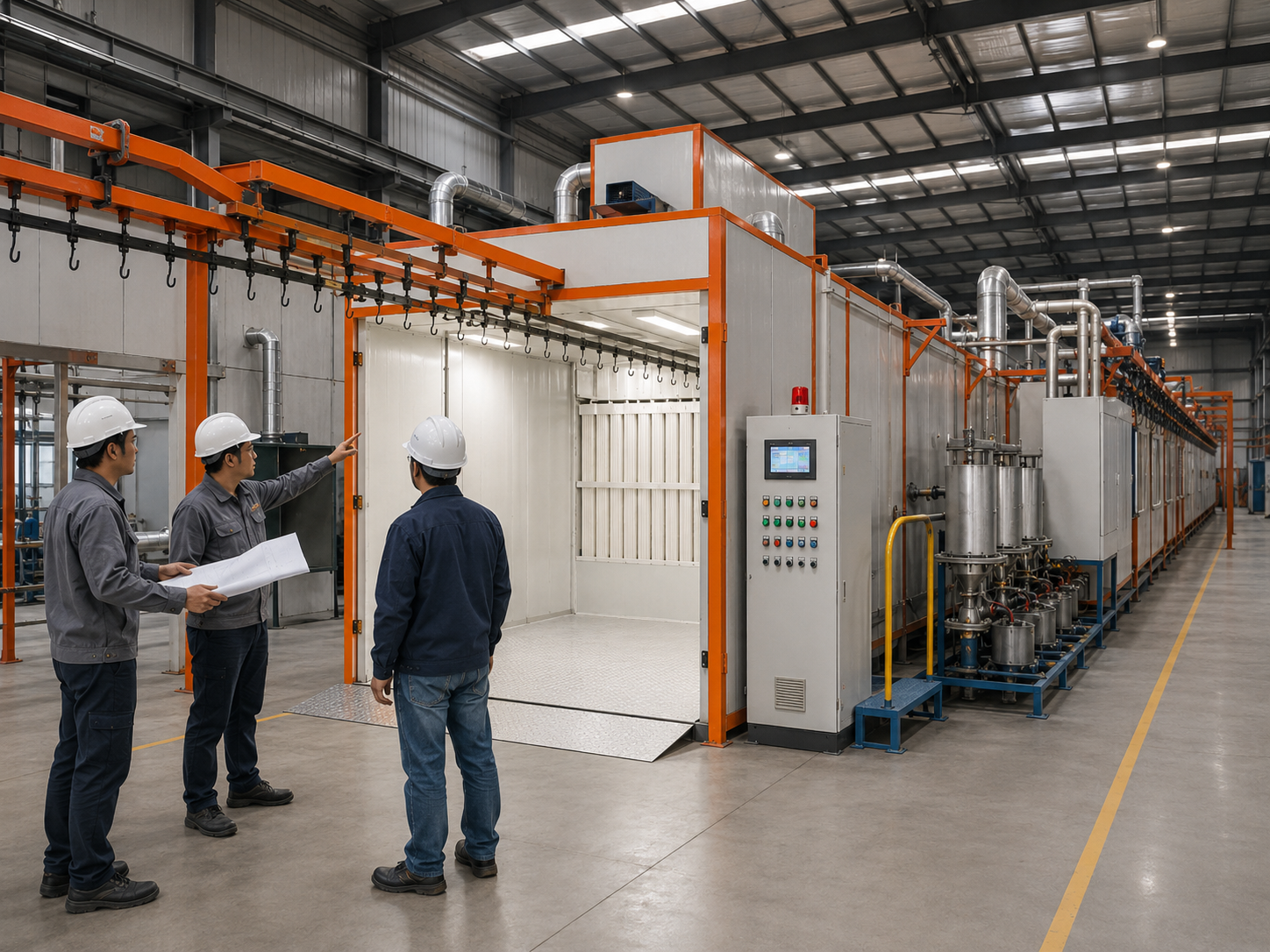
Coating Material & Process
Support for various powder types, colors, and curing parameters. Temperature, humidity, and humidity-controlled options.
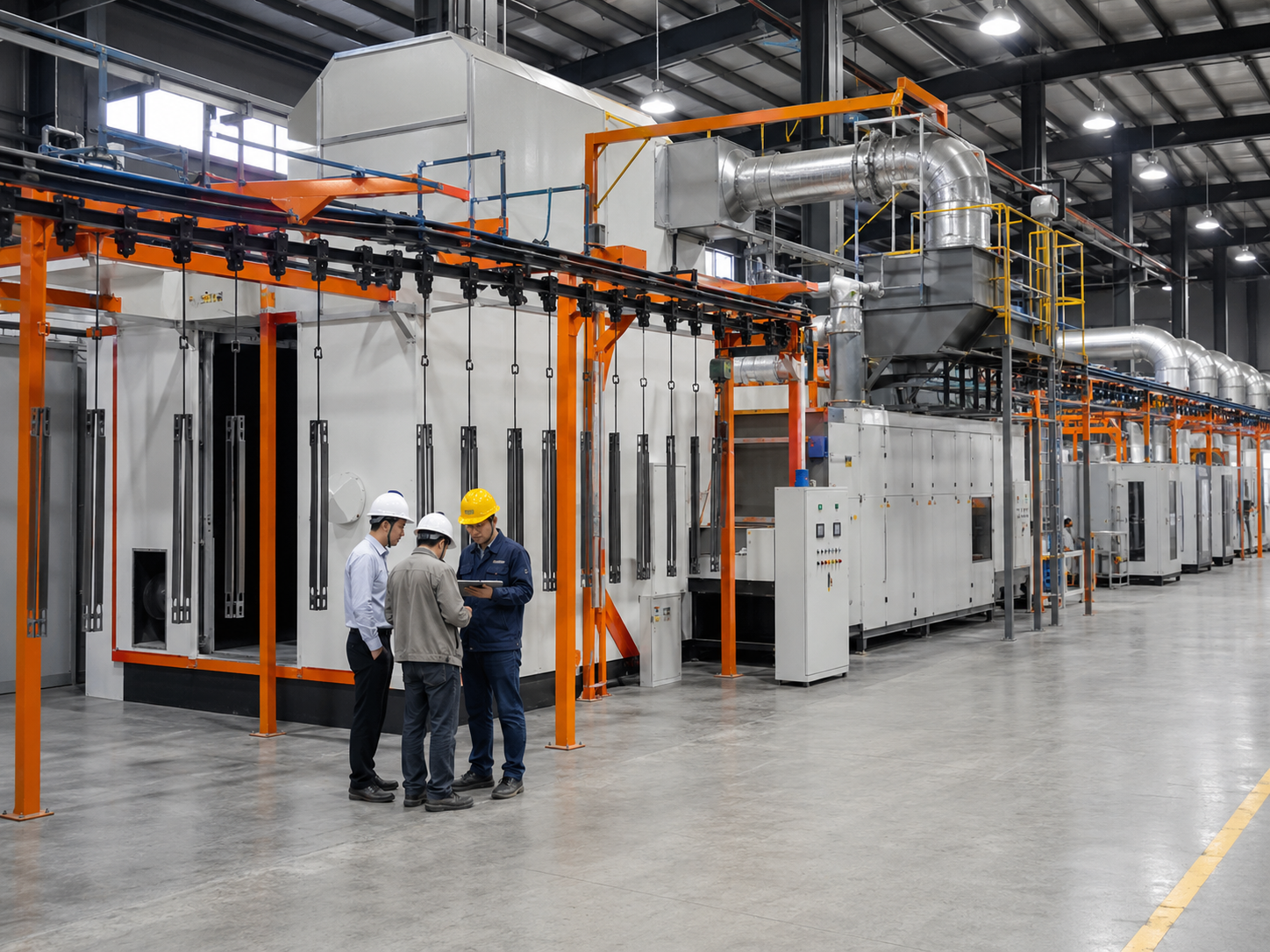
Material Handling Solutions
Custom hanging fixtures, conveyor systems, and jigs for optimal product positioning and flow through each station.
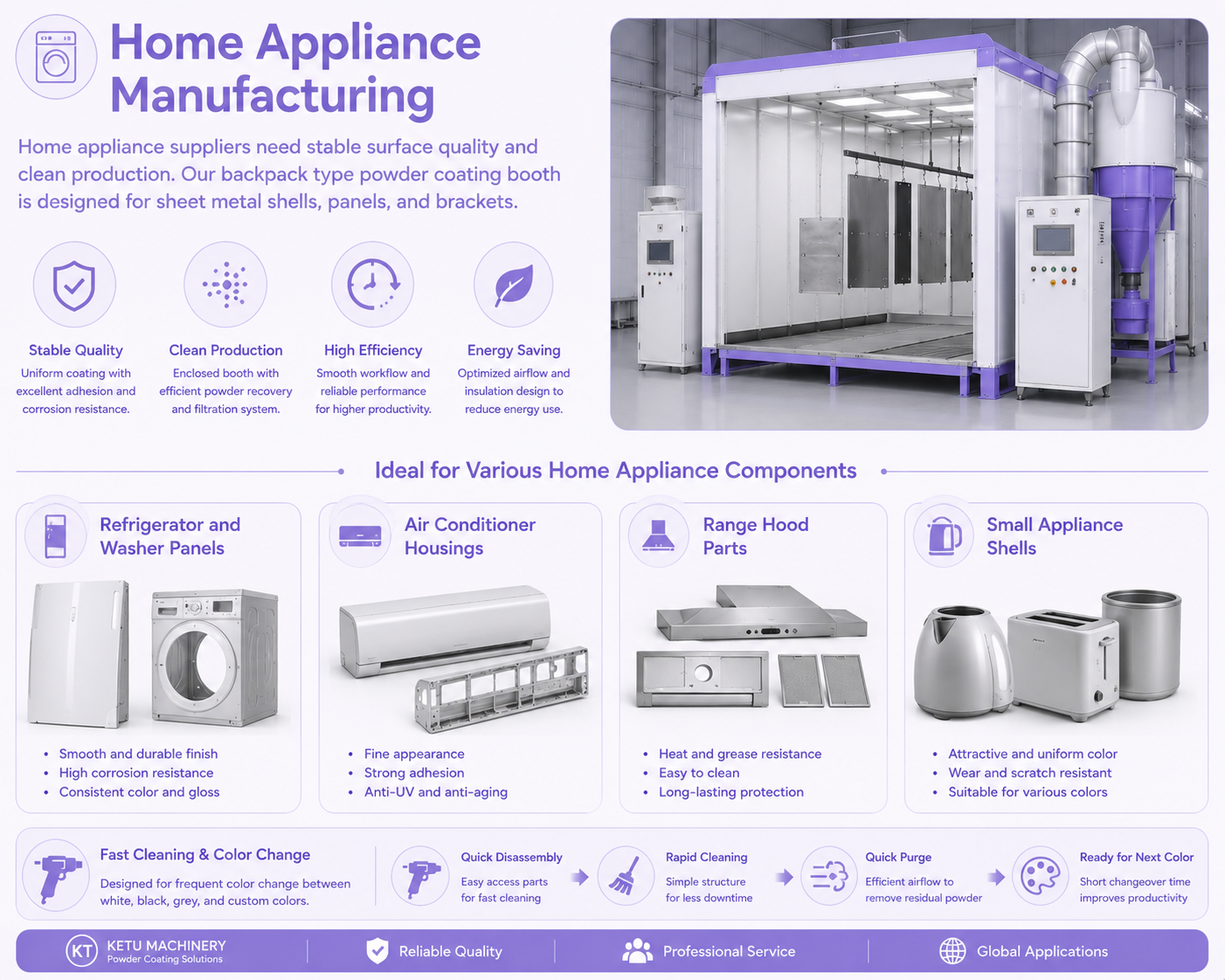
Environmental & Compliance
Dust collection efficiency, emissions control, energy optimization, and compliance with local environmental regulations.
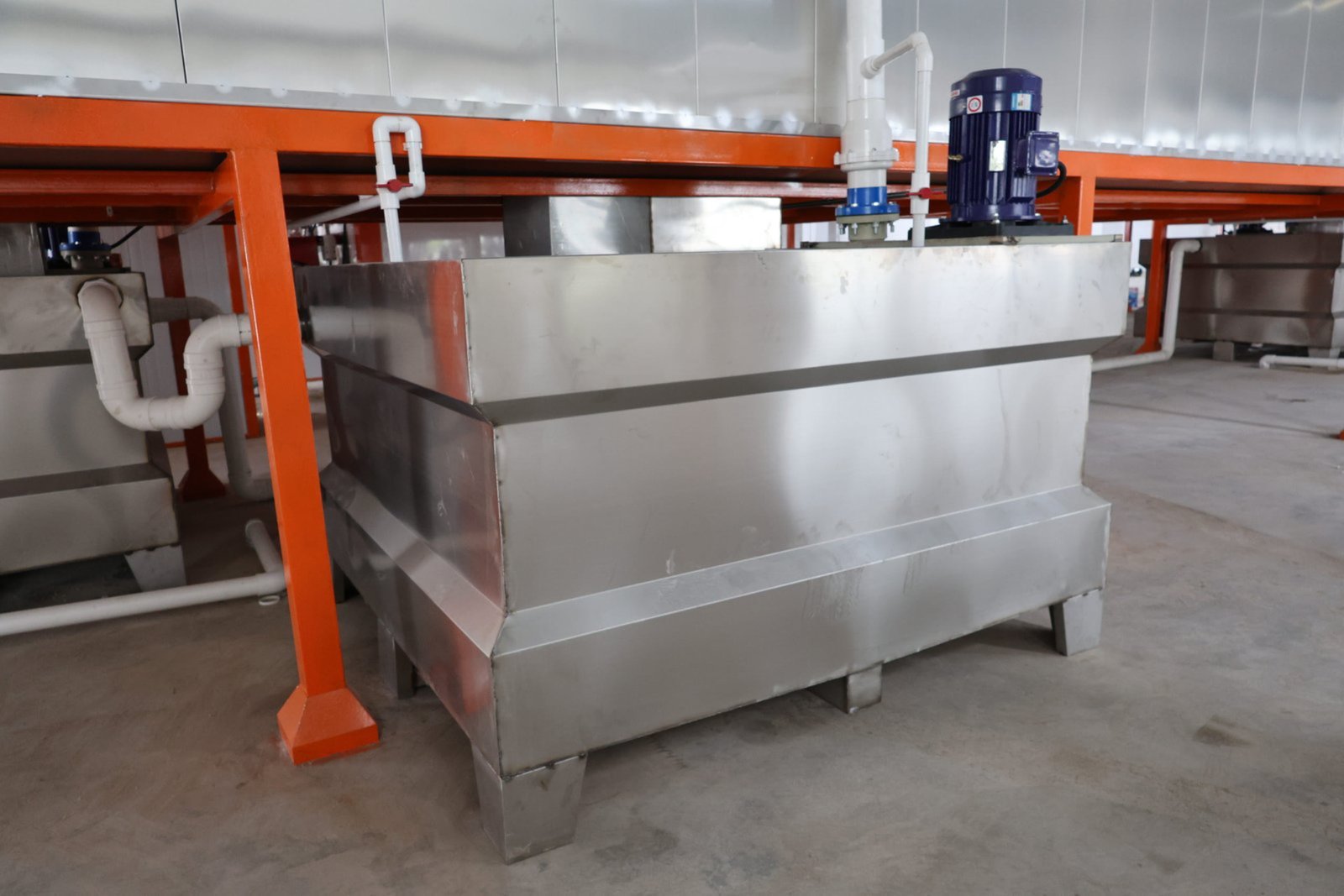
Budget & Timeline Flexibility
Phased deployment options, modular upgrades, and flexible payment terms to match your investment schedule.

Why Customization Matters
Fit Your Needs: No wasted capacity or under-utilization. Every component serves your exact requirements.
Cost Savings: Custom solutions eliminate unnecessary features, reducing capital investment and operating costs.
Future Scalability: Build modular systems that grow with your business—add capacity without replacing existing equipment.
Our engineers will analyze your needs and design the perfect coating line for your operation.
The Complete Guide to Powder Coating for Metal Products
From understanding the process to selecting the right equipment, this guide walks you through everything you need to know about powder coating your metal products.
Quick Navigation
1. What is Powder Coating?
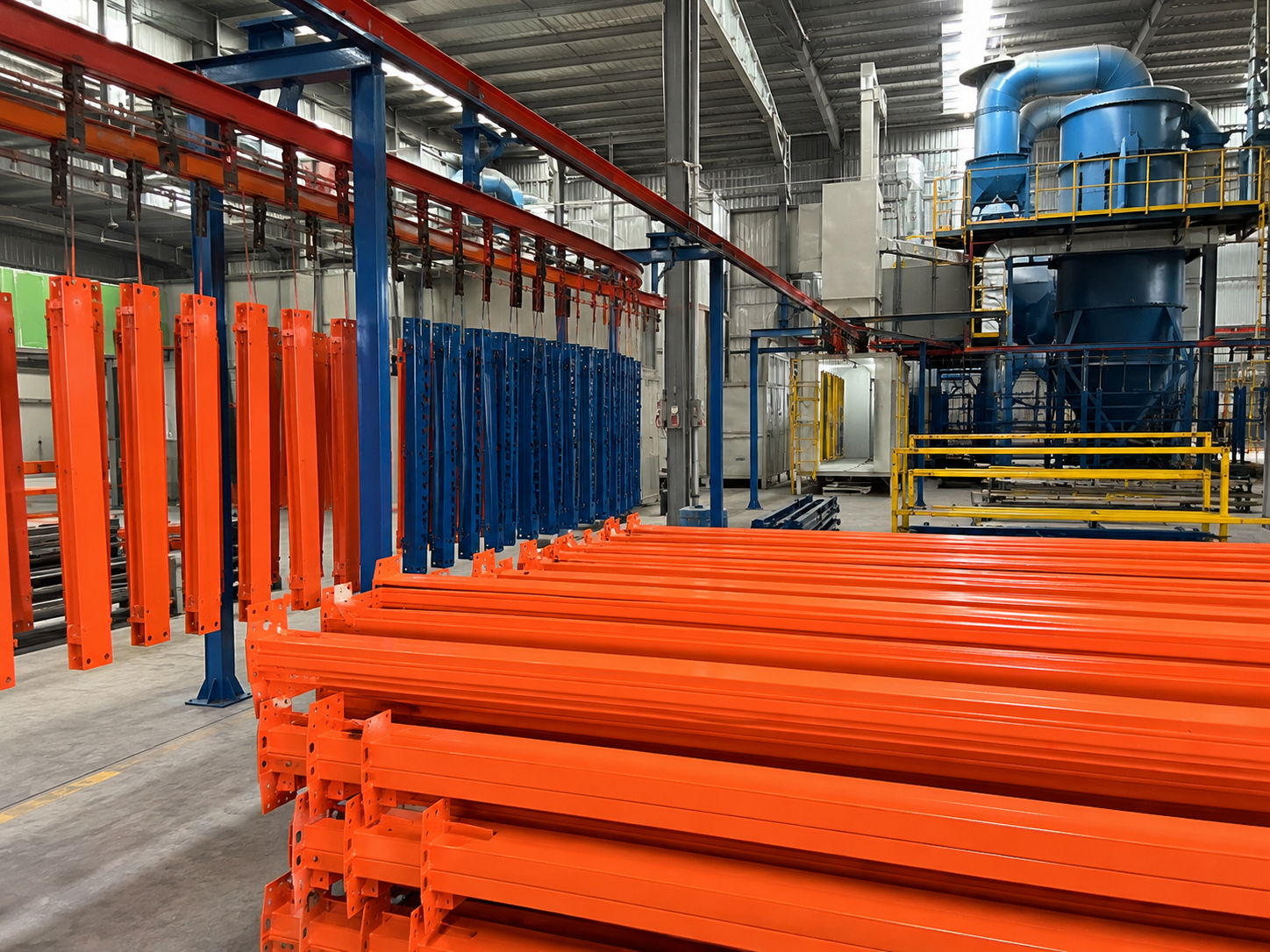
Powder coating is an advanced finishing process where dry powder (not liquid paint) is electrostatically applied to a metal surface and then heat-cured to form a durable, protective coating. The powder particles are electrically charged and attracted to the grounded metal workpiece, creating an even, smooth finish.
Key advantages over liquid coating: No VOC emissions, zero overspray waste, superior adhesion, more uniform thickness, and dramatically longer coating life (10-25 years vs. 3-5 years for liquid paint).
Powder coatings provide excellent protection against rust, corrosion, UV fading, and mechanical damage—making them ideal for metal furniture, industrial equipment, architectural components, and consumer products.
2. Why Powder Coat Metal Products?
Metal surfaces are inherently vulnerable to corrosion, oxidation, and environmental degradation. Powder coating provides a complete protective barrier while enhancing appearance and extending product lifespan.
For steel: Prevents rust and extends service life from 5 years to 20+ years. For aluminum: Protects against oxidation and UV damage while maintaining lightweight properties. For stainless steel: Adds aesthetic value and corrosion resistance in harsh marine or chemical environments.
Beyond protection, powder coating delivers aesthetic benefits—vibrant colors, matte or glossy finishes, texture options—making your products more appealing to customers and commanding premium pricing in competitive markets.
3. The Powder Coating Process Explained
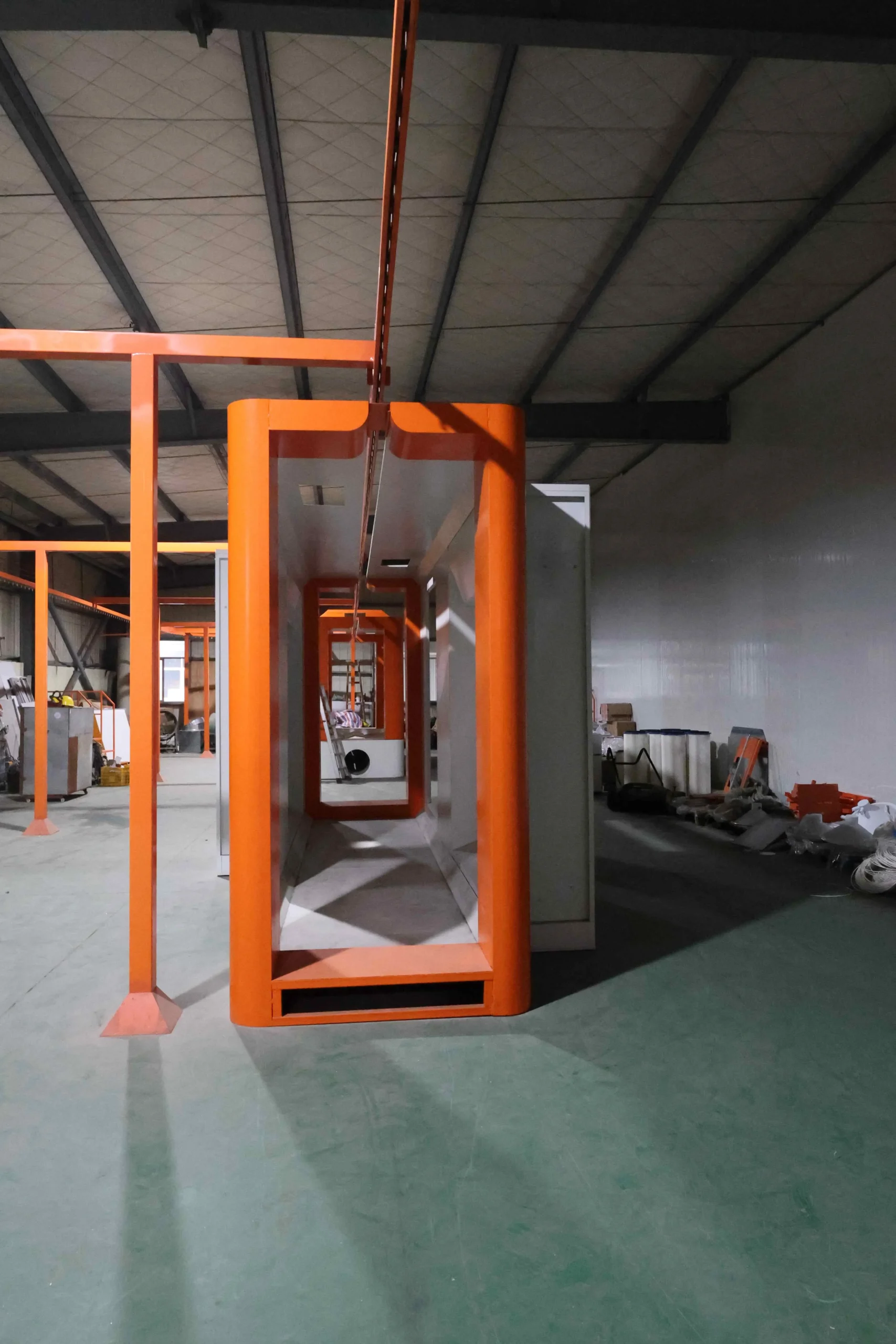
A complete powder coating process consists of five integrated stages working together seamlessly:
Pretreatment (5-15 minutes)
Metal is cleaned, degreased, and treated with a conversion coating to remove oils, rust, and contaminants. This stage is critical for adhesion and corrosion resistance.
Preheating (2-5 minutes)
Parts are gently warmed to evaporate residual moisture and prepare the surface for optimal powder adhesion.
Powder Application (3-10 minutes)
Charged powder particles are electrostatically sprayed onto the grounded metal surface. Booth systems capture excess powder for recirculation, minimizing waste.
Curing/Baking (10-30 minutes)
Parts enter a heated oven where the powder melts, flows, and chemically cures to form a hard, durable finish. Temperature and time depend on powder type and product thickness.
Cooling & Finishing (5-10 minutes)
Coated parts cool to ambient temperature and are removed, inspected, and packaged. The result is a uniform, professional-grade finish.
4. Key Equipment in a Powder Coating Line
A professional powder coating line integrates multiple specialized components:
- ✓ Pretreatment System: Spray tunnels or immersion tanks for cleaning and surface prep
- ✓ Conveyor System: Hanging chain or moving platforms to transport parts through each stage
- ✓ Powder Spray Booth: Electrostatic gun system with powder recovery (cyclone or filter cartridge)
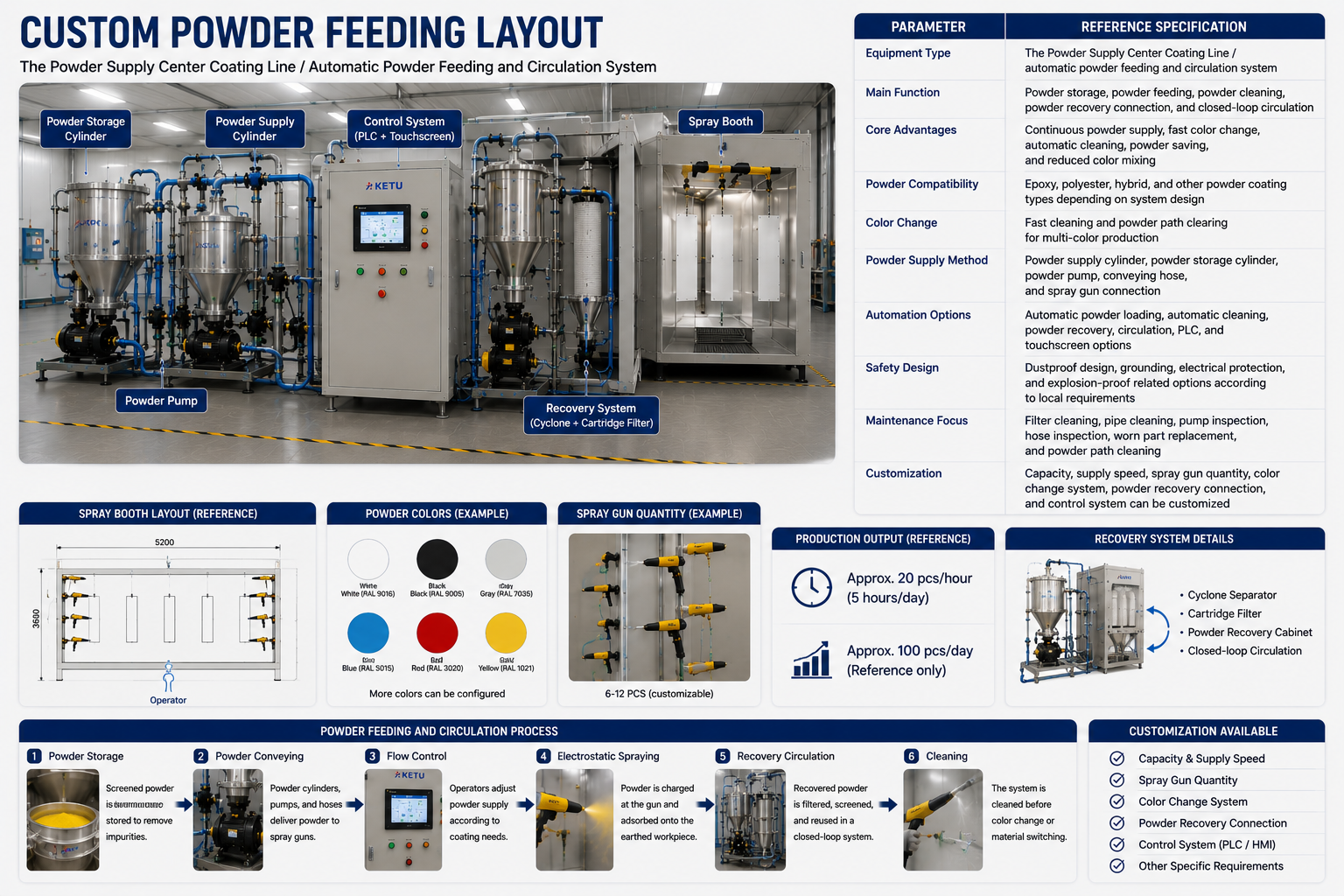
- ✓ Powder Supply Center: Hopper, feeder, and distribution system for continuous spray gun feed
- ✓ Curing Oven: Electric or gas-heated chamber with uniform temperature control
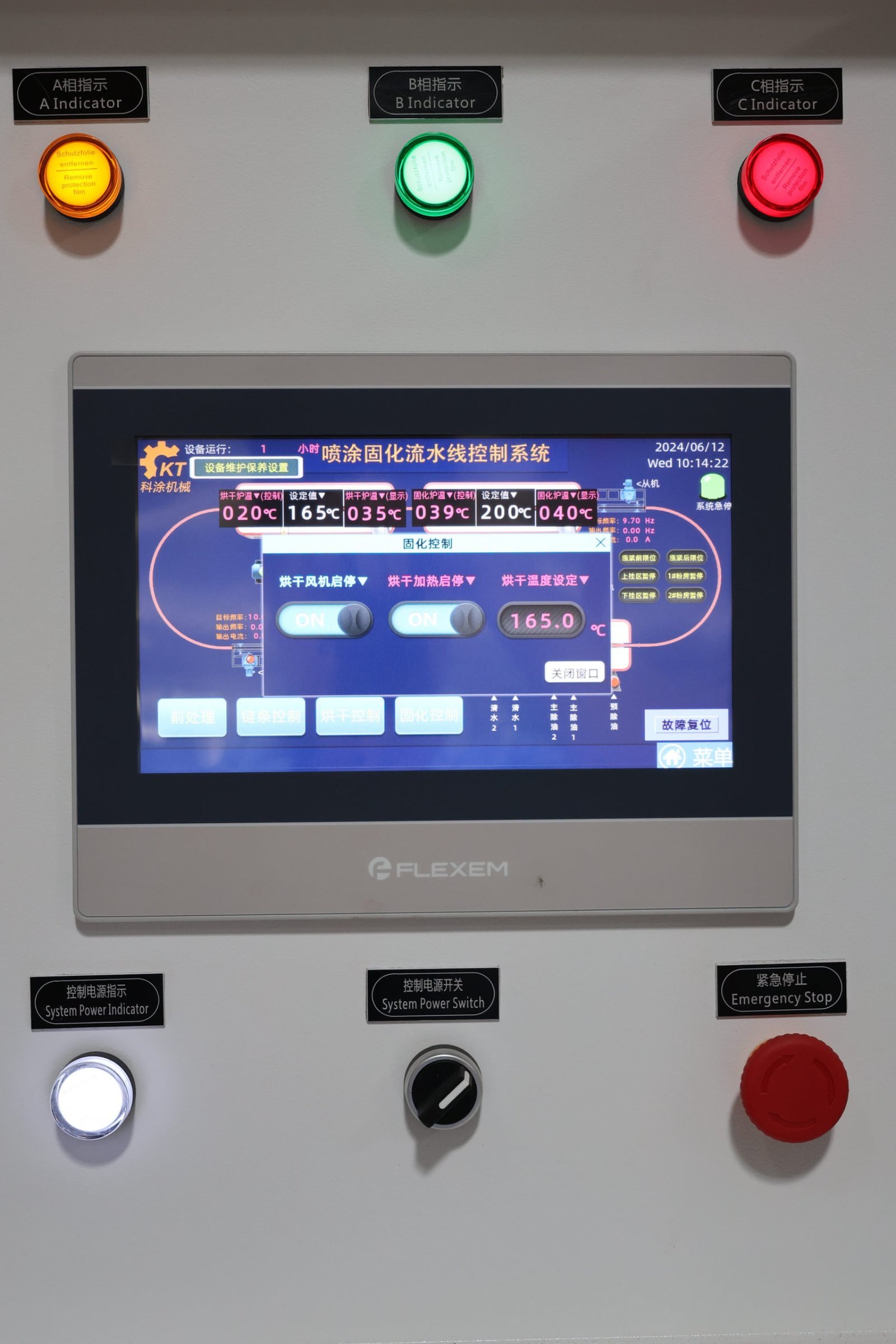
- ✓ Control System: PLC or automation to manage temperature, timing, and conveyor speed
Each component must work in perfect synchronization to ensure consistent quality, minimal downtime, and maximum throughput.
5. Choosing the Right Spray Booth
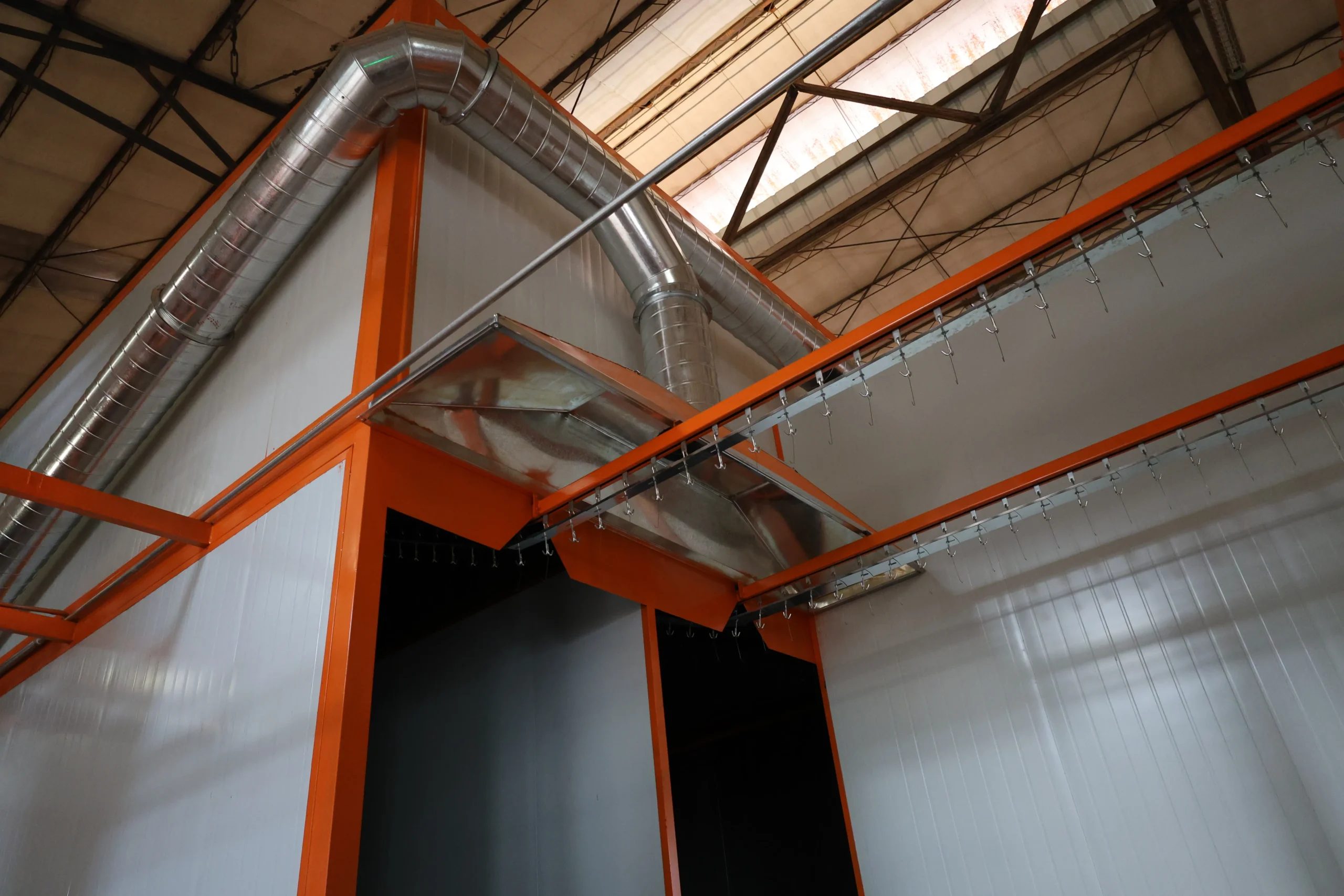
Spray booth selection is critical—it directly impacts coating quality, powder waste, and operating costs.
Manual Spray Booths:
Ideal for low-volume production, complex shapes, or frequent color changes. Operators spray by hand. Lower capital cost but higher labor cost.
Automatic Spray Booths:
Robotic guns provide consistent coverage on standard parts. Higher throughput, reduced labor, better finish quality. Best for high-volume production.
Hybrid Configurations:
Combine automatic and manual booths to balance flexibility and efficiency. Scale up manually for complex shapes; use robots for volume.
Powder Recovery System:
Modern cyclone collectors or filter cartridges recover 90-99% of overspray. This reduces material costs and environmental impact significantly.

6. Oven Selection & Temperature Control
The curing oven's job is to melt and chemically cure the powder at precisely controlled temperature and time. Equipment selection impacts energy efficiency and coating quality.
Electric Ovens:
Precise temperature control, no combustion byproducts. Higher energy cost but excellent for environmental compliance and sensitive applications. Ideal for urban or enclosed facilities.
Gas-Fired Ovens:
Lower operating cost in regions with cheap gas. Faster heat-up, higher throughput. Requires venting and combustion air management. Best for high-volume operations in industrial areas.
Temperature Control:
Most powder coatings cure at 350°F–450°F for 10–30 minutes. PLC control systems maintain ±5°C uniformity. Multi-zone ovens ensure even heating from entry to exit.
Energy Efficiency:
Insulated chambers, recirculation fans, and VFD drives reduce energy consumption by 20–30% compared to older designs. Quick payback through lower utility bills.

7. Customizing Your Line for Your Product
No two manufacturers are identical. Professional suppliers tailor every aspect of your line to match your specific products, capacity, and constraints.
- • Product Size & Shape: Custom hanging fixtures and conveyor geometry to accommodate your part dimensions and weight
- • Required Capacity: Equipment sizing and booth dimensions scaled to your target throughput (tons/month)
- • Available Space: Compact L-shaped, linear, or vertical configurations to fit your factory layout
- • Production Volume & Color Ranges: Powder supply systems and spray booth design optimized for your batch sizes and color-change frequency
- • Budget & Phased Investment: Modular deployment so you start with essentials and add capacity as demand grows
- • Utilities & Utilities Availability: Electrical power, gas lines, compressed air, water—all configured for your facility's infrastructure

8. Quality Control & Coating Finish
Powder coating quality is determined by three main factors: coating thickness, surface uniformity, and adhesion. Professional manufacturers implement rigorous controls at every stage.
Critical Quality Parameters:
- Coating Thickness: 50–150 µm (typically 80–100 µm for optimal durability)
- Adhesion Strength: Must pass ISO 2409 cross-hatch adhesion test
- Gloss/Finish: Matte, satin, or gloss—depends on powder formulation and application
- Color Uniformity: No visible streaks, drips, or thin spots
- Impact Resistance: Forward and reverse impact testing per ASTM standards
Quality Assurance Process:
- ✓ Incoming material inspection and testing
- ✓ Pretreatment solution monitoring (pH, concentration)
- ✓ Spray application parameters logged and tracked
- ✓ Oven temperature continuously recorded
- ✓ Final parts inspected for defects, coating thickness, and adhesion
- ✓ Random sampling and destructive testing to confirm quality

9. Environmental & Compliance Considerations
Powder coating is one of the most environmentally friendly coating methods available. It inherently complies with strict environmental regulations in most jurisdictions.
Zero VOC (Volatile Organic Compounds):
Powder coating emits no harmful gases during application or curing—unlike liquid paint which releases VOCs into the air. No air pollution, no health hazards for workers.
Minimal Overspray Waste:
Advanced powder recovery systems recapture 90–99% of overspray for reuse. Only 1–5% material loss vs. 30–50% with liquid spray painting.
No Water Discharge:
Unlike liquid painting, powder coating generates no wet waste, sludge, or wastewater. No effluent treatment required.
Energy Efficiency Options:
Modern ovens with insulation and variable-frequency drives consume 20–30% less energy. Complies with ISO 50001 and local energy efficiency mandates.
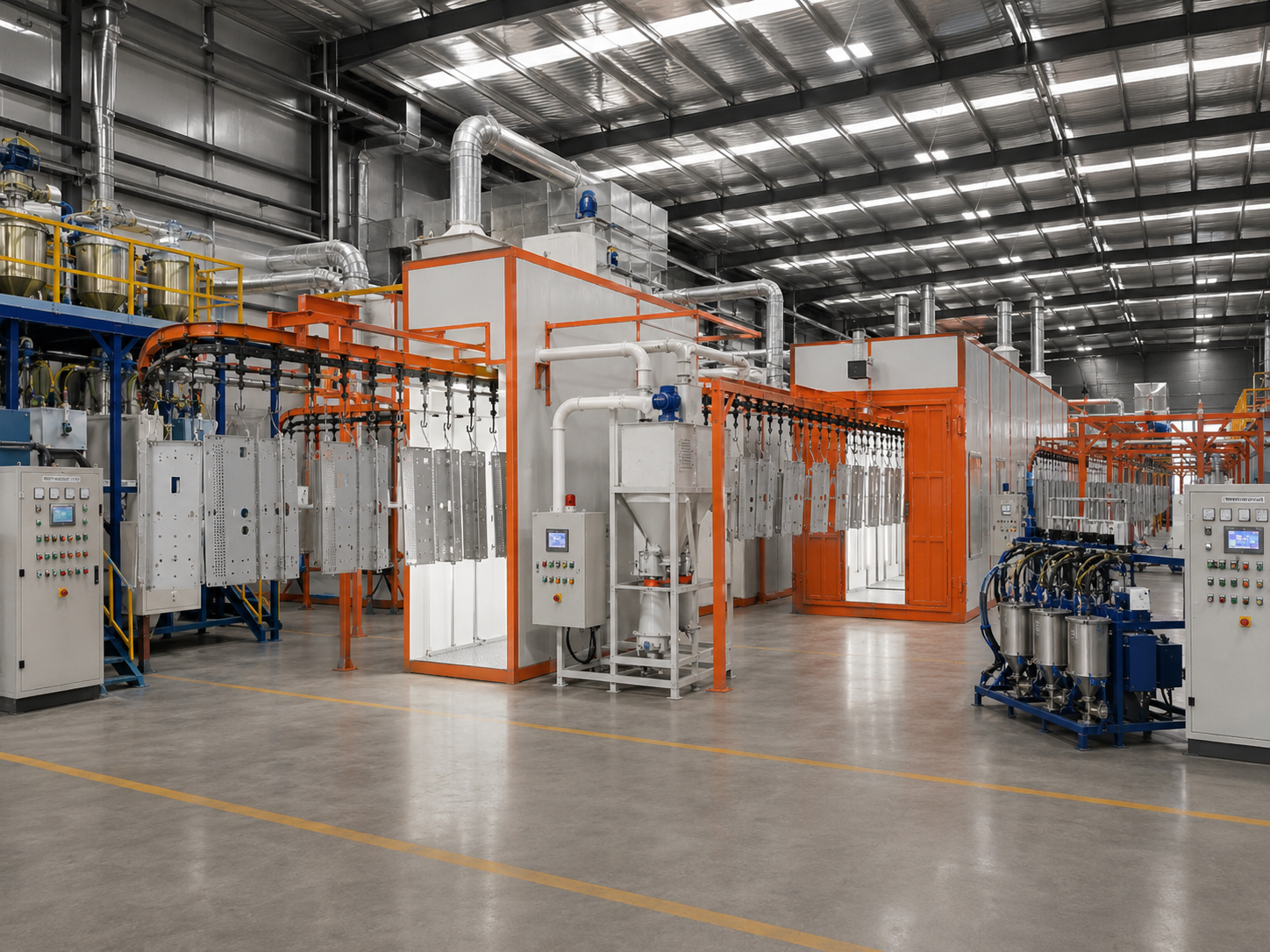
10. Cost Analysis & ROI
Powder coating equipment is a significant capital investment, but the operational efficiencies and product value typically deliver strong ROI within 2–4 years.
Capital & Setup Costs
- Small Manual Line (5–10 tons/month): $50,000–$150,000
- Medium Semi-Auto (20–50 tons/month): $150,000–$400,000
- Large Automated Line (100+ tons/month): $400,000–$1,000,000+
- Installation, training, and commissioning add 10–15% to equipment cost
Operating Costs (per ton coated)
- Powder Material: $3–$8 per kg (~30–50% of total cost)
- Pretreatment Chemicals: $2–$5 per ton (~10–15%)
- Energy (oven heating): $5–$15 per ton (~20–25%)
- Labor (operator + setup): $10–$30 per ton (~20–30%)
- Maintenance & Wear: ~5% of annual production value
ROI Example: Small Manufacturer
Scenario: Company currently uses contract coating at $150/ton. Plans to coat 200 tons/year in-house.
• Current annual coating cost: 200 tons × $150 = $30,000/year
• In-house cost: 200 tons × $50 (material + labor + energy) = $10,000/year
• Annual savings: $20,000
• Equipment payback period: $200,000 ÷ $20,000 = 10 years (conservative)
But add: product price premium (+$30–$50/ton), reduced lead time, better quality control → actual payback ~3–4 years
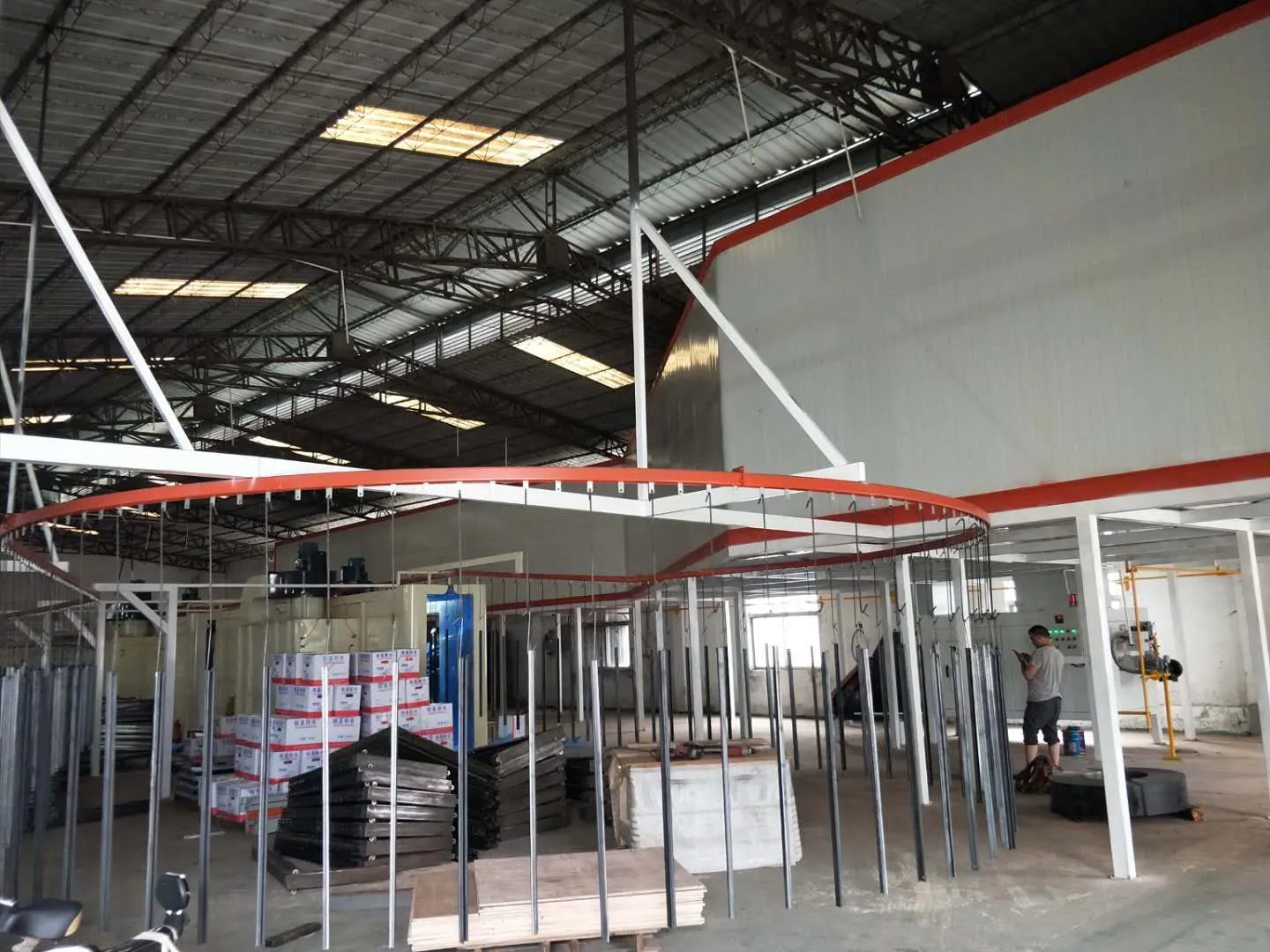
Key Takeaway:
Powder coating equipment is not just a cost—it's an investment in product quality, brand reputation, and operational independence. With typical payback periods of 3–5 years and 10+ year equipment lifespan, the financial case is compelling for most manufacturers coating 100+ tons annually.
Ready to Get Started?
This guide covers the fundamentals, but every operation is unique. Our engineers are ready to analyze your specific needs and design the perfect powder coating solution.
Frequently Asked Questions About Powder Coating for Metal
Quick answers to the most common questions from manufacturers considering powder coating equipment and services.
Line Selection & Configuration
Should we choose a manual or automatic spray booth?
It depends on your production profile:
- Choose Manual if: You have low to medium volume (5–50 tons/month), frequently change colors, or coat highly complex shapes requiring positioning flexibility.
- Choose Automatic if: You have high volume (50–200+ tons/month), coat standard-sized parts with consistent geometry, and need maximum efficiency and labor cost reduction.
- Choose Hybrid if: You want flexibility—use automatic robots for high-volume standard parts and keep manual booths for small batches and specials.
How do I calculate the required production capacity for my line?
Formula: Capacity (tons/month) = (Average part weight × parts/hour × operating hours/month) ÷ 1,000
Example: If you coat 100 parts/hour, each weighing 5 kg, running 16 hours/day, 20 working days/month:
- Capacity = (5 kg × 100 × 320 hours) ÷ 1,000 = 160 tons/month
We recommend sizing equipment for 120–130% of your current demand to allow room for growth without bottlenecking.
Can different sized metal products be coated on the same line?
Yes, absolutely. Our lines use adjustable hanging fixtures and modular jigs that accommodate different part sizes within a reasonable range.
- ✓ Small parts (50–200g) to large assemblies (50+ kg)
- ✓ Different shapes without line modification
- ✓ Quick changeover between product types (10–30 minutes for fixture swap)
For extreme size variations (e.g., tiny components vs. large structures), we may design specialized jigs or auxiliary conveyors. Discuss your range during the design phase.
We have limited floor space. Can you design a compact line?
Yes. Space constraints are common. We offer several solutions:
- L-Shaped Lines: Efficient use of corner space. Pretreatment and spray on one side, oven on the perpendicular section.
- Vertical Stacking: Multi-tier conveyor systems for operations with high ceilings but limited floor footprint.
- Modular Booth + Separate Oven: Decoupled spray and cure areas with shorter conveyors between stages.
Share your facility dimensions and photos during consultation. We'll create a CAD layout showing exact space requirements before commitment.
Pretreatment & Surface Preparation
Why is pretreatment so critical? Can we skip it?
No, pretreatment is non-negotiable. Skipping it will result in poor adhesion, early coating failure, and customer complaints.
Pretreatment removes: Mill scale, rust, oils, fingerprints, and contaminants that block powder adhesion.
It also creates: A conversion coating (zinc phosphate or chromate-free alternative) that chemically bonds to the metal and improves corrosion resistance.
Without pretreatment: Coatings peel off within weeks. Your reputation and warranty suffer.
Cost: Pretreatment chemicals are ~5–10% of total operating cost—a worthwhile investment for a durable finish.
Do different metals (steel, aluminum, stainless) need different pretreatment?
Yes, some adjustments are needed:
- Steel & Iron: Standard zinc phosphate pretreatment works well. Good corrosion protection.
- Aluminum: Requires different chemistry (often zirconium-based). Aluminum oxidizes quickly, so speed is critical to prevent re-oxidation.
- Stainless Steel: Can be tricky. Passive layer must be removed without over-etching. Special pretreatment formulations recommended.
Good news: Modern pretreatment systems handle all three metals in the same line with simple chemistry adjustments. Tell us your metal mix during design.
How often do pretreatment chemicals need to be replaced? What's the cost?
Depends on tank size and production volume. Typical guidelines:
- • Degreasing solution: Monthly to quarterly (heavy loading reduces life)
- • Rinse tanks: Every few months with continuous soft-water circulation
- • Conversion coating: Every 1–2 months for active tanks (monitor pH and concentration)
Cost estimate: $500–$2,000/month for a mid-size operation (20–50 tons/month). About 5–8% of total operating cost.
Pro tip: Invest in automated monitoring (pH sensors, conductivity meters) to extend solution life and reduce waste.
Powder Coating Booth & Spray System
What powder recovery efficiency can we expect?
Modern systems achieve 90–99% recovery:
- Cyclone Collectors: 90–95% efficiency. Standard, cost-effective, minimal maintenance.
- Filter Cartridge Systems: 95–99% efficiency. Higher upfront cost but better dust containment and air quality.
- Hybrid (Cyclone + Cartridge): 99%+ efficiency. Pre-separation reduces filter loading and extends service intervals.
Impact on costs: Recovery efficiency directly reduces powder consumption. Every 10% improvement saves ~$50–$150/month for a typical operation.
We recommend cyclone + cartridge hybrid systems for long-term cost optimization and environmental compliance.
How long does a color changeover typically take?
Depends on your setup:
- Manual clearing: 5–10 minutes (operator manually clears spray gun and hoses)
- Automated purge system: 2–3 minutes (system purges old powder, feeds new color automatically)
- Multi-booth setup: 0 minutes downtime (switch to parallel booth with different color while first completes cure cycle)
For frequent color changes (daily or more): Invest in automated purge systems or parallel booths. Downtime cost often exceeds equipment cost within 1–2 years.
How should we maintain spray gun filters and air delivery systems?
Preventive maintenance schedule:
- Daily: Visual inspection of spray gun nozzles and electrodes. Check air pressure (usually 4–6 bar)
- Weekly: Clean air filters. Compressed air should be dry and oil-free (use dryer + desiccant filters)
- Monthly: Deep clean spray gun interior. Check electrode wear and coating thickness.
- Quarterly: Replace worn spray gun components (nozzles, electrodes, air caps)
Cost: ~$50–$200/month for consumables (filters, electrodes, nozzles). Much cheaper than repair/replacement of damaged spray systems.
Oven & Curing
Should we choose electric or gas-fired ovens for curing?
Decision matrix:
Choose Electric if:
- • Natural gas is unavailable or very expensive
- • Urban location with environmental restrictions on combustion
- • Precision temperature control is critical (±2°C tolerance)
- • You need flexibility to ramp capacity up/down quickly
- • Energy cost in your region is moderate to low
Choose Gas if:
- • Natural gas is cheap and readily available in your area
- • High volume production (100+ tons/month) justifies fuel savings
- • Industrial setting with proper venting infrastructure
- • Faster heat-up and recovery times needed
Typical payback: If gas is cheaper, gas ovens pay for themselves within 2–3 years through lower fuel costs.
How is temperature uniformity maintained inside the oven?
Multi-zone control & airflow design:
- Multiple heating zones: Entry, middle, exit zones with independent temperature control. Ensures gradual heating without thermal shock.
- Recirculation fans: High-velocity air circulation ensures uniform temperature throughout the chamber (±3–5°C variation).
- Insulation: Double-wall construction with rockwool or ceramic fiber minimizes heat loss and stabilizes chamber temperature.
- Temperature sensors: Multi-point sensors (entry, center, exit) continuously monitored by PLC. Alerts flag any deviation.
- Data logging: Every cure cycle recorded for traceability and compliance documentation.
Professional standard: ±5°C uniformity is achievable. Premium systems achieve ±2°C. This consistency ensures reliable cure and repeatable finish quality.
How long should parts stay in the oven to fully cure?
Depends on powder formulation and thickness:
Typical cure parameters:
- • Standard polyester powder: 10–15 minutes @ 400°F (200°C)
- • Polyester-polyol powder: 8–12 minutes @ 350°F (175°C)
- • Hybrid epoxy-polyester: 15–25 minutes @ 420°F (215°C)
Coating thickness also matters:
- • 50–75 µm: 8–10 minutes
- • 75–100 µm (typical): 10–15 minutes
- • 100–150 µm (heavy duty): 15–20 minutes
Your powder supplier will specify exact cure time + temperature. Don't guess—under-curing leads to soft finish and poor durability; over-curing wastes energy and risks powder degradation.
We program these parameters into your oven's PLC during commissioning.
Capacity, Layout & Factory Space
Can you help us plan the factory layout for our new coating line?
Yes, absolutely. Factory layout is critical to operational success. We provide:
- Free consultation: You share facility dimensions, existing equipment, utilities, workflows. We analyze and propose optimal layout.
- CAD 2D/3D drawings: Showing exact line placement, equipment footprints, clearances, and utility connections (electrical, water, gas, air).
- Material flow analysis: Input staging → pretreatment → spray → oven → cooling → packing. Minimizes handling and optimizes throughput.
- Infrastructure recommendations: Power requirements, compressed air capacity, drain systems, ventilation, dust collection placement.
Most layouts are completed within 1–2 weeks of initial consultation. This planning investment saves time and cost during installation.
What electrical power and utilities does a coating line typically require?
Typical utility requirements:
Small Manual Line (5–10 tons/month):
- • Electrical: 15–30 kW @ 3-phase 380V
- • Compressed air: 3–5 m³/min @ 6 bar (needs dryer)
- • Water: 1–2 m³/month (pretreatment rinse)
- • Drain: 5–10 L/minute capacity
Mid-Size Semi-Auto (20–50 tons/month):
- • Electrical: 30–50 kW @ 3-phase 380V
- • Compressed air: 5–10 m³/min @ 6 bar
- • Water: 5–10 m³/month
- • Drain: 10–20 L/minute
Large Automated Line (100+ tons/month):
- • Electrical: 50–100+ kW @ 3-phase 380/415V
- • Compressed air: 15–25 m³/min @ 6 bar (dedicated compressor)
- • Water: 20–50 m³/month
- • Drain: 30–50 L/minute
If using gas oven: Add natural gas line (BTU/hour depends on oven size; usually 100,000–500,000 BTU/hour).
We provide a detailed utility specification sheet before purchase. Have your facility engineer review and confirm infrastructure can support these loads.
Can we upgrade our line later as production grows?
Yes. We design lines with modular scalability in mind.
Typical upgrade paths:
- Add a second spray booth: Parallel manual + automatic booths. Doubles spray capacity without replacing existing equipment.
- Expand conveyor speed/cycles: Increase line speed to handle more parts/hour. Minimal cost, major capacity gain.
- Upgrade oven capacity: Add oven sections or install a larger oven beside existing setup. Old oven kept for backup.
- Automate manual booths: Retrofit robotic guns into existing spray booths. Modernize over time rather than all-at-once.
Planning: During initial design, we ensure connections, utilities, and spacing allow future additions without major disruption.
This modular approach spreads capital investment over time and lets you grow capacity in sync with market demand.
Quality, Coating Result & Efficiency
What's the standard powder coating thickness, and how do we control it?
Typical coating thickness: 50–150 micrometers (µm).
Industry standards:
- • Indoor furniture: 60–80 µm
- • Outdoor/architectural: 80–120 µm
- • Heavy-duty industrial: 100–150 µm
How to control thickness:
- Spray voltage & amperage: Higher voltage attracts more powder. Calibrate spray gun to target thickness.
- Gun-to-part distance: Typically 15–25 cm. Closer distance = thicker coating. Maintain consistent distance via jigs or robots.
- Spray time: Longer spray = more buildup. Automate for repeatability.
- Air pressure: Affects powder particle velocity and deposition efficiency. Set per powder supplier specs.
Measurement: Use digital coating thickness gauge (DFT) to verify. Sample 3–5 spots per batch. Record for documentation.
Target 80–100 µm for most applications. It's a sweet spot between durability and material cost.
How do we ensure color uniformity and prevent streaks or thin spots?
Color uniformity depends on:
- Consistent spray application: Even gun travel speed, distance, and overlap. Robotic systems excel here. Manual requires skilled operators + training.
- Stable powder supply: Hopper pressure, feed rate, and powder quality must remain constant during spray cycle.
- Part orientation: Jigs ensure consistent positioning. Rotating or tumbling fixtures prevent shaded areas.
- Powder quality: Use powder from same batch if possible. Different batches may have slight color variations.
- Electrostatic voltage: Maintain consistent spray voltage. Fluctuations cause color variations (Faraday cage effect in recesses).
Thin spots (Faraday cage areas): Inside corners and narrow gaps receive less coating due to geometry. Solutions:
- • Multi-angle spray guns to reach difficult areas
- • Jig rotation to expose all surfaces
- • Post-spray touch-up for critical areas
Best practice: Invest in operator training or robotic spray system. Consistency pays dividends in customer satisfaction.
What's an acceptable defect/rework rate, and how do we minimize it?
Target defect rate: <1–2% for well-operated lines.
Common defects and causes:
- Poor adhesion / peeling: Inadequate pretreatment. Solution: Monitor pretreatment chemistry, improve surface cleaning.
- Thin spots / streaks: Inconsistent spray application. Solution: Use robots, improve jigs, operator training.
- Drips / sagging: Over-spray or too-thick coating. Solution: Adjust spray voltage/distance, reduce gun dwell time.
- Orange peel texture: Powder too coarse or spray distance too far. Solution: Check powder batch, adjust spray parameters.
- Color mismatch: Different powder batch or incomplete color purge. Solution: Use same batch, improve color change procedures.
Rework cost: High. Budget 1–3% material + labor cost for rework. Prevention is much cheaper than fixing defects.
Key to low defect rates: Operator training, preventive maintenance, documented processes, and regular quality audits.
Customization, MOQ & Commercial Terms
Do you have a minimum order quantity for equipment?
No strict minimum. We treat each customer individually.
A complete coating line system is our typical base unit. We can customize around:
- • 1 complete small line (manual spray booth + oven)
- • Partial equipment (e.g., just pretreatment system or spray booth)
- • Lease/rental options for seasonal or trial production
Work with us on your specific needs. Most customers purchase full systems, but we're flexible.
What's the typical delivery and installation timeline?
Typical timeline:
- Design & engineering: 2–4 weeks (drawings, specs, quotation)
- Order confirmation & payment: 1 week
- Manufacturing: 8–12 weeks (standard line) to 12–16 weeks (high customization)
- Factory testing & QC: 1–2 weeks
- Packaging & shipping: 1–2 weeks (depending on destination)
- On-site installation & commissioning: 2–4 weeks
Total from inquiry to production: 4–6 months typical. Expedited delivery available at premium cost.
Plan ahead. Early consultations with site preparation (electrical, water, ventilation) running in parallel accelerate overall timeline.
Can you support flexible payment terms and financing?
Yes. We offer flexible commercial terms tailored to your situation.
- Deposit (30–50%): Due upon order confirmation to secure manufacturing slot
- Progress payments: Milestone-based payments during manufacturing (e.g., 25% at mid-production, 25% upon completion)
- Balance on delivery / after commissioning: Final payment due upon successful factory tests or installation completion
- Lease/rental: Monthly equipment rental available for short-term trials
- Phased investment: Purchase core equipment now, add optional modules later as budget allows
Financing partnerships: We can connect you with equipment finance providers in your region. Spreads payments over 3–5 years.
Discuss your cash flow situation during quotation. We'll structure a deal that works for both parties.
After-Sales Support & Technical Support
How long does on-site installation and commissioning typically take?
Installation timeline (on-site):
- Day 1–2: Foundation & utilities check – Verify electrical, water, gas, compressed air, and drainage are ready. Make final adjustments if needed.
- Day 2–3: Equipment placement & anchoring – Carefully position each component (pretreatment, spray booth, oven, conveyor). Secure with anchor bolts.
- Day 3–4: Connections & testing – Connect electrical, pneumatic, hydraulic, and fluid lines. Test individual subsystems (pump, fan, heater, etc.).
- Day 4–5: Full system integration & dry run – Operate line without parts. Verify synchronization, safety interlocks, and emergency stops.
- Day 5–7: Wet run & parameter tuning – Coat test parts. Fine-tune pretreatment chemistry, spray parameters, oven temperature, and timing.
- Day 7–10: Operator training & handover – Train your team on operation, maintenance, troubleshooting, and safety. Provide documentation.
Total: 2–3 weeks typical for a mid-size installation. Larger or more complex systems may require 4+ weeks.
Your responsibilities during installation: Ensure factory is clean and dry, utilities are live and safe, and your team is available for training.
Do you provide operator training? How long and what's included?
Yes, comprehensive training included.
Standard training package (3–7 days):
- Day 1: System overview – How each component works and how they integrate
- Day 2: Daily operation – Startup, loading parts, spray/oven parameters, unloading, quality checks
- Day 3: Parameter adjustment – Fine-tuning thickness, color, temperature, timing for different products
- Day 4: Maintenance & troubleshooting – Preventive maintenance tasks, common problems and fixes, spare part locations
- Day 5: Safety & compliance – Safety procedures, emergency stops, PPE, environmental compliance
- Day 6–7: Hands-on practice – Your operators run the line with our engineer supervising
Training languages: English typically. Local language interpreter available at extra cost if needed.
Documentation provided: Operation manuals, maintenance schedules, spare parts list, troubleshooting flowcharts, wiring/piping schematics.
What's your warranty policy and after-sales support commitment?
Standard warranty & support:
- Equipment warranty: 1–2 years parts & labor (covers manufacturing defects, not wear items)
- Spare parts availability: Standard components available for 10+ years. We maintain stock of critical parts.
- Technical support hotline: Email, phone, WhatsApp support available during business hours (and 24/7 emergency line)
- Remote diagnostics: Video call or remote equipment access for troubleshooting. Resolves most issues without on-site visit.
- Field service visits: Paid engineer visits available ($500–$1,500/day + travel) for on-site repairs or upgrades
- Software updates: Free PLC updates and feature enhancements via downloadable files
Extended warranty options: 3–5 year extended warranties available at purchase for additional peace of mind.
Our commitment: Maximum downtime 48 hours for spare part delivery to most locations. Emergency repairs prioritized.
Still Have Questions?
Our technical team is ready to discuss your specific needs and provide personalized solutions.
Ready to Start Your Metal Coating Project?
Let's build your custom powder coating solution together. Our engineers are ready to discuss your specific needs, provide detailed specifications, and deliver a comprehensive proposal.
Quick Contact Info
Business Hours
Monday – Friday: 8:00 AM – 6:00 PM (GMT+8)
24/7 emergency support available for existing customers
Get Your Custom Quote
Fill out our inquiry form and our engineering team will respond within 24 hours with a detailed technical proposal tailored to your production needs.
Typical response time: 2–4 business hours
Trusted by Manufacturers Worldwide
20+
Years Experience
500+
Customers Served
8000+
Tons/Year Capacity
24/7
Technical Support
The Complete Guide to Powder Coating for Metal Products
From understanding the fundamentals to selecting the right equipment – everything you need to know about powder coating metal
What is Powder Coating?
Powder coating is a dry finishing process that applies a finely ground plastic powder to metal surfaces using electrostatic attraction. Unlike liquid paint, the powder particles adhere to the metal surface and are then heated in an oven to cure and form a durable, uniform coating.
Key Advantages:
- ✓ Superior Durability: Resistant to corrosion, scratching, and fading
- ✓ Environmentally Friendly: Zero VOC (volatile organic compounds) emissions
- ✓ Cost-Effective: Minimal overspray waste, high material utilization
- ✓ Aesthetic Appeal: Smooth, professional finish with uniform color
- ✓ Faster Curing: Rapid cure times reduce production cycle
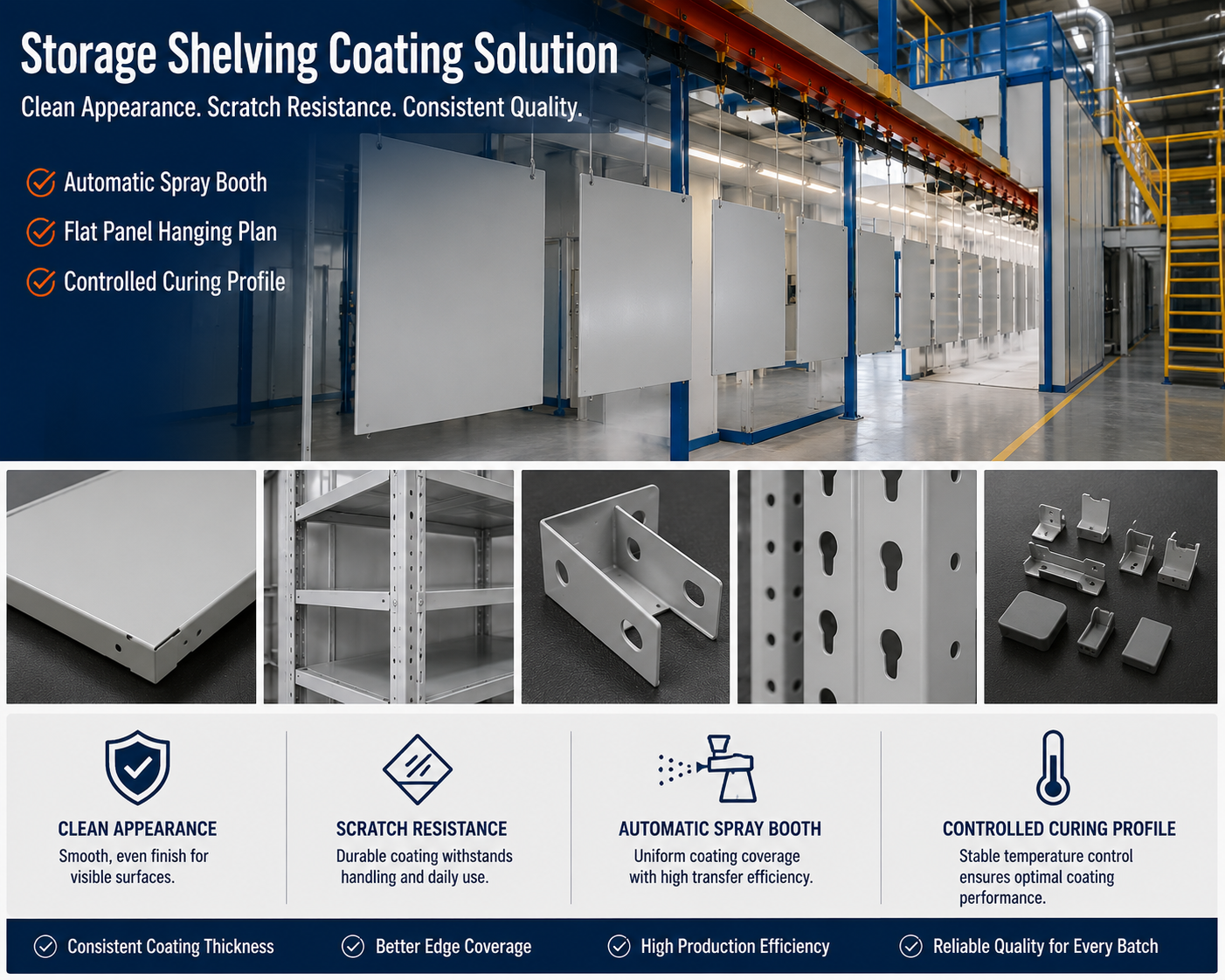
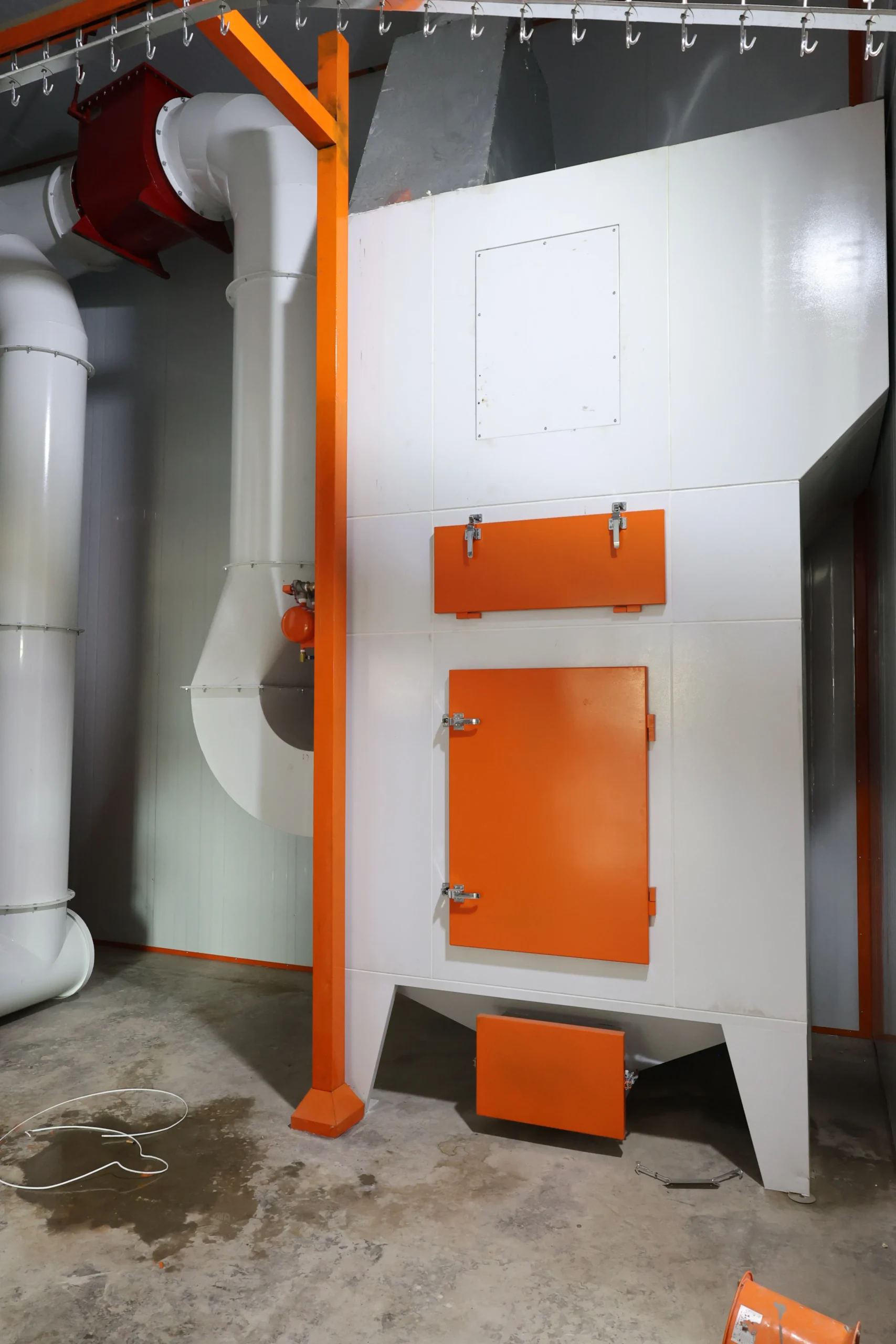
Why Powder Coating for Metal Products?
Metal products face constant threats from corrosion, oxidation, and wear. Powder coating provides a protective barrier while enhancing aesthetic appeal and product value.
Critical Protection for Metal:
- → Steel Products: Prevents rust and oxidation in harsh environments
- → Aluminum Components: Protects against galvanic corrosion and enhances durability
- → Stainless Steel: Adds decorative finishes while maintaining hygiene standards
- → Industrial Parts: Extends service life and reduces maintenance costs
Whether you're coating furniture, shelving, electrical cabinets, or mechanical components, powder coating delivers consistent, professional results that keep your products looking new.
The Powder Coating Process Explained
A complete powder coating production line follows a precise 5-stage process to ensure superior coating quality and durability:
Stage 1: Pretreatment
Metal surfaces are cleaned, degreased, and treated to remove oils, rust, and contaminants. This crucial step ensures excellent adhesion and coating durability.
Stage 2: Spray Application
Powder is electrostatically sprayed onto the prepared metal surface. The electrostatic charge causes particles to firmly adhere to the workpiece.
Stage 3: Curing & Baking
Coated parts enter a heated oven where high temperature causes the powder to melt, flow, and chemically cross-link, forming a solid coating.
Stage 4: Cooling
Parts exit the oven and cool naturally or with forced air cooling, allowing the coating to fully harden and achieve maximum hardness.
Stage 5: Packaging
Finished products are inspected, packaged, and prepared for shipment to ensure safe delivery with perfect coating finish.

Key Equipment in a Powder Coating Line
Pretreatment System
Includes spray tunnels, immersion tanks, and rinse stations. Removes contaminants and prepares metal for optimal coating adhesion.
Key Parameter: pH level, temperature control
Powder Spray Booth
Features electrostatic spray guns, powder delivery system, and particle recovery mechanism. Available in manual or automatic configurations.
Key Parameter: Spray pressure, recovery efficiency
Curing Oven
Electric or gas-fired system with precise temperature control and uniform heat distribution. Enables fast curing and excellent coating properties.
Key Parameter: Temperature accuracy ±5°C, heating speed
Conveyor System
Includes hanging chains, workholders, and drive systems. Ensures smooth, continuous movement of parts through all stations.
Key Parameter: Speed control, load capacity
Powder Supply & Recovery
Cyclone collectors, powder hoppers, and filtration systems. Recovers oversprayed powder for reuse, reducing material waste by 90%+.
Key Parameter: Recovery rate, filter efficiency
Control System
Advanced PLC or automation system manages all line parameters. Provides real-time monitoring, data logging, and remote diagnostics capability.
Key Parameter: Recipe programming, remote access

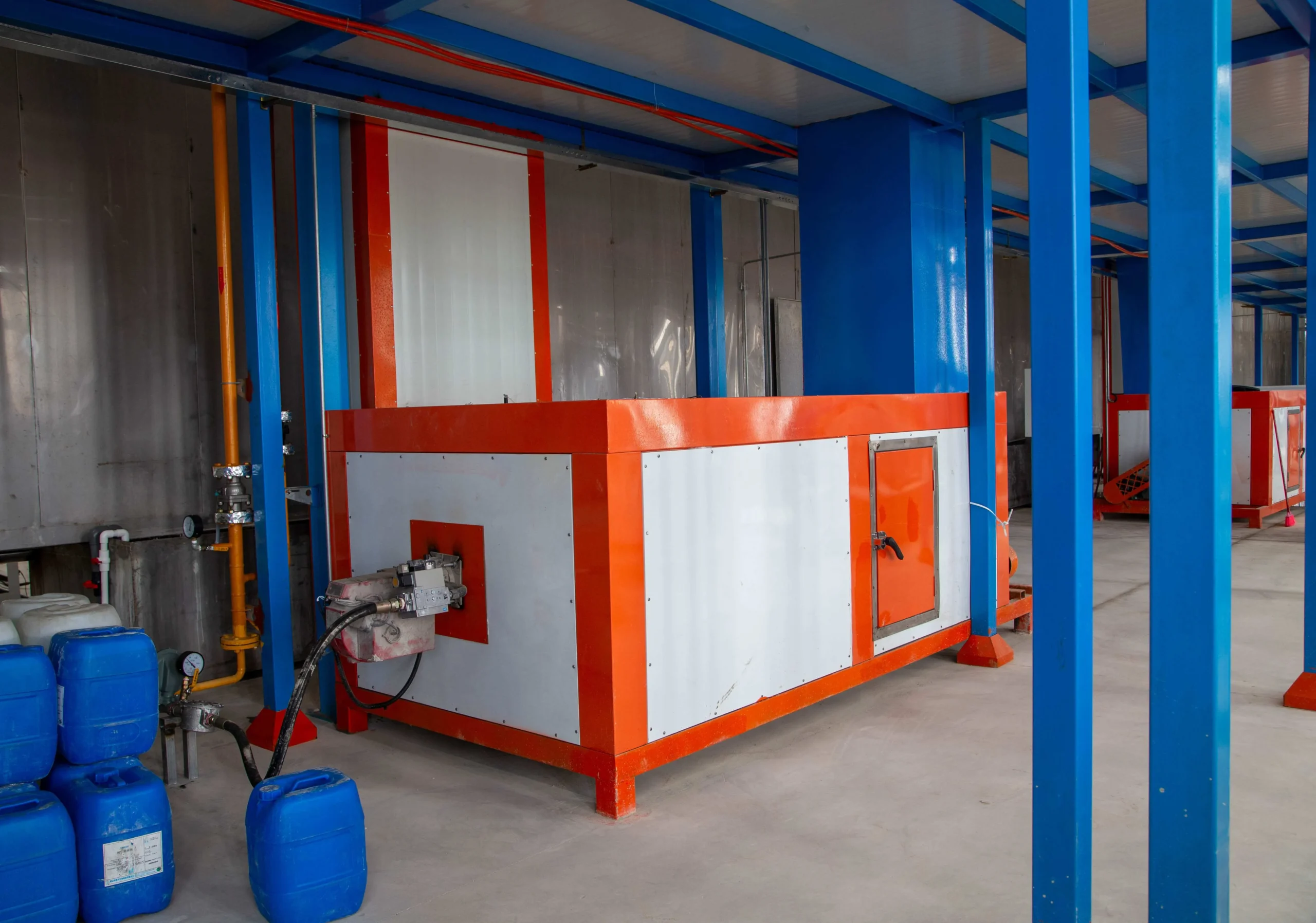
Choosing the Right Spray Booth
Selecting the appropriate spray booth is critical to achieving consistent, high-quality coating results. Consider these key factors:
Manual Spray Booth
Best for: Complex geometries, small batches, frequent color changes
Advantages: Flexibility, lower initial cost, operator control
Considerations: Requires skilled operators, variable coating uniformity
Automatic Spray Booth
Best for: Standard parts, high volumes, consistent coating requirements
Advantages: Superior consistency, faster cycle time, reduced labor
Considerations: Higher investment, requires standardized parts
Powder Recovery & Efficiency
Modern cyclone collection systems achieve 90-95% powder recovery rates, dramatically reducing material costs and environmental impact.
Color Change Speed
Manual cleaning: 5-10 minutes | Automatic purge system: 2-3 minutes | Select based on your production diversity.
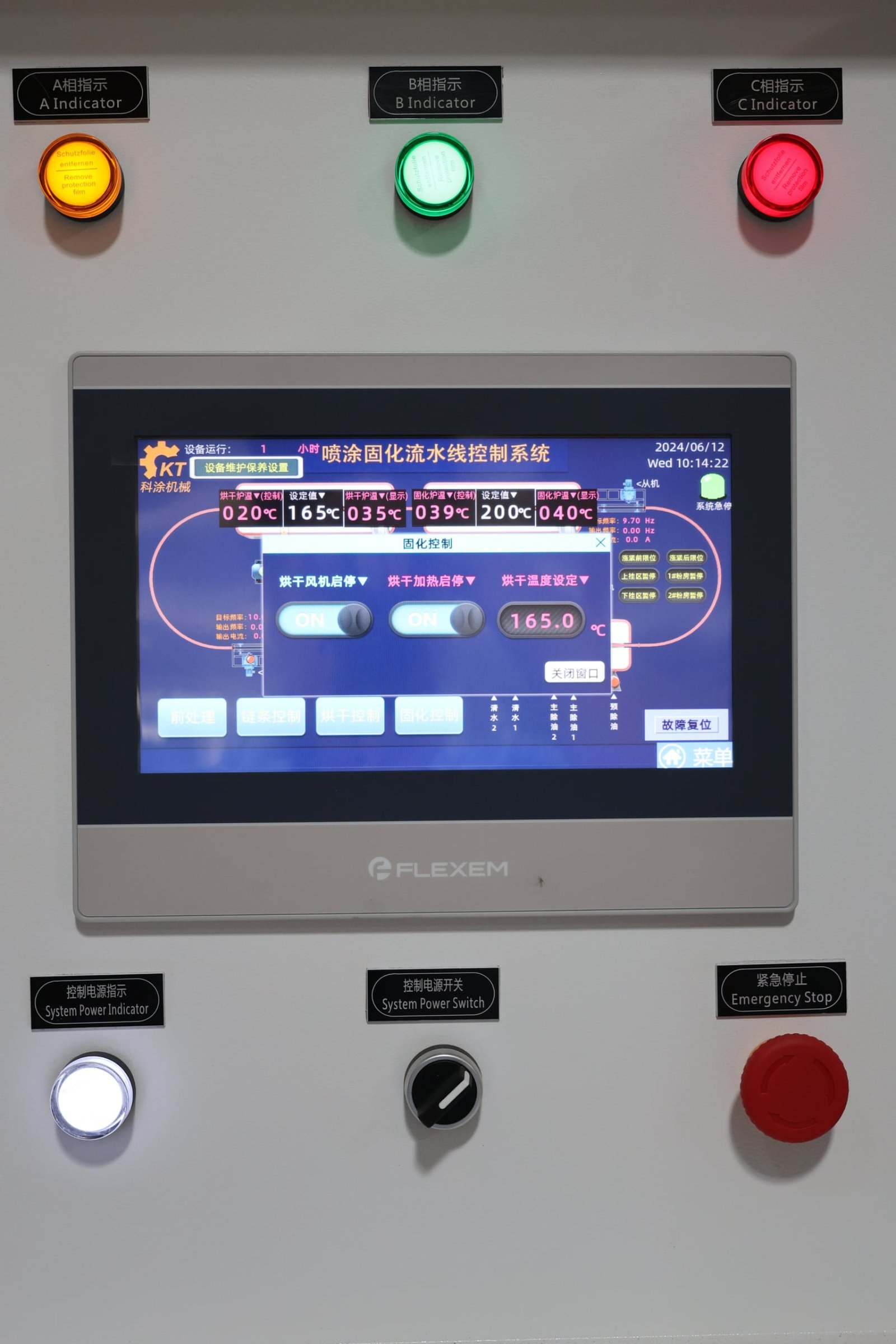
Oven Selection & Temperature Control
The curing oven is the heart of your coating line. Proper temperature control directly impacts coating quality, cycle time, and energy efficiency.
Electric Curing Ovens
- Temperature Range: 150-250°C (adjustable)
- Advantages: Precise control, quick startup, clean operation
- Energy Efficiency: Moderate; good for smaller production runs
- Best for: Sensitive parts, clean environments, frequent parameter changes
Gas-Fired Curing Ovens
- Temperature Range: 140-250°C (fast ramp-up)
- Advantages: Lower operating costs, high thermal efficiency, rapid heating
- Energy Efficiency: Superior; optimal for continuous high-volume production
- Best for: High-volume operations, cost-sensitive environments, large parts
✓ Temperature Uniformity Guarantee
Our ovens maintain ±5°C temperature accuracy across all zones with multi-point sensing and circulation fan systems, ensuring consistent coating cure and final quality.
Customizing Your Coating Line for Your Product
Product Size & Geometry
We design workholders and spray patterns specifically for your product dimensions. From small fasteners to large structural parts, we optimize fixture design for efficiency and quality.
→ Custom jigs, hangers, and carousel solutions
Factory Space & Layout
Limited space? We provide compact, modular line designs that maximize floor efficiency. Our layout consultants work with your existing infrastructure.
→ 3D CAD layouts, space utilization optimization
Production Capacity
Scale matters. We size every component—conveyor speed, oven capacity, spray booth throughput—to match your target monthly output and quality standards.
→ Capacity planning from 5 tons/month to 100+ tons/month
Automation Level
Choose your level of automation. From manual spray booths to fully robotic systems with vision inspection, we match your labor availability and budget.
→ Manual, semi-automatic, or full-auto configurations
Budget & Timeline
We work within your financial constraints and delivery schedule. Modular deployment allows phased investment—build core functions first, expand later.
→ Flexible payment terms, 8-16 week delivery options
Environmental Compliance
Meets strict emission standards with advanced dust collection and air quality management. Lower energy consumption through optimized fan systems.
→ ISO 14001 compliant, 20-30% energy savings
Every line is unique. Let our engineers design your perfect solution.
Quality Control & Coating Finish
Superior coating quality requires precise parameter control and rigorous inspection at every stage.
Coating Thickness
Target: 50-150 micrometers. Controlled via spray gun positioning, powder supply rate, and application time. Tested with coating thickness gauge.
Color Consistency
Achieved through stable powder supply, constant spray distance, and uniform oven heating. Color matching standards (Delta E <1.0).
Adhesion & Durability
Tested via cross-hatch adhesion test, salt spray (ASTM B117), and impact resistance. Target: <5% coating failure.
Defect Prevention
Common issues like sagging, orange peel, or undercure prevented through pretreatment quality, spray parameter tuning, and oven profiling.
Acceptable Reject Rate
With proper training and process control, reject rates should stay below 2-3%. Our support team helps you establish SOP and continuous improvement.
Pro Tip: Invest in operator training and establish a quality dashboard. Regular parameter monitoring and quick adjustments prevent batch defects before they occur.
Environmental Compliance & Sustainability
Eco-Friendly Advantages
- • Zero VOC Emissions: No volatile organic compounds unlike liquid paint
- • Minimal Waste: 90%+ powder recovery reduces material loss
- • Water Conservation: No water-based washing required
- • Safer Workplace: Non-toxic, non-flammable powder particles
Energy Efficiency
- • Thermal Insulation: Reduces heat loss by 20-30%
- • Variable Frequency Drives: Fan speed optimization cuts energy usage
- • Heat Recovery Systems: Capture exhaust heat for preheating
- • Estimated Savings: 25-40% lower operating costs vs. alternative coatings
Compliance & Certifications
ISO 9001
Quality Management
ISO 14001
Environmental Management
CE Mark
European Compliance
NFPA 79
Electrical Standards
Cost Analysis & Return on Investment
Understanding the total cost of ownership helps justify the investment in professional powder coating equipment.
1. Initial Investment Breakdown
Small Line (5-10 tons/month): $50,000 - $150,000
Medium Line (20-50 tons/month): $150,000 - $400,000
Large Line (50+ tons/month): $400,000 - $1,000,000+
2. Monthly Operating Costs
Powder Material: $3-8 per kg (90%+ recovery)
Pretreatment Chemicals: $200-500/month
Energy (electricity/gas): $800-2,000/month
Maintenance & Spare Parts: $300-800/month
3. Revenue & Payback Analysis
Coating Service Rate: $15-30 per kg (depending on complexity)
Monthly Production at 50% capacity: $12,000 - $40,000 revenue
Estimated Payback: 12-24 months for medium-sized operations
Key Insight: The ROI improves significantly with higher capacity utilization and consistent customer base. We help you develop pricing strategy and capacity planning to maximize returns.
Ready to Start Your Powder Coating Project?
Our experts can help you design a custom coating solution based on everything you've learned. Get a detailed technical assessment and investment proposal today.
Frequently Asked Questions About Powder Coating for Metal
Find answers to the most common questions from manufacturers considering powder coating solutions
Line Selection & Configuration
Should we choose manual or automatic spray booth? +
Manual: Best for small volumes, complex shapes, frequent color changes. Requires skilled operators. Cost: $30K-80K.
Automatic: Best for high volumes, standard parts, consistent specifications. Lower labor. Cost: $100K-300K+.
Our Recommendation: Start manual, upgrade to automatic as volume grows. We offer modular migration paths.
How do we calculate the right production capacity? +
Capacity calculation depends on:
- • Average part weight and size
- • Target production volume (tons/month)
- • Required spray time per part
- • Curing time and oven residence
- • Desired line efficiency (typically 70-85%)
Our engineers create a detailed capacity model based on your product and can simulate different line configurations.
Can different sized products run on the same line? +
Yes, with proper fixture design. We create modular workholders that accommodate size variations (±20% typically). Larger variations require different fixtures, but hanging system remains unchanged. Setup time: 30-60 minutes between product changes.
What if our factory space is limited? +
We design compact lines optimized for your available space. Options include:
- • Vertical oven designs (stacked heating zones)
- • U-shaped line layouts (shorter footprint)
- • Turntable spray booths (360° coverage)
- • Reduced pretreatment sections
Typical compact line: 20-30 m² for 5-10 tons/month capacity.
Pretreatment & Surface Prep
Why is pretreatment so critical? +
Pretreatment removes oils, rust, and mill scale, allowing powder to bond properly. Poor pretreatment = poor adhesion = coatings fail in salt spray tests. It's the foundation of durability. Our systems achieve 95%+ cleaning effectiveness.
Do different metals need different pretreatment? +
Steel: Spray or immersion degreasing + phosphate conversion coating
Aluminum: Alkaline degreasing + chromate or chromium-free conversion coating (for corrosion protection)
Stainless Steel: Mild degreasing only (skip phosphate, use passive layer)
We calibrate chemistry and flow rates for your specific material mix.
How often do pretreatment chemicals need replacement? +
Depends on production volume and contamination levels. Typically:
- • Degreaser: Every 2-4 weeks (500-1,000 parts)
- • Conversion coating: Every 4-8 weeks
- • Rinse water: Continuous (recycling system recommended)
Cost: $200-500/month typically. We provide monitoring strips and disposal guidance.
Can we reuse pretreatment chemicals? +
Limited. Degreaser can be partially recycled via coalescence (oil separation). Conversion coating cannot be recycled but reduced-waste options exist. We recommend closed-loop water recycling to minimize fresh water usage and chemical consumption.
Spray Booth & Spray System
What powder recovery efficiency can we expect? +
Modern cyclone collectors achieve 90-95% recovery rates. The remaining 5-10% escapes as micro-particles or adheres to spray booth walls. Recovery rates depend on:
- • Cyclone design and efficiency
- • Filter cleanliness (auto vs manual purge)
- • Spray gun distance and technique
Our big cyclone systems guarantee 95%+ recovery, saving significant material costs.
How long does color changeover take? +
Manual cleaning: 5-10 minutes (clean gun, hopper, lines)
Automatic purge system: 2-3 minutes (pushes old powder out, sprays new color)
Quick-change cartridge: <1 minute (pre-filled cartridges swap in/out)
Choose based on your production mix and color change frequency.
How do we maintain spray booth filters? +
Filter maintenance is critical for efficiency:
- • Manual cleaning: Weekly or when pressure drop exceeds 100 Pa
- • Automatic pulse cleaning: Triggered by timer or sensor (recommended)
- • Replacement: Every 6-12 months depending on usage
- • Cost: $50-200 per filter cartridge
We provide spare filter kits and teach your team proper maintenance procedures.
What's the difference between manual and automatic spray guns? +
Manual (Operator): Handheld, full directional control, best for complex shapes. Requires skill and consistency training.
Automatic (Robotic): Fixed trajectory, programmable patterns, superior consistency, faster cycle time. Ideal for repetitive geometries.
Hybrid: Stationary guns on booth walls + operator for touch-up. Balances consistency with flexibility.
Oven & Curing
Is electric or gas oven more economical? +
Gas Cost Advantage: 30-40% lower operating cost per unit of heat. Better for high-volume, continuous operations.
Electric Advantages: Quicker startup, no combustion emissions, cleaner environment, easier maintenance.
Our Recommendation: Gas for 24/7 production, Electric for shift work or variable capacity. Payback on gas system: 3-5 years.
How is oven temperature uniformity maintained? +
Our ovens maintain ±5°C accuracy through:
- • Multi-zone heating (top, side, bottom)
- • Circulation fans that force-recirculate hot air
- • Multi-point RTD sensors (4-6 points per oven)
- • PLC closed-loop control with PID tuning
Result: Uniform coating cure with no undercure or over-bake defects.
What's a typical curing time? +
Depends on powder type and part size:
- • Fast-cure powders: 6-8 minutes at 200°C
- • Standard powders: 10-15 minutes at 200-230°C
- • Thick coatings (>150µm): 20-30 minutes
Residence time = oven length / line speed. We size ovens to match your target cycle time.
Can we reduce oven energy consumption? +
Yes. Energy-saving strategies include:
- • Thicker insulation (fiberglass/ceramic blanket)
- • Stainless steel reflective interior
- • Variable frequency fans (reduce speed when below target temp)
- • Heat recovery: Exhaust air preheats fresh air inlet
- • Optimized oven length (minimize residence time)
Expected savings: 20-30% reduction in oven energy costs.
Customization & Commercial
What's the minimum order for a coating line? +
A complete production line is our basic unit. No strict MOQ, but we recommend:
- • Single-line orders for 5-100 tons/month capacity
- • Multi-line orders for 100+ tons/month (bulk discount)
- • Equipment-only orders (just booth, oven, etc.)
We welcome first-time buyers and provide scalable solutions.
What's your typical delivery timeline? +
Standard line: 8-12 weeks (design, manufacturing, testing, packaging)
Custom/Complex: 12-16 weeks (advanced customization, special materials)
Fast-track: 6-8 weeks (expedited manufacturing, higher cost)
We provide detailed Gantt schedules and weekly progress updates. Installation on-site: 2-4 weeks.
Do you support phased/modular investment? +
Absolutely. Many customers start with pretreatment + spray booth, add oven later. Or begin with manual spray, upgrade to automatic. Our modular design allows flexible phasing without re-engineering. We provide upgrade paths and integration planning.
What payment terms do you offer? +
Standard: 30% deposit, 40% on shipment, 30% on installation
Financing: We partner with leasing companies for flexible terms (3-5 year arrangements available)
Special Arrangements: Negotiable for large orders or long-term partnerships
All prices are ex-works. Shipping, insurance, and installation are quoted separately.
After-Sales & Support
How long does on-site installation take? +
Timeline depends on line complexity:
- • Small booth-only: 3-5 days
- • Complete small line: 7-10 days
- • Complete large line: 14-21 days
- • + 3-5 days training and commissioning
We provide full technical coordination and site management.
What training do our employees get? +
Our standard training program covers:
- • Safe operation and emergency procedures (1 day)
- • Line startup, shutdown, and parameter control (2 days)
- • Spray technique and quality standards (2 days)
- • Maintenance, troubleshooting, spare part replacement (1 day)
- • Quality inspection and defect diagnosis (1 day)
Total: 7 days. All training is hands-on with our engineers. Documentation and videos provided.
What happens if equipment breaks down? +
Multi-level support:
- • Phone/Email support: Immediate response during business hours
- • Remote diagnostics: Video call or remote PC access for troubleshooting
- • Field service: On-site engineer dispatch (2-5 days depending on location)
- • Spare parts: Stock of critical components at our facility + regional warehouses
Warranty: 1-2 years on equipment parts. Extended support contracts available.
How do we order spare parts and supplies? +
Easy ordering process:
- • Parts manual with SKU numbers provided at commissioning
- • Online parts catalog available (login required)
- • Email or phone orders processed within 24 hours
- • Common parts ship in 2-7 days; special items 3-4 weeks
- • Recommended spare kit provided at startup (filter, seals, spray tips, etc.)
Annual maintenance contract available for predictive replacement scheduling.
Still Have Questions?
Our technical experts are ready to answer detailed questions about your specific application. Get personalized guidance for your powder coating project.
Trusted by Metal Manufacturers Worldwide
Proven success across industries with verified customer testimonials and real-world project results
500+
Metal Manufacturers Served
8,000+
Tons Annual Output
20+
Years Industry Experience
45+
Countries Served
Installation & Operation Gallery
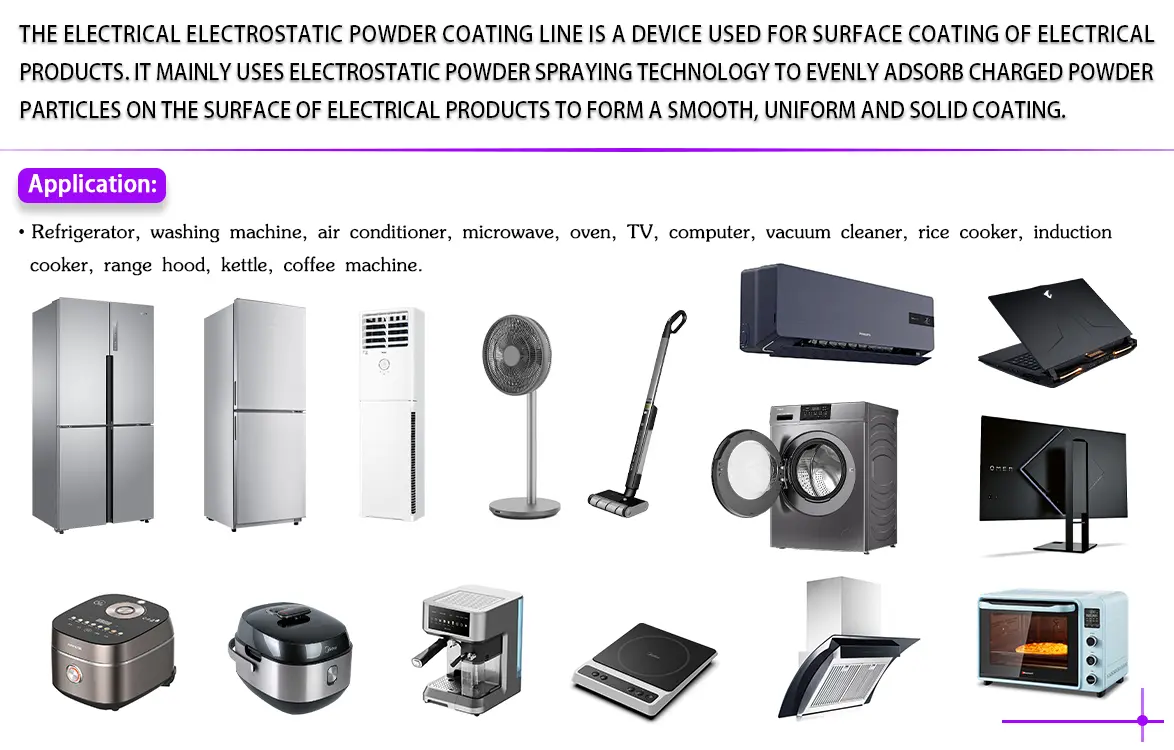
Complete Coating Line Installation
Full line commissioning with pretreatment, spray booth, and oven

Furniture Industry Application
Metal chairs, tables, and cabinets with premium finish
Spray Booth Operation
Cyclone collection system achieving 95%+ powder recovery
Sheet Metal Coating
Industrial sheet metal parts with uniform color finish
Electrical Enclosure Coating
Control cabinets and electrical boxes with corrosion protection
Building Materials Coating
Metal profiles and structural components for construction industry
What Our Customers Say
Jacob Martinez
Manufacturing Manager
"Ketu designed and built our powder coating production line with exceptional expertise. Their focus on energy efficiency has significantly reduced our operational costs while maintaining perfect product quality. Their after-sales support is outstanding."
Metal Furniture Manufacturer, Canada
Stephen Chen
Quality Director
"The quality and finish of products coated with Ketu's equipment are exceptional. Our customers immediately recognize the superior coating quality. This gave us a competitive advantage in the market and built strong brand loyalty."
Industrial Components Manufacturer, USA
Diana Wilson
Operations Manager
"Ketu quickly understood our specific needs and delivered a perfectly tailored solution. Their engineering team is highly knowledgeable, and their customer service responds to issues with impressive efficiency. We trust them completely."
Storage Solutions Manufacturer, Europe
Ryan Thompson
Plant Manager
"Ketu's professionalism and technical excellence are unmatched. They demonstrated deep knowledge of coating processes and showed genuine responsibility in delivering our project on time and on budget. Highly recommended."
Mechanical Equipment Supplier, Asia
Industries & Applications We Serve
Furniture Industry
Metal chairs, tables, storage units
Storage & Shelving
Industrial racks and warehousing systems
Electrical Enclosures
Control cabinets and power distribution boxes
Building Materials
Metal profiles, structural components
Industrial Machinery
Equipment components and metal parts
Elevator Systems
Elevator parts and metal frames
Ready to Start Your Metal Powder Coating Project?
Let our coating experts design a custom solution tailored to your production needs, capacity, and budget. Get a free technical consultation and detailed investment proposal.
What You'll Get:
- ✓ Free technical needs assessment
- ✓ Custom line design & 3D layout
- ✓ Detailed capacity & ROI analysis
- ✓ Competitive pricing & delivery timeline
- ✓ Support through all project stages
Get Your Free Quote
Fill in your details and our experts will contact you within 24 hours with a customized proposal.
We respect your privacy. Your information is confidential and used only for your consultation.
20+
Years in Business
500+
Projects Delivered
45+
Countries Served
24h
Support Response
✓ ISO 9001 Certified | ✓ 1-2 Year Warranty | ✓ Lifetime Technical Support
 English
  German
  Vietnamese
  French