
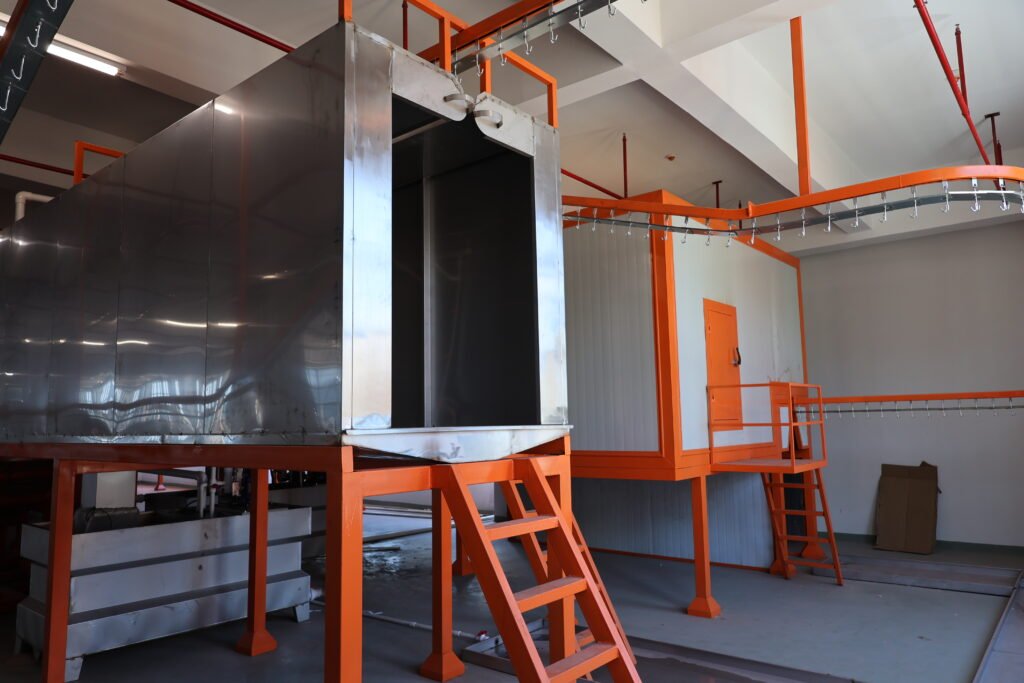
If you've ever noticed a smooth, durable finish on metal furniture, industrial equipment, or architectural components, you've likely seen powder coating at work. Yet many manufacturing professionals still confuse it with traditional liquid paint spraying. The difference is substantial—and it matters for your production line, your costs, and your product quality.
This guide cuts through the confusion. I'll explain what powder coating actually is, how it works, and why an increasing number of factories are switching from conventional paint to electrostatic powder systems. More importantly, I'll share insights from our experience working with manufacturers across cabinet production, outdoor furniture, and aluminum extrusion to help you decide if powder coating is right for your operation.
What Is Powder Coating? (Definition & Basic Concept)
Powder coating is a dry finishing process that applies finely ground powder particles to a workpiece using electrostatic attraction, followed by heat curing to form a continuous, durable surface layer. Unlike liquid paint that relies on solvent evaporation, powder coating uses a solid powder that melts, flows, and chemically hardens when heated—a fundamentally different mechanism that delivers superior results in many applications.
The powder itself is a mixture of resin, curing agents, pigments, and additives blended into fine particles, typically 10-100 micrometers in diameter. When charged by a spray gun and attracted to a grounded workpiece, the powder adheres uniformly to the entire surface—including recessed areas, corners, and internal cavities that liquid spray often struggles to coat evenly.
How Powder Coating Differs from Traditional Liquid Paint
The contrast is stark. Traditional liquid paint contains 30-70% volatile organic compounds (VOCs)—solvents that evaporate into the air as the paint dries. This process is wasteful, environmentally problematic, and requires constant ventilation and air quality management.
Powder coating contains essentially zero VOCs. The powder is applied in solid form and only the unreacted particles that miss the workpiece are collected and recycled—not discarded. This means higher material efficiency, lower environmental impact, and lower operational costs over time.
Liquid paint also requires multiple thin coats to achieve adequate film thickness; powder coating typically delivers adequate protection in a single application. The final coating is thicker, denser, and more uniform than most liquid finishes, which translates to better corrosion resistance and durability.
The Static Electricity Process: How Powder Adheres to Metal
The mechanism is elegantly simple: static electricity pulls the powder onto the workpiece.
Inside the spray gun, a high-voltage electrode (typically 40-90 kV) imparts a negative charge to the powder particles. The workpiece is grounded, creating a positive reference point. The charged powder particles are naturally attracted to the grounded surface by electrostatic force—they essentially "fall" onto the workpiece from the cloud of particles being sprayed.
This is why grounding quality matters so much in production. Poor electrical contact between the workpiece and ground means weak electrostatic attraction, which leads to uneven coating thickness, reduced transfer efficiency, and wasted powder. It's one of the first things we check when troubleshooting coating quality on a new production line.
How Does Powder Coating Work? (The Application Process)
The Three Core Steps of Static Spray Application
Step 1: Powder is charged.
The spray gun pressurizes and atomizes powder from a supply hopper, and the electrostatic generator charges each particle to approximately -5 to -20 microamperes. The operator or automatic spray head directs this charged cloud toward the workpiece.
Step 2: Powder adheres to the workpiece.
The grounded workpiece attracts the charged powder particles, which accumulate on its surface in a uniform layer. The powder clings firmly due to electrostatic force, even on vertical or overhead surfaces. For complex geometry—internal cavities, deep recesses, corners—the electrostatic field helps guide powder into areas that mechanical spray would miss entirely.
Step 3: The workpiece enters the curing oven.
Once fully coated, the workpiece moves into a heated environment (typically 160–230°C / 320–450°F, depending on the powder formulation). The heat causes the powder to:
- Melt and flow, filling minor surface irregularities and creating a smooth finish
- Undergo a chemical cross-linking reaction that hardens the coating
- Form a permanent, continuous film with properties tailored to the specific resin system used
The entire process—from spray booth to oven exit—typically takes 15-30 minutes per piece, though timing varies with part size and oven design.
Why the Electrostatic Principle Matters for Coverage and Quality
This is where powder coating's real advantage emerges: electrostatic force ensures even coverage that mechanical spray cannot achieve.
In our work with cabinet manufacturers and aluminum extrusion producers, we've seen that the electrostatic principle solves the "hard-to-reach area" problem that plagues liquid spray. Recesses, slot openings, blind holes, and internal edges that would require careful manual repositioning or multiple spray angles are naturally enveloped by the electrostatic field. The powder seeks out these areas almost automatically.
This translates to:
- Higher first-pass quality: fewer missed spots, fewer rework cycles
- Uniform film thickness: across flat and complex surfaces
- Consistent color and appearance: especially important for visible cabinet doors or furniture components
- Faster production: because manual adjustment and re-spray are minimized
What Are the Main Advantages of Powder Coating?
Superior Durability and Corrosion Resistance
Powder coatings, especially epoxy and polyester formulations, create a protective barrier that far exceeds typical liquid paint. The denser film thickness and superior cross-linking produce coatings that resist chipping, scratching, fading, and corrosion for 10-15 years or more, depending on the environment and formulation.
For cabinet manufacturers serving industrial or marine applications, this durability directly reduces warranty claims and enhances product reputation. For outdoor furniture makers, powder-coated aluminum and steel frames withstand UV exposure and moisture cycles that would degrade liquid finishes in 2-3 years.
We've observed this durability advantage consistently across our customer base—whether serving the harsh North African climate in Algeria, the Mediterranean coastal conditions for Turkey-based furniture exporters, or the high-temperature industrial environments where Indian aluminum manufacturers operate.
Environmental Benefits (Zero VOC Emissions & Recyclability)
This is the advantage that resonates most with modern manufacturers. Powder coating emits virtually no volatile organic compounds during application or curing. This eliminates:
- Regulatory compliance burden for air quality permits
- Required ventilation infrastructure investment
- Operator exposure to harmful chemical fumes
- Workplace health and safety incidents related to solvent exposure
Additionally, unreacted powder is physically recovered from the spray booth and air handling system and can be reused directly in subsequent applications—yielding recovery rates of 85-99% depending on the equipment design. This contrasts sharply with liquid paint, where 30-50% of the material may end up as waste sludge requiring disposal.
For facilities operating in regions with strict environmental standards—like the EU-adjacent regulations applied in some North African markets or India's growing air quality requirements—powder coating is increasingly not just preferable but mandatory.
Long-Term Cost Effectiveness
The initial investment in powder coating equipment is higher than a simple spray booth. A complete line with pre-treatment, spray room, recovery system, and curing oven typically runs $150,000–$500,000+ depending on automation and production speed.
However, the long-term math strongly favors powder coating:
- Material efficiency: 85-99% transfer efficiency vs. 50-70% for liquid spray means 30-50% less paint consumed per part
- No solvent cost: Powder requires no thinners or solvents
- Lower labor per part: Fewer rework cycles, less manual touch-up, simpler color changes (swap powder supply, no extensive flushing)
- Longer equipment life: The coating's durability means end-customers experience fewer returns and warranty issues
- Reduced rework: Better coverage means fewer rejected parts returning to the line
We typically see our customers recover their equipment investment within 2-4 years when comparing total cost of ownership against their prior liquid spray system—especially if they were previously experiencing high rework rates or high material waste.
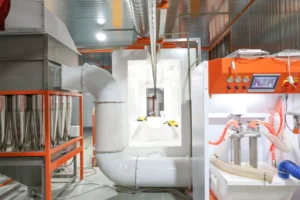
Aesthetic Quality and Finish Options
Powder coatings offer a range of visual finishes that liquid paint struggles to match: high-gloss, satin, matte, textured, metallic, and color-shift effects. The powder melts uniformly and flows during curing, creating smooth, consistent surfaces with no drips, sags, or runs.
For furniture manufacturers and architectural product makers, this aesthetic consistency is a significant competitive advantage. A cabinet door or aluminum frame finished with powder coating looks more refined, more durable, and more premium than equivalent liquid paint—and that perception translates directly to customer willingness to pay.
Application Speed and Efficiency
Once the pre-treatment and spray infrastructure is in place, powder coating is remarkably efficient. A single coat is typically sufficient; liquid paint often requires 2-3 coats for equivalent coverage. Spray time is brief—often 30-60 seconds per part—and the part moves directly from spray to cure without waiting for intermediate drying.
For high-volume manufacturers (10-100 parts per hour), this efficiency compounds significantly. The line operates on a steady cycle, with predictable throughput and minimal bottlenecks.
Safer Workplace Conditions
Powder coating eliminates the chemical hazards associated with liquid paint:
- No solvent inhalation risk
- No skin contact with harmful chemicals
- No fire risk from volatile fumes
- Simpler personal protective equipment (powder-rated face protection vs. respirators)
- Lower OSHA compliance burden
We've observed that facilities transitioning to powder coating report improved worker satisfaction and lower occupational health claims—benefits that extend beyond the balance sheet.
What Finishes and Colors Can Powder Coating Achieve?
Powder coating is available in virtually any color and finish style you can specify. Standard options include:
- High-gloss: Mirror-like finish, maximum visual appeal
- Satin: Subtle sheen, professional appearance
- Matte: Flat finish, modern aesthetic
- Textured: Sand, wrinkle, or hammertone effects for visual interest or functional grip
- Metallic: Shimmer or pearl finishes for premium products
- Color-shifting: Pearlescent or chameleon effects for high-end applications
The color range extends from standard industrial grays and blacks to custom Pantone matches. For brands with strict color specifications—whether automotive suppliers or furniture companies—powder coating accommodates tight tolerance control.
The finish durability is also a major advantage. Powder-coated colors resist fading from UV exposure far better than liquid paint, which makes powder coating the obvious choice for any product that spends time outdoors or in bright indoor environments.
What Are the Limitations and Disadvantages of Powder Coating?
When Powder Coating May Not Be Suitable
Powder coating excels with metal and some engineered plastics, but has limits:
- Wood: Wood's porous surface and moisture absorption make powder coating difficult; liquid finishes work better
- Complex assembles: If components must be assembled before coating, internal surfaces remain uncoated
- Touch-up and repair: Adding powder to an already-cured coating requires high skill; liquid paint is easier to patch
- Thin-walled or delicate components: The heating process may warp very thin or heat-sensitive parts
- Small or one-off runs: The equipment investment only makes sense with adequate volume; below roughly 5-10 parts per shift, liquid spray may be more economical
Initial Investment and Equipment Requirements
The equipment cost is real. Beyond the spray booth and recovery system, you need:
- Pre-treatment system (degreasing, rust removal, conversion coating)
- Compressed air infrastructure
- Electrical service (380V three-phase typical for larger lines)
- Waste disposal and environmental controls
- Operator training and maintenance expertise
For small shops or contract finishers handling variable part types, this investment is a significant hurdle. However, for manufacturers committed to volume production with consistent part geometry, the investment typically proves justified within a few years.
Which Industries and Products Benefit Most from Powder Coating?
Typical Applications Across Manufacturing Sectors
Cabinet and Enclosure Manufacturing: Electrical cabinets, server racks, control boxes. Powder coating's superior corrosion resistance and uniform appearance make it the standard finish for industrial enclosures.
Outdoor Furniture: Metal frames for patio furniture, garden benches, recreational equipment. Powder coating's UV resistance and weather durability are essential in this category.
Aluminum Extrusion: Window frames, architectural profiles, structural components. Powder coating provides consistent, durable finish while supporting high-speed continuous production.
Metal Shelving and Storage: Warehouse racking, retail display units, industrial storage. Powder coating's impact resistance and clean appearance support both durability and aesthetics.
Automotive Components: Brackets, fasteners, structural parts. Powder coating meets automotive OEM quality standards and environmental regulations.
HVAC and Mechanical Equipment: Ductwork, equipment housings, structural frames. Powder coating provides long-term corrosion protection in demanding environments.
Material Compatibility (Metal, Plastic, Wood)
Steel: Excellent compatibility. Steel is the primary substrate for powder coating. Pre-treatment (typically phosphating) ensures optimal adhesion.
Aluminum: Excellent compatibility. Requires conversion coating (non-chromate or chromate) to enhance adhesion. Aluminum's light weight and corrosion resistance make powder coating the ideal finish.
Stainless Steel: Good compatibility, though some adhesion challenges exist. Requires specialized pre-treatment and powder formulations.
Galvanized Steel: Compatible, though pre-treatment protocols differ from bare steel to account for the zinc layer.
Engineered Plastics: Limited compatibility. Some powder systems adhere to plastics, but adhesion and heat tolerance remain challenges. Not recommended for standard applications.
Wood: Not suitable. The porous surface and moisture sensitivity make powder coating impractical. Liquid finishes are appropriate.
Powder Coating vs. Traditional Paint: A Direct Comparison
| Criteria | Powder Coating | Traditional Liquid Paint |
|---|---|---|
| VOC Emissions | Virtually zero (~0%) | High (30-70% of volume) |
| Material Efficiency | 85-99% transfer efficiency | 50-70% transfer efficiency |
| Film Thickness | Thick (2-4 mils typical) | Thin (1-2 mils typical) |
| Coats Required | Single coat usually sufficient | 2-3 coats for equivalent protection |
| Application Speed | 30-60 seconds per part | 1-3 minutes per part (including drying) |
| Durability | 10-15+ years typical | 3-7 years typical |
| Color/Finish Options | Excellent range | Good range, but fading more common |
| Initial Equipment Cost | $150,000–$500,000+ | $30,000–$100,000 |
| Long-term Cost (per part) | Low (material + energy efficient) | Higher (more material, more labor) |
| Environmental Compliance | Minimal burden | Requires air quality permits, ventilation |
| Workplace Safety | High (no VOC hazard) | Moderate to low (solvent exposure risk) |
| Suitable for High-Volume Production | Excellent | Good, but less efficient |
The comparison is clear: for volume production of metal parts requiring durable, consistent finish, powder coating is superior on almost every metric except initial capital cost.
How Long Does Powder Coating Last?
The lifespan of a powder-coated finish depends on several factors:
Indoor, dry environment: 15-20+ years. The coating degrades slowly without UV exposure or moisture cycling.
Outdoor, temperate climate: 10-15 years. UV and moisture shorten lifespan compared to indoor exposure, but powder's durability still far exceeds liquid paint.
Outdoor, harsh environment (marine, high-salinity, tropical): 5-10 years. Intensive salt spray and UV accelerate degradation, but the coating still outlasts liquid alternatives in the same conditions.
High-temperature industrial environment: 5-10 years depending on peak temperatures and the specific powder formulation. Continuous exposure to elevated heat can accelerate breakdown of the resin system.
The key advantage remains clear: even in harsh conditions, a quality powder coating typically lasts 2-3x longer than an equivalent liquid paint finish. For manufacturers with products in the field, this durability translates to fewer warranty claims and higher customer satisfaction.
Frequently Asked Questions About Powder Coating
Q: Can powder coating be applied to pre-assembled components?
A: No. Assembly must occur after coating, since the spray process applies powder to all exposed surfaces. Internal surfaces, fastener holes, and assembled cavities cannot be coated. This requires careful design-for-manufacturability planning.
Q: What happens if the workpiece is not properly grounded?
A: Poor grounding reduces electrostatic attraction, resulting in thin coverage, missed areas, and wasted powder. It's one of the most common causes of quality issues in our customer operations. Checking grounding continuity is the first troubleshooting step when coverage is uneven.
Q: Can powder coating be applied over existing paint?
A: Not reliably. The powder requires direct contact with the substrate. Existing paint or rust must be removed via blast cleaning or other surface preparation. Applying powder over old paint typically fails due to poor adhesion.
Q: Is powder coating food-safe?
A: Standard powder coatings are not food-contact safe. Specialized epoxy powders with FDA approval exist for food processing equipment, but these are expensive and require specific suppliers. Verify requirements before assuming standard powder meets food-contact standards.
Q: How do you change colors between production runs?
A: The spray system is purged with virgin powder of the new color, and the collection/recovery system is cleaned. Color change time typically ranges from 15 minutes to 1 hour depending on line complexity and thoroughness of cleaning. This is faster than flushing and changing over liquid paint systems in most cases.
Q: What is the minimum batch size for powder coating to be economical?
A: Generally, 5-10 parts per shift is a practical minimum. Below this volume, the overhead of pre-treatment, spray setup, and oven operation makes per-part cost uncompetitive versus outsourced finishing or liquid spray. Above 10-20 parts per shift, powder coating's efficiency advantage becomes substantial.
More Related Questions
Why is pre-treatment so critical in powder coating?
Pre-treatment removes oils, oxides, and contaminants, and applies a conversion coating that chemically enhances adhesion. Poor pre-treatment is the root cause of most adhesion failures we encounter in the field.
What causes orange-peel texture in powder-coated finishes?
Over-thick application, low oven temperature, or powder formulation mismatch. Adjusting spray gun distance, oven temperature curve, or switching powder batch typically resolves the issue.
Can you apply different powders on the same part?
Yes, but it requires careful masking and multi-stage spraying. For most production, single-color runs are more efficient.
Conclusion
Powder coating is a dry electrostatic finishing process that delivers superior durability, environmental compliance, and cost efficiency compared to traditional liquid paint—especially for high-volume metal part manufacturing. The zero-VOC formulation, 85-99% material efficiency, and long service life make it the increasingly standard choice for cabinet makers, furniture producers, and metal component manufacturers worldwide.
If your production involves metal parts in volumes exceeding 5-10 per shift, and your product spends time in demanding environments, powder coating deserves serious consideration. The initial equipment investment is substantial, but the long-term returns in material savings, labor efficiency, and product durability typically justify the cost within 2-4 years.
Ready to explore whether powder coating makes sense for your operation? Contact us directly. We specialize in designing integrated powder coating systems tailored to your specific product geometry, production volume, and performance requirements. We offer factory tours, live production demonstrations, and detailed technical consultation to help you make an informed decision.
 English
  German
  Vietnamese
  French