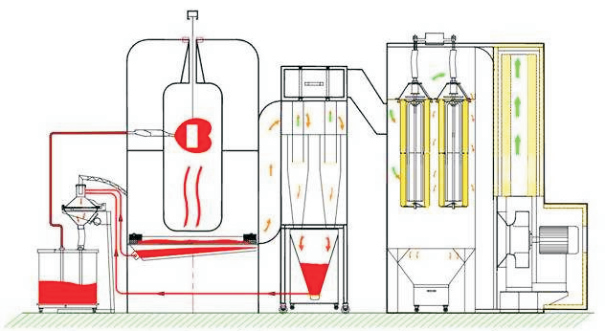
Secondary Recycling Cabinet Coating Machine
The Secondary Recycling Cabinet Coating Machine is a key powder recycling module in modern powder coating lines. It captures excess powder after spraying, performs secondary recovery through fine filtration, and helps factories improve powder utilization while supporting eco-friendly coating and sustainable production.
Core system advantages:
- Efficient powder recycling with secondary recovery and negative-pressure exhaust.
- Fine filtration captures residual powder particles and improves reusable powder control.
- Automatic pulse backflush cleaning keeps filter elements from clogging.
- Compact structure for integration with spray booths, cyclone rooms, and coating lines.
- Safe, reliable, wear-resistant, easy to maintain, and suitable for multiple powder coating tasks.
Secondary Recovery for Higher Powder Utilization and Sustainable Production
This page is built around three core buying keywords: powder recycling, secondary recovery, and eco-friendly coating. The cabinet helps factories capture residual powder, reduce material waste, and build a cleaner, more sustainable powder coating process.
Designed for Better Powder Utilization
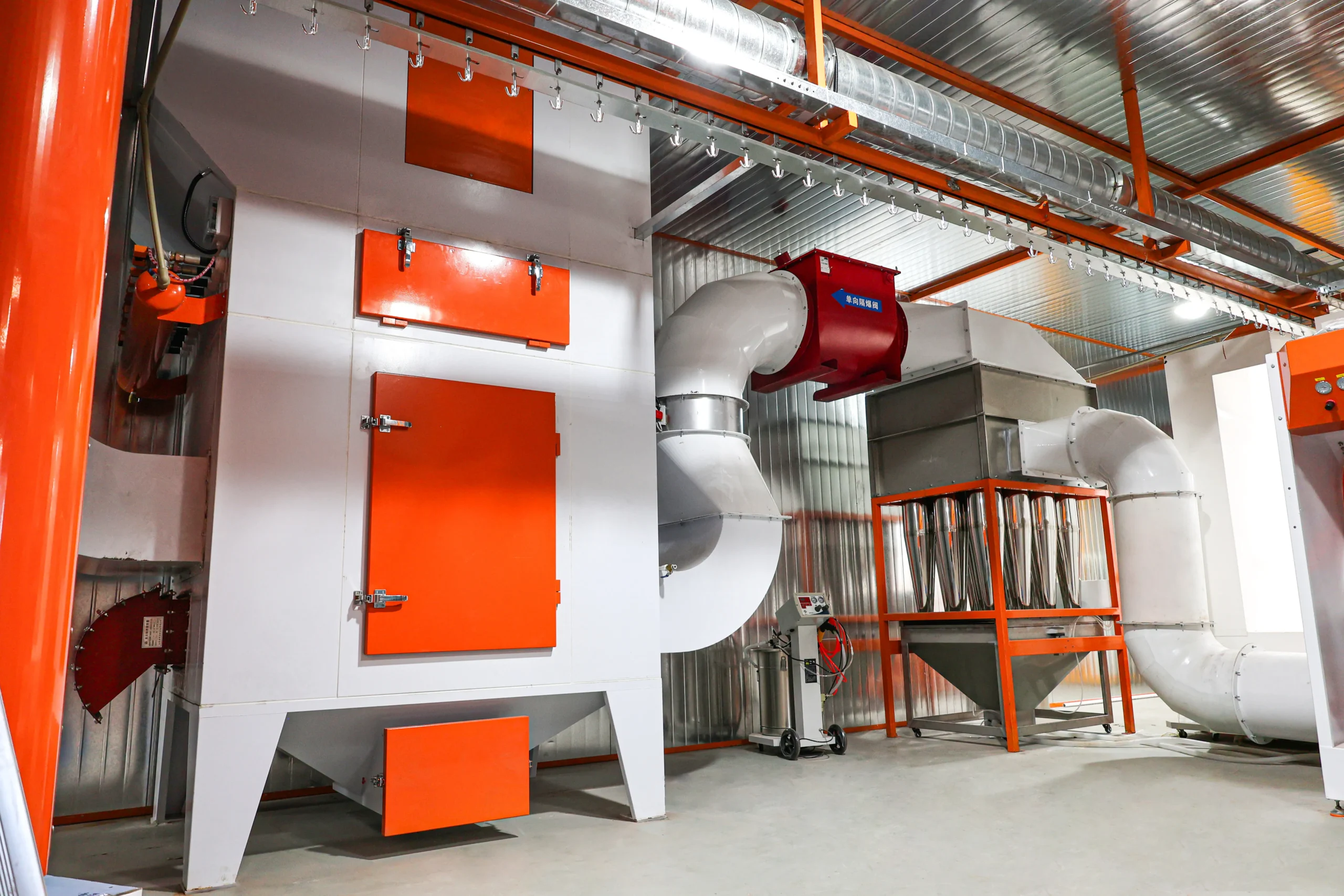
In a powder coating line, overspray powder that escapes primary recovery may still contain reusable material. The secondary recycling cabinet captures this remaining powder through filtration and pulse-cleaning recovery, helping manufacturers reduce waste and improve powder material efficiency.
Why This Cabinet Is Different
The value is not only dust collection. The real difference is turning excess powder into a controlled recovery stream while supporting cleaner air, lower powder loss, and more sustainable coating production.
Powder Recycling
Captures powder particles that would otherwise become waste or workshop dust.
Secondary Recovery
Works after primary booth or cyclone recovery to improve total powder collection performance.
Eco-Friendly Coating
Supports lower dust discharge, cleaner production, and better environmental compliance.
Sustainable Production
Helps reduce material waste, operating cost, filter burden, and long-term production impact.
Eco-Friendly Powder Recycling and Secondary Recovery for Coating Lines
The secondary recycling cabinet is designed to improve powder utilization, support secondary recovery, reduce pollution, and help coating factories move toward more sustainable production.
Robust Construction for Industrial Powder Recovery
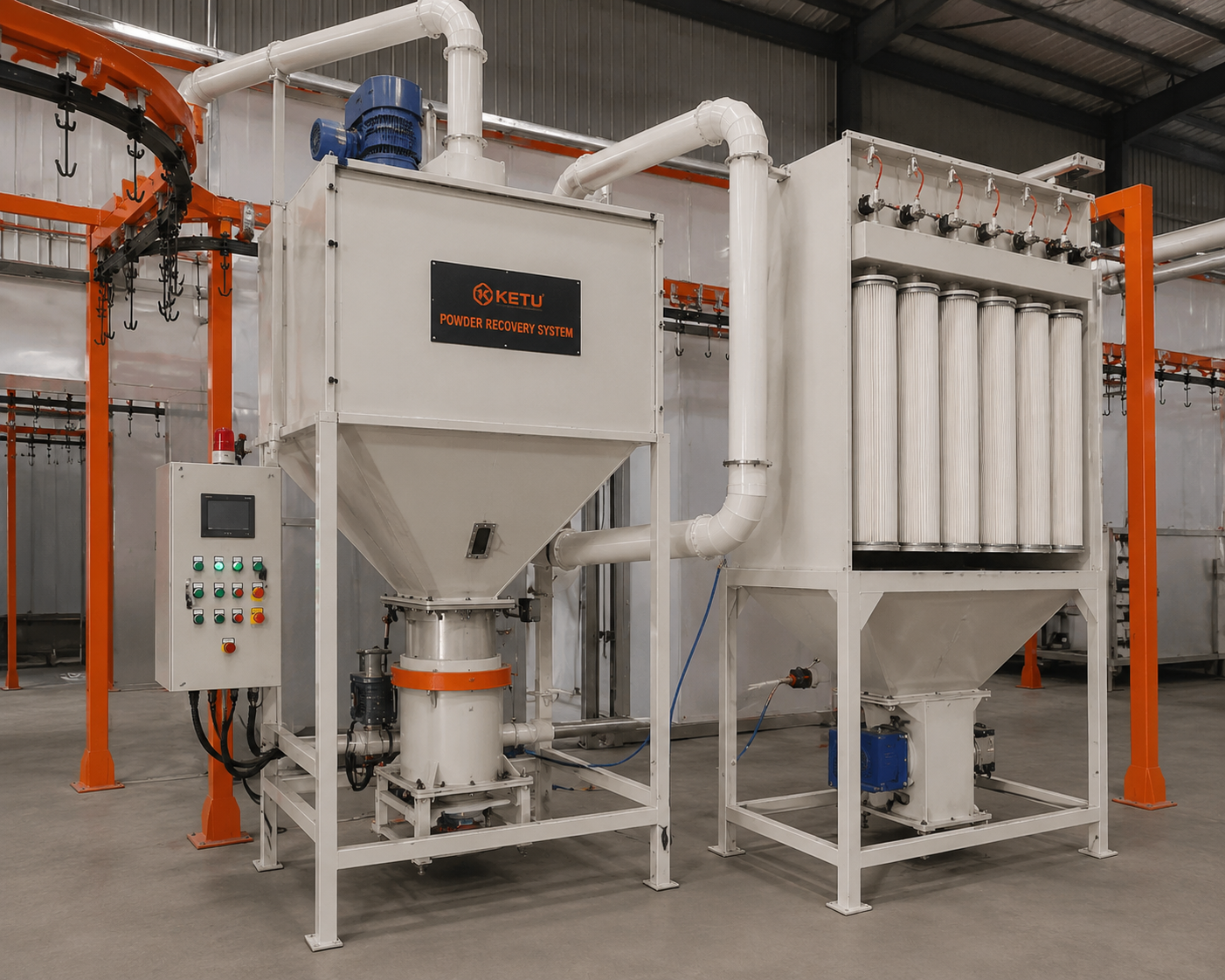
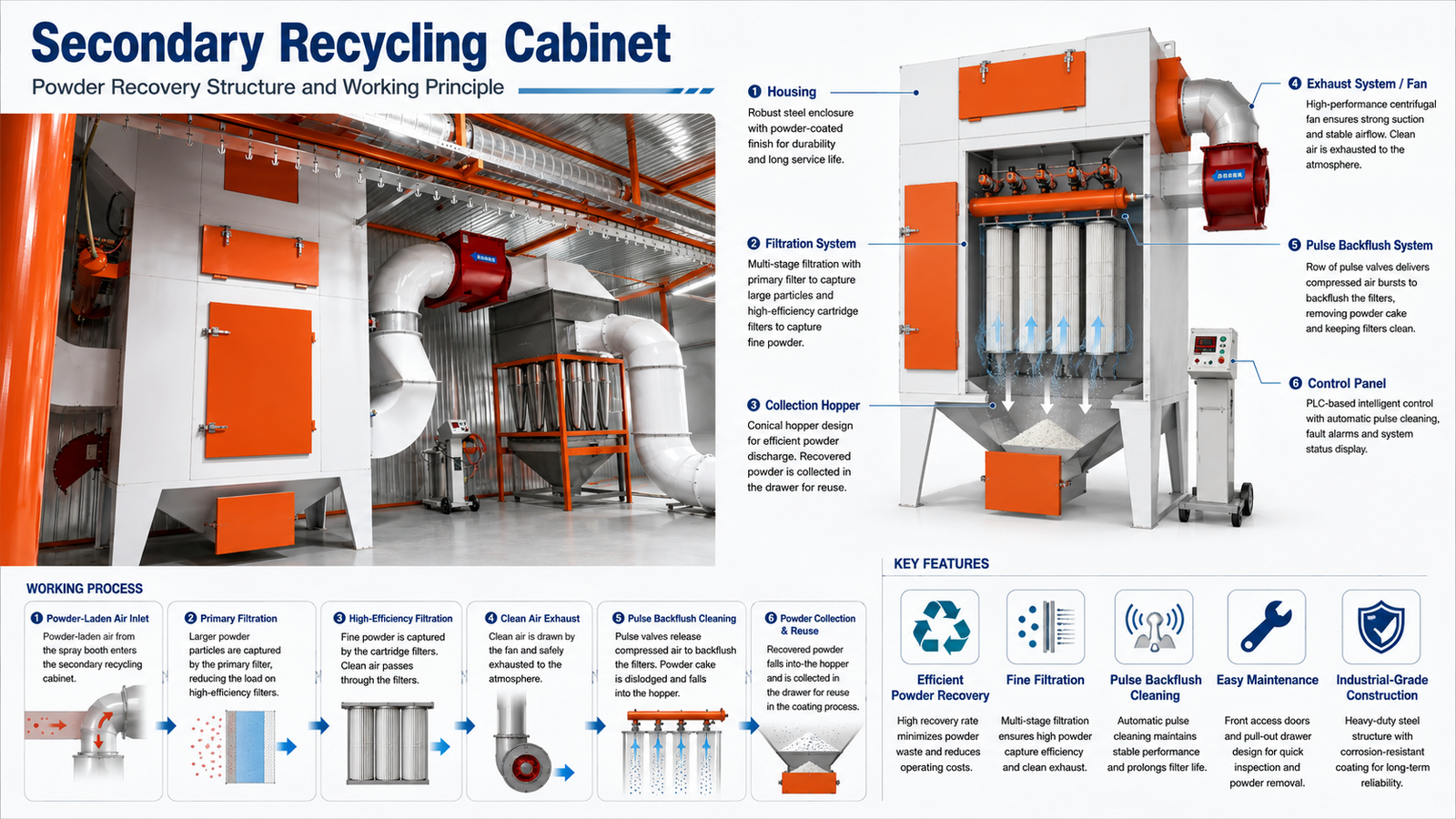
The cabinet is built from durable, corrosion-resistant materials and is designed for long-term use in powder coating workshops. It normally includes a housing, powder filtration system, exhaust mechanism, pulse cleaning system, and control panel.
This structure combines durability, clean appearance, and practical maintenance access for daily powder recovery operations.
- Durable cabinet housing for industrial use
- Corrosion-resistant material options
- Integrated filtration, exhaust, and control system
- Designed for easy operation and routine maintenance
High Recovery Efficiency Through Advanced Filtration
The powder secondary recovery cabinet can work with cyclone separation and fiber filter technology. The primary stage captures larger powder particles, while the high-efficiency filter captures finer powder particles from the airflow.
This two-stage process improves powder recovery rate, reduces dust discharge, and helps maintain cleaner air in the workshop.
- Primary filtration captures larger powder particles
- High-efficiency filter elements capture finer powder
- Negative-pressure exhaust draws powder through filters
- Improves powder recovery and air quality
Automatic Backflush Cleaning for Stable Filter Performance
The pulse backflush system periodically uses compressed air to clean filter elements. Powder attached to the filter surface falls into the hopper, helping maintain airflow and prevent filter clogging.
This self-cleaning capability reduces manual cleaning frequency and helps keep the recovery cabinet working reliably during production.
- Automatic pulse cleaning by time or pressure difference
- Compressed air back-blows filter elements
- Powder falls into hopper for collection
- Maintains filtration efficiency and reduces downtime
Core Benefits of Powder Secondary Recycling Cabinet
These advantages help coating line operators reduce powder waste, protect the working environment, and keep production stable.
Efficient Recovery
Captures excess powder from the coating process and improves total powder utilization.
Fine Filtration
Primary and high-efficiency filters help capture both larger and finer powder particles.

Automatic Cleaning
Pulse backflush cleaning helps prevent filter blockage and keeps airflow stable.
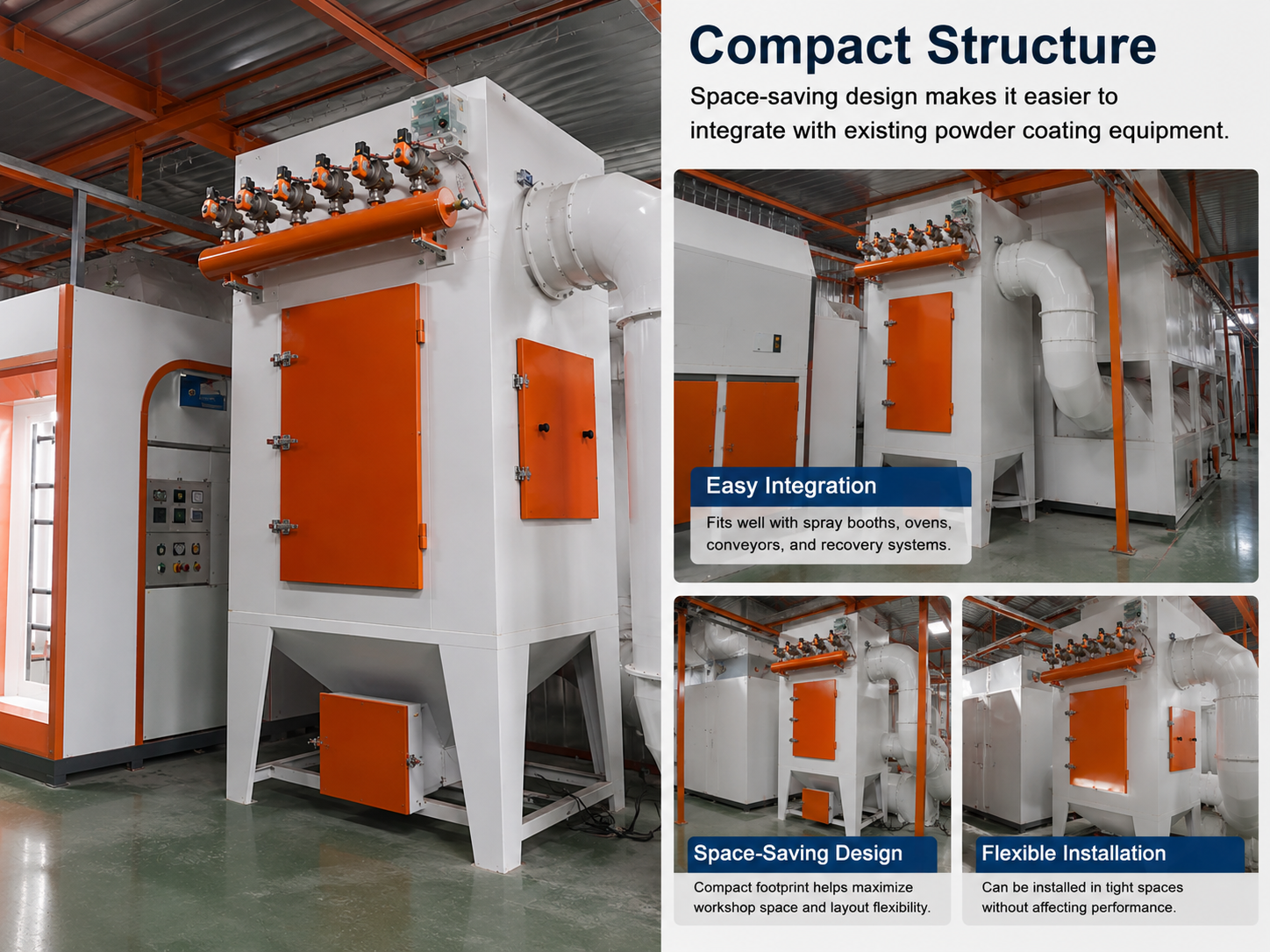
Compact Structure
Space-saving design makes it easier to integrate with existing powder coating equipment.

Easy Operation
Control options support automatic and manual operation for fan, cleaning, and maintenance tasks.
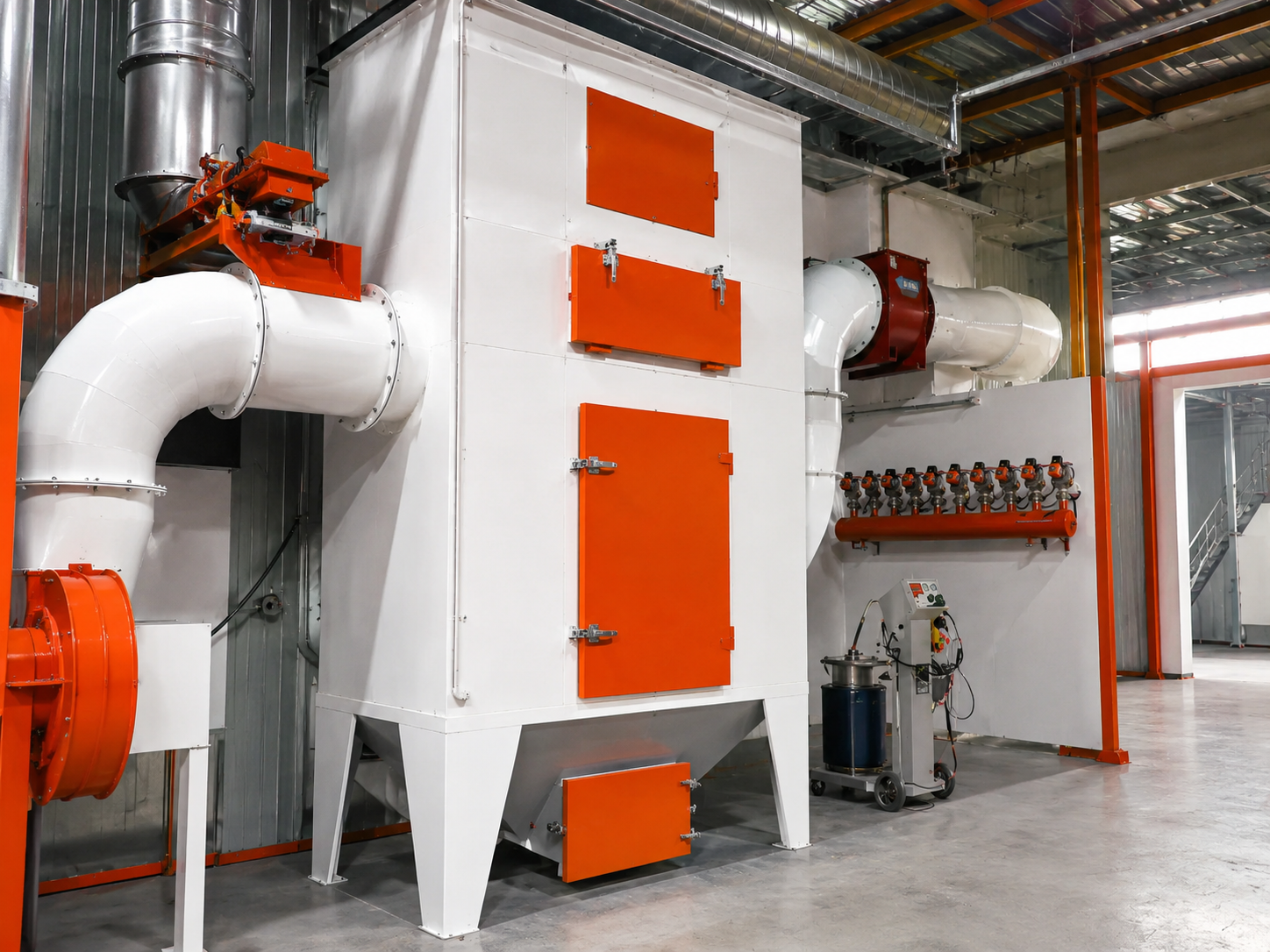
Safe and Reliable
Electrical and mechanical safety design helps protect operators during powder recovery work.
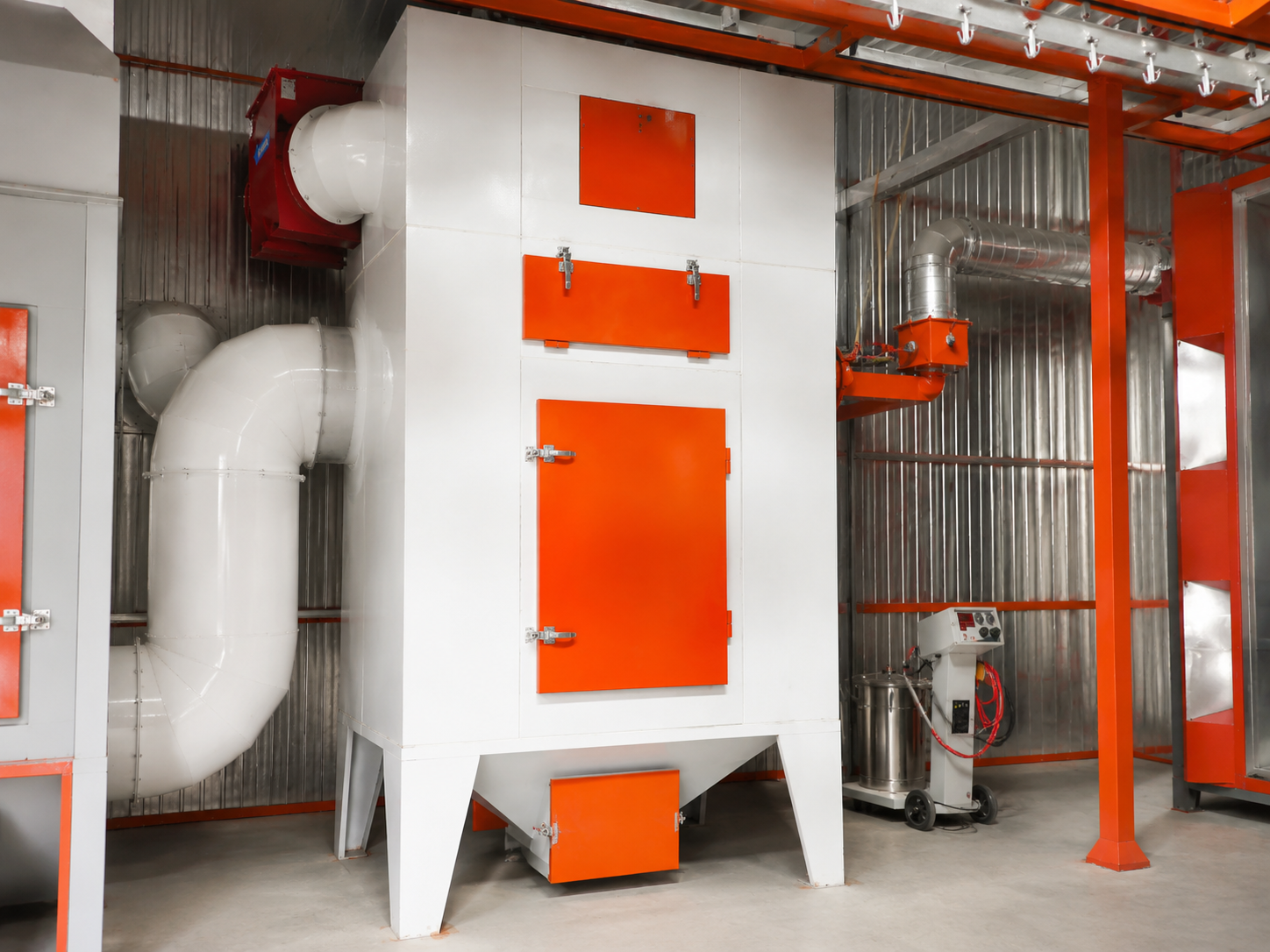
Wear Resistance
Durable materials support longer service life under powder airflow and filtration conditions.

Flexible Application
Suitable for mechanical parts, automotive components, appliances, chemical equipment, and light industrial goods.
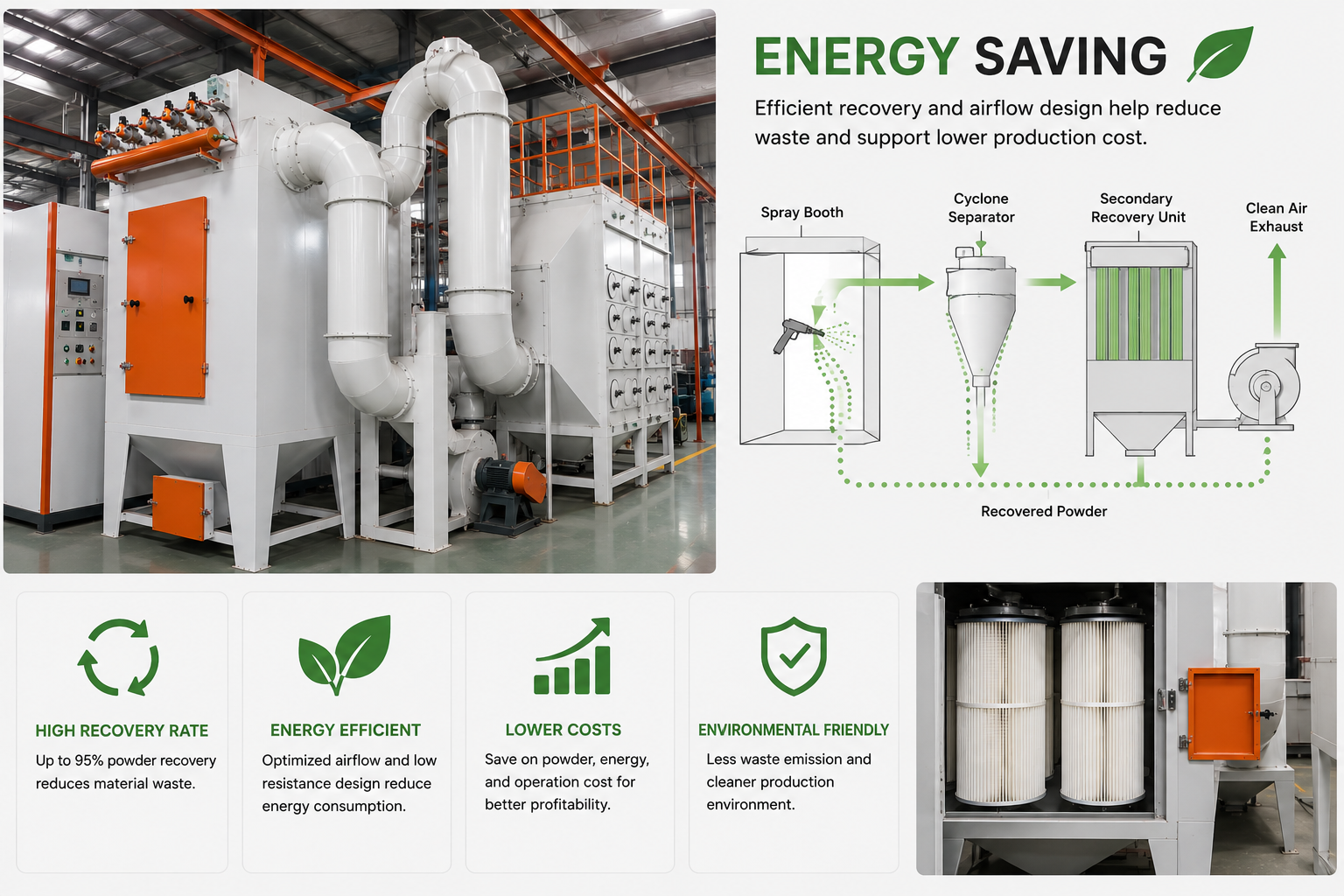
Energy Saving
Efficient recovery and airflow design help reduce waste and support lower production cost.
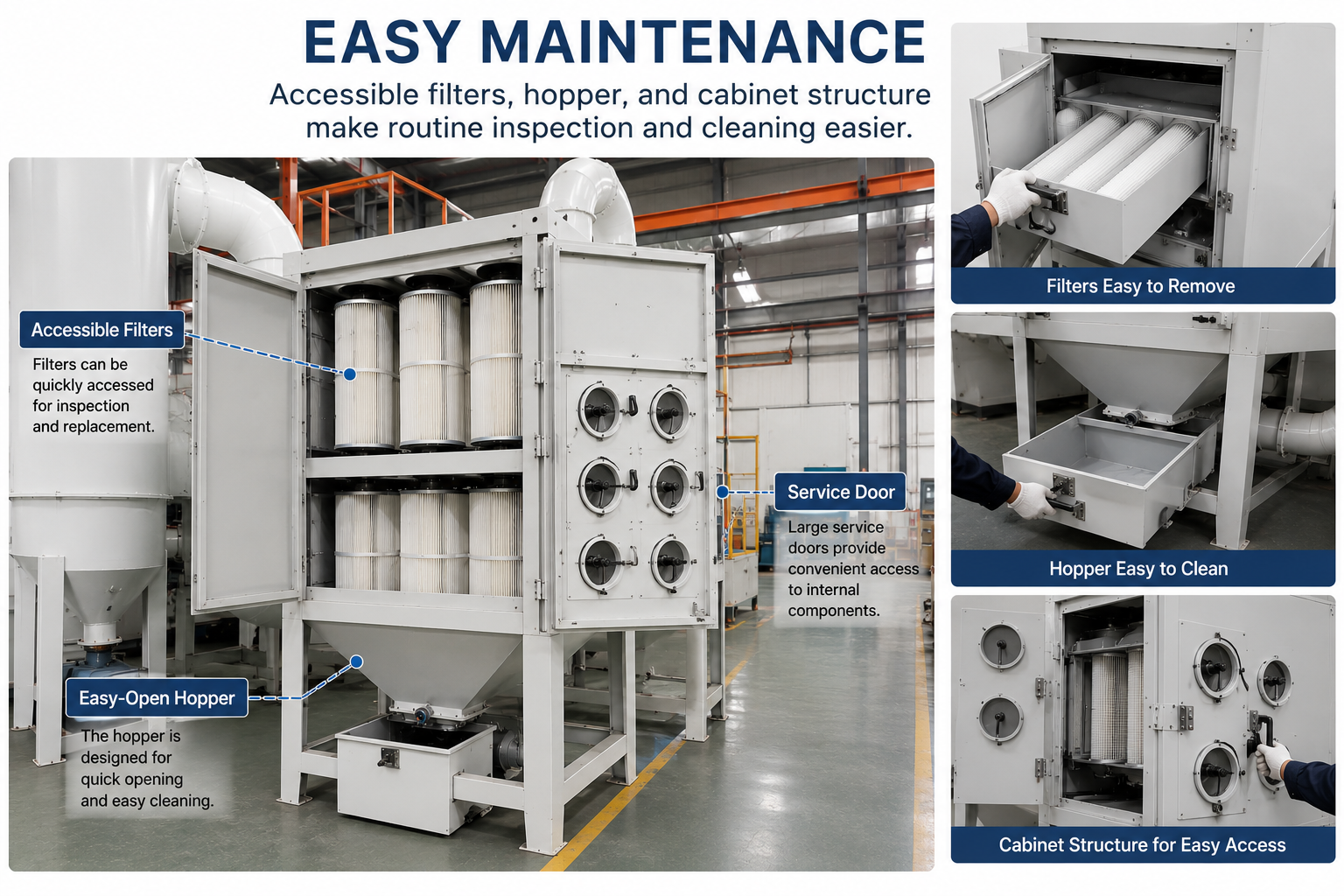
Easy Maintenance
Accessible filters, hopper, and cabinet structure make routine inspection and cleaning easier.
Two-Stage Filtration for Cleaner Powder Recovery
The secondary recycling cabinet uses a staged filtration process to capture powder particles and discharge cleaner air from the recovery system.
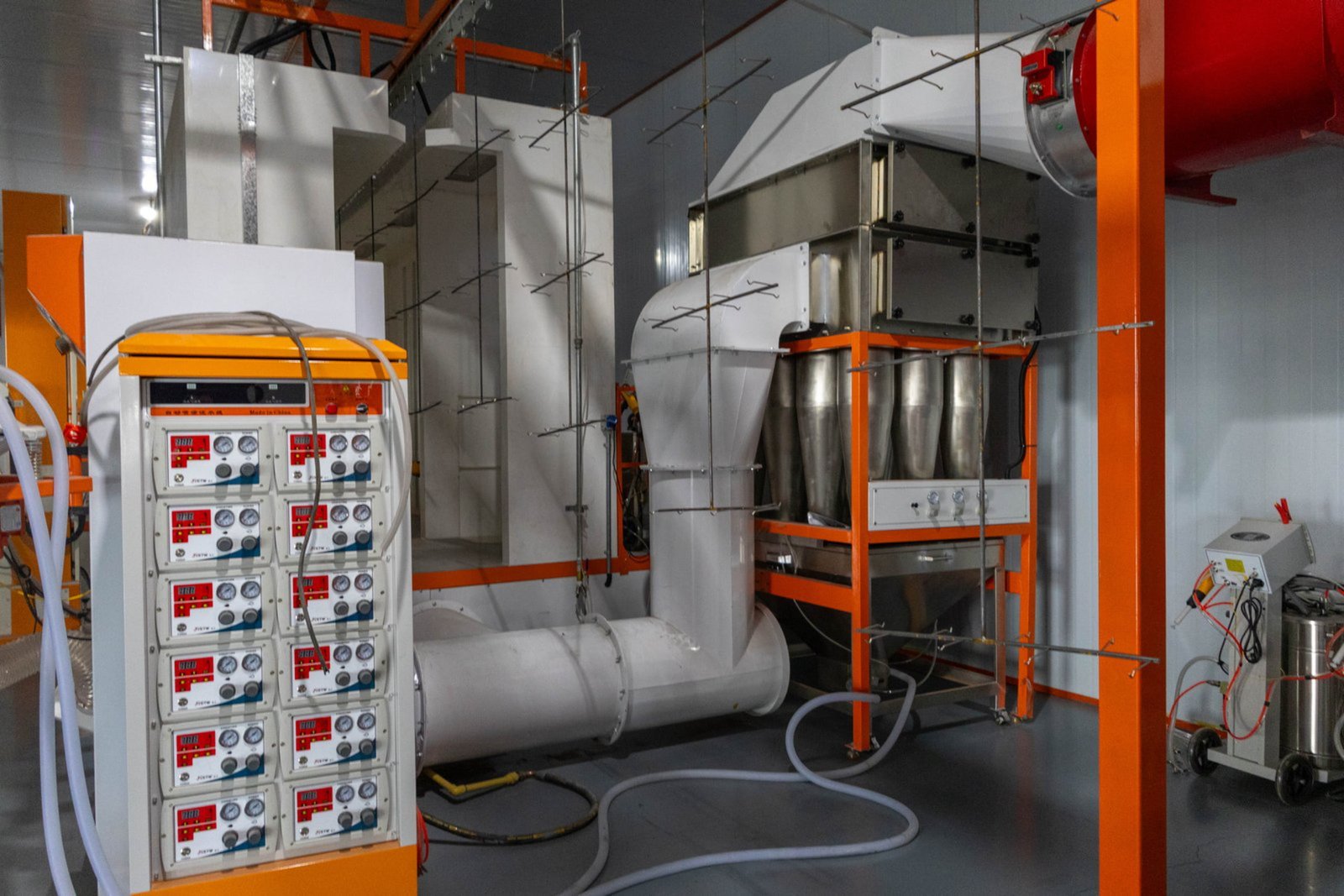
Two-Stage Filtration Process
The recycling cabinet creates negative pressure through the exhaust fan. Powder-laden air is drawn into the cabinet and passes through filters for particle capture.
- 1Primary filtration: Larger powder particles are initially trapped by the primary filter or separated before reaching the fine filter area.
- 2High-efficiency filtration: Air then passes through fiber filter elements to capture finer powder particles effectively.
- 3Pulse backflush: Compressed air periodically cleans the filter elements and makes powder fall into the collection hopper.
- 4Exhaust discharge: Filtered air is discharged by the fan after powder particles are captured by the filtration system.
- 5Powder collection: Recovered powder can be collected for reuse or handled according to production and powder quality requirements.
Main Components of the Secondary Recycling Cabinet
The cabinet combines housing, filtration, exhaust, pulse cleaning, and control systems into a compact powder recovery module.
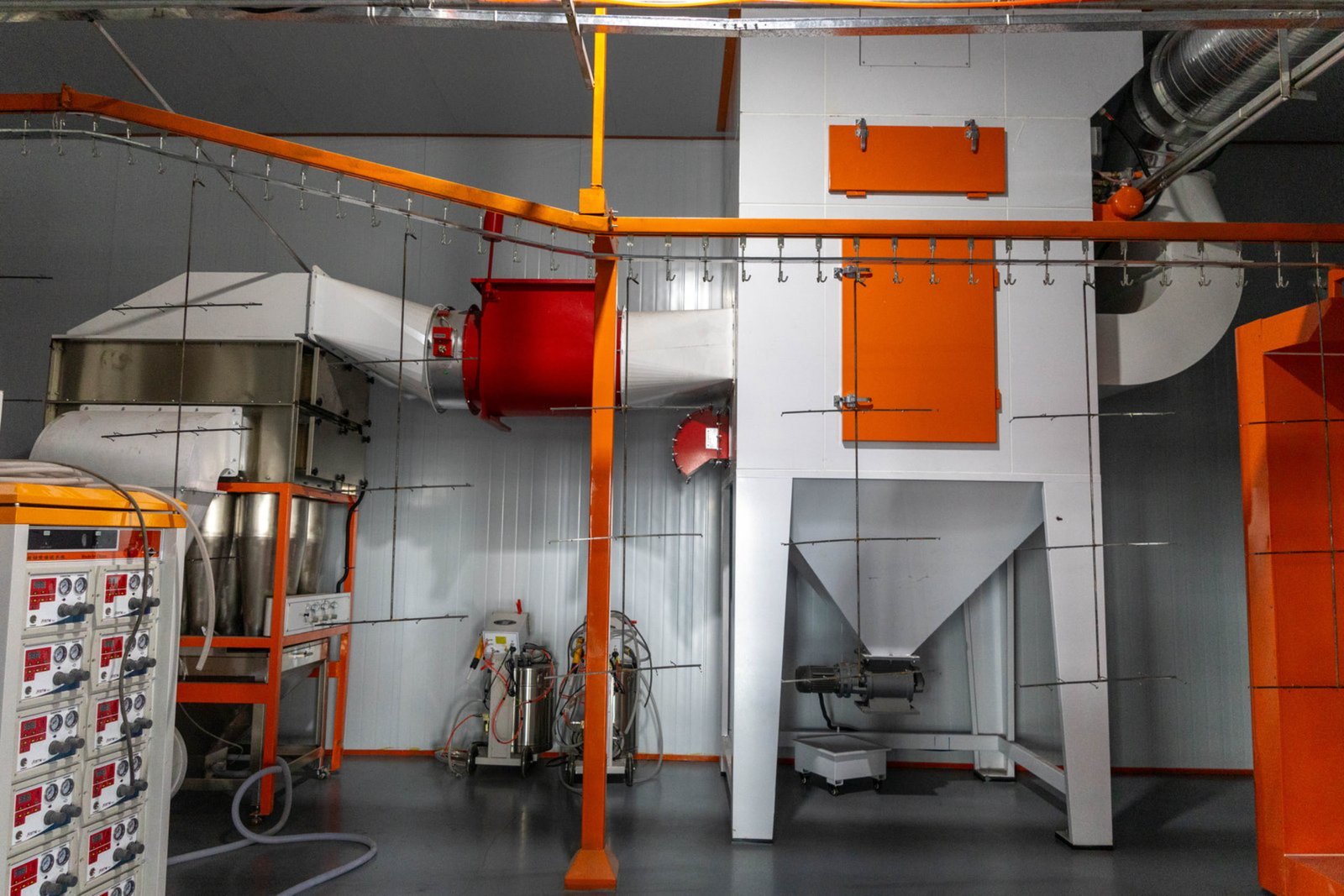
Integrated Recovery Module
The cabinet can be configured according to booth size, powder volume, airflow demand, filtration precision, and maintenance preference.
| Component | Function |
|---|---|
| Housing | Made of robust, corrosion-resistant materials for durability and industrial workshop use |
| Filtration System | Combines primary and high-efficiency filters for powder recovery and air purification |
| Exhaust System | Uses a fan to create negative pressure and draw powder-laden air through the filters |
| Pulse Backflush System | Periodically cleans filter elements by compressed air to prevent clogging |
| Collection Hopper | Collects powder that falls from the filter element after pulse cleaning |
| Control System | Supports automatic and manual operation for fan, pulse cleaning, and maintenance functions |
Standard Operation Method for Powder Secondary Recovery Cabinet
A clear operating method helps maintain filter performance, stable airflow, and safe powder recovery during daily coating production.
Step 1: Preparation
Confirm correct installation and connection of the recycling cabinet to the spray system. Verify the filtration system’s functionality, including filter element status and cabinet sealing.
Step 2: Startup Procedure
Power on the recycling cabinet and start the fan and pulse cleaning system. Confirm that the fan rotates correctly and airflow is smooth toward the filter area.
Step 3: Cleaning Cycle
Initiate pulse cleaning according to system-set time or pressure difference. Compressed air back-blows the filter element, causing accumulated powder to fall into the hopper.
Step 4: Maintenance
Routinely inspect the filtration system. Clean or replace filter elements as required, and check the hopper, exhaust fan, air lines, and control system.
Step 5: Safety Measures
Follow safety operating procedures when starting and stopping the equipment. Ensure complete power shutdown before maintenance or cleaning work.
Secondary Recycling Cabinet Reference Configuration
Exact cabinet size, fan capacity, filtration area, filter element type, pulse cleaning system, and control method should be customized according to powder volume and line configuration.

Custom Recovery System Layout
Send your spray booth layout, powder volume, line output, exhaust requirement, and existing equipment details. A customized recovery cabinet layout can be prepared for quotation.
| Parameter | Reference Specification |
|---|---|
| Equipment Type | Secondary recycling cabinet / powder secondary recovery cabinet for powder coating line |
| Application | Powder recovery, fine filtration, air purification, and secondary powder collection |
| Filtration Structure | Primary filtration + high-efficiency fiber filter elements |
| Cleaning Method | Automatic pulse backflush cleaning by time or pressure difference |
| Exhaust System | Fan creates negative pressure and draws powder-laden air through filter elements |
| Control Method | Automatic and manual control options for fan, pulse cleaning, and maintenance functions |
| Cabinet Structure | Compact, robust, corrosion-resistant housing with easy maintenance access |
| Safety Design | Electrical safety, mechanical protection, power shutdown before maintenance, and safe operation procedures |
| Suitable Products | Mechanical parts, chemical equipment, light industrial goods, automotive components, household appliances, and general powder coating products |
| Customization | Cabinet size, fan capacity, filter quantity, hopper size, pulse system, control system, and duct connection can be customized |
The Complete Purchasing Guide for Secondary Recycling Cabinet Coating Machines
Buying a Secondary Recycling Cabinet Coating Machine should not be based only on cabinet price. A good decision should evaluate powder recycling value, secondary recovery capacity, filtration efficiency, pulse cleaning, exhaust airflow, structural strength, compatibility, energy consumption, safety, and maintenance cost.
This guide helps buyers compare key technical factors before requesting a quotation or integrating the cabinet into a powder coating line.
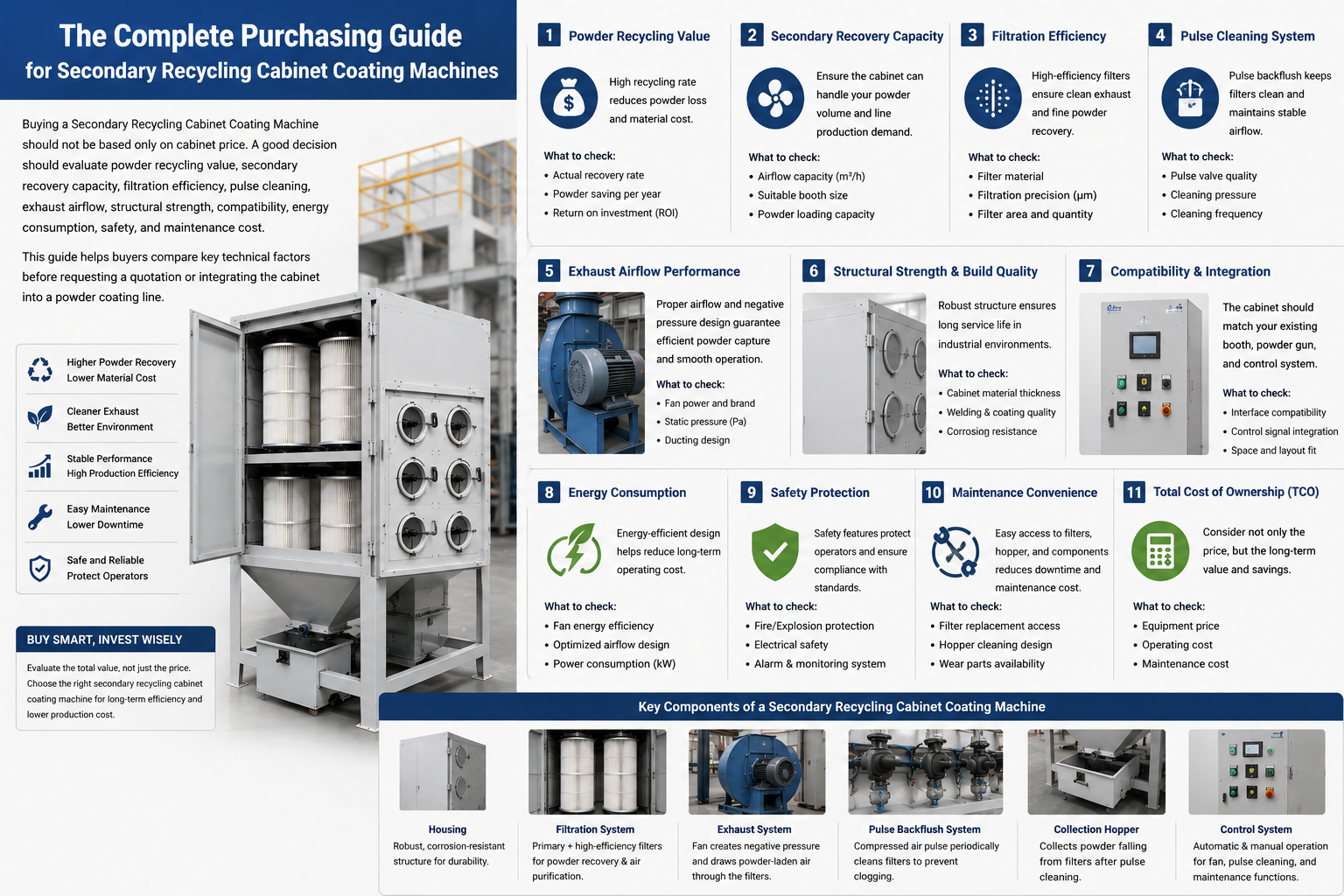
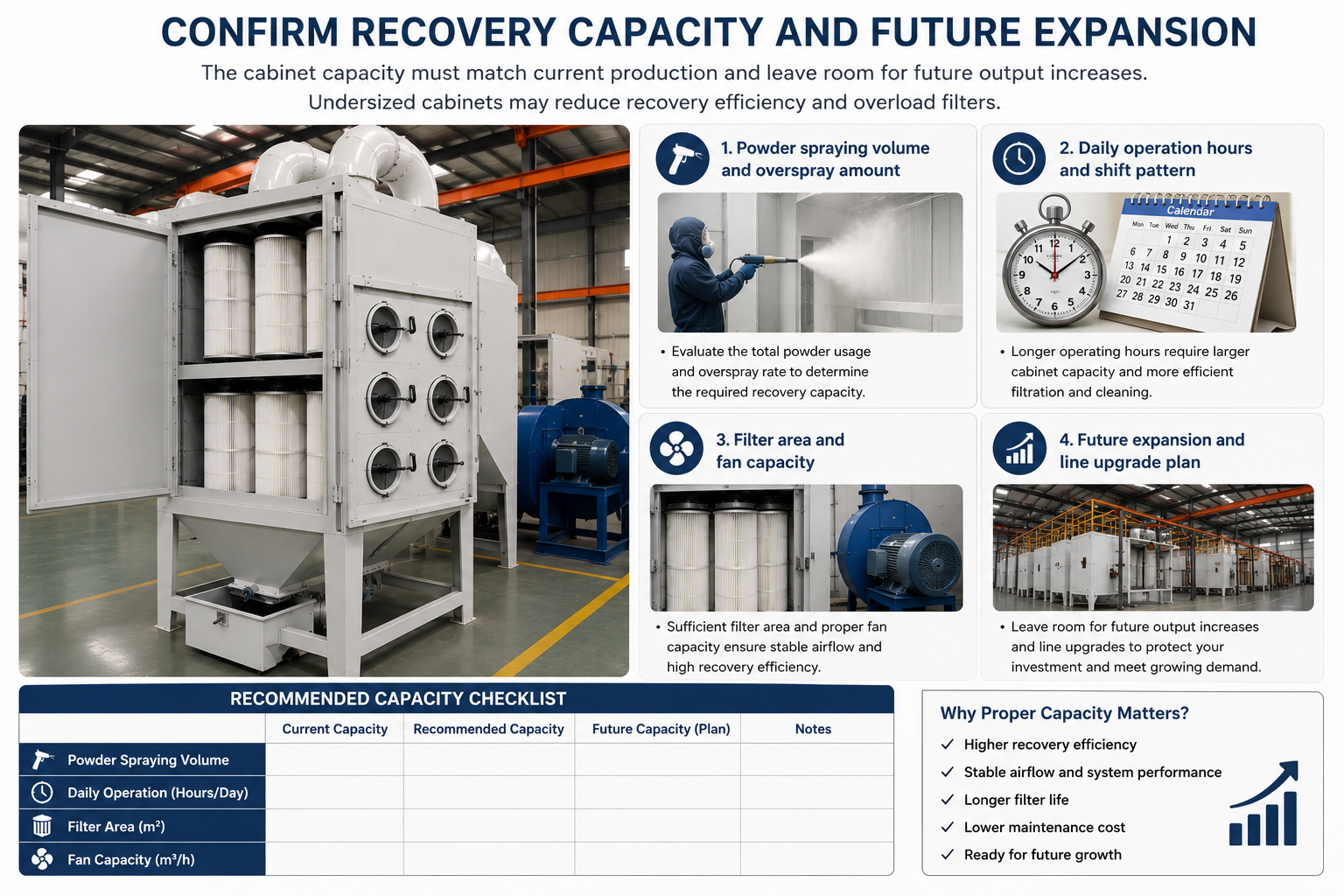
Confirm Recovery Capacity and Future Expansion
The cabinet capacity must match current production and leave room for future output increases. Undersized cabinets may reduce recovery efficiency and overload filters.
- Powder spraying volume and overspray amount
- Daily operation hours and shift pattern
- Filter area and fan capacity
- Future expansion and line upgrade plan
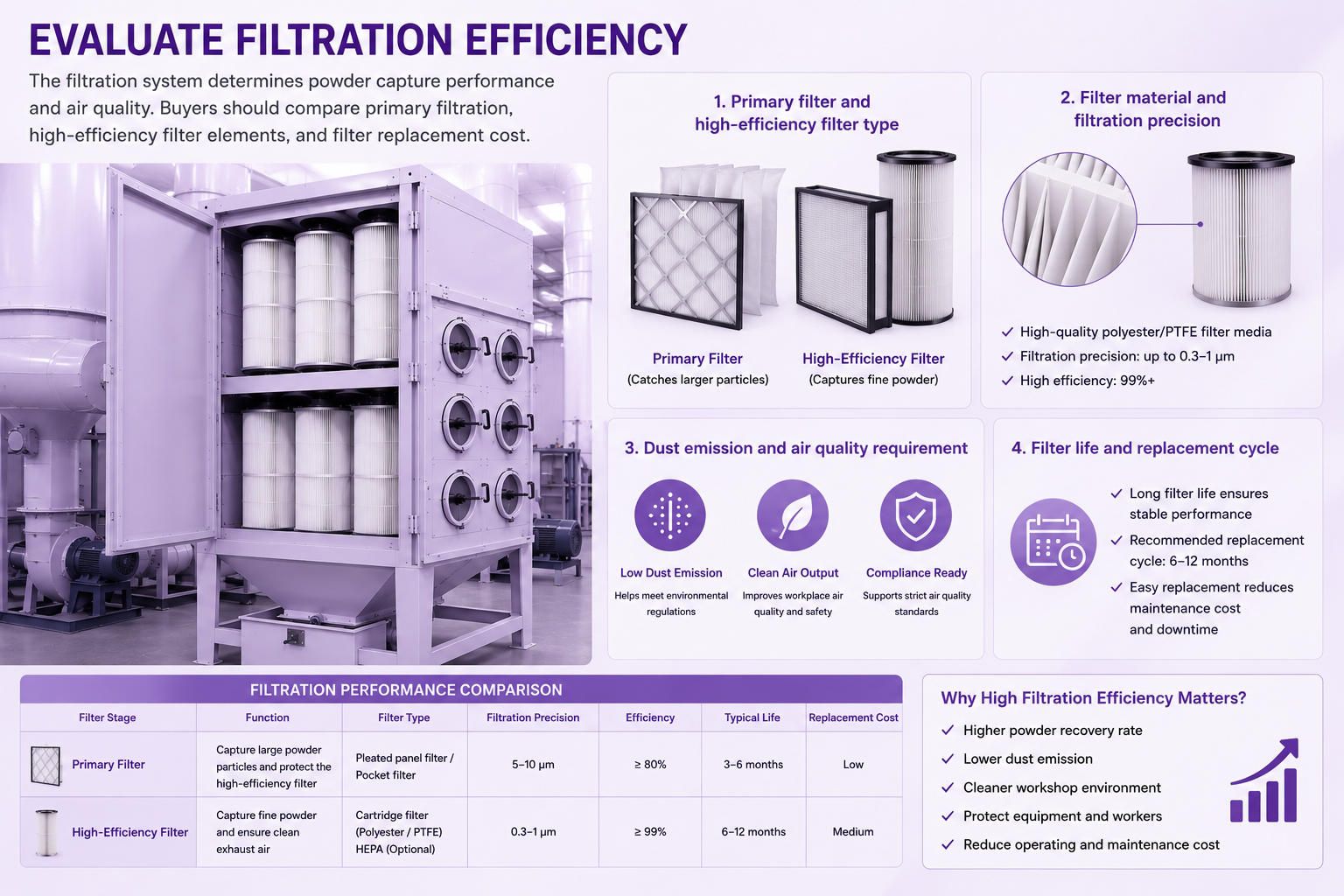
Evaluate Filtration Efficiency
The filtration system determines powder capture performance and air quality. Buyers should compare primary filtration, high-efficiency filter elements, and filter replacement cost.
- Primary filter and high-efficiency filter type
- Filter material and filtration precision
- Dust emission and air quality requirement
- Filter life and replacement cycle
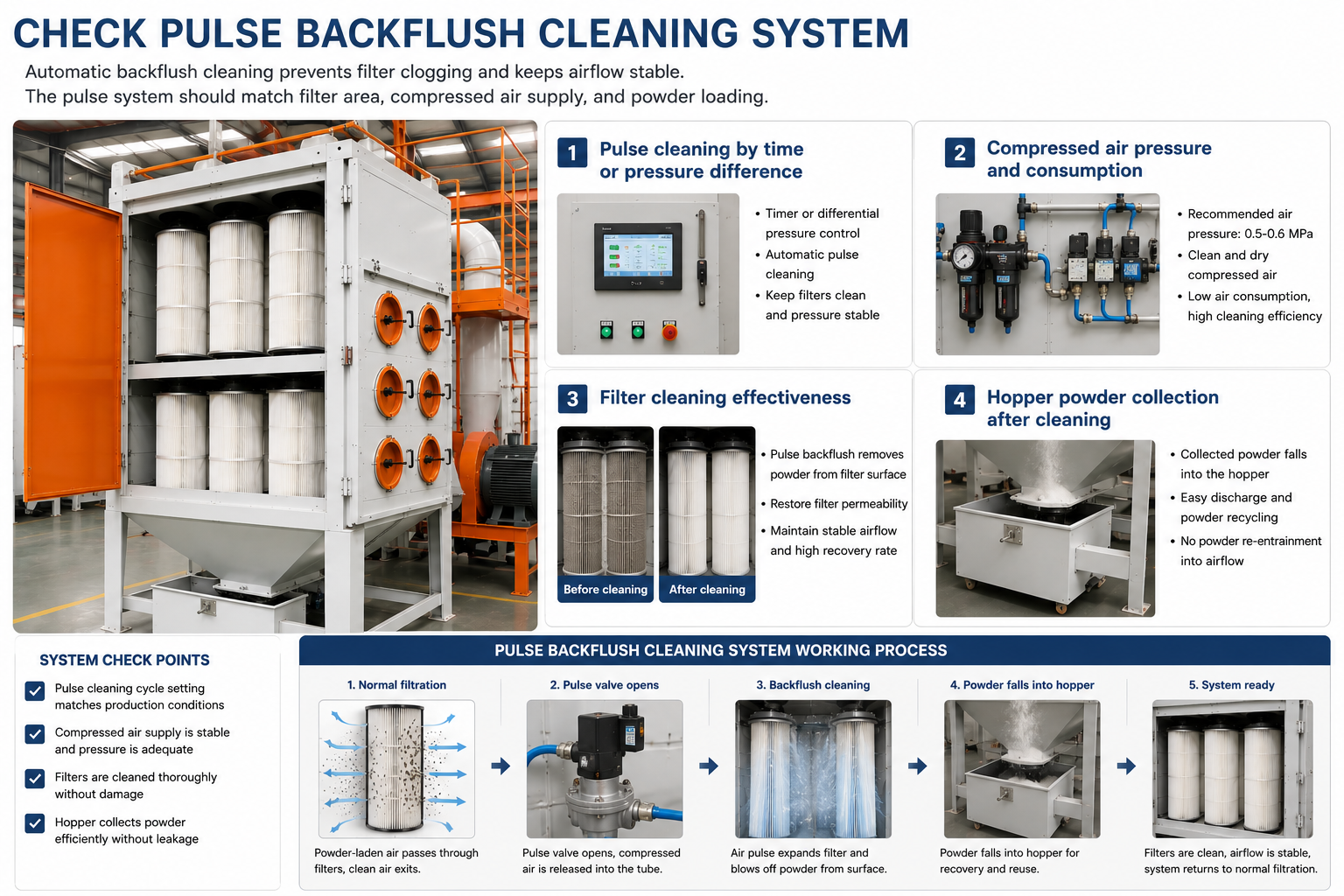
Check Pulse Backflush Cleaning System
Automatic backflush cleaning prevents filter clogging and keeps airflow stable. The pulse system should match filter area, compressed air supply, and powder loading.
- Pulse cleaning by time or pressure difference
- Compressed air pressure and consumption
- Filter cleaning effectiveness
- Hopper powder collection after cleaning
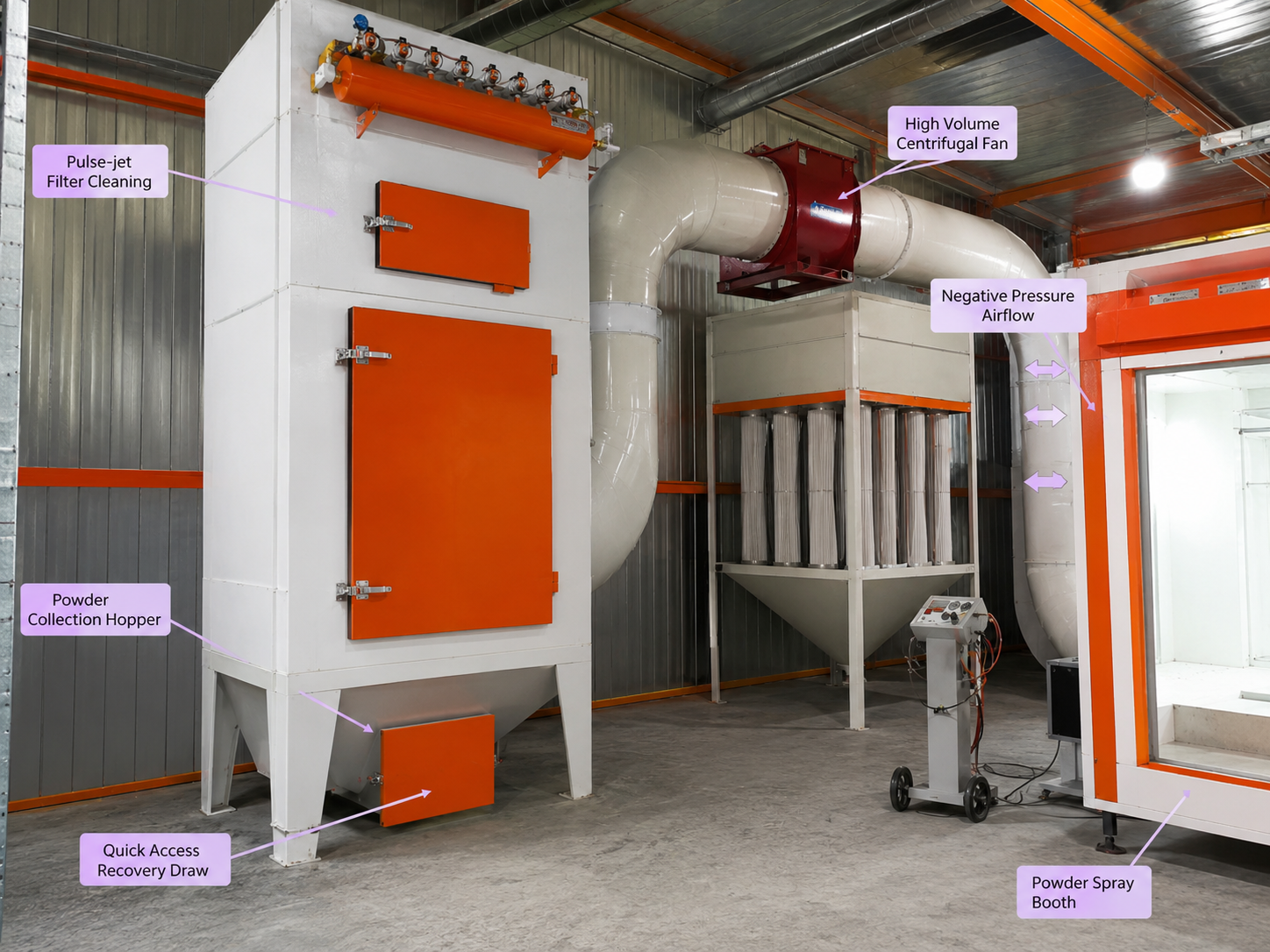
Match Fan Capacity and Exhaust Duct Design
The fan creates negative pressure and draws powder-laden air through the filters. Fan capacity and duct design must match the spray system and airflow demand.
- Air volume and negative pressure requirement
- Duct size and connection method
- Noise and energy consumption
- Airflow balance with spray booth

Confirm Compatibility With Existing Equipment
The cabinet should match your current spray booth, powder recovery route, control logic, duct location, and workshop layout.
- Spray booth and cabinet connection
- Control system compatibility
- Available installation space
- Maintenance access around the cabinet

Review Safety and Environmental Standards
Powder recovery equipment should meet electrical and mechanical safety requirements. Environmental rules should also be checked before purchase.
- Electrical safety and protection design
- Power shutdown during maintenance
- Dust control and emission compliance
- Operator safety procedure and training
Evaluate Operation and Maintenance Convenience
Easy operation and maintenance reduce downtime. Buyers should check filter access, hopper cleaning, pulse valve maintenance, and spare parts availability.
- Filter element cleaning and replacement
- Hopper and powder collection access
- Pulse valve and air pipe inspection
- Routine maintenance schedule

Compare Total Cost and Supplier Support
Do not compare only equipment price. Consider powder savings, energy consumption, filter cost, maintenance downtime, supplier quality, warranty, and after-sales support.
- Purchase and installation cost
- Powder recovery and material savings
- Filter and spare part cost
- Supplier service and technical support
Quick Buyer Comparison Table
Use this table to evaluate whether a secondary recycling cabinet matches your powder coating line requirement.

| Buying Factor | What to Check | Why It Matters |
|---|---|---|
| Recovery Capacity | Powder volume, filter area, fan capacity | Prevents overload and supports stable recovery performance |
| Filtration Efficiency | Primary filter, fine filter, filter element quality | Improves air quality and powder capture performance |
| Pulse Cleaning | Backflush control, compressed air, pressure difference | Keeps filters from clogging and reduces downtime |
| Compatibility | Spray booth connection, duct design, control system | Ensures smooth integration with existing coating line |
| Safety | Electrical protection, safe shutdown, maintenance procedure | Protects operators and reduces equipment risk |
| Maintenance | Filter access, hopper cleaning, spare parts | Reduces downtime and keeps recovery performance stable |
Need a purchasing recommendation for your secondary recycling cabinet?
Send your spray booth layout, powder volume, fan requirement, filter preference, and existing line photos. We can help you select the right secondary recycling cabinet configuration.
Get Configuration Advice
Frequently Asked Questions About Secondary Recycling Cabinet Coating Machine
These questions cover filtration, powder recovery, pulse cleaning, operation, maintenance, compatibility, environmental compliance, and purchasing decisions.
What is a powder secondary recycling cabinet?
A powder secondary recycling cabinet is a powder recovery and filtration module used in powder coating lines. It collects powder-laden air, filters powder particles, and helps reduce powder waste and dust emission.
Why is it important in a powder coating line?
It improves powder utilization, supports air quality control, reduces material waste, and helps factories meet environmental requirements. It is especially useful when the main recovery system needs additional fine filtration.
How does two-stage filtration work?
Larger powder particles are captured by the primary filtration stage. Finer particles are then captured by high-efficiency fiber filter elements. This process improves powder recovery and reduces dust discharge.
What is pulse backflush cleaning?
Pulse backflush cleaning uses compressed air to periodically blow back through the filter elements. Powder accumulated on the filter surface falls into the hopper, helping maintain airflow and filter efficiency.
Can it be connected to an existing coating line?
Yes. The cabinet can be designed to connect with existing spray booths, exhaust ducts, and recovery systems. Compatibility should be confirmed by checking airflow, duct position, control method, and installation space.
What information should I provide before quotation?
Please provide spray booth size, powder type, production output, exhaust airflow requirement, current recovery method, available installation space, compressed air condition, and photos or drawings of the existing coating line.
How often should filters be cleaned or replaced?
The cleaning and replacement cycle depends on powder volume, filter material, production hours, pulse cleaning performance, and air quality requirements. Routine inspection is needed to keep filtration stable.
What maintenance is required?
Maintenance includes checking filter elements, pulse valves, compressed air lines, hopper powder collection, exhaust fan, electrical control, cabinet sealing, and duct connections. Power must be shut down before maintenance.
Does the cabinet help with environmental compliance?
Yes. By improving powder recovery and filtration, the cabinet can reduce dust discharge and material waste. Final compliance still depends on local regulations, system design, airflow, and filtration performance.
What industries can use this cabinet?
It is suitable for powder coating of mechanical parts, chemical equipment, light industrial goods, automotive components, household appliances, hardware, furniture parts, and general metal products.
What safety points should operators follow?
Operators should follow startup and shutdown procedures, check airflow and filter status, avoid opening electrical parts during operation, and fully shut down power before maintenance or cleaning tasks.
What should I check before final purchase?
Check recovery capacity, filtration efficiency, pulse cleaning system, fan capacity, structural strength, safety standards, compatibility with existing equipment, environmental compliance, maintenance convenience, and supplier after-sales support.
Still not sure which secondary recycling cabinet is right?
Send spray booth photos, coating line layout, powder volume, and environmental requirements. Our team can help compare filter cabinet, cyclone recovery, secondary recovery, and complete powder coating line options.
Ask Our Coating Line ExpertRequest a Custom Secondary Recycling Cabinet Solution
Tell us your powder coating line layout, powder volume, fan requirement, and filtration needs. We will recommend a suitable recovery cabinet configuration.
 English
  German
  Vietnamese
  French