What is the Difference Between Painting and Powder Coating?
When we talk about surface finishing[^1] in manufacturing, two methods dominate the industry: traditional painting (liquid spray coating) and powder coating[^2] (electrostatic powder application). While they may appear similar on the surface—both apply color and protection to metal objects—the differences between them are substantial. From my perspective as someone working directly with coating line production, I've seen firsthand how these two processes deliver very different results in quality, efficiency, and long-term value.
The question "What's the difference?" is far more important than it might seem. For manufacturing companies considering which process to adopt, the answer directly impacts product quality, production costs, environmental compliance, and profitability. This article breaks down the key distinctions so you can make an informed decision for your operation.
Quick Comparison: Painting vs. Powder Coating
| Aspect | Painting (Liquid Spray) | Powder Coating |
|---|---|---|
| Material Form | Liquid mixed with solvent | Dry powder particles |
| Application Method | Atomized spray through gun | Electrostatic attraction |
| VOC Emissions | High (30-60% solvent evaporation) | Near zero (environmentally compliant) |
| Dry Time | 30-60+ minutes | 10-20 minutes (after heating) |
| Coating Thickness | Thinner, variable (25-75 microns) | Thicker, uniform (50-100+ microns) |
| Material Utilization | 40-50% typical recovery | 90%+ recovery with recycling |
| Color Variety | Extensive options readily available | Growing, but more limited for custom colors |
| Surface Finish | Smooth, glossy (traditional appearance) | Smooth, textured, or matte options |
| Adhesion | Good when properly prepared | Excellent, typically superior |
| Corrosion Resistance | Moderate to good | Excellent with proper pre-treatment |
| Durability in Outdoor Use | 3-7 years (varies by environment) | 7-15+ years (UV and weather resistant) |
| Initial Equipment Cost | Lower to moderate | Higher upfront investment |
| Operating Cost/Unit | Higher (material waste, labor) | Lower (efficiency, material recovery) |
| Maintenance Requirements | Moderate (cleaning, filter changes) | Moderate (filter changes, system checks) |
| Automation Potential | Moderate (requires skilled sprayers) | High (can be fully automated) |
| Suitable for Small Batches | Yes (easy color change) | Less flexible (requires cleaning between colors) |
| Compliance Burden | High (VOC regulations, ventilation) | Low (minimal emissions, eco-friendly) |

How Painting Works: Process, Materials, and Results
Traditional liquid spray painting has been the industry standard for decades, and it remains widely used for good reason—but understanding its mechanics helps explain why powder coating is gaining ground.
The Core Process
In painting, liquid coating is mixed with solvent. The spray gun atomizes this mixture, breaking it into fine droplets that travel through air toward the workpiece. As droplets land on the surface, the solvent begins to evaporate, and the remaining coating hardens through air-dry or forced-heat curing. This is a continuous chemical process where the liquid transitions from flowing to solid.
What You're Actually Spraying
Liquid paint typically contains:
- Resin (the binding agent)
- Pigment (color)
- Solvent (carrier—usually 40-60% of the mixture)
- Additives (for flow, adhesion, UV resistance)
The solvent is essential during application (it keeps paint sprayable) but becomes waste after the coating forms. This is a fundamental inefficiency built into the process.
Application Reality
In most painting operations, only 40-50% of sprayed material actually adheres to the workpiece. The rest escapes as overspray—lost to air, settling on surrounding equipment, or requiring capture and disposal. On a 1,000-part production run, this waste compounds significantly.
Quality Considerations
Painting can produce excellent results when executed correctly. The coating dries to a smooth, professional finish familiar to most customers. However, several factors create variability:
- Humidity and temperature affect dry time and finish quality
- Operator skill directly influences coating evenness and thickness
- Overspray accumulation in the booth degrades air quality and workpiece cleanliness
- Solvent residue can trap moisture, compromising adhesion
Timeline and Throughput
A typical painted part requires 30-60+ minutes to cure sufficiently for handling, depending on coating type and ambient conditions. This extends production cycles and ties up floor space. For high-volume manufacturing, this becomes a significant bottleneck.
How Powder Coating Works: Process, Materials, and Results
Powder coating operates on fundamentally different physics and chemistry. Instead of a liquid suspended in solvent, powder coating uses electrostatic attraction[^3] and thermal fusion—a approach that eliminates many of painting's inherent inefficiencies.
The Core Process
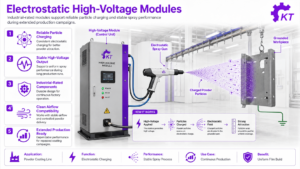
Powder particles are applied through an electrostatic gun[^4]. The gun charges the powder particles with negative voltage (typically 60-90 kV). The workpiece is grounded, creating an electric field that attracts charged powder particles to the surface. This electrostatic pull is powerful—particles actively move toward the workpiece rather than simply "landing" there. Once coated, the workpiece enters a heated curing oven where powder melts, flows, and chemically hardens through cross-linking.
What You're Actually Applying
Powder coating consists of:
- Resin (binding agent)
- Pigment (color)
- Hardener (cross-linking agent)
- Additives (flow, anti-static, UV protection)
Notice the absence of solvent. Powder coating is 100% solid material. Every particle that reaches the workpiece becomes part of the final coating.
Application Reality
With proper grounding and equipment setup, powder coating achieves 90-99% transfer efficiency. Overspray powder that doesn't reach the workpiece falls into collection systems and is recycled back into the spray gun. This dramatically reduces material waste and environmental emissions. On that same 1,000-part run, the cost difference becomes obvious.
Quality Characteristics
Powder coating produces uniformly thick, consistent coatings. Because application relies on electrical attraction rather than manual spray technique, coating thickness is more predictable. The result is:
- Superior adhesion (electrostatic pull ensures complete contact)
- Thicker protective layers (50-100+ microns vs. 25-75 for paint)
- More uniform color and appearance across complex shapes
- Better encapsulation of edges and recesses
Timeline and Throughput
Powder-coated parts complete curing in 10-20 minutes inside a heated oven (depending on oven design and part mass). This is 2-5× faster than painting. Combined with higher transfer efficiency, powder coating supports significantly higher production volumes per square foot of facility space.
Key Differences in Durability, Finish Quality, and Performance
The real value of choosing between these processes emerges over time—after parts reach the customer and enter years of real-world service.
Adhesion, Coating Thickness, and Long-term Protection
Adhesion Reality
This is where my operational experience becomes crucial. I've observed countless instances where paint adhesion fails not because the paint is poor, but because the foundation was compromised. Powder coating, by contrast, leverages physics itself—the electrostatic force presses powder particles directly onto the surface, creating mechanical interlocking that paint cannot match.
When pre-treatment (surface cleaning and preparation) is done correctly:
- Powder coating adhesion: typically 5-7 rating on adhesion test[^5] scales (nearly impossible to delaminate)
- Paint adhesion: typically 3-5 rating (vulnerable to delamination under stress, temperature cycling, or moisture)
Thickness Advantage
Powder coating naturally deposits at 50-100+ microns because powder particles accumulate in layers. Paint atomizes into ultra-fine droplets, settling at 25-75 microns—thinner by nature. Thicker coating means:
- Deeper corrosion protection (rust has farther to migrate through the layer)
- Better impact and abrasion resistance
- Longer service life in harsh environments
In cabinet manufacturing (electrical enclosures, telecom boxes), this thickness difference translates to 7-15+ year outdoor durability versus 3-7 years for painted alternatives.
Environmental Protection
In salt-spray testing[^6] (an industry standard for corrosion resistance), powder-coated steel with proper pre-treatment consistently outperforms painted steel by 2-3× in time-to-rust.
Surface Appearance and Color Consistency
Visual Uniformity
Powder coating excels at achieving consistent appearance across complex geometries. Because particles are electrostatically pulled to the surface, even internal angles, recesses, and narrow gaps receive consistent coating. Paint, sprayed by human operator or automation gun, struggles with these areas—edges often appear lighter or heavier.
For customers who inspect for color uniformity (furniture makers, appliance manufacturers, cabinet builders), powder's consistency is a competitive advantage.
Color Options and Limitations
Painting wins on this dimension. Liquid coating systems offer virtually unlimited custom colors and finishes. Powder coating offers extensive standard options but custom color runs typically require 4-6 week lead times and minimum orders. If your business model requires frequent small-batch color changes, painting remains more practical.
Finish Textures
Powder coating offers textured finishes (wrinkle, hammer-tone, matte) that are difficult to achieve with paint without specialized additives and application techniques. Modern powder formulations can also produce glossy, semi-gloss, or matte finishes comparable to paint quality.

Environmental Impact and Safety Considerations
This comparison reveals a significant divergence in regulatory burden and operational risk.
VOC Emissions and Environmental Compliance
The Emissions Gap
Painting relies on solvent evaporation—a necessary evil. As liquid coating dries, 40-60% of the mixture becomes airborne VOC (volatile organic compound)[^7] emissions. In regions with strict air quality regulations, this creates compliance liability.
Powder coating emits essentially zero VOC. No solvent, no evaporation, no airborne chemical release. This alone makes powder coating the choice in environmentally sensitive areas or where customers demand carbon-neutral production credentials.
Regulatory Pressure
Many jurisdictions now impose VOC limits on industrial painting operations, requiring:
- Advanced air capture systems (expensive capital investment)
- Cartridge filters and treatment equipment (ongoing maintenance cost)
- Emissions monitoring and reporting (administrative burden)
Powder coating installations face minimal regulatory scrutiny by comparison.
Waste Disposal
Paint overspray requires collection (wet scrubber systems or cartridge filtration) and disposal as hazardous waste. Powder overspray is dry, inert, and recyclable—returning directly to production rather than disposal fees.
Worker Safety and Dust Control
Health Exposure
Paint spray operators inhale solvent vapors continuously. Even with respiratory protection, long-term exposure carries health risks documented in occupational health literature. Powder coating operators work in a drier environment with lower chemical exposure—though powder dust inhalation remains a concern requiring proper respiratory protection and booth ventilation.
Explosion Risk
Powder in high concentrations presents dust explosion potential—a recognized industrial hazard. Proper booth design with negative pressure, grounding, and dust collection eliminates this risk. Paint, by contrast, is not explosion-hazard classified, though solvent fumes present fire risk in certain conditions.
Booth Environment
Powder coating booths are cleaner, drier work environments. Paint booths accumulate overspray residue, requiring frequent cleaning and creating a messier workspace. This matters for operator satisfaction and equipment maintenance.
Cost Analysis: Equipment Investment and Operating Expenses
The financial comparison between these processes is more complex than headline numbers suggest—and this is where I see the most confusion among manufacturing decision-makers.
Initial Setup and Infrastructure Requirements
Capital Outlay
A basic paint spray setup (spray booth, gun, compressor, ventilation):
- Budget: $30,000-$80,000 depending on size and automation level
A comparable powder coating line (spray booth, electrostatic system, curing oven, powder recovery):
- Budget: $80,000-$200,000+
Powder coating appears more expensive upfront. However, this comparison is incomplete without considering what each system can actually deliver.
Facility Requirements
Paint requires:
- Heated/cooled booth (maintain humidity within spray-able range)
- Robust air capture (wet scrubber or cartridge system)
- Solvent storage and handling (fire code compliance, special flooring)
- Exhaust ducting (to safely remove solvent-laden air)
Powder requires:
- Temperature-controlled booth (less stringent than paint)
- Powder recovery system (simple cyclone or cartridge filter)
- Electric curing oven (energy cost but minimal environmental risk)
- Compressed air quality management (dryer, filter)
Facility infrastructure for powder is typically less complex and lower cost than paint, offsetting some of the equipment premium.
Material Utilization and Waste Management
Cost Per Unit
Let's model a 1,000-unit monthly production run:
Painting scenario:
- Material cost: $5/unit (paint + solvent)
- Overspray waste: 50% (500 units worth of material lost)
- Effective material cost: $10/unit
- Disposal cost: ~$200-400/month (hazardous waste)
Powder coating scenario:
- Material cost: $3/unit (powder + hardener)
- Recovery rate: 95% (only ~50 units worth lost)
- Effective material cost: $3.15/unit
- Disposal cost: ~$0 (powder recycled)
Over 12 months and 12,000 units:
- Painting total material cost: $120,000
- Powder coating total material cost: $37,800
The material advantage for powder coating compounds dramatically with volume.
Quality and Rework
Paint coatings average 2-5% rework rate due to runs, sags, color inconsistency, or adhesion issues. Powder coating typically runs 0.5-1.5% rework (simpler process, fewer operator variables). Rework costs—stripping, respraying, inspection—add another 3-8% to true paint production cost.
Labor and Production Efficiency
Staffing Requirements
Spray painting typically demands:
- Skilled spray operators (require training, command higher wages)
- Booth maintenance personnel (managing overspray accumulation)
- Quality inspectors (high rework rates demand close oversight)
Powder coating systems, especially semi-automated or fully automated:
- Fewer operators (loading/unloading, powder monitoring)
- Lower skill barrier (electrostatic process is consistent, forgiving)
- Less intensive inspection (lower defect rates)
For a facility coating 12,000 parts monthly:
- Paint operation: 4-5 FTE minimum
- Powder operation: 2-3 FTE
Labor savings: ~$100,000-150,000 annually at typical wage rates.
Production Velocity
Paint line throughput: ~15-30 parts/hour (depending on size and complexity)
Powder coating line: ~40-80 parts/hour
Same facility footprint, 2-3× more output. This allows:
- Smaller facility footprint (rent savings)
- Faster customer delivery
- Higher capacity utilization
- Lower per-unit fixed cost allocation
Real Business Impact
A manufacturing company I worked with transitioned a 5,000 sq ft cabinet assembly operation from painting to powder coating. Results over year one:
| Metric | Before (Paint) | After (Powder) | Change |
|---|---|---|---|
| Monthly capacity | 8,000 units | 18,000 units | +125% |
| Floor space utilized | 100% | 60% | 40% freed up |
| Labor headcount | 5 FTE | 3 FTE | 2 positions eliminated |
| Material cost per unit | $8.50 | $2.80 | -67% |
| Rework rate | 4.2% | 0.8% | -81% |
| Customer complaints (finish) | 18/month | 2/month | -89% |
| 3-year ROI on equipment | N/A | 18 months | Positive |
This is not theoretical—it's operational reality from a business that made the transition thoughtfully.
Choosing the Right Process: Applications, Scenarios, and Decision Factors
No single coating method is universally superior. The right choice depends on your specific operational context.
Which Products and Industries Benefit from Each Method
Powder Coating Excels For:
-
Metal cabinetry and enclosures (electrical, telecom, industrial equipment)
- Why: High volume, standard colors, need for durability and corrosion resistance, clean appearance critical
-
Outdoor furniture (garden chairs, tables, shelving)
- Why: UV resistance, salt-spray durability, weather exposure, long product life justifies processing cost
-
Aluminum extrusions and profiles (window frames, structural components)
- Why: High throughput, consistent appearance, thickness control, architectural specifications
-
Appliance manufacturing (refrigerators, washers, ovens)
- Why: Large surfaces, high volume, perfect finish expected, consistent color critical to brand perception
-
Metal storage and shelving systems (warehouse racks, filing cabinets)
- Why: High daily usage demands durability, industrial appearance acceptable, material cost savings significant
-
Automotive components (brackets, guards, fasteners)
- Why: Precision thickness control, corrosion resistance, repeatability across millions of units
Painting Remains Optimal For:
-
Custom or artistic finishes (hand-painted details, murals, specialized effects)
- Why: Liquid paint offers creative flexibility powder cannot match
-
Small-batch, multi-color production (prototypes, limited editions, frequent color changes)
- Why: Powder requires line purging between colors; paint swaps colors easily
-
Complex geometries with recessed areas (sculptures, ornamental metalwork)
- Why: Paint can reach areas difficult for electrostatic attraction to penetrate
-
Products requiring specific gloss levels unavailable in powder (automotive clear-coats, high-gloss finishes)
- Why: Liquid coating offers more finish options
-
On-site field coating (touch-ups, repair work, installation painting)
- Why: Powder requires booth infrastructure; paint works portable
Production Volume, Batch Size, and Automation Needs
High-volume, standardized production (10,000+ units/month):
Powder coating ROI becomes compelling. Equipment cost amortizes quickly. Material and labor savings accumulate to justify the investment. Automation potential reduces per-unit cost further.
Medium volume (2,000-10,000 units/month):
This is the decision sweet spot. Powder cooking offers advantages but requires careful analysis. If your operation runs 24/5 with steady demand, powder makes sense. If you have seasonal swings or frequent product changes, paint may retain flexibility advantage.
Low volume, batch work (under 2,000 units/month):
Equipment payback stretches beyond acceptable timeframes. Painting's lower capital requirement becomes advantageous. Unless you specifically need powder's durability, paint remains practical.
Automation potential:
Powder coating naturally integrates with automation. Electrostatic application can be fully roboticized with no loss of quality. Paint spray can be automated but demands more complex programming due to pattern complexity and material waste management. If you envision future automation, powder is the scalable choice.
Switching from Painting to Powder Coating: Feasibility and Considerations
Many established manufacturers ask: "Can we convert our paint line to powder?"
The short answer: partially, but it's rarely a simple retrofit.
What transfers:
- Conveyor systems (transport line can often remain)
- Curing ovens (electric ovens work for powder; some gas ovens can adapt)
- Some booth infrastructure (spray chamber can be modified)
- Facility space layout
What requires replacement:
- Spray guns and powder supply equipment (fundamentally different technology)
- Air handling (powder requires different filtration than paint)
- Pre-treatment systems (paint and powder have different surface prep needs)
- Control systems (electrical and timing sequences differ)
Realistic conversion cost:
Roughly 60-70% of a new installation cost. You're not building from scratch but retrofitting is substantial.
Transition timeline:
- Planning and design: 4-8 weeks
- Equipment manufacturing: 8-12 weeks
- Installation: 3-4 weeks
- Testing and optimization: 2-4 weeks
- Full ramp-up: 4-8 weeks
Total project window: 4-6 months (realistic 5-7 months accounting for delays).
Risk management during transition:
- Plan the changeover during a planned facility shutdown if possible
- Run parallel systems temporarily (keep paint line operational while powder line comes online)
- Staff up operator training in advance
- Expect 10-20% scrap rate during first 2-3 weeks while operators and systems stabilize
When NOT to convert:
- Frequent custom colors (unless you can batch production)
- Small parts below powder system's minimum capacity
- Products requiring liquid paint's specific properties
- If your facility has <2,000 sq ft (space constraints make powder line layout difficult)
When conversion makes sense:
- Current paint operation running near capacity
- High customer demand for improved durability
- Environmental regulations tightening
- Labor shortage making skilled spray operators unavailable
- Long-term demand visibility (5+ years) supports payback
Conclusion
The difference between painting and powder coating extends far beyond surface appearance. These are fundamentally different technologies with distinct advantages, constraints, and total-cost-of-ownership implications.
Painting remains the right choice if you prioritize flexibility, require artistic customization, operate at low volumes, or need on-site portability. It's a mature, familiar technology with well-established supply chains and operator skill availability.
Powder coating emerges as the strategic choice if you operate at scale, demand superior durability, need environmental compliance, want to reduce operational costs, or plan to invest in automation. The higher upfront investment pays dividends through material efficiency, labor reduction, quality consistency, and production velocity.
From my experience as someone who has worked directly with both technologies at the equipment manufacturing level, the companies making the right choice aren't debating which is "better"—they're matching their choice to their business model. Cabinet makers with standard product lines and 5,000+ monthly units convert to powder and never look back. Custom finishers and low-volume prototypers stick with paint because it serves their model better.
The real opportunity isn't in choosing one over the other universally—it's in assessing your specific operation against these criteria and committing to the process that optimizes your true cost structure and customer delivery model.
If you're currently running a paint operation and believe powder coating might unlock capacity or cost advantages for your manufacturing business, we recommend conducting a facility assessment and running a small pilot before committing to a full conversion. The data will guide you better than any general recommendation.
For manufacturers serious about evaluating powder coating infrastructure and system design, we're available to discuss your production requirements, volume targets, facility constraints, and long-term business objectives. We work with companies at every scale—from exploring feasibility to designing and implementing complete turnkey solutions.
Contact us directly:
ketucoatingline@gmail.com
WhatsApp: +8618925987762
We'd be happy to explore what a powder coating solution could deliver for your operation.
[^1]: Explains manufacturing processes that improve metal surfaces through coating, finishing, or protective treatments.
[^2]: Describes the electrostatic process of applying dry powder particles to create protective finishes on metal components.
[^3]: Covers the electrical forces that attract oppositely charged particles, fundamental to powder coating application technology.
[^4]: Details equipment that uses electric fields to apply charged powder coatings uniformly to workpieces.
[^5]: Describes testing methods for measuring how well coatings bond to substrate materials.
[^6]: Explains the standardized corrosion resistance test using salt-laden atmospheres to evaluate coating durability.
[^7]: Defines organic compounds that evaporate at room temperature, creating air quality and environmental concerns in painting.
 English
  German
  Vietnamese
  French