
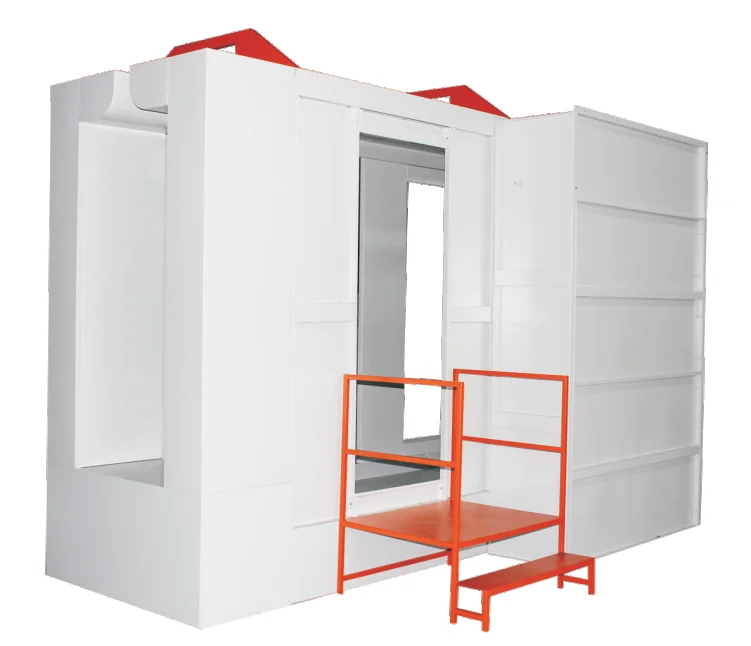
Spray Gun Atomization Technology: Current Solutions and Development Trends
What is spray gun atomization and why does it matter?
Spray gun atomization[^1] is the process of breaking down powder coating into fine, evenly distributed particles that can be electrostatically charged and precisely applied to workpiece surfaces. In electrostatic powder coating[^2]—one of the most efficient surface treatment methods in modern manufacturing—atomization quality determines whether you achieve uniform film thickness, excellent adhesion, and cost-effective powder utilization.
I've worked with hundreds of manufacturing plants across industries like cabinet production, aluminum extrusion, furniture manufacturing, and metal fabrication. What I've consistently observed is that companies often struggle with coating defects—uneven thickness, poor adhesion, edge accumulation, and excessive powder waste—when the root cause isn't actually the spray gun itself, but rather poor atomization control paired with inadequate upstream conditions like weak grounding, contaminated compressed air, or insufficient pre-treatment. This is why understanding atomization technology has become critical for achieving production stability and cost control.
Atomization isn't a standalone technical achievement—it's the foundation of an entire system. When atomization is optimized correctly, everything downstream improves: higher transfer efficiency, lower powder consumption, better final coating quality, and easier compliance with environmental standards.
How do mainstream spray gun atomization technologies work?
Electrostatic spray guns: principle and application scope
Electrostatic spray guns[^3], commonly called corona-type or high-voltage guns, work by charging powder particles to approximately 60–90 kV (kilovolts) as they pass through the spray head. The workpiece, which must be reliably grounded, creates an electric field that attracts the charged particles toward its surface with strong force.
The atomization mechanism relies on a corona electrode inside the spray gun that generates a high-voltage electric discharge. As powder flows past this electrode, particles acquire an electrostatic charge. The charged powder then exits the nozzle in a fine mist. The electric field between the charged particles and the grounded workpiece acts as an invisible "magnet," pulling the powder onto the surface regardless of spray angle or distance—to a certain degree.
Strengths of electrostatic spray guns:
- High transfer efficiency (typically 85–95%), meaning more powder lands on the workpiece and less is wasted
- Faster deposition speed, allowing shorter cycle times for automated lines
- Excellent uniformity on flat and moderately curved surfaces
- Lower powder consumption translates directly to reduced material costs
- Widely standardized; compatible with most modern powder formulations
Typical application scope:
We see electrostatic guns working best on cabinet bodies, steel sheet metal parts, flat aluminum profiles, and medium-complexity stampings. They're the industry standard for high-volume production in cabinet manufacturing, shelving systems, and appliance component coating.
Friction spray guns: advantages and typical use cases
Friction spray guns[^4] (also called mechanical guns) atomize powder through mechanical friction rather than electrostatic charge. The powder is fed against a rotating bell or disk that imparts a charge through friction between particles and the bell surface, or through mechanical shearing.
How it works:
Powder is fed into the spray head where it contacts a rotating atomizer—typically a bell or cup spinning at high speed. This mechanical action charges the particles and propels them toward the workpiece. Some designs incorporate additional air streams to help separate and accelerate the powder cloud.
Key advantages:
- Superior penetration into complex geometries, deep recesses, and enclosed structures (less susceptible to Faraday cage effect)
- Ability to handle a wider range of powder types, including specialty formulations
- Better performance on non-conductive or poorly grounded parts
- Consistent spray pattern less dependent on workpiece distance
- Effective for recirculated/recovered powder that may have lost charge
Typical applications:
Friction guns excel in furniture manufacturing (especially curved frames and intricate designs), complex automotive components, aluminum profiles with inner surfaces, electrical enclosures with shields and internal cavities, and any scenario where workpieces have deep internal geometry that electrostatic field cannot easily reach.
Comparison of electrostatic vs. friction spray guns
| Dimension | Electrostatic Spray Gun | Friction Spray Gun |
|---|---|---|
| Operating Principle | High-voltage charge creates electric field attraction | Mechanical friction charges particles; motion-based propulsion |
| Transfer Efficiency | 85–95% (very high) | 75–85% (good, but typically lower) |
| Powder Waste | Low | Moderate; higher overspray on complex parts |
| Geometry Coverage | Excellent on simple/flat surfaces; struggles with deep recesses and internal cavities | Excellent on complex geometries; no dead zones from Faraday effect |
| Distance Dependency | More sensitive to spray distance changes; optimal range narrower | Less sensitive; more forgiving distance tolerance |
| Powder Type Flexibility | Works best with standard formulations; sensitive to conductivity | Handles broader range of formulations and recovered powder |
| Grounding Requirements | CRITICAL—poor grounding causes dramatic efficiency loss | Less critical; mechanical charging works even on marginal grounding |
| Maintenance | Regular electrode cleaning required; corona wear is common | More moving parts; bell/disk wear management needed |
| Cost | Lower capital cost typically | Higher capital cost |
| Energy Consumption | Moderate (HV generation uses energy) | Can be higher (motor-driven atomizer) |
| Application Speed | Fast | Moderate to fast |
From my field experience: Most factories don't need to choose one exclusively. The best automated lines I've designed actually use both technologies in tandem: electrostatic guns for primary coating on flat/standard surfaces (to maximize efficiency), combined with friction guns positioned to hit internal cavities, edges, or complex undercuts. This hybrid approach captures the efficiency advantage of electrostatic while eliminating the Faraday cage blind spots.
 )
)
What factors affect spray gun atomization quality and coating performance?
Impact of spray gun parameters (voltage, current, distance, powder feed rate)
Spray gun atomization quality isn't determined by any single parameter—it's a coordinated system. I've seen perfectly capable spray guns produce poor results because operators or engineers didn't understand how these four parameters interact.
Voltage (typical range: 60–90 kV):
Voltage is the driving force of electrostatic attraction. Too low, and particles won't be attracted strongly enough to the workpiece; they'll drift away or bounce off. Too high, and you risk two problems: strike-through (electrical arcing that creates pinholes in the coating) and excessive edge accumulation (particles cluster too aggressively at corners and edges).
In my experience, there's no universal "best" voltage. A cabinet body might perform optimally at 75 kV, but a thin aluminum sheet at the same voltage might suffer from edge buildup. The right voltage depends on workpiece material conductivity, coating film thickness target, and powder conductivity. Most automated lines we design include voltage adjustment capability so operators can fine-tune for each product family.
Current (typical range: 10–20 μA, microamperes):
Current represents the intensity of charge transfer. Higher current = more charge on particles = stronger pull to the workpiece, but also higher risk of back-ionization and powder cloud instability. I've observed that excessive current often causes the powder cloud to collapse prematurely, resulting in uneven coating near the workpiece surface.
In field troubleshooting, I often recommend checking current stability first before adjusting voltage. A fluctuating current (common when air pressure is unstable or electrode is slightly dirty) causes inconsistent film thickness across the spray pattern.
Distance (typical optimal range: 150–300 mm, varies):
Distance between spray gun nozzle and workpiece affects both atomization pattern and transfer efficiency. The electric field strength diminishes with distance.
- Too close (< 150 mm typically): Powder cloud is too dense; particles haven't fully separated; high risk of edge accumulation and film thickness unevenness; potential for strike-through
- Too far (> 300 mm typically): Electric field weakens; particles lose charge and drift; transfer efficiency drops sharply; excessive powder waste; film becomes thinner
For automated spray lines, maintaining consistent distance is critical. We invest in precision reciprocator guides and encoder-controlled gun positioning specifically to hold distance within ±10 mm, because even 20 mm variation can shift film thickness by 10–15 microns.
Powder feed rate (supply pressure and volume control):
Feed rate controls the density of powder particles in the spray cloud. Too little powder, and you have excess air in the atomized cloud—poor efficiency, thin coatings, and visual defects. Too much powder, and the particles clump; the electric field becomes overwhelmed; coating becomes uneven.
We've designed multiple projects where the customer complained of "inconsistent spray quality" but the actual problem was an undersized air compressor or a worn-out powder pump creating erratic supply pressure. Stabilizing feed rate through proper air filtration, drying, and pneumatic circuit design often resolves 40–50% of field atomization complaints.
Influence of workpiece geometry, grounding, and air source quality
Workpiece geometry:
Complex shapes introduce the Faraday cage effect[^5]—interior cavities, deep recesses, and enclosed structures create "dead zones" where the electric field cannot effectively penetrate. The powder particles simply don't receive sufficient directional force to enter these regions.
This is where empirical design matters. On a recent cabinet project for an electrical equipment manufacturer, we encountered this exact problem: the interior of electrical cabinets wasn't receiving adequate coating coverage. Our solution wasn't to add more spray guns blindly—it was to:
- Lower voltage slightly (reducing the "pull" to exterior surfaces, allowing some powder to drift into cavities)
- Reduce spray gun distance for cavity-facing positions (strengthening local field)
- Combine electrostatic guns with friction guns positioned specifically at cavity entrances
- Adjust reciprocator trajectory to angle spray guns toward internal surfaces
Result: coverage improved from 70% to 95% in difficult zones, without increasing total powder consumption.
Grounding quality:
This is non-negotiable. I've repeatedly found that when a customer reports "powder not sticking uniformly" or "50% efficiency loss," the first thing I check is workpiece grounding.
- Poor contact between workpiece and grounding point → electrical resistance increases → voltage drop across the workpiece is reduced → electric field weakens
- Loose grounding clips → intermittent contact → inconsistent atomization cycle-to-cycle
- Oxide layer on grounding contact points → resistance spike → field collapses
In our automated lines, we always specify multiple contact points, copper grounding brushes (not just clips), and regular cleaning schedules. I've seen facilities that added dedicated grounding verification sensors—essentially measuring grounding resistance every cycle—and eliminated 30–40% of coating defects overnight.
Compressed air quality:
Powder atomization depends on dry, clean, oil-free air[^6]. Here's why:
- Water contamination: Powder absorbs moisture; particles clump; spray pattern becomes chaotic; atomization breaks down
- Oil carryover: Oil droplets in the air combine with powder; surface becomes greasy; adhesion fails
- Particles/dust: Foreign particles interfere with powder flow; jams spray gun passages; erratic atomization
I've lost count of how many "spray gun failures" were actually air quality issues. One major aluminum profile manufacturer we worked with had chronic coating defects until we installed a three-stage air treatment system: coalescing filter + refrigerated dryer + activated charcoal filter. Within two weeks, their reject rate dropped from 8% to 1.2%.
Role of powder recovery efficiency and circulation system design
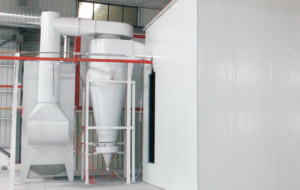
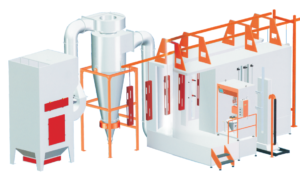
In modern electrostatic lines, most spray booths include powder recovery systems—typically cyclone separators or cartridge filter systems that capture overspray powder and recirculate it back to the supply system. Recovery efficiency directly impacts atomization quality of the second cycle.
Why this matters:
When powder is recovered and recirculated, it mixes with fresh powder. If recovery is incomplete:
- Recirculated powder often has lower charge-holding capacity (particles have lost some surface conductivity)
- Contamination accumulates (booth dust, oxidized particles, humidity-compromised powder)
- The mixed powder becomes unpredictable; atomization becomes less uniform
We design recovery systems with these principles:
- High-efficiency cyclone design: Achieve >95% separation rate so minimal fines escape; ensure separated powder falls cleanly into hopper
- Screening and de-lumping before re-entry: Use vibrating screens or pneumatic de-lumpers to break up any caked powder before it re-enters supply circuit
- Powder residence time management: Fresh powder blends with recirculated powder in a controlled staging hopper, not directly in the active supply
- Humidity control in recovery circuit: The recovery hopper sits in a booth; ambient humidity rises as air is drawn through. We always spec partial air conditioning or desiccant control around recovery areas
A well-designed recovery system can maintain atomization consistency even with 30–40% recirculated content, provided the initial separation and screening are robust.
 )
)
What are the key challenges in current spray gun atomization technology?
Faraday cage effect on complex geometries
The Faraday cage effect is perhaps the most fundamental limitation of electrostatic spray technology—and it's pure physics, not a "bug" to be fully fixed.
When a workpiece has internal cavities or deeply enclosed structures, electric field lines cannot penetrate effectively. The field exists primarily on external surfaces. Internal surfaces experience greatly reduced field strength, so powder particles lose attractive force and cannot deposit uniformly into these zones.
Real-world impact:
In electrical cabinet manufacturing, the interior of a cabinet—where most of the expensive electronics will live—often receives only 40–70% coating coverage compared to exterior surfaces. This creates corrosion risk for internal components and warranty issues.
Current mitigation strategies we employ:
- Voltage optimization: Lower voltage = weaker attraction to external surfaces = more powder drifting deeper into cavities. Trade-off: efficiency on flat surfaces drops slightly.
- Gun repositioning: Dual-gun spray heads positioned to aim into cavities; friction guns positioned at apertures
- Fixture design: Orient workpieces to expose maximum internal surface area to spray cloud during spray cycle
- Pre-spray or secondary stage: Some designs use a lower-intensity "prescan" pass to coat internal surfaces, followed by standard pass for external coverage
None of these fully eliminates Faraday cage—they're mitigation strategies. The reality is that fully enclosed cavities simply cannot be coated evenly with electrostatic guns alone.
Common defects: film thickness unevenness, powder rebound, edge accumulation
These three defects account for 60–70% of coating quality complaints I encounter:
Film thickness unevenness:
Root causes typically include:
- Inconsistent spray gun distance (±20 mm variation = ±15 micron thickness variation)
- Unstable powder feed pressure
- Uneven workpiece grounding (some contact points loose)
- Incorrect reciprocator speed on automated lines
Prevention: Precision distance maintenance, air pressure regulation with +/- 0.1 bar tolerance, grounding verification systems, encoder-controlled reciprocator timing.
Powder rebound (low transfer efficiency):
Powder particles that are charged too strongly or encounter too-high voltage can literally bounce off the workpiece surface. If the electrostatic attraction is excessive, particles may not decelerate gently—they hit the surface, rebound elastically, and escape the coating zone.
This typically appears as:
- Thin, inconsistent coating
- High powder consumption (50%+ overspray)
- Visible "blown off" areas near edges
Fix: Reduce voltage incrementally until transfer efficiency stabilizes; improve workpiece grounding; increase spray distance slightly to allow particles more deceleration space.
Edge accumulation:
Edges and corners create localized field distortions. Powder particles experience enhanced attraction at edges because field lines concentrate there. Result: edges receive 2–3× more coating than flat surfaces, creating visible "beads" and uneven color.
Prevention:
- Lower voltage to reduce edge pull
- Add secondary friction guns at edges with reduced intensity
- Angle electrostatic guns slightly away from sharp edges
- Design fixtures to shield sharp edges during initial spray phase
Balance between atomization precision and powder utilization
There's an inherent tension here: maximum precision (perfect film thickness uniformity) often requires lower transfer efficiency (more powder waste), while maximum efficiency often tolerates less precision.
The tradeoff:
- High precision focus: Lower powder feed rate, higher voltage for tighter control, closer spray distance → Transfer efficiency can drop to 75–80%; powder waste increases 20–25%
- High efficiency focus: Higher powder feed rate, moderate voltage, broader spray distance → Transfer efficiency reaches 92–95%; but film thickness variance increases ±20–30%
For cabinet production, we typically optimize toward precision (target ±10 micron thickness variance) because customer inspection specs demand it; powder waste is accepted as cost of quality. For some commodity products, efficiency wins and precision tolerance widens.
The best modern spray systems include closed-loop feedback—sensors measure film thickness and transfer efficiency in real-time, and PLC adjusts voltage/distance/feed dynamically to find the optimal balance specific to that production run.
 )
)
How is spray gun atomization technology advancing toward automation and precision?
Integration with automated spray lines and trajectory optimization
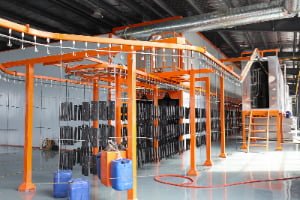
Modern automated spray lines don't simply mount a spray gun in a fixed position. They embed multiple layers of precision:
Reciprocator systems with encoder control:
A reciprocator[^7] is an electromechanical device that moves the spray gun(s) in a programmed path—typically vertical oscillation or multi-axis trajectories. Precision reciprocators use servo motors and encoders to repeat trajectories within ±2–5 mm accuracy, cycle after cycle. This ensures every workpiece receives identical spray pattern and coverage.
I've designed lines where the reciprocator trajectory is optimized using computer modeling—we simulate spray particle trajectories and electric field distribution on the actual workpiece geometry, then program the gun path to maximize coverage and uniformity. For complex parts with cavities and protrusions, this is far superior to manual operator spray technique.
Dual-gun and multi-gun configurations:
Automated lines increasingly use two or more spray guns working in synchronized patterns—perhaps one at +45° angle, one at -45°, one direct-facing—each with independent voltage/current controls. This overlapping coverage dramatically improves evenness on complex shapes.
Some lines now include friction guns as secondary "fill" guns positioned specifically at cavity entrances, running at lower intensity after the primary electrostatic pass. This hybrid approach captures efficiency and coverage simultaneously.
Trajectory-based compensation for geometry:
Advanced systems now include workpiece shape recognition (vision-based or preset fixture data) that automatically adjusts gun path and parameters for that specific part geometry. A cabinet body might follow one trajectory; an L-channel profile a different trajectory; internal cavities trigger a secondary friction gun pass.
Digital control systems and parameter repeatability
This is where modern spray technology diverges dramatically from legacy systems.
Programmable Logic Controllers (PLCs) managing spray parameters:
Every spray gun I've specified for a new line over the past 8 years includes digital parameter control—voltage setpoint, current limit, air pressure regulation, powder feed rate, all tied to the facility's production planning system. An operator (or better, an automated production scheduler) selects the product variant, and the spray system reconfigures automatically.
Benefits:
- Voltage/current/pressure held within ±2% tolerance (manual adjustment typically ±5%)
- Exact repeatability across production runs and across multiple identical spray guns
- Audit trail: system logs every parameter change, every shift, every product batch
- No operator drift or "trial and adjustment" that wastes time and powder
Real-time monitoring dashboards:
We've implemented systems that display live spray parameters on the booth control panel and on a central production dashboard. Operators can see instantly if voltage is sagging, if air pressure is drifting, if powder feed is unstable. Predictive alerts trigger maintenance before defects appear.
One aluminum profile manufacturer we equipped this way reduced coating defects from 5.2% to 1.1% in the first six weeks simply by giving operators real-time visibility into spray health.
Historical data capture for root cause analysis:
Modern spray systems log atomization parameters every second during production. When a quality issue occurs, engineers can replay the exact sequence of events—voltage, current, pressure, distance, feed rate—from the minute the bad part entered the spray zone. This forensic capability has eliminated weeks of guesswork in troubleshooting.
Real-time monitoring and adaptive adjustment
Closed-loop film thickness feedback:
Some advanced lines now include non-contact thickness measurement sensors (often infrared-based, measuring surface temperature after spraying, which correlates to powder density) positioned downstream of the spray zone. These sensors report thickness in real-time and feed back to the spray controller.
The spray system can then adjust voltage or feed rate incrementally to correct drift. This is no longer theoretical—several automotive component suppliers and aluminum extrusion plants are running this now. Result: thickness variance drops from ±25 microns to ±8 microns, dramatically reducing rework.
Transfer efficiency monitoring:
Some booths now weigh the powder entering the supply system and compare it to the mass of powder recovered post-spray. The efficiency calculation triggers automatic parameter adjustment if efficiency falls below target threshold.
Predictive maintenance flags:
Spray gun electrodes wear over time; electrode degradation causes voltage instability and atomization deterioration. Rather than waiting for catastrophic failure, modern systems track voltage stability trends and flag "electrode service due" alerts when drift patterns indicate imminent failure. This prevents unplanned downtime.
 )
)
What role do environmental and efficiency requirements play in shaping atomization technology?
Shift from high voltage pursuit to powder transfer efficiency focus
Ten years ago, spray gun marketing focused heavily on "highest voltage capability" as a proxy for performance. The logic was: higher voltage = stronger atomization = better coverage.
This was always incomplete thinking. The industry has shifted—and I believe correctly—toward transfer efficiency as the primary performance metric. Here's why:
The economics of powder waste:
Modern powder coatings cost $8–15 per kilogram. On a 200-unit-per-day production line, the difference between 88% and 92% transfer efficiency equals roughly $40–60 daily powder waste—$10,000–15,000 annually. Over a 5-year spray line lifecycle, that's $50,000–75,000 in pure material cost difference. For a capital equipment investment of $150,000–200,000, this is material.
Environmental compliance:
Many jurisdictions now have strict limits on airborne powder emissions (often expressed as mg/m³ or % dust escape). Higher transfer efficiency = less overspray = less powder in the exhaust stream = easier compliance. Some regions now legally require ≥90% transfer efficiency. Spray gun atomization technology is being shaped by these regulations.
The practical shift:
Modern spray guns are optimized for:
- Consistent transfer efficiency across a defined working range (e.g., 88–94% from 150–250 mm distance) rather than "maximum possible voltage"
- Stable performance with recovered/recirculated powder, recognizing that real-world production relies on powder circulation
- Predictable behavior across voltage range, so operators can dial in the right balance without surprise efficiency collapse
Manufacturers like Nordson, ITW, and others have responded by designing guns with better electrode geometry, improved charge distribution, and more forgiving distance/voltage maps. The result: operators have wider operational windows and more consistent results.
Energy optimization and waste reduction strategies
Efficient voltage generation:
Modern spray guns use switched-mode power supplies instead of older transformer-rectifier designs. Switched-mode supplies waste less heat, achieve tighter voltage regulation, and consume 15–20% less electrical energy. This sounds minor until you multiply across thousands of spray guns worldwide.
Reduced air consumption:
Friction guns historically consumed substantial compressed air (40–60 CFM per gun). Newer designs have reduced this to 20–30 CFM through more efficient atomizer designs. On a facility with 10 guns running 16 hours daily, this can reduce air compressor demand enough to eliminate the need for an additional compressor unit—capital and energy savings.
Integrated powder supply optimization:
We now design powder supply systems with variable-displacement powder pumps that modulate supply rate based on demand, rather than running at constant output. This reduces excess powder circulation, which reduces friction heat in supply lines and powder degradation.
Heat recovery from overspray powder:
Some advanced booths capture overspray powder in collection hoppers, which generates frictional heat. Instead of venting this heat, collection hoppers are now designed with air-to-air heat exchangers that precondition incoming spray booth makeup air. Not revolutionary, but it recovers 5–10% of thermal energy.
Compliance with environmental standards
VOC and dust emission standards:
Environmental regulations in EU, North America, and increasingly in Asia now strictly limit both volatile organic compounds (eliminated by powder coating vs. liquid paint) and particulate matter. Modern spray atomization technology supports this through:
- Higher transfer efficiency (less powder escape)
- Cartridge filter designs with staged filtration (10 micron, 3 micron, sub-micron stages)
- Booth air velocities optimized to capture overspray without excessive fan energy
- Electrostatic precipitators[^8] in exhaust streams (emerging technology) to capture charged particles before atmospheric release
RoHS/REACH compliance:
Spray gun materials—electrodes, nozzles, contact points—have shifted to eliminate lead, cadmium, and restricted substances. This doesn't directly affect atomization performance, but it shapes material selection and manufacturing processes.
Noise reduction:
Friction gun atomizers are inherently noisier than electrostatic (spinning motor). Modern friction designs now use sound-absorbing shrouds and bearings optimized for low-noise operation, addressing workplace safety regulations that increasingly limit occupational noise exposure.
What are the future development directions for spray gun atomization technology?
Industry-specific customization (automotive, furniture, architecture, aluminum profiles)
The next phase of spray gun evolution isn't "one universal design"—it's industry-tailored solutions.
Automotive:
Automotive coating has unique requirements: extremely tight film thickness tolerance (±5 microns), zero defects (optical inspection is standard), and massive production volume (100+ parts/hour). Future automotive spray guns will be:
- Integrated with real-time thickness feedback and AI-based parameter optimization
- Capable of dynamic voltage modulation during a single spray cycle (lower voltage at edges to prevent accumulation, higher at flat surfaces for efficiency)
- Equipped with automatic fault detection (electrode wear, nozzle degradation) with self-alerting
Furniture and architectural:
Furniture and architectural products tolerate slightly wider thickness variance (±15 microns) but demand superior surface finish appearance. Future guns will:
- Include integrated air quality management (ensuring consistently dry, clean air directly at the gun)
- Offer easy modular electrode/nozzle swapping for rapid color changes (currently 15–30 min; target: 5 min)
- Support friction and electrostatic hybrid nozzles on the same gun body for a single unit to handle complex geometries
Aluminum profiles:
Aluminum extrusion presents the hardest atomization challenge: very long, thin workpieces with complex internal cavities (channels, slots). Future systems will:
- Use AI-trained trajectory optimization based on 3D scans of the profile geometry
- Employ dynamic spray gun arrays (5–7 guns per profile, each with independent trajectory control)
- Integrate real-time thickness mapping (laser/infrared scanning along the full profile length)
Advanced matching between spray guns and powder formulations
Currently, spray gun selection is somewhat decoupled from powder chemistry. A cabinet shop might use the same gun for epoxy powders, polyester powders, and specialty low-gloss formulations—just adjusting parameters.
Future development will see tighter integration:
Powder-specific gun designs:
Certain specialized powders (ultra-low-conductivity formulations for specialty markets, high-flow powders with different particle size distributions) will have optimized gun designs. The electrode geometry, nozzle bore, and airflow patterns will be matched to that powder's charging characteristics.
Dynamic parameter recommendations:
As powder formulations become more complex (functional powders with special additives, sustainability-focused bio-based powders), spray systems will include embedded databases that automatically configure parameters based on powder SKU scanned at line startup.
Compatibility testing automation:
Future booths might include a small-scale spray test station that quickly validates powder atomization quality before committing to full-line production. Samples are tested, atomization analyzed, and parameters automatically adjusted.
Intelligent system integration and predictive maintenance
AI-powered spray control:
Machine learning models trained on millions of spray cycles across different products, powders, and equipment will enable spray systems to predict optimal parameters for a new product variant in seconds, rather than requiring manual trial-and-error adjustment.
Integrated booth health management:
Beyond individual spray gun monitoring, future systems will holistically manage booth health—air pressure, humidity, temperature, booth cleanliness, electrode wear across all guns, powder inventory quality, filter saturation—and automatically trigger maintenance or parameter adjustment to maintain target atomization performance.
Predictive defect prevention:
Rather than reacting to observed coating defects, systems will detect precursor conditions (voltage drift, air pressure creep, powder feed instability) and make corrections before parts enter the booth. This shifts from "defect detection" to "defect prevention."
Supply chain integration:
Future spray systems will communicate with powder suppliers, coating material trackers, and quality management systems. When a batch of powder exhibits slightly different charging characteristics, the spray booth will automatically adjust. When environmental conditions change (seasonal humidity shifts), parameters adapt proactively.
How to Choose the Right Spray Gun Atomization Technology?
For cabinet and metal fabrication: Electrostatic guns deliver optimal efficiency and uniformity on flat/moderately complex parts. Invest in precision distance control (reciprocators with ±5 mm accuracy) and real-time parameter monitoring. If deep cavities are involved, add secondary friction guns positioned at cavity apertures.
For aluminum extrusion and profiles: Friction guns or hybrid systems are essential due to internal cavity complexity. Pair with intelligent trajectory optimization and multi-gun arrays. Transfer efficiency will be 75–85%, which is acceptable for this geometry class; optimize toward coverage uniformity instead.
For furniture and aesthetic products: Electrostatic primary pass + friction secondary pass provides both efficiency and appearance quality. Invest in closed-loop thickness monitoring to maintain tight uniformity (±10 micron target).
For high-speed automation: Programmable digital control, encoder-verified reciprocator positioning, and real-time parameter feedback are non-negotiable. The capital cost (additional $30k–50k) pays back in 18–24 months through reduced defects and powder waste.
For environmental compliance: Confirm that the spray system achieves ≥90% transfer efficiency at your target production speed and geometry. Specify cartridge-filter recovery with ≥95% collection efficiency. Verify booth air handling design achieves <5 mg/m³ dust emission.
For evolving product mix: Select spray guns with modular electrode/nozzle designs enabling quick changeover. Specify PLC-based parameter control with product database capability. Budget for annual electrodes and nozzles replacement (~$3k–5k/gun/year).
Conclusion
Spray gun atomization technology has evolved from a simple mechanical process into a sophisticated, digitally-controlled system where precision, efficiency, and environmental performance are tightly integrated. The transition from "maximize voltage" to "optimize transfer efficiency with tight process control" reflects the industry's maturation.
From my perspective managing hundreds of electrostatic powder coating lines across multiple industries, the future belongs to systems that combine:
- Hardware precision: Spray guns with stable, repeatable charging and atomization
- Digital intelligence: Real-time monitoring, predictive adjustment, and adaptive control
- System integration: Atomization performance matched to workpiece geometry, powder formulation, and environmental context
- Service support: Predictive maintenance and rapid response capability
The spray gun itself is becoming a "smart sensor and actuator" within a larger integrated manufacturing ecosystem, rather than a standalone tool.
If you're planning a coating line or upgrading an existing system, I recommend focusing less on gun specifications alone (voltage, current ratings) and more on the total system architecture: grounding integrity, compressed air quality, recovery efficiency, digital control capability, and data visibility. These systemic factors determine whether atomization technology delivers the quality and efficiency you expect.
For detailed consultation on spray gun selection, atomization system design, or performance optimization for your specific product and facility context, I welcome direct outreach. We can discuss your geometry challenges, production volume, quality requirements, and environmental constraints to identify the optimal atomization solution.
Contact us: WhatsApp: +8618925987762 | Email: ketucoatingline@gmail.com
[^1]: Wikipedia article explaining the physical process of atomization and its applications across industries.
[^2]: ISO 12944 standard specification for electrostatic powder coating systems and performance requirements.
[^3]: Demonstration video showing how electrostatic spray gun charging mechanisms work in industrial coating applications.
[^4]: Research publication on friction charging principles and their application in mechanical atomization spray systems.
[^5]: Wikipedia entry on the Faraday cage effect, explaining how electric fields cannot penetrate enclosed metal structures.
[^6]: ISO 8573-1 standard defining the purity requirements for compressed air used in powder coating systems.
[^7]: Wikipedia overview of reciprocating mechanisms and their motion control principles in industrial equipment.
[^8]: Wikipedia article on electrostatic precipitator technology for capturing charged powder particles in exhaust air streams.
 English
  German
  Vietnamese
  French