

How to Achieve the Best Combination of Spraying Technology and Spraying Equipment?
When most factories approach us about electrostatic powder coating[^1] lines, they begin with a single question: "What equipment do you have?" But in my years working with cabinet makers, furniture manufacturers, and aluminum profile producers, I've learned that this is rarely the right starting point. The real question should be: "How do I align my coating process with the right equipment configuration?"
The core challenge isn't finding good equipment—it's matching that equipment to your specific process requirements, product geometry, production targets, and quality standards. I've seen projects fail not because the machinery was poor, but because the technology and equipment weren't designed to work together from the beginning. Conversely, I've watched factories with seemingly standard setups achieve exceptional results because every component—from pre-treatment timing to curing temperature curves—was orchestrated as a unified system.
This guide walks you through exactly how we approach this alignment at KETU, and what you need to verify before making your purchasing decision.
Why Matching Spraying Technology with Equipment Matters: The Real Cost of Misalignment
Misalignment between your coating process and your equipment creates a cascade of problems that compounds throughout the production line.
I've observed this pattern repeatedly: A factory decides to upgrade to a higher-speed spraying room to boost output, but doesn't recalibrate the drying oven residence time. Result: coating defects, lower first-pass quality, and paradoxically lower real throughput because of rework. Or a customer invests in an automated spray gun system with sophisticated electrostatic control, but the pre-treatment process leaves residual moisture on the workpiece. The technology becomes a liability rather than an asset.
The cost of misalignment manifests in four ways:
1. Coating Quality Degradation
When spray technology and equipment operate at cross-purposes, surface defects multiply: poor adhesion, uneven film thickness, pinholes, curing inconsistencies. These aren't small cosmetic issues—they directly impact corrosion resistance, durability, and customer acceptance. For cabinet makers targeting military or marine specs, these failures can be catastrophic.
2. Hidden Production Losses
Equipment mismatch doesn't always show as obvious breakdowns. Instead, you get subtle line imbalances: pre-treatment section running too fast, powder booth idle, curing oven at maximum capacity. The bottleneck moves constantly, and real throughput stays 15–20% below nameplate capacity.
3. Wasted Material and Energy
Poor spray-to-equipment alignment drives powder waste up. When spray parameters don't match booth recovery efficiency, or when curing parameters don't align with product thermal mass, you're burning energy inefficiently. I've seen factories waste 25–30% more powder than necessary simply because the spray pressure, gun distance, and recovery system weren't designed together.
4. Operational Complexity and Downtime
When operators have to constantly adjust parameters to compensate for mismatches, training takes longer, consistency suffers, and maintenance becomes reactive rather than predictive. Every adjustment is a bandage on a structural problem.
The real cost isn't the equipment purchase price—it's the 3–5 years of mediocre performance, recycled waste, overtime labor, and customer complaints that follow.
Three Core Dimensions for Evaluating Technology-Equipment Compatibility
From our experience with cabinet manufacturers in North Africa, furniture producers in Turkey, and aluminum processors in India, I can distill the technology-equipment fit into three overlapping dimensions that determine whether your line will actually deliver.
Product Surface Requirements and Coating Specifications
Before you specify a single piece of equipment, you must define exactly what your coating needs to accomplish.
Surface finish quality is the first anchor point. Outdoor furniture demands a specific gloss level and surface smoothness that a different process might deliver differently than cabinet work. When we work with furniture clients, we're often designing for a tactile, premium finish—not just protective coating. This shapes spray gun selection (smoother atomization, smaller nozzle orifices), booth air velocity (lower turbulence), and curing temperature profiles (careful heating to avoid orange-peel or over-flow).
Conversely, cabinet makers often prioritize corrosion resistance and adhesion strength over gloss perfection. This pushes us toward different pre-treatment protocols (more aggressive phosphating for steel), higher spray voltage for better transfer efficiency, and longer curing times to ensure cross-link density.
Paint system compatibility is equally critical. An epoxy-polyester[^2] system cures at different temperatures and times than pure polyester. If your equipment is designed for one system but you're spraying another, you'll fight mismatches in cure completeness, final hardness, and flexibility.
Thickness and tolerance requirements directly dictate spray gun pressure, atomization air, and booth residence time. If your product specification calls for ±25 microns film thickness consistency, you need equipment—not just spray guns—designed to hold that tolerance across varying workpiece geometries and batch sizes.
Production Capacity and Cycle Time Constraints
Production targets sound simple but drive profound choices about line architecture.
If you need 50 cabinets per 8-hour shift at 1500×1100×1200mm per unit, that's roughly one piece every 10 minutes including spray and curing. That's not a casual specification—it means every section of the line must synchronize to that heartbeat. Your conveyor speed, pre-treatment spray duration, booth residence time, oven throughput, and cooling section all lock together. If any section can't maintain rhythm, your actual output collapses.
We see this constantly with aluminum manufacturers: they specify high tonnage (say, 30 tons per month of coated profiles), but don't account for the fact that different profile sizes need different spray times and drying protocols. A 40mm×40mm section might dry in 3 minutes; a hollow structural profile might need 7. If the line is designed for average profile geometry, short profiles still occupy line space during drying (waste), and long profiles back up at the spray booth (bottleneck).
The technology choice amplifies this. Manual spraying offers flexibility—an operator can adjust timing and coverage for different geometries. But it sacrifices consistency and throughput. Automated spray systems lock in parameters for specific products, delivering repeatability but requiring thorough upfront geometry analysis and quick changeover protocols between product families.
Environmental and Durability Standards
This dimension is frequently overlooked until too late.
Corrosion performance ties directly to pre-treatment chemistry[^3] and coverage uniformity. If your customer requires 500-hour salt-spray performance (common for outdoor furniture), the coating system alone isn't enough—pre-treatment must form a stable conversion layer, and spray coverage must be 100% with no mechanical damage or holidays. This shapes booth design (e.g., multiple spray passes vs. single high-pressure), spray gun positioning, and conveyance angle.
Environmental regulations in your market shape equipment choices. North African customers often face stricter VOC monitoring than Asian markets; Middle Eastern plants need dust-explosion-rated electrical systems; European manufacturers must meet strict waste powder recovery targets. None of these are afterthoughts—they influence your cyclone separator efficiency, secondary recovery cabinet design, and electrical enclosure ratings from day one.
Durability expectations for end-use define curing protocols. A coating for indoor office furniture (5–10 year service life) demands different hardness and flexibility than one for marine-exposed[^4] railings (20+ years, UV, salt, temperature cycling). Curing oven temperature curves and dwell times adjust accordingly, which cascades back to line speed, product spacing, and energy consumption.
Pre-Treatment to Curing: The Hidden Dependencies You Can't Ignore
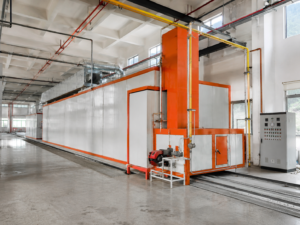
The most expensive discovery is learning that your spray booth is excellent, your curing oven is stable, but your coating still fails—because pre-treatment was incomplete. I've walked into factories with brand-new spray systems where the pre-treatment area is essentially unchanged from 10 years prior. The technology-equipment mismatch begins there.
How Pre-Treatment Quality Affects Downstream Spraying and Curing Performance
Pre-treatment removes surface contaminants (oil, oxide, salt, dust) and creates a surface condition that enables adhesion and corrosion resistance. But it does something else: it conditions the workpiece for consistent electrostatic charge reception.
Residual moisture is the silent killer. If workpieces exit pre-treatment with water still clinging to crevices, the powder spray can't establish full electrostatic contact. You get partial adhesion, pinholes where moisture bubbles out during curing, and reduced corrosion protection because the coating never fully seals the base metal. The spray technology is irrelevant if the foundation is compromised.
Oil and contamination residues similarly sabotage spray-to-substrate bonding. I've seen facilities with dual-stage degreasers followed by inadequate rinse protocols. The spray booth looks clean—powder adheres visibly—but within weeks, customers report peeling. The root wasn't the spray gun; it was incomplete degreasing.
Phosphate film quality varies widely depending on tank concentration, temperature, immersion time, and pH. A 500–1000 mg/m² phosphate layer on steel provides excellent corrosion resistance when combined with powder coating. But 100 mg/m² delivers poor protection and weak adhesion. Your spray technology can't compensate for insufficient conversion layer thickness.
From our perspective, we've shifted how we consult with new customers. We no longer design spray systems in isolation—we audit the entire pre-treatment line first. Only then do we specify booth size, gun configuration, and curing protocol.
Balancing Drying Time with Spray Gun Selection and Oven Capacity
This is where many projects stumble.
Drying before spray is non-negotiable. Residual water on a workpiece entering the spray booth reduces powder transfer efficiency by 15–30% and compromises the final coating. A dedicated drying oven between pre-treatment and spray is often worth more than an oversized recovery system—the return on investment is cleaner coatings, higher first-pass quality, and lower waste.
But drying takes time and floor space. If your drying oven is sized too conservatively, workpieces back up into pre-treatment, and your entire line rhythm breaks. If it's oversized, you're heating air and burning energy unnecessarily.
Spray gun air supply and pressure directly affect drying needs. High-pressure spray guns (90+ kV) deposit powder faster but can trap micro-moisture in the coating. This means your curing oven must include a specific "degassing" phase (lower temperature initially to allow trapped moisture to escape) before final cure temperature. If your oven can't deliver this profile, you end up with porosity and adhesion loss.
Conversely, lower-pressure spray systems (60–70 kV) are gentler but require longer booth residence time to build adequate film thickness. This trades spray time for oven capacity. It's not obviously better or worse—it's a design choice that cascades through your entire line layout and capital cost.
![metal cabinet powder coating process]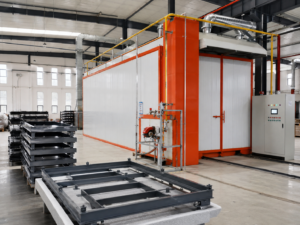
Equipment Configuration Varies by Product Type: Cabinets, Furniture, and Aluminum Profiles
One of the most persistent illusions in the industry is that a spray line is a spray line. The architecture changes dramatically depending on what you're coating.
Spray Gun Angle and Power Selection for Complex Geometries
Cabinet and switchgear producers face a specific challenge: workpieces have internal cavities, deep recesses, multiple bends, and sometimes intentional Faraday cage geometry (nested metal shields). A spray gun optimized for flat panel coating won't adequately cover the inside of a deep cabinet or the bottom of a nested corner.
For cabinets, we typically specify multi-gun arrangements with different angles:
- Overhead guns at 30–45° for top and recessed surfaces
- Side guns at 90° for vertical internal walls
- Bottom guns at angles for underneath surfaces and feet
This multi-angle approach is more expensive than a single, straight-ahead gun, but it's also non-negotiable. Without it, coverage is incomplete, and internal corrosion accelerates because these recessed areas receive inconsistent coating or remain bare.
Gun power (voltage and current) also varies by product. High-voltage systems (80–90 kV) work well for simple geometries where electrostatic attraction is straightforward. But for complex cavities, lower voltage (60–70 kV) with multiple pass spray patterns often outperforms single high-voltage passes because the powder doesn't ricochet off the initial landing point into field-dead zones.
For outdoor furniture, the geometry is often curved, hollow-section tube, or assembled frames. The spray system needs flexibility—some areas require higher transfer efficiency (outside surfaces for appearance), while internal bracing can tolerate slightly lower coverage if it provides structural corrosion protection. We typically use moderate voltage (70–80 kV) with optimized gun distance (200–250mm) to deliver a consistent aesthetic finish across curved surfaces without excessive electrostatic turbulence.
Aluminum profiles present a different puzzle. They're often continuous extrusions, relatively simple geometry, but with length constraints. The spray booth must accommodate lengths of 2, 4, or 6 meters depending on the customer's product line. Gun positioning becomes about maintaining uniform distance along the length, which argues for automated spray heads with coordinated motion rather than fixed manual stations. For aluminum, we emphasize precision thickness control (±15 microns) because over-thickness on profiles can cause assembly fit issues downstream.
Transport Speed and Line Rhythm Across All Stations
Line speed is the metronome that orchestrates quality or chaos.
Too fast, and powder doesn't transfer fully, drying is incomplete, and curing is rushed. Film thickness drops, adhesion suffers, and first-pass quality plummets.
Too slow, and you're leaving capacity on the table, energy consumption per unit rises, and your capital investment yield diminishes.
For cabinet work, we typically specify 0.3–0.5 meters per minute depending on workpiece size and geometry complexity. This allows adequate spray coverage time (usually 60–90 seconds per station for multi-pass coverage), drying (3–5 minutes in a dedicated oven), and curing (10–15 minutes at temperature depending on powder chemistry).
For furniture, line speed is often product-specific. Small chairs or outdoor loungers might move at 0.4–0.6 m/min, allowing fine surface finishing. Larger structures might run 0.2–0.4 m/min to ensure inside surfaces and joints are adequately covered.
For aluminum profiles, line speed is constrained by length. A 6-meter profile can't move faster than the oven can accommodate it. If your oven is 5 meters long and your profiles are 6 meters, the profile must move slower to allow the trailing end adequate residence time. This is why automated systems for aluminum typically operate at 0.2–0.4 m/min—not because the equipment is slow, but because product geometry dictates it.
The critical hidden dependency: all line sections must synchronize to the design speed. If pre-treatment is designed for 0.4 m/min but the spray booth is physically sized for 0.25 m/min, one section is always starved or backed up. Real throughput becomes whatever the slowest section can deliver, and your line velocity averages down.
Manual vs. Automated Spraying: Different Technology-Equipment Combinations
One of the first decisions we guide customers through is: Should this line be manual or automated? The answer cascades through every subsequent choice.
Process Parameter Differences and Equipment Specifications for Each Approach
Manual spraying relies on operator skill, adaptability, and consistent technique. The technology is simpler: spray gun, hose, compressed air supply, high-voltage power source. The equipment can be standard, relatively inexpensive, and flexible—same booth can spray different product sizes with minimal adjustment.
But manual spraying also means process variables are human-dependent: spray distance, gun angle, traverse speed, dwell time over complex areas all vary between operators and even between spray cycles by the same operator. This creates natural variation in film thickness, coverage, and final quality. From our experience, manual lines achieve ±40–50 microns thickness variation under good conditions, ±60–70 under typical conditions.
The curing equipment can be simpler too because the line doesn't need to be perfectly balanced. If manual spray is slow some days and fast others, downstream equipment has some forgiveness. You don't need elaborate control systems—just stable temperature and adequate residence time.
Automated spraying uses programmed spray guns[^5], often on robotic arms or reciprocating mechanisms, combined with workpiece positioning systems. The technology is more complex: servo motors, PLC controllers, vision systems for workpiece detection, coordinated multi-gun sequences.
But automated spraying delivers process consistency: same spray pattern, gun distance, dwell time on every pass, every cycle. Film thickness variation tightens to ±20–30 microns under good conditions. Coverage becomes 99%+ because the spray pattern is repeatable and optimized for the specific geometry.
Automated lines require tighter line integration. If spray is consistent at 0.5 m/min, the oven must reliably process at 0.5 m/min. The conveyor can't drift; thermal zones must be stable; curing parameters must be tight. Any variation in equipment downstream becomes visible as quality scatter.
The equipment cost for automation is higher—typically 30–50% more than equivalent manual capability—but the operational cost per unit is lower because waste decreases, rework diminishes, and labor per unit drops.
Coverage Uniformity and Throughput Trade-offs
Here's the practical tension we navigate constantly:
Manual spraying achieves high coverage uniformity because the operator can slow down over complex areas, adjust angle on-the-fly, and ensure inside surfaces and joints get adequate powder. A skilled operator can deliver 98%+ coverage on a geometrically complex cabinet. But this operator attention costs time, and throughput per operator is limited—typically 15–25 units per shift depending on complexity.
Automated spraying trades some of that adaptive coverage uniformity for consistency and throughput. A properly programmed system will achieve 95–97% coverage on the same complex cabinet, consistently, on every cycle. The throughput jumps to 40–60 units per shift (depending on cycle time) because there's no operator fatigue or variation. The trade is: you lose a few percentage points of coverage but gain consistency and scale.
For outdoor furniture where visual appearance matters, we often recommend manual or semi-automated hybrid approaches: fixed spray guns for high-visibility exterior surfaces (manual operator fine-tunes coverage), automated lower-coverage interior bracing. This balances appearance quality (manual flexibility) with volume (automation efficiency).
For commodity cabinet work where consistency is paramount, we lean automated because predictability matters more than marginal coverage optimization.
How to Evaluate and Verify Technology-Equipment Fit Before Purchasing
Specification documents and performance charts are necessary but insufficient. I've seen factories sign contracts for systems that looked perfect on paper and delivered mediocrity in practice.
Questions to Ask Suppliers About Their Understanding of the Combination
When we present proposals to prospective customers, we're alert to one specific signal: Does the supplier show evidence of thinking about technology-equipment integration, or are they just configuring boxes?
Specific questions that reveal depth:
1. "How did you size the spray booth volume relative to our production target and part geometry?"
A competent supplier answers by referencing your specific part—not generic numbers. They explain booth volume, air velocity, residence time for powder to land and stabilize, how this enables your target film thickness with your powder chemistry at your required line speed.
A weak answer is: "We made it 3m x 2.5m x 2.5m because that's standard for your capacity." No connection to your actual part or your actual process.
2. "What drying time does the pre-treatment oven need to deliver consistent adhesion for our workpieces?"
Competent answer: "Given your cabinet geometry and moisture-holding crevices, we spec 4–5 minutes at 80°C to ensure < 3% residual moisture entering spray. This drives the oven size and residence time."
Weak answer: "Most customers use 3–4 minutes. That should be fine."
3. "How did you match spray gun pressure and atomization air to our powder chemistry and target film thickness?"
Competent answer: "Your powder flows best at 75–85 kV with 0.8–1.2 bar atomization air. This combination achieves your 80±15 micron target at 0.4 m/min line speed. We've sized the air compressor to deliver this consistently."
Weak answer: "Standard setup is 80 kV and 1 bar. It'll work fine."
4. "What curing temperature profile did you program into the oven controller, and why?"
Competent answer: "Your powder data sheet specifies 200°C for 10 minutes (substrate temperature). The oven ramps at 15°C/min, holds plateau for 10 min, then cools. We've sized the heating capacity to achieve this in your specific line speed. Faster speed = slower ramp, so we ensured sufficient heating power."
Weak answer: "We set it to 200°C for 12 minutes. Adjust if needed."
These questions separate suppliers who've actually engineered the system from those who are configuring off-the-shelf components.
On-Site Verification: Sample Production Line Validation vs. Specification Sheets Alone
This is non-negotiable: Before you sign a final contract, you should see the system running with your specific product (or as close as possible).
We typically invite prospective customers to our factory to observe spray systems running production for similar products. They see:
- Actual pre-treatment timing and workpiece condition entering spray
- Live spray coverage and powder adhesion
- Film thickness measurements[^6] (we use wet-film gauges, not estimates)
- Curing process and final product quality
- Line rhythm and changeover time
Why this matters: A spray booth looks the same whether it's well-designed or mediocre—until you see actual production and film quality. We show customers test boards coated on our systems, measure adhesion (cross-hatch test), check thickness distribution, and discuss what adjustments were needed to achieve their target.
Equally important: Ask to see data from actual production runs—not controlled demos. Film thickness distribution over 100 parts, first-pass quality rates, rework frequency. This is real evidence of whether the technology-equipment combination works.
For some customers, especially those geographically distant, we also offer:
- Video documentation of their specific product running on our sample line
- Sample coated parts shipped to them for adhesion testing and final validation
- Remote technical review where their technical team consults with our engineers
This verification step typically costs 2–4 weeks of project time. It's worth every day because it catches misalignment before it becomes a $100,000+ operational problem.
Common Pitfalls and How to Avoid Them: A Selection and Verification Checklist
Based on projects we've executed across cabinet manufacturing, outdoor furniture, and aluminum profile production, these are the most expensive mistakes we see:
| Mistake | Why It Happens | Consequence | How to Prevent It |
|---|---|---|---|
| Pre-treatment undersized relative to spray booth | Pre-treatment capacity is estimated separately from spray capacity; they're not synchronized. | Water backup; incomplete drying; adhesion failures; coating porosity. | Model pre-treatment throughput as part of the integrated line rhythm. Verify drying oven residence time at your target line speed. |
| Spray booth sized by square footage, not residence time | Supplier quotes "standard 3m x 2.5m booth" without calculating gas dwell time needed for powder settlement. | Inadequate powder landing; thin coatings; uneven coverage; high recirculation waste. | Calculate booth residence time = booth volume / (air flow rate). Ensure ≥ 3–5 seconds depending on powder and air velocity. |
| Automated line designed for one product family, then product mix changes | Initial spec is locked for Product A geometry; later customer needs to spray Product B (different size/complexity). | Spray program doesn't fit; coverage misses increase; line downtime for reprogramming. | Design automated spray patterns for geometry range, not single geometry. Build flexibility into gun positioning and timing. |
| Curing oven residence time insufficient at actual production speed | Oven is sized for average part; when actual parts are slower to move (due to weight or size), residence time is cut. | Incomplete cure; final hardness low; customer complaints about flexibility/durability. | Model actual part thermal mass and expected substrate temperature rise. Verify oven capacity at your target line speed, not best-case speed. |
| Recovery system inefficiency compounded by wrong spray pressure | High spray pressure drives more powder to booth walls than substrate; recovery system sees higher waste load than designed for. | Recovery system backs up; pressure drop; downstream equipment starves; line stops. | Match spray pressure to part geometry and target film thickness. Over-pressure is waste, not coverage. Verify recovery system capacity at your actual (not theoretical) powder consumption. |
| Manual spray operator skill variation creating thickness scatter | Operator 1 achieves consistent 80±10 microns; Operator 2 achieves 80±30 microns same shift. | Quality inconsistency; customer rejects; rework labor. | Implement spray technique training, film thickness measurement at line (not inspection), and process parameter documentation. Consider semi-automated assistance (fixed guns + manual pass control) |
| Aluminum profile program spec'd for single length, line receives multiple lengths | Profile oven is designed for 4m profile; 2m and 6m profiles also run the line. | 2m under-cures (too fast through oven); 6m back-logs (too slow). Line balancing fails. | Specify equipment for product family parameters, not single SKU. Ensure conveyor can adjust speed between products or oven can accommodate length variation. |
| Environmental standard (salt-spray, VOC, noise) discovered after line is built | Scope creep; local regulations change; customer requirement updated mid-project. | Expensive retrofit; emission controls inadequate; line fails inspection. | Front-load all regulatory requirements. Verify standards for customer location (North Africa ≠ Europe ≠ Asia). Build compliance margin into spec. |
| Compressed air quality not specified; moisture/oil in supply | Supplier provides standard air hookup; plant air is contaminated. | Powder clumping in spray gun; pinholes in coating; recurring blockages. | Specify dry, filtered air (< 3 microns, < -40°C dew point). Install dedicated dryer and filter at line entry. Verify monthly. |
| Spray gun selection based on competitor equipment, not your geometry | "If Facility X uses Gun Model ABC, we should too." | Gun works fine for Facility X's parts; inadequate for your complex cavities. | Specify guns based on your part geometry, not neighbor's setup. Run proof-of-concept spray on sample parts before line build. |
Recommendation: A Framework for Final Decision-Making
When you're down to evaluating competing proposals, use this simplified matrix to assess technology-equipment fit:
Score each dimension 1–5 (1=poor fit, 5=excellent fit):
- Pre-treatment integration: Does the proposal connect pre-treatment dwell time to your part geometry and spray booth residence time?
- Spray technology matching: Is spray gun pressure/current/atomization selected specifically for your powder and target thickness?
- Curing alignment: Is oven residence time calculated for your part thermal mass at your actual line speed?
- Automation readiness: For automated systems, does the proposal address your product geometry range, not just a single SKU?
- Environmental compliance: Are local electrical standards, explosion-proof[^7] ratings, and emission controls addressed?
- Verification depth: Is the supplier offering sample runs, proof-of-concept testing, or only specification review?
A proposal scoring 4+ on most dimensions suggests competent integration thinking. A proposal scoring 2–3 on more than two dimensions suggests the supplier is configuring components rather than engineering integration.
Conclusion: Why This Matters for Your Factory's Future
The difference between a spray line that delivers and one that struggles isn't mysterious. It's rooted in whether technology and equipment were designed as a unified system from the beginning or treated as separate components bolted together.
From our experience across cabinet makers in North Africa, furniture producers in Turkey, and aluminum manufacturers in India, the factories that achieve consistently high quality and efficiency share one thing in common: they insisted on technology-equipment alignment during the specification phase, invested time in verification before purchase, and held suppliers accountable for integrated performance—not just component specs.
If you're evaluating spray line proposals, look for suppliers who ask detailed questions about your product geometry, production targets, and surface requirements. Look for evidence that they've modeled pre-treatment drying time, calculated spray booth residence time, and sized curing ovens for your actual line speed. Ask them to support their configurations with data from similar production environments.
And most importantly: Verify on actual equipment before you commit. Watch a system run your product. Measure film thickness. Test adhesion[^8]. See the line operate at your target speed. This pre-purchase validation eliminates most of the risk that comes from misalignment.
Ready to evaluate your spray system design with a supplier who prioritizes technology-equipment integration? We work with factories across multiple industries and geographies to ensure the systems we design actually deliver on your performance targets. If you'd like to discuss your specific requirements—product geometry, production goals, environmental standards—or arrange a factory visit to see our systems in production, reach out.
Contact us for a detailed consultation:
WhatsApp: +8618925987762
Email: ketucoatingline@gmail.com
We're here to help you align technology with equipment for reliable, high-quality production.
[^1]: Covers the basics of powder coating technology, including electrostatic application principles and industrial coating processes.
[^2]: Explains the composition and curing properties of epoxy-polyester hybrid coating systems used in industrial applications.
[^3]: Details surface preparation and pre-treatment methods essential for coating adhesion and corrosion resistance.
[^4]: Describes environmental conditions and corrosion factors affecting coatings in marine and outdoor exposure settings.
[^5]: Explores robotic automation systems and programmed spray gun applications in manufacturing environments.
[^6]: Covers measurement techniques and standards for determining coating thickness in quality control processes.
[^7]: Defines equipment design standards and safety ratings required for hazardous and explosive atmospheres.
[^8]: Explains the mechanical bond between coating and substrate, and testing methods like cross-hatch adhesion tests.
 English
  German
  Vietnamese
  French