
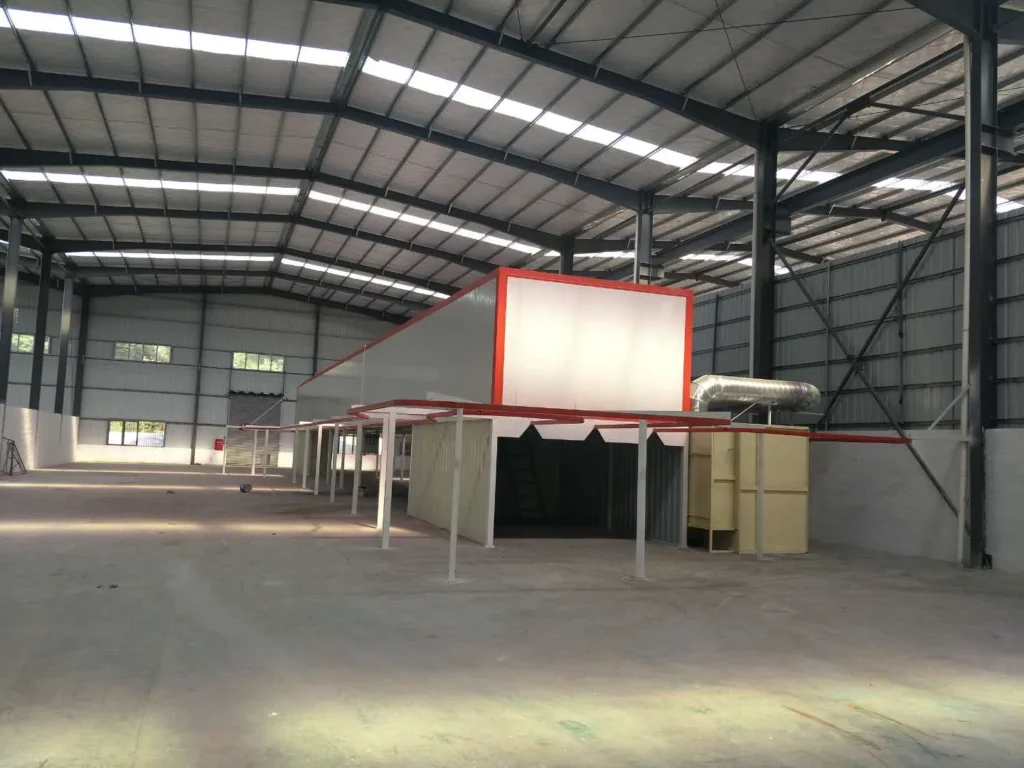
Does Metal Thickness Affect Powder Coating? Complete Guide to Process Impact, Parameter Adjustment & Multi-Thickness Production Solutions
Einleitung
In electrostatic powder In electrostatic powder coating, metal thickness appears to be a minor specification detail—but it directly influences spray quality, process stability, production costs, and long-term coating performance. Many manufacturers focus on workpiece shape and output targets while overlooking how different substrate thicknesses actually behave during the entire coating cycle. This oversight often surfaces during production as uneven film thickness, color inconsistency, adhesion failure, or workpiece distortion.
From our experience running multiple electrostatic Pulverbeschichtungsanlages across cabinet, aluminum profile, and hardware manufacturing clients, we've seen that metal thickness mismatch is one of the most common—and most preventable—causes of quality variation. Many coating plants invest in premium equipment only to struggle with inconsistent results because they failed to account for substrate thickness differences during the design phase.
This article explores how metal thickness affects powder coating from both engineering and practical perspectives, covering thermal dynamics, electrostatic behavior, process parameter adjustment, and real-world solutions for handling mixed-thickness production on a single line.
How Metal Thickness Affects Powder Coating: The Five Core Impacts
Yes, metal thickness significantly affects powder coating results. The impact spans five interconnected areas:
1. Thermal Absorption and Heat Dissipation
Thin metal (0.5–2 mm):
- Heats up rapidly but also cools quickly
- Lower thermal mass means temperature spikes faster in the curing oven
- Risk of overcuring or thermal distortion if oven temperature is not reduced
- Requires lower bake settings and shorter dwell times to prevent surface degradation
Thick metal (3+ mm):
- Higher thermal mass ensures more uniform temperature distribution
- Heats more slowly but maintains stable temperature longer
- Better suited to standard or slightly elevated curing parameters
- May require longer dwell time to ensure complete internal cross-linking
2. Electrostatic Field Distribution and Powder Deposition
Thin substrates:
- Shorter grounding path = more stable electrostatic field
- Generally easier for powder to adhere uniformly
- However, thin workpieces can be displaced by spray gun air pressure
- Risk of positioning instability during spraying
Thick substrates:
- Longer grounding paths may increase contact resistance
- Larger mass resists air displacement, improving spray stability
- But increased complexity (recesses, holes, internal cavities) in thick workpieces creates more severe Faraday cage effects
- Powder has greater difficulty reaching internal edges and deep features
3. Coating Uniformity and Film Thickness Variation
Thin and thick metals respond differently to the same spray parameters:
- Thin metals: smaller surface area + faster heat absorption = less forgiving tolerance band for achieving uniform thickness
- Thick metals: larger surface area + thermal buffering = wider acceptable parameter window, but deeper recesses demand more careful spray coverage planning
4. Surface Finish Quality and Appearance
Thin metals are more prone to:
- Orange peel texture (due to rapid cooling and reduced flow-out time)
- Sag or runs (if film is too thick for rapid cooling)
- Brittleness in the cured layer
cURL Too many subrequests by single Worker invocation. To configure this limit, refer to https://developers.cloudflare.com/workers/wrangler/configuration/#limits
- cURL Too many subrequests by single Worker invocation. To configure this limit, refer to https://developers.cloudflare.com/workers/wrangler/configuration/#limits
- cURL Too many subrequests by single Worker invocation. To configure this limit, refer to https://developers.cloudflare.com/workers/wrangler/configuration/#limits
- cURL Too many subrequests by single Worker invocation. To configure this limit, refer to https://developers.cloudflare.com/workers/wrangler/configuration/#limits
cURL Too many subrequests by single Worker invocation. To configure this limit, refer to https://developers.cloudflare.com/workers/wrangler/configuration/#limits
- cURL Too many subrequests by single Worker invocation. To configure this limit, refer to https://developers.cloudflare.com/workers/wrangler/configuration/#limits cURL Too many subrequests by single Worker invocation. To configure this limit, refer to https://developers.cloudflare.com/workers/wrangler/configuration/#limits
- cURL Too many subrequests by single Worker invocation. To configure this limit, refer to https://developers.cloudflare.com/workers/wrangler/configuration/#limits cURL Too many subrequests by single Worker invocation. To configure this limit, refer to https://developers.cloudflare.com/workers/wrangler/configuration/#limits
cURL Too many subrequests by single Worker invocation. To configure this limit, refer to https://developers.cloudflare.com/workers/wrangler/configuration/#limits.
cURL Too many subrequests by single Worker invocation. To configure this limit, refer to https://developers.cloudflare.com/workers/wrangler/configuration/#limits
cURL Too many subrequests by single Worker invocation. To configure this limit, refer to https://developers.cloudflare.com/workers/wrangler/configuration/#limits
cURL Too many subrequests by single Worker invocation. To configure this limit, refer to https://developers.cloudflare.com/workers/wrangler/configuration/#limits
| Parameter | cURL Too many subrequests by single Worker invocation. To configure this limit, refer to https://developers.cloudflare.com/workers/wrangler/configuration/#limits | cURL Too many subrequests by single Worker invocation. To configure this limit, refer to https://developers.cloudflare.com/workers/wrangler/configuration/#limits |
|---|---|---|
| cURL Too many subrequests by single Worker invocation. To configure this limit, refer to https://developers.cloudflare.com/workers/wrangler/configuration/#limits | cURL Too many subrequests by single Worker invocation. To configure this limit, refer to https://developers.cloudflare.com/workers/wrangler/configuration/#limits | cURL Too many subrequests by single Worker invocation. To configure this limit, refer to https://developers.cloudflare.com/workers/wrangler/configuration/#limits |
| cURL Too many subrequests by single Worker invocation. To configure this limit, refer to https://developers.cloudflare.com/workers/wrangler/configuration/#limits | cURL Too many subrequests by single Worker invocation. To configure this limit, refer to https://developers.cloudflare.com/workers/wrangler/configuration/#limits | cURL Too many subrequests by single Worker invocation. To configure this limit, refer to https://developers.cloudflare.com/workers/wrangler/configuration/#limits |
| cURL Too many subrequests by single Worker invocation. To configure this limit, refer to https://developers.cloudflare.com/workers/wrangler/configuration/#limits | cURL Too many subrequests by single Worker invocation. To configure this limit, refer to https://developers.cloudflare.com/workers/wrangler/configuration/#limits | Moderate (more forgiving) |
| Optimal oven temp | 160–180°C | 180–220°C |
| Dwell time needed | cURL Too many subrequests by single Worker invocation. To configure this limit, refer to https://developers.cloudflare.com/workers/wrangler/configuration/#limits | 12–20 minutes |
| Distortion risk | High if over-heated | Niedrig |
Our observation: In mixed-thickness operations, we've found that one of the biggest mistakes is using a single oven temperature and time for both thin and thick substrates. The result is either under-cured thin parts or thermal stress on thin plates. The solution is either to run separate lines with different parameters, or to design a variable-speed oven that allows thick parts to spend more time at standard temperature while thin parts move through faster.
Electrostatic Charging & Grounding Effects
Thin metal advantages:
- Shorter grounding path = faster charge path establishment
- Less resistance = more stable, predictable electrostatic field
- Powder attracts uniformly across surface
Thin metal challenges:
- Light mass = easily displaced by spray gun air pressure
- Workpiece can shift or rotate during spraying, disrupting field alignment
- May require lower air pressure or spray gun adjustments
Thick metal advantages:
- Heavier mass = stable positioning during spray
- Can handle higher air pressures without movement
Thick metal challenges:
- Longer grounding path through fixture and workpiece
- Risk of contact resistance increases with corner or recessed areas
- Faraday cage effect more pronounced in internal cavities
- Powder "shadow" zones in deep recesses become harder to reach
Unsere Empfehlung: For mixed-thickness runs, always prioritize grounding continuity. Use conductive fixtures rated for the heaviest workpieces, maintain low contact resistance at all touch points, and verify grounding resistance regularly. We typically spec fixtures that can handle 150% of maximum workpiece weight for stability.
Coating Uniformity & Film Thickness Variation
Film thickness uniformity depends heavily on substrate thermal behavior:
Thin metals show:
- Higher variance in film thickness across surface (±15–20% typical)
- Faster solidification = less time for powder to flow and level
- Edge and corner buildup more noticeable
- Difficulty achieving thick films (>100 µm) without orange peel
Thick metals show:
- Lower variance (±8–12% typical)
- Better flow-out and leveling during heating
- More even edge distribution
- cURL Too many subrequests by single Worker invocation. To configure this limit, refer to https://developers.cloudflare.com/workers/wrangler/configuration/#limits
Wichtiges Erkenntnis: cURL Too many subrequests by single Worker invocation. To configure this limit, refer to https://developers.cloudflare.com/workers/wrangler/configuration/#limits.
cURL Too many subrequests by single Worker invocation. To configure this limit, refer to https://developers.cloudflare.com/workers/wrangler/configuration/#limits
cURL Too many subrequests by single Worker invocation. To configure this limit, refer to https://developers.cloudflare.com/workers/wrangler/configuration/#limits
| cURL Too many subrequests by single Worker invocation. To configure this limit, refer to https://developers.cloudflare.com/workers/wrangler/configuration/#limits | cURL Too many subrequests by single Worker invocation. To configure this limit, refer to https://developers.cloudflare.com/workers/wrangler/configuration/#limits | cURL Too many subrequests by single Worker invocation. To configure this limit, refer to https://developers.cloudflare.com/workers/wrangler/configuration/#limits |
|---|---|---|
| Orangenhaut | cURL Too many subrequests by single Worker invocation. To configure this limit, refer to https://developers.cloudflare.com/workers/wrangler/configuration/#limits | cURL Too many subrequests by single Worker invocation. To configure this limit, refer to https://developers.cloudflare.com/workers/wrangler/configuration/#limits |
| Color variation | cURL Too many subrequests by single Worker invocation. To configure this limit, refer to https://developers.cloudflare.com/workers/wrangler/configuration/#limits | cURL Too many subrequests by single Worker invocation. To configure this limit, refer to https://developers.cloudflare.com/workers/wrangler/configuration/#limits |
| cURL Too many subrequests by single Worker invocation. To configure this limit, refer to https://developers.cloudflare.com/workers/wrangler/configuration/#limits | Variable | cURL Too many subrequests by single Worker invocation. To configure this limit, refer to https://developers.cloudflare.com/workers/wrangler/configuration/#limits |
| Edge buildup | cURL Too many subrequests by single Worker invocation. To configure this limit, refer to https://developers.cloudflare.com/workers/wrangler/configuration/#limits | Mäßig |
| cURL Too many subrequests by single Worker invocation. To configure this limit, refer to https://developers.cloudflare.com/workers/wrangler/configuration/#limits | cURL Too many subrequests by single Worker invocation. To configure this limit, refer to https://developers.cloudflare.com/workers/wrangler/configuration/#limits | cURL Too many subrequests by single Worker invocation. To configure this limit, refer to https://developers.cloudflare.com/workers/wrangler/configuration/#limits |
cURL Too many subrequests by single Worker invocation. To configure this limit, refer to https://developers.cloudflare.com/workers/wrangler/configuration/#limits
cURL Too many subrequests by single Worker invocation. To configure this limit, refer to https://developers.cloudflare.com/workers/wrangler/configuration/#limits
Was passiert:
cURL Too many subrequests by single Worker invocation. To configure this limit, refer to https://developers.cloudflare.com/workers/wrangler/configuration/#limits
- cURL Too many subrequests by single Worker invocation. To configure this limit, refer to https://developers.cloudflare.com/workers/wrangler/configuration/#limits
- cURL Too many subrequests by single Worker invocation. To configure this limit, refer to https://developers.cloudflare.com/workers/wrangler/configuration/#limits
- Stress marks or micro-cracking in coating
- Assembly fit problems downstream
Prevention strategies:
-
Lower oven temperature for thin substrates
- Target 160–180°C instead of 190–220°C
- Verify internal workpiece temperature (not just air temp) with thermal imaging
- Extend dwell time slightly to compensate
-
Increase line speed through curing section
- Faster movement limits total heat exposure
- Reduces peak temperature on thin parts
- May require longer total oven length to achieve same cure time
-
Reduce spray film thickness on thin parts
- Thinner films cure faster and generate less internal heat stress
- Target 50–80 µm DFT instead of 100+ µm
- Reduces both curing time and distortion risk
-
Use thermal simulation
- Model the part before production starts
- Calculate peak temperature reached at different oven positions
- Adjust line speed or oven temp zone accordingly
-
Implement part orientation control
- Position thin parts flat (not edge-on) to oven airflow
- Reduces asymmetric heating
- Improves temperature uniformity
Coating Adhesion Failure on Thin Substrates
Ursachen:
- Insufficient pre-treatment (common on thin metal because operators rush)
- Poor electrostatic transfer due to workpiece movement
- Under-curing due to inadequate dwell time
- Residual moisture on surface before spray
Vorbeugung:
-
Enforce rigorous pre-treatment
- Thin metals show adhesion problems faster, so don't compromise on cleaning
- Extend immersion time and ensure thorough rinsing
- Verify final surface is completely dry
-
Reduce electrostatic voltage slightly
- Lower voltage = less transfer force but also less risk of adhesion stress
- At 60–70 kV: good for thin metals; at 80+ kV: better for thick parts
- Balance transfer efficiency with adhesion robustness
-
Confirm adequate dwell time
- Minimum 8–10 minutes at proper temperature for thin metals
- Use time + temperature recorder to verify actual cure profile
- cURL Too many subrequests by single Worker invocation. To configure this limit, refer to https://developers.cloudflare.com/workers/wrangler/configuration/#limits
-
cURL Too many subrequests by single Worker invocation. To configure this limit, refer to https://developers.cloudflare.com/workers/wrangler/configuration/#limits
- cURL Too many subrequests by single Worker invocation. To configure this limit, refer to https://developers.cloudflare.com/workers/wrangler/configuration/#limits
- cURL Too many subrequests by single Worker invocation. To configure this limit, refer to https://developers.cloudflare.com/workers/wrangler/configuration/#limits
- cURL Too many subrequests by single Worker invocation. To configure this limit, refer to https://developers.cloudflare.com/workers/wrangler/configuration/#limits
cURL Too many subrequests by single Worker invocation. To configure this limit, refer to https://developers.cloudflare.com/workers/wrangler/configuration/#limits
Problem:
cURL Too many subrequests by single Worker invocation. To configure this limit, refer to https://developers.cloudflare.com/workers/wrangler/configuration/#limits
- cURL Too many subrequests by single Worker invocation. To configure this limit, refer to https://developers.cloudflare.com/workers/wrangler/configuration/#limits
- cURL Too many subrequests by single Worker invocation. To configure this limit, refer to https://developers.cloudflare.com/workers/wrangler/configuration/#limits
- cURL Too many subrequests by single Worker invocation. To configure this limit, refer to https://developers.cloudflare.com/workers/wrangler/configuration/#limits
cURL Too many subrequests by single Worker invocation. To configure this limit, refer to https://developers.cloudflare.com/workers/wrangler/configuration/#limits
-
cURL Too many subrequests by single Worker invocation. To configure this limit, refer to https://developers.cloudflare.com/workers/wrangler/configuration/#limits
- cURL Too many subrequests by single Worker invocation. To configure this limit, refer to https://developers.cloudflare.com/workers/wrangler/configuration/#limits
- cURL Too many subrequests by single Worker invocation. To configure this limit, refer to https://developers.cloudflare.com/workers/wrangler/configuration/#limits
- cURL Too many subrequests by single Worker invocation. To configure this limit, refer to https://developers.cloudflare.com/workers/wrangler/configuration/#limits
-
cURL Too many subrequests by single Worker invocation. To configure this limit, refer to https://developers.cloudflare.com/workers/wrangler/configuration/#limits
- cURL Too many subrequests by single Worker invocation. To configure this limit, refer to https://developers.cloudflare.com/workers/wrangler/configuration/#limits
- cURL Too many subrequests by single Worker invocation. To configure this limit, refer to https://developers.cloudflare.com/workers/wrangler/configuration/#limits
- cURL Too many subrequests by single Worker invocation. To configure this limit, refer to https://developers.cloudflare.com/workers/wrangler/configuration/#limits
-
cURL Too many subrequests by single Worker invocation. To configure this limit, refer to https://developers.cloudflare.com/workers/wrangler/configuration/#limits
- cURL Too many subrequests by single Worker invocation. To configure this limit, refer to https://developers.cloudflare.com/workers/wrangler/configuration/#limits
- cURL Too many subrequests by single Worker invocation. To configure this limit, refer to https://developers.cloudflare.com/workers/wrangler/configuration/#limits
- cURL Too many subrequests by single Worker invocation. To configure this limit, refer to https://developers.cloudflare.com/workers/wrangler/configuration/#limits
-
Improve fixture design
- Support thin parts on multiple contact points
- Use distributed holding vs. single-point suspension
- Test fixture rigidity before production
Advantages & Challenges of Powder Coating Thick Metals
Superior Stability & Consistency
Key advantages:
| Aspekt | Benefit |
|---|---|
| Thermal stability | Predictable curing; works with standard oven profiles |
| Positioning stability | Heavy mass resists spray air displacement |
| Grounding reliability | Larger contact area = lower resistance variation |
| Process repeatability | Parameter window wider; easier to maintain consistency |
| Schichtgleichmäßigkeit | Better powder flow = more uniform thickness distribution |
Real-world impact: On our cabinet production lines, workpieces with 2–3 mm gauge achieve first-pass adhesion rates >98% when pre-treatment and spray parameters are held constant. When we introduce thinner gauge parts to the same line, adhesion variance increases to 85–92% until we adjust parameters.

Faraday Cage Effect in Complex Geometries
What it is:
Interior surfaces, deep recesses, inner corners, and holes present electrostatic "shadow zones" where the electric field penetrates poorly. Powder particles have difficulty reaching these zones because the surrounding metal "shieldsElectric field lines.
Why it's more pronounced on thick metals:
- Thick metals are often used for structural cabinets, enclosures, or complex manifolds with many internal features
- Recesses are proportionally deeper relative to substrate dimensions
- More internal surfaces = more complex field geometry
How to address it:
-
Lower spray voltage
- Reduces field complexity; improves penetration into cavities
- Trade-off: slightly lower transfer efficiency
- Use 60–75 kV for complex thick parts; 75–90 kV for simple shapes
-
Use friction spray guns
- Deposit via friction, not just electrostatic attraction
- Better access to hard-to-reach areas
- Standard electric corona guns less effective for deep cavities
-
Adjust workpiece orientation
- Rotate or tilt to expose interior surfaces to spray gun
- May require custom fixtures
- Improves coverage on critical internal areas
-
Apply multiple spray passes
- cURL Too many subrequests by single Worker invocation. To configure this limit, refer to https://developers.cloudflare.com/workers/wrangler/configuration/#limits
- cURL Too many subrequests by single Worker invocation. To configure this limit, refer to https://developers.cloudflare.com/workers/wrangler/configuration/#limits
- cURL Too many subrequests by single Worker invocation. To configure this limit, refer to https://developers.cloudflare.com/workers/wrangler/configuration/#limits
-
cURL Too many subrequests by single Worker invocation. To configure this limit, refer to https://developers.cloudflare.com/workers/wrangler/configuration/#limits
- cURL Too many subrequests by single Worker invocation. To configure this limit, refer to https://developers.cloudflare.com/workers/wrangler/configuration/#limits
- cURL Too many subrequests by single Worker invocation. To configure this limit, refer to https://developers.cloudflare.com/workers/wrangler/configuration/#limits
- cURL Too many subrequests by single Worker invocation. To configure this limit, refer to https://developers.cloudflare.com/workers/wrangler/configuration/#limits
cURL Too many subrequests by single Worker invocation. To configure this limit, refer to https://developers.cloudflare.com/workers/wrangler/configuration/#limits
Herausforderung:
cURL Too many subrequests by single Worker invocation. To configure this limit, refer to https://developers.cloudflare.com/workers/wrangler/configuration/#limits.
cURL Too many subrequests by single Worker invocation. To configure this limit, refer to https://developers.cloudflare.com/workers/wrangler/configuration/#limits
| cURL Too many subrequests by single Worker invocation. To configure this limit, refer to https://developers.cloudflare.com/workers/wrangler/configuration/#limits | cURL Too many subrequests by single Worker invocation. To configure this limit, refer to https://developers.cloudflare.com/workers/wrangler/configuration/#limits | cURL Too many subrequests by single Worker invocation. To configure this limit, refer to https://developers.cloudflare.com/workers/wrangler/configuration/#limits | cURL Too many subrequests by single Worker invocation. To configure this limit, refer to https://developers.cloudflare.com/workers/wrangler/configuration/#limits |
|---|---|---|---|
| cURL Too many subrequests by single Worker invocation. To configure this limit, refer to https://developers.cloudflare.com/workers/wrangler/configuration/#limits | 8–10 Min | 160–180°C | cURL Too many subrequests by single Worker invocation. To configure this limit, refer to https://developers.cloudflare.com/workers/wrangler/configuration/#limits |
| cURL Too many subrequests by single Worker invocation. To configure this limit, refer to https://developers.cloudflare.com/workers/wrangler/configuration/#limits | 12–15 Min | cURL Too many subrequests by single Worker invocation. To configure this limit, refer to https://developers.cloudflare.com/workers/wrangler/configuration/#limits | 15–20 Min. |
| cURL Too many subrequests by single Worker invocation. To configure this limit, refer to https://developers.cloudflare.com/workers/wrangler/configuration/#limits | 15–20 Min. | cURL Too many subrequests by single Worker invocation. To configure this limit, refer to https://developers.cloudflare.com/workers/wrangler/configuration/#limits | cURL Too many subrequests by single Worker invocation. To configure this limit, refer to https://developers.cloudflare.com/workers/wrangler/configuration/#limits |
cURL Too many subrequests by single Worker invocation. To configure this limit, refer to https://developers.cloudflare.com/workers/wrangler/configuration/#limits
- Outer coating cures quickly (5–8 min at temp)
- Full cross-link reaction continues for 15–20 min
- Premature cooling = incomplete cure, reduced adhesion and hardness
- Over-curing (>25 min at high temp) risks yellowing and brittleness
Optimization:
- Use thermal imaging to measure actual part temperature at oven exit
- Don't rely on air temperature alone
- Adjust line speed or oven length to maintain dwell time within optimal window
Critical Process Parameters to Adjust for Different Metal Thicknesses
| Parameter | cURL Too many subrequests by single Worker invocation. To configure this limit, refer to https://developers.cloudflare.com/workers/wrangler/configuration/#limits | cURL Too many subrequests by single Worker invocation. To configure this limit, refer to https://developers.cloudflare.com/workers/wrangler/configuration/#limits | Mixed-Thickness Strategy |
|---|---|---|---|
| Curing Temp | 160–180°C | 190–220°C | Use 175–190°C; extend dwell time |
| Oven Dwell | 8–12 Min. | 15–20 Min. | Variable speed or zone-based |
| Electrostatic Voltage | 60–75 kV | 75–90 kV | Start at 70 kV; adjust per part |
| cURL Too many subrequests by single Worker invocation. To configure this limit, refer to https://developers.cloudflare.com/workers/wrangler/configuration/#limits | 200–250 mm | 150–180 mm | Set 200 mm; adjust angle for recesses |
| Powder Feed Rate | Reduced (60–80% standard) | Normal to high (90–110% standard) | Calibrate per thickness; test coverage |
| Gleichlaufgeschwindigkeit | Slow (3–5 m/min) | Standard (6–10 m/min) | Variable speed oven or separate lines |
Curing Temperature & Dwell Time Settings
For thin metals:
- Lower oven temperature reduces thermal stress and distortion risk
- Compensate with longer dwell time to ensure full cure
- Typical profile: 170°C for 10–12 minutes
For thick metals:
- Standard to slightly elevated oven temperature is acceptable
- Sufficient thermal mass handles heat without distortion
- Typical profile: 200°C for 15–18 minutes
cURL Too many subrequests by single Worker invocation. To configure this limit, refer to https://developers.cloudflare.com/workers/wrangler/configuration/#limits
-
cURL Too many subrequests by single Worker invocation. To configure this limit, refer to https://developers.cloudflare.com/workers/wrangler/configuration/#limits
- cURL Too many subrequests by single Worker invocation. To configure this limit, refer to https://developers.cloudflare.com/workers/wrangler/configuration/#limits
- cURL Too many subrequests by single Worker invocation. To configure this limit, refer to https://developers.cloudflare.com/workers/wrangler/configuration/#limits
- cURL Too many subrequests by single Worker invocation. To configure this limit, refer to https://developers.cloudflare.com/workers/wrangler/configuration/#limits
-
cURL Too many subrequests by single Worker invocation. To configure this limit, refer to https://developers.cloudflare.com/workers/wrangler/configuration/#limits
- cURL Too many subrequests by single Worker invocation. To configure this limit, refer to https://developers.cloudflare.com/workers/wrangler/configuration/#limits
- cURL Too many subrequests by single Worker invocation. To configure this limit, refer to https://developers.cloudflare.com/workers/wrangler/configuration/#limits
- cURL Too many subrequests by single Worker invocation. To configure this limit, refer to https://developers.cloudflare.com/workers/wrangler/configuration/#limits
- cURL Too many subrequests by single Worker invocation. To configure this limit, refer to https://developers.cloudflare.com/workers/wrangler/configuration/#limits
-
cURL Too many subrequests by single Worker invocation. To configure this limit, refer to https://developers.cloudflare.com/workers/wrangler/configuration/#limits
- cURL Too many subrequests by single Worker invocation. To configure this limit, refer to https://developers.cloudflare.com/workers/wrangler/configuration/#limits
- cURL Too many subrequests by single Worker invocation. To configure this limit, refer to https://developers.cloudflare.com/workers/wrangler/configuration/#limits
cURL Too many subrequests by single Worker invocation. To configure this limit, refer to https://developers.cloudflare.com/workers/wrangler/configuration/#limits
cURL Too many subrequests by single Worker invocation. To configure this limit, refer to https://developers.cloudflare.com/workers/wrangler/configuration/#limits
- cURL Too many subrequests by single Worker invocation. To configure this limit, refer to https://developers.cloudflare.com/workers/wrangler/configuration/#limits cURL Too many subrequests by single Worker invocation. To configure this limit, refer to https://developers.cloudflare.com/workers/wrangler/configuration/#limits
- cURL Too many subrequests by single Worker invocation. To configure this limit, refer to https://developers.cloudflare.com/workers/wrangler/configuration/#limits cURL Too many subrequests by single Worker invocation. To configure this limit, refer to https://developers.cloudflare.com/workers/wrangler/configuration/#limits
- cURL Too many subrequests by single Worker invocation. To configure this limit, refer to https://developers.cloudflare.com/workers/wrangler/configuration/#limits cURL Too many subrequests by single Worker invocation. To configure this limit, refer to https://developers.cloudflare.com/workers/wrangler/configuration/#limits
cURL Too many subrequests by single Worker invocation. To configure this limit, refer to https://developers.cloudflare.com/workers/wrangler/configuration/#limits
- cURL Too many subrequests by single Worker invocation. To configure this limit, refer to https://developers.cloudflare.com/workers/wrangler/configuration/#limits 200–250 mm (reduces air pressure impact; maintains electrostatic field)
- cURL Too many subrequests by single Worker invocation. To configure this limit, refer to https://developers.cloudflare.com/workers/wrangler/configuration/#limits 150–200 mm (improves efficiency for deep cavities; allows higher deposition rate)
- Check frequently: Distance variation ±20 mm creates noticeable film thickness variance
cURL Too many subrequests by single Worker invocation. To configure this limit, refer to https://developers.cloudflare.com/workers/wrangler/configuration/#limits
- Distance affects both electrostatic field strength and spray air velocity
- Too close on thin parts = dimensional distortion + excessive force
- Too far on thick parts = poor cavity coverage + under-deposition
- Consistent distance = predictable, repeatable results
Powder Feed Rate & Line Speed Optimization
Feed rate by thickness:
| Dicke | Feed Rate (% of Standard) | Deposition Rate | Film Target |
|---|---|---|---|
| cURL Too many subrequests by single Worker invocation. To configure this limit, refer to https://developers.cloudflare.com/workers/wrangler/configuration/#limits | 60–75% | Reduced | 50–80 µm |
| 1–2 mm | 75–90% | Standard | 80–100 µm |
| cURL Too many subrequests by single Worker invocation. To configure this limit, refer to https://developers.cloudflare.com/workers/wrangler/configuration/#limits | 90–110% | Standard to high | 100–120 µm |
| cURL Too many subrequests by single Worker invocation. To configure this limit, refer to https://developers.cloudflare.com/workers/wrangler/configuration/#limits | 110–130% | Hoch | 120–150 µm |
Line speed optimization:
- Slow: 3–5 m/min (thin metals, complex geometry, high-quality requirement)
- Standard: 6–8 m/min (mid-range, most common industrial setting)
- Fast: 9–12 m/min (thick, simple geometry, high-volume production)
Key principle: Longer dwell time in spray zone = thicker, more uniform coating. If you need thicker film, either slow the line or add spray guns. Don't just increase feed rate, as that increases powder waste.
Can You Mix Different Metal Thicknesses on the Same Production Line?
Short answer: Yes, but with deliberate design and control.
Most modern manufacturing operates under pressure to handle multiple product variants on a single line. In cabinet shops, for example, you might need to spray frames (1.2 mm), door panels (0.8 mm), and reinforcement brackets (3 mm) all on the same equipment. The question is: how do you maintain quality across this range?
Design Considerations for Multi-Thickness Production
1. Fixture and Suspension System
- Design fixtures that support both light and heavy parts securely
- Use adjustable or modular fixtures that adapt to different part weights
- Verify grounding contact remains stable across all thickness ranges
- Test fixture rigidity at full operating load (thickest + heaviest parts)
2. Spray Gun Configuration - cURL Too many subrequests by single Worker invocation. To configure this limit, refer to https://developers.cloudflare.com/workers/wrangler/configuration/#limits
- cURL Too many subrequests by single Worker invocation. To configure this limit, refer to https://developers.cloudflare.com/workers/wrangler/configuration/#limits
- cURL Too many subrequests by single Worker invocation. To configure this limit, refer to https://developers.cloudflare.com/workers/wrangler/configuration/#limits
cURL Too many subrequests by single Worker invocation. To configure this limit, refer to https://developers.cloudflare.com/workers/wrangler/configuration/#limits
- cURL Too many subrequests by single Worker invocation. To configure this limit, refer to https://developers.cloudflare.com/workers/wrangler/configuration/#limits
- cURL Too many subrequests by single Worker invocation. To configure this limit, refer to https://developers.cloudflare.com/workers/wrangler/configuration/#limits
- cURL Too many subrequests by single Worker invocation. To configure this limit, refer to https://developers.cloudflare.com/workers/wrangler/configuration/#limits
- cURL Too many subrequests by single Worker invocation. To configure this limit, refer to https://developers.cloudflare.com/workers/wrangler/configuration/#limits
- cURL Too many subrequests by single Worker invocation. To configure this limit, refer to https://developers.cloudflare.com/workers/wrangler/configuration/#limits
cURL Too many subrequests by single Worker invocation. To configure this limit, refer to https://developers.cloudflare.com/workers/wrangler/configuration/#limits
- cURL Too many subrequests by single Worker invocation. To configure this limit, refer to https://developers.cloudflare.com/workers/wrangler/configuration/#limits cURL Too many subrequests by single Worker invocation. To configure this limit, refer to https://developers.cloudflare.com/workers/wrangler/configuration/#limits
- cURL Too many subrequests by single Worker invocation. To configure this limit, refer to https://developers.cloudflare.com/workers/wrangler/configuration/#limits
- cURL Too many subrequests by single Worker invocation. To configure this limit, refer to https://developers.cloudflare.com/workers/wrangler/configuration/#limits
- cURL Too many subrequests by single Worker invocation. To configure this limit, refer to https://developers.cloudflare.com/workers/wrangler/configuration/#limits
- cURL Too many subrequests by single Worker invocation. To configure this limit, refer to https://developers.cloudflare.com/workers/wrangler/configuration/#limits
cURL Too many subrequests by single Worker invocation. To configure this limit, refer to https://developers.cloudflare.com/workers/wrangler/configuration/#limits
- cURL Too many subrequests by single Worker invocation. To configure this limit, refer to https://developers.cloudflare.com/workers/wrangler/configuration/#limits
- cURL Too many subrequests by single Worker invocation. To configure this limit, refer to https://developers.cloudflare.com/workers/wrangler/configuration/#limits
- cURL Too many subrequests by single Worker invocation. To configure this limit, refer to https://developers.cloudflare.com/workers/wrangler/configuration/#limits
- cURL Too many subrequests by single Worker invocation. To configure this limit, refer to https://developers.cloudflare.com/workers/wrangler/configuration/#limits
cURL Too many subrequests by single Worker invocation. To configure this limit, refer to https://developers.cloudflare.com/workers/wrangler/configuration/#limits
Recommended multi-thickness fixture design:
| Fixture Feature | Thin Metal Support | Thick Metal Support |
|---|---|---|
| Contact points | 4–6 (distributed) | 3–4 (concentrated) |
| Clamp force | Light (0.5–1 N) | Medium (2–3 N) |
| Grounding path | Direct, low resistance | Verified conductive track |
| Material | Aluminum or ductile iron | Stahl |
| Thermal capability | 100°C max | 150°C+ |
Modular fixture example:
- Base frame: universal, accommodates all sizes
- Quick-change clamp blocks: sized for thin, mid-range, and thick parts
- Color-coded for easy identification
- Integrated grounding: ensures contact regardless of block size
- Change time: <5 minutes per variant
Grounding best practices:
- Verify contact resistance <1 Ω across all part types
- Clean contact surfaces regularly (oil, dust buildup increases resistance)
- Use conductive grease on contact points (improves stability)
- Test grounding before and after each setup change
Quality Control Strategies Across Thickness Ranges
1. Real-time monitoring:
- Install film thickness gauges at line exit to measure DFT per part
- Set upper/lower limits per product variant
- Flag out-of-spec parts before packing
- Track thickness data over time to identify drift
2. Regular sampling and testing:
- Pull samples every 30–50 parts per variant
- Test adhesion (ASTM D3359), hardness (pencil or Buchholz), impact resistance
- Verify appearance (gloss, color, orange peel) visually
- cURL Too many subrequests by single Worker invocation. To configure this limit, refer to https://developers.cloudflare.com/workers/wrangler/configuration/#limits
cURL Too many subrequests by single Worker invocation. To configure this limit, refer to https://developers.cloudflare.com/workers/wrangler/configuration/#limits
- cURL Too many subrequests by single Worker invocation. To configure this limit, refer to https://developers.cloudflare.com/workers/wrangler/configuration/#limits
- cURL Too many subrequests by single Worker invocation. To configure this limit, refer to https://developers.cloudflare.com/workers/wrangler/configuration/#limits
- cURL Too many subrequests by single Worker invocation. To configure this limit, refer to https://developers.cloudflare.com/workers/wrangler/configuration/#limits
- cURL Too many subrequests by single Worker invocation. To configure this limit, refer to https://developers.cloudflare.com/workers/wrangler/configuration/#limits
cURL Too many subrequests by single Worker invocation. To configure this limit, refer to https://developers.cloudflare.com/workers/wrangler/configuration/#limits
- cURL Too many subrequests by single Worker invocation. To configure this limit, refer to https://developers.cloudflare.com/workers/wrangler/configuration/#limits
- cURL Too many subrequests by single Worker invocation. To configure this limit, refer to https://developers.cloudflare.com/workers/wrangler/configuration/#limits
- cURL Too many subrequests by single Worker invocation. To configure this limit, refer to https://developers.cloudflare.com/workers/wrangler/configuration/#limits
- cURL Too many subrequests by single Worker invocation. To configure this limit, refer to https://developers.cloudflare.com/workers/wrangler/configuration/#limits
cURL Too many subrequests by single Worker invocation. To configure this limit, refer to https://developers.cloudflare.com/workers/wrangler/configuration/#limits
- cURL Too many subrequests by single Worker invocation. To configure this limit, refer to https://developers.cloudflare.com/workers/wrangler/configuration/#limits
- cURL Too many subrequests by single Worker invocation. To configure this limit, refer to https://developers.cloudflare.com/workers/wrangler/configuration/#limits
- cURL Too many subrequests by single Worker invocation. To configure this limit, refer to https://developers.cloudflare.com/workers/wrangler/configuration/#limits
- cURL Too many subrequests by single Worker invocation. To configure this limit, refer to https://developers.cloudflare.com/workers/wrangler/configuration/#limits
cURL Too many subrequests by single Worker invocation. To configure this limit, refer to https://developers.cloudflare.com/workers/wrangler/configuration/#limits
| Anwendung | cURL Too many subrequests by single Worker invocation. To configure this limit, refer to https://developers.cloudflare.com/workers/wrangler/configuration/#limits | cURL Too many subrequests by single Worker invocation. To configure this limit, refer to https://developers.cloudflare.com/workers/wrangler/configuration/#limits | cURL Too many subrequests by single Worker invocation. To configure this limit, refer to https://developers.cloudflare.com/workers/wrangler/configuration/#limits | Anmerkungen |
|---|---|---|---|---|
| cURL Too many subrequests by single Worker invocation. To configure this limit, refer to https://developers.cloudflare.com/workers/wrangler/configuration/#limits | cURL Too many subrequests by single Worker invocation. To configure this limit, refer to https://developers.cloudflare.com/workers/wrangler/configuration/#limits | 80–100 | 180°C / 12 min | Standard industrial |
| Exterior cabinet/outdoor | 1.5–2.5 mm | 100–120 | 185°C / 14 min | Extra adhesion for harsh env. |
| Thin sheet metal parts | cURL Too many subrequests by single Worker invocation. To configure this limit, refer to https://developers.cloudflare.com/workers/wrangler/configuration/#limits | 50–80 | 165°C / 10 min | Lower temp to prevent distortion |
| Structural aluminum | 3–5 mm | 100–140 | 200°C / 16 min | Higher temp for full cure |
| High-corrosion environment | 2–4 mm | 120–150 | 200°C / 18 min | Max film for durability |
| Electrical/thermal critical | 1–2 mm | 50–75 | 175°C / 11 min | Thin coat to retain conductivity or heat dissipation |
Why recommendations vary:
- cURL Too many subrequests by single Worker invocation. To configure this limit, refer to https://developers.cloudflare.com/workers/wrangler/configuration/#limits need lower film thickness to avoid orange peel and thermal stress
- cURL Too many subrequests by single Worker invocation. To configure this limit, refer to https://developers.cloudflare.com/workers/wrangler/configuration/#limits can support and benefit from thicker coatings for durability
- Corrosive environments (salt spray, outdoor) benefit from thicker coatings but must have proper adhesion
- Thermal applications (heat sinks, electronic enclosures) may require thin coating to maintain heat transfer
Key principle: DFT should match both the substrate thermal capacity and the end-use requirement. Don't default to "thicker is better"—often the optimal thickness is a balance between protection and workability.
Key Takeaways: Ensuring Consistent Quality Across All Metal Thicknesses
From our experience managing multi-thickness production lines, here are the essential points:
-
Metal thickness directly affects thermal behavior. Thin metals heat and cool fast; thick metals heat slowly but maintain stable temperature. Design oven profiles and line speeds to match this difference.
-
Electrostatic field strength and spray gun distance must be adjusted per thickness. cURL Too many subrequests by single Worker invocation. To configure this limit, refer to https://developers.cloudflare.com/workers/wrangler/configuration/#limits.
-
cURL Too many subrequests by single Worker invocation. To configure this limit, refer to https://developers.cloudflare.com/workers/wrangler/configuration/#limits. cURL Too many subrequests by single Worker invocation. To configure this limit, refer to https://developers.cloudflare.com/workers/wrangler/configuration/#limits.
-
cURL Too many subrequests by single Worker invocation. To configure this limit, refer to https://developers.cloudflare.com/workers/wrangler/configuration/#limits. cURL Too many subrequests by single Worker invocation. To configure this limit, refer to https://developers.cloudflare.com/workers/wrangler/configuration/#limits.
-
cURL Too many subrequests by single Worker invocation. To configure this limit, refer to https://developers.cloudflare.com/workers/wrangler/configuration/#limits. cURL Too many subrequests by single Worker invocation. To configure this limit, refer to https://developers.cloudflare.com/workers/wrangler/configuration/#limits.
-
cURL Too many subrequests by single Worker invocation. To configure this limit, refer to https://developers.cloudflare.com/workers/wrangler/configuration/#limits. cURL Too many subrequests by single Worker invocation. To configure this limit, refer to https://developers.cloudflare.com/workers/wrangler/configuration/#limits.
-
cURL Too many subrequests by single Worker invocation. To configure this limit, refer to https://developers.cloudflare.com/workers/wrangler/configuration/#limits. cURL Too many subrequests by single Worker invocation. To configure this limit, refer to https://developers.cloudflare.com/workers/wrangler/configuration/#limits.
-
cURL Too many subrequests by single Worker invocation. To configure this limit, refer to https://developers.cloudflare.com/workers/wrangler/configuration/#limits. cURL Too many subrequests by single Worker invocation. To configure this limit, refer to https://developers.cloudflare.com/workers/wrangler/configuration/#limits.
-
cURL Too many subrequests by single Worker invocation. To configure this limit, refer to https://developers.cloudflare.com/workers/wrangler/configuration/#limits. cURL Too many subrequests by single Worker invocation. To configure this limit, refer to https://developers.cloudflare.com/workers/wrangler/configuration/#limits.
-
cURL Too many subrequests by single Worker invocation. To configure this limit, refer to https://developers.cloudflare.com/workers/wrangler/configuration/#limits. cURL Too many subrequests by single Worker invocation. To configure this limit, refer to https://developers.cloudflare.com/workers/wrangler/configuration/#limits.
cURL Too many subrequests by single Worker invocation. To configure this limit, refer to https://developers.cloudflare.com/workers/wrangler/configuration/#limits
At Ketu, we've designed and implemented electrostatic Pulverbeschichtungssystemss for manufacturers dealing with single-thickness and multi-thickness production challenges across cabinet, furniture, aluminum profile, and hardware sectors.
cURL Too many subrequests by single Worker invocation. To configure this limit, refer to https://developers.cloudflare.com/workers/wrangler/configuration/#limits
- cURL Too many subrequests by single Worker invocation. To configure this limit, refer to https://developers.cloudflare.com/workers/wrangler/configuration/#limits cURL Too many subrequests by single Worker invocation. To configure this limit, refer to https://developers.cloudflare.com/workers/wrangler/configuration/#limits
- Design customized fixtures and spray configurations suited to your product range
- Optimize oven profiles for reliable curing across thickness variants
- Implement real-time quality monitoring to catch drift before scrap occurs
- Train your team on parameter management for multi-thickness operations
Reach out to discuss your project:
- WhatsApp: +8618925987762
- E-Mail: ketucoatingline@gmail.com
We look forward to partnering with you to ensure consistent, high-quality coating results regardless of metal thickness.
 German
  English
  Vietnamese
  French