Large Cyclone Collector Coating Line
High-Capacity Powder Coating System for Industrial Scale Production
Advanced electrostatic powder coating technology combined with industrial-grade cyclone collection system designed for manufacturers requiring maximum throughput, superior finish quality, and environmental compliance.
Why Large Cyclone Collector Systems Outperform Standard Dust Collection
The difference between adequate dust control and true environmental excellence lies in cyclone separator engineering and electrostatic spray precision.
Superior Dust Separation Through Centrifugal Technology
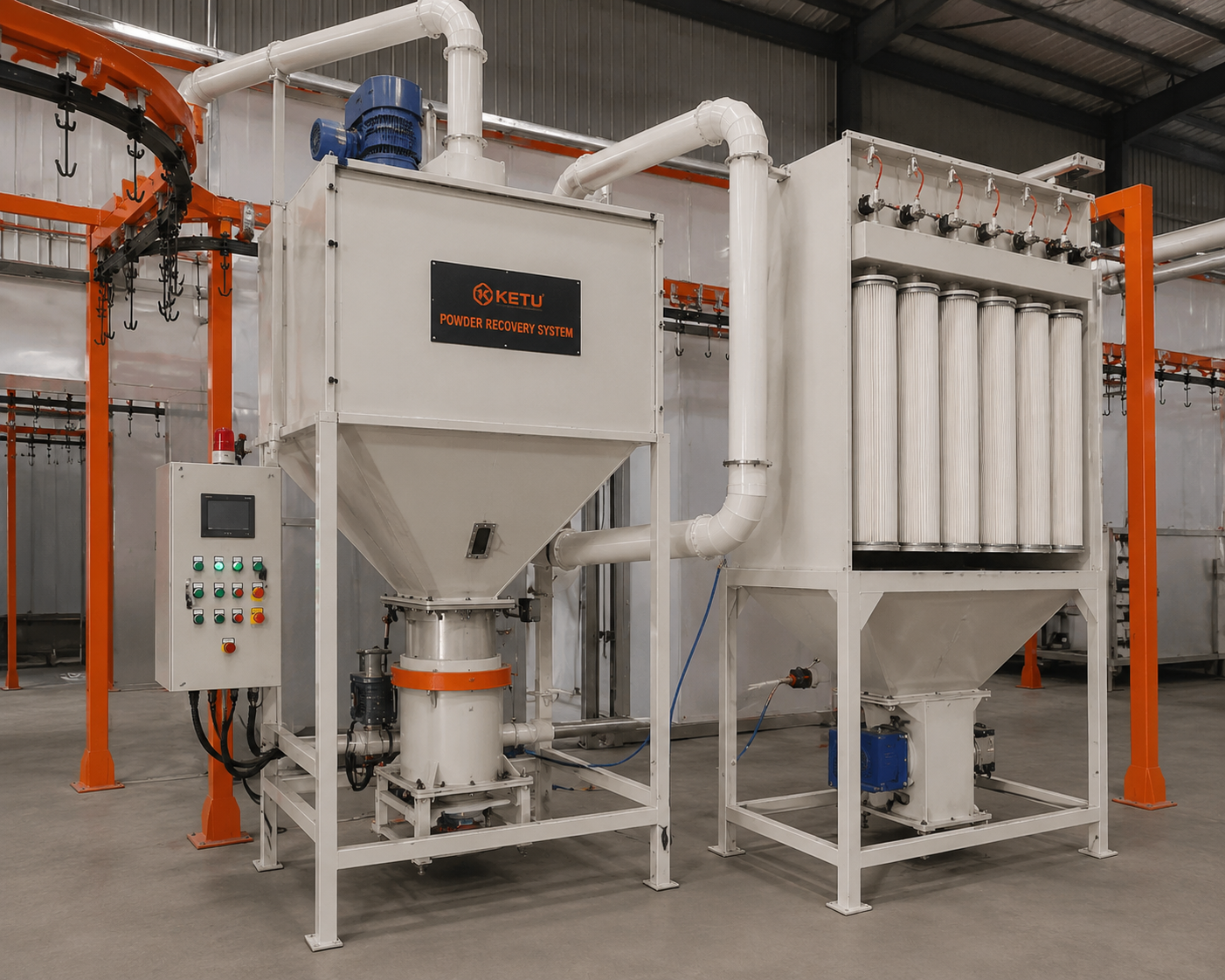
Our large cyclone collectors utilize dual-stage centrifugal separation technology to extract particulate matter from the airstream with exceptional efficiency. When dust-laden gas enters the cone-designed barrel body, the specialized inlet pipe geometry creates high-velocity rotational motion. Centrifugal force pushes heavier particles toward the barrel wall, where they slide gravitationally into the hopper collection chamber, while purified air discharges from the top outlet.
This design achieves 99.5% separation efficiency while maintaining consistent airflow dynamics across 8000-ton annual production volumes. Key benefits include near-zero powder loss during spray cycles, reduced material waste translating to lower per-unit coating costs, minimized environmental emissions, and extended spray booth lifespan due to cleaner operational conditions.
Explore Cyclone Technology
Uniform, High-Quality Coverage Through Electrostatic Particle Acceleration
Electrostatic powder spraying technology charges powder particles to create electromagnetic attraction between the coating material and grounded workpiece surfaces. Our spray systems accelerate charged powder particles toward the target at controlled velocities, ensuring even penetration into recesses, sharp edges, and complex geometries.
The result is smooth, uniform, and structurally sound coating thickness across 100% of the workpiece surface, eliminating under-coated zones, drips, and finish defects common with conventional spray methods. Typical coating thickness ranges from 80 to 150 microns with plus or minus 25 microns uniformity. Key benefits include consistent coating quality enabling 98%+ first-pass acceptance rates, professional finish appearance, superior adhesion and corrosion resistance, and flexible powder changeover supporting multi-color production without downtime.
Download Technical SpecificationsLarge Cyclone Collector Coating Line — Complete System Technical Profile
A complete large cyclone collector coating line is not only a spray booth. It is an integrated production system combining cyclone powder recovery, electrostatic spray control, conveyor movement, curing, air treatment, and PLC-based process monitoring. This redesigned technical profile presents the system in a visual, specification-led layout for engineers, purchasing teams, and production managers.
Cyclone Collector Performance Specifications
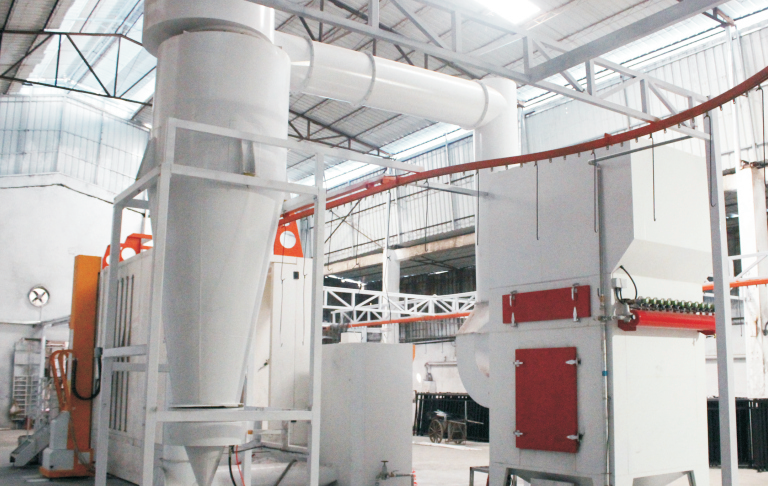
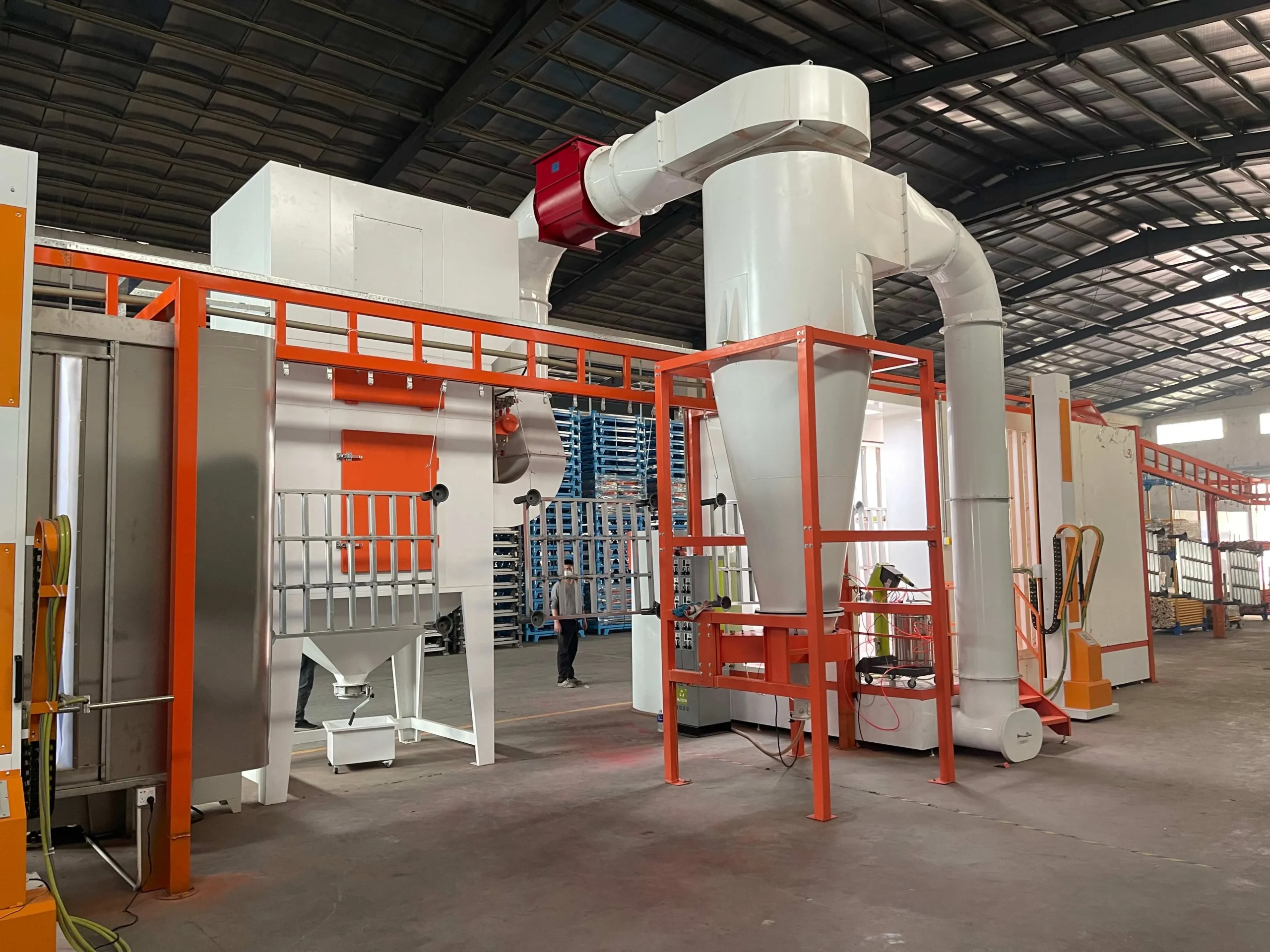
The cyclone collector is the core recovery module of the line. Dust-laden airflow enters the cone-designed chamber through a tangential inlet, creating high-speed rotational movement. Centrifugal force separates powder particles from the air stream, allowing recoverable powder to move into the hopper while cleaner air exits through the upper outlet.
This structure is suitable for high-volume coating operations where powder recovery, stable airflow, and low maintenance frequency directly affect operating cost.
Electrostatic Spray System Parameters
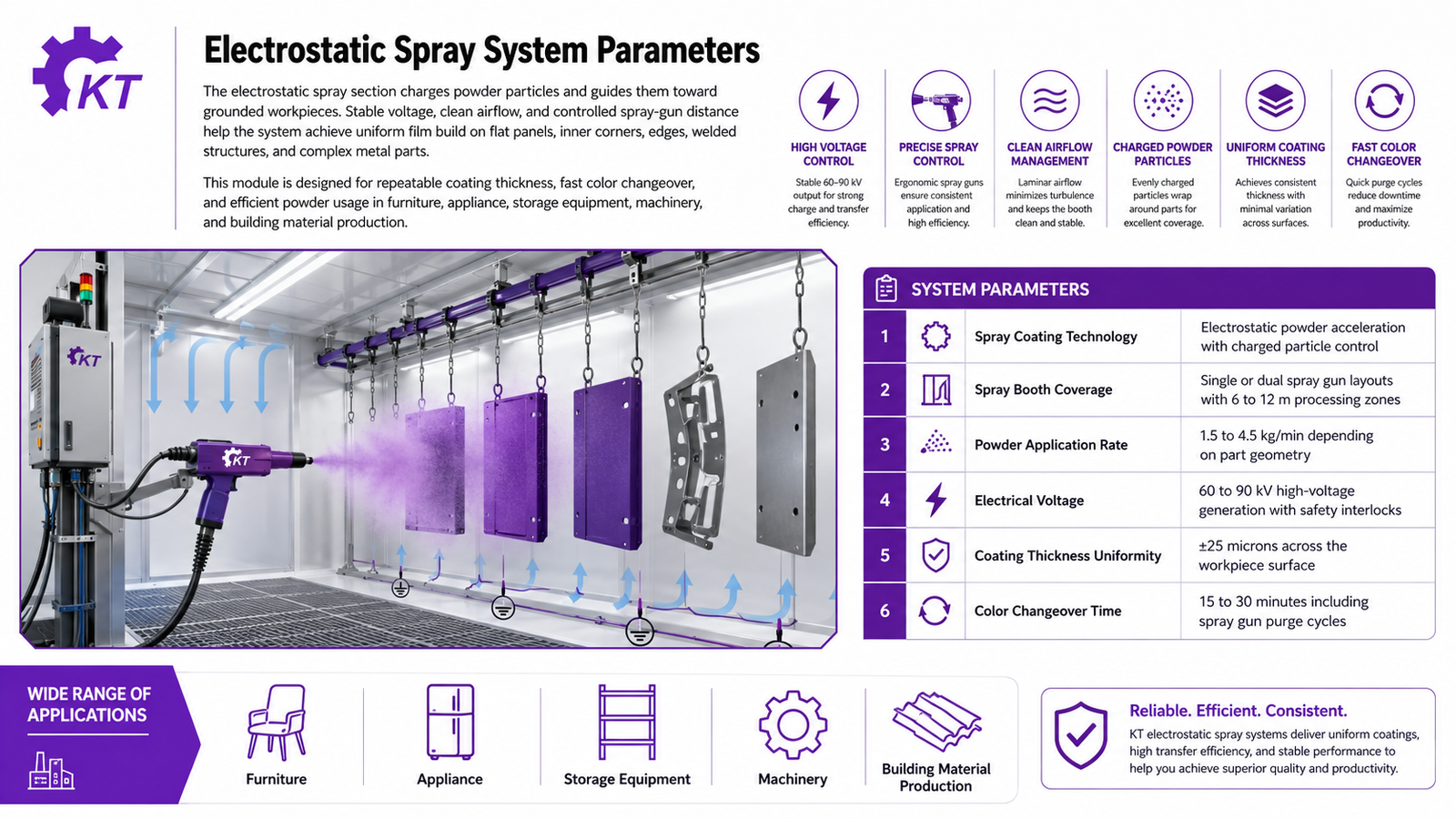
The electrostatic spray section charges powder particles and guides them toward grounded workpieces. Stable voltage, clean airflow, and controlled spray-gun distance help the system achieve uniform film build on flat panels, inner corners, edges, welded structures, and complex metal parts.
This module is designed for repeatable coating thickness, fast color changeover, and efficient powder usage in furniture, appliance, storage equipment, machinery, and building material production.
Production Capacity Range
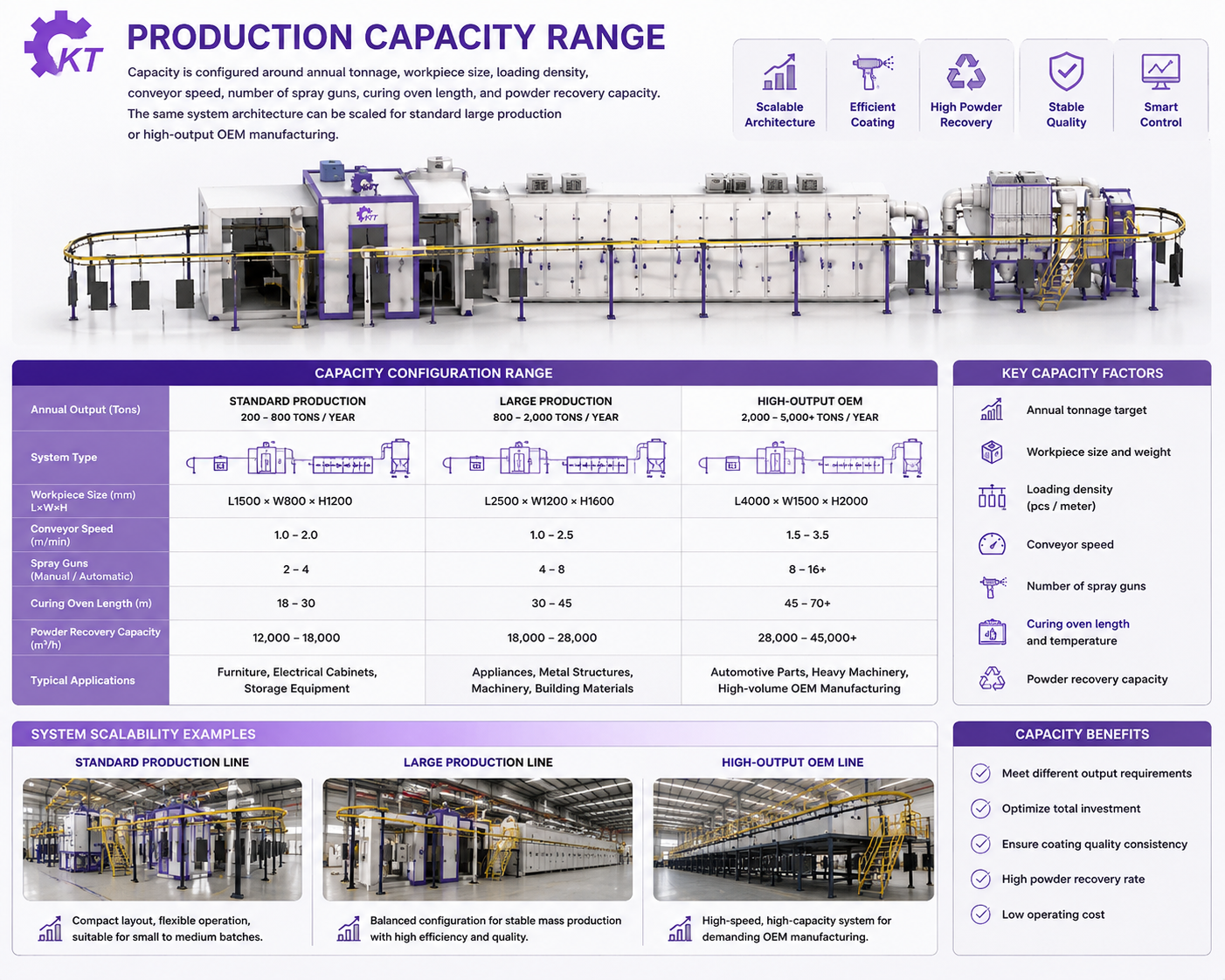
Capacity is configured around annual tonnage, workpiece size, loading density, conveyor speed, number of spray guns, curing oven length, and powder recovery capacity. The same system architecture can be scaled for standard large production or high-output OEM manufacturing.
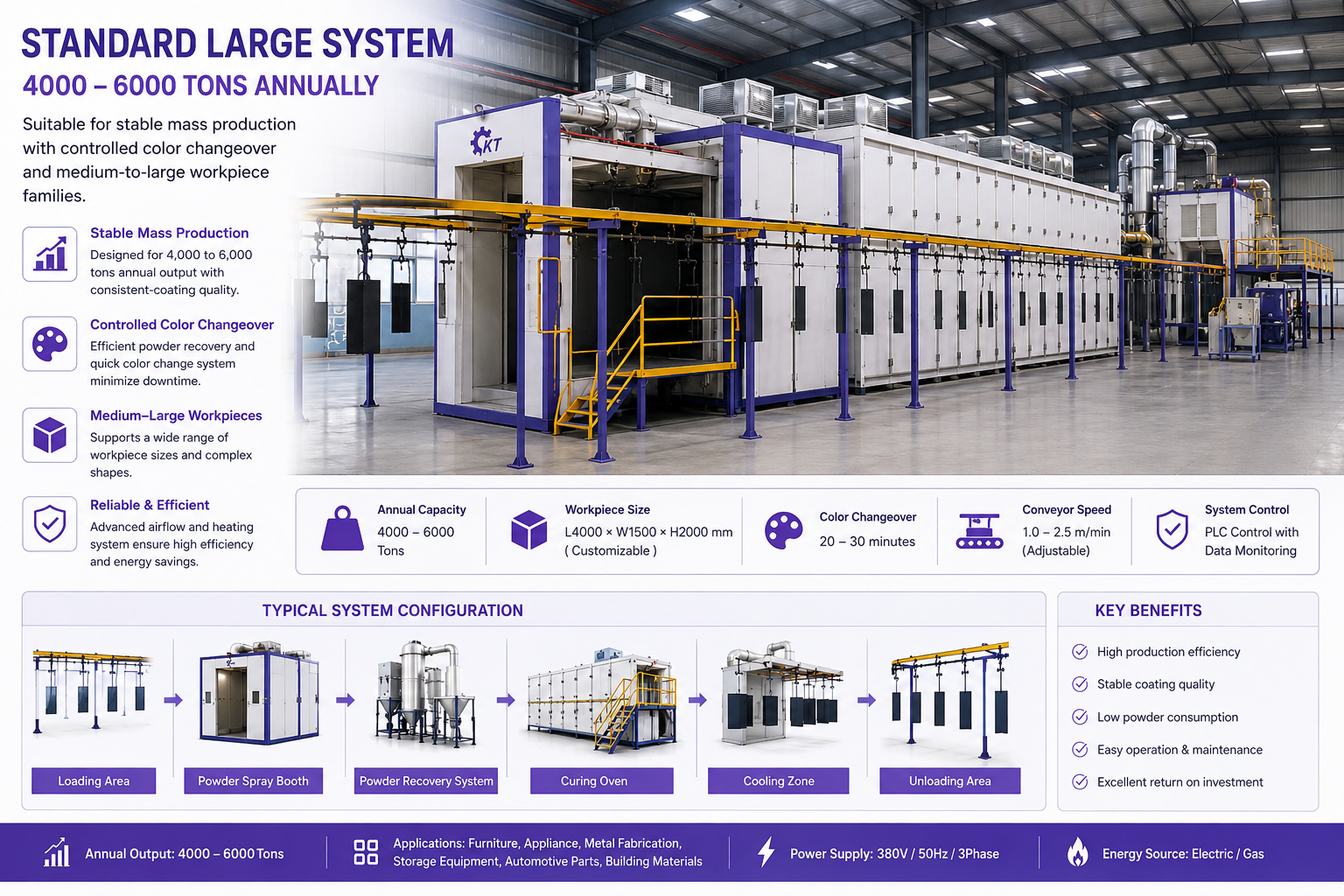
Standard Large System
4000 to 6000 tons annually. Suitable for stable mass production with controlled color changeover and medium-to-large workpiece families.
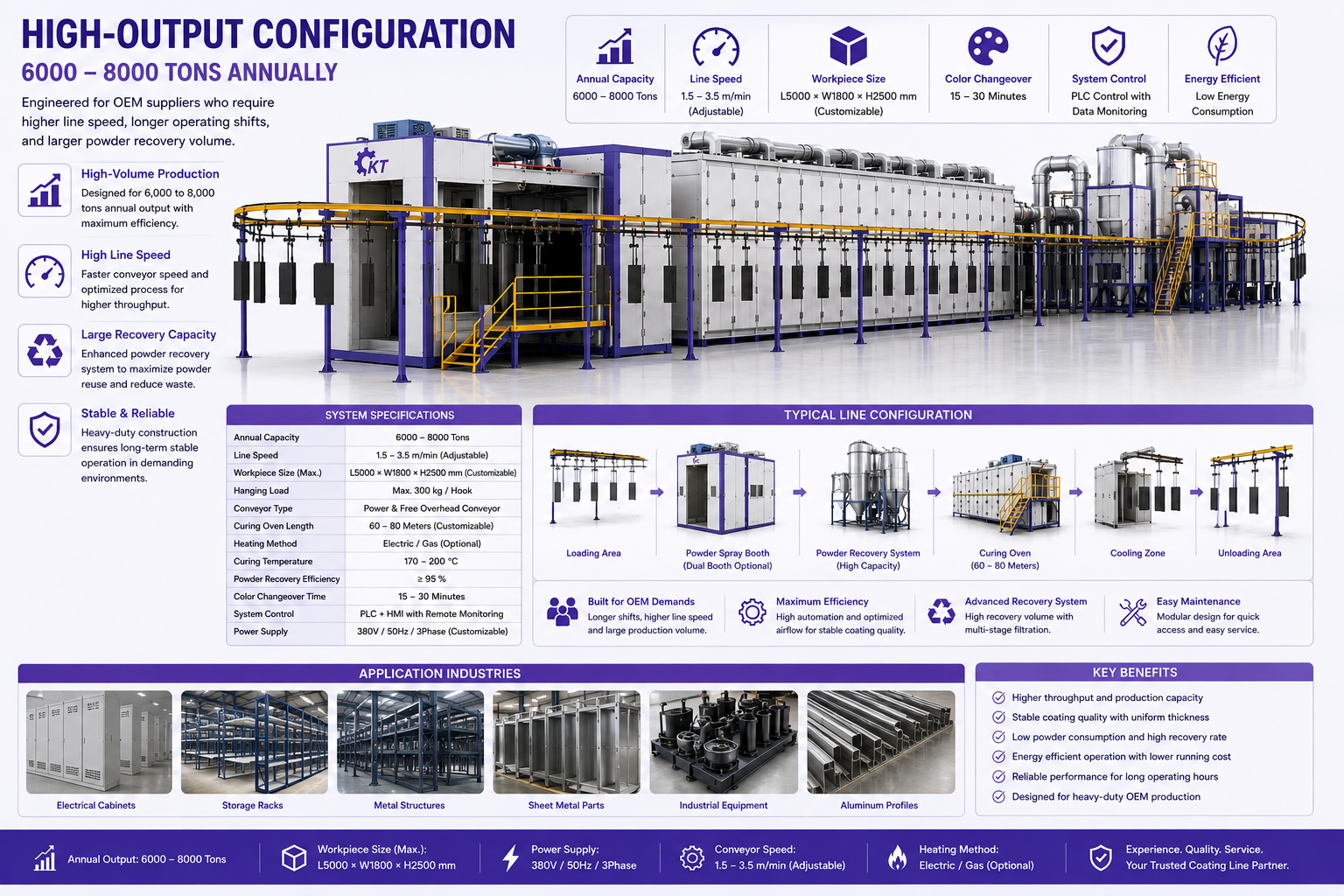
High-Output Configuration
6000 to 8000 tons annually. Built for OEM suppliers requiring higher line speed, longer operating shifts, and larger recovery volume.
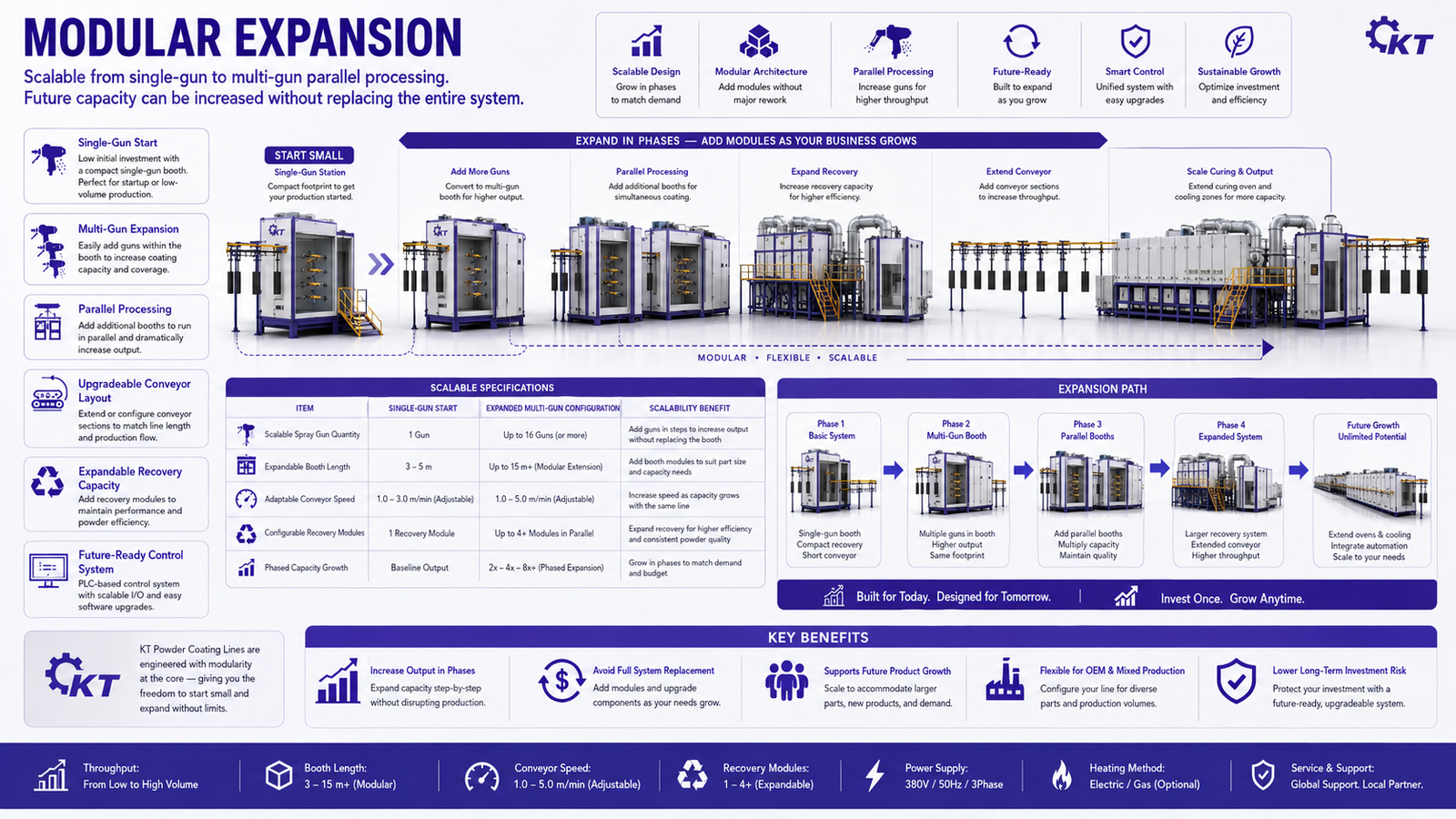
Modular Expansion
Scalable from single-gun to multi-gun parallel processing. Future capacity can be increased without replacing the entire system.
Component Quality Standards
Reliable output depends on the quality of the high-voltage module, PLC control system, pneumatic parts, electrical protection, steel fabrication, and powder-contact components. Each module should be selected for industrial duty, long operating hours, spare-part availability, and safe maintenance access.
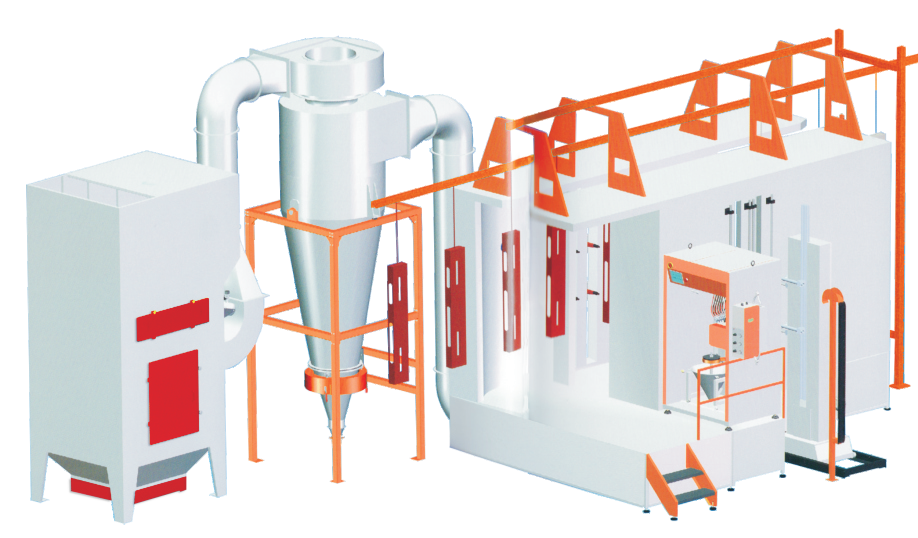

Electrostatic High-Voltage Modules
Industrial-rated modules support reliable particle charging and stable spray performance during extended production campaigns.
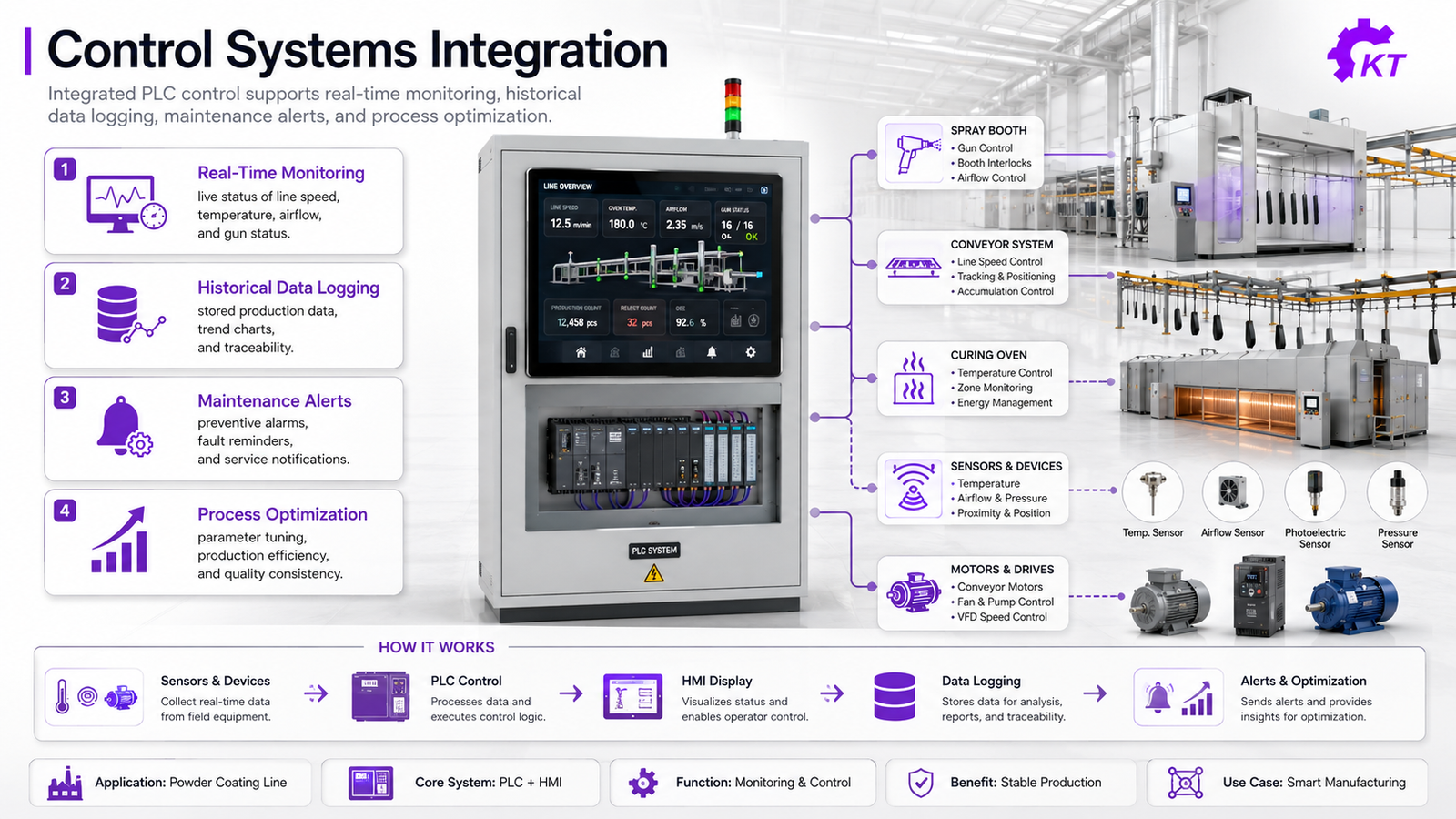
Control Systems Integration
Integrated PLC control supports real-time monitoring, historical data logging, maintenance alerts, and process optimization.
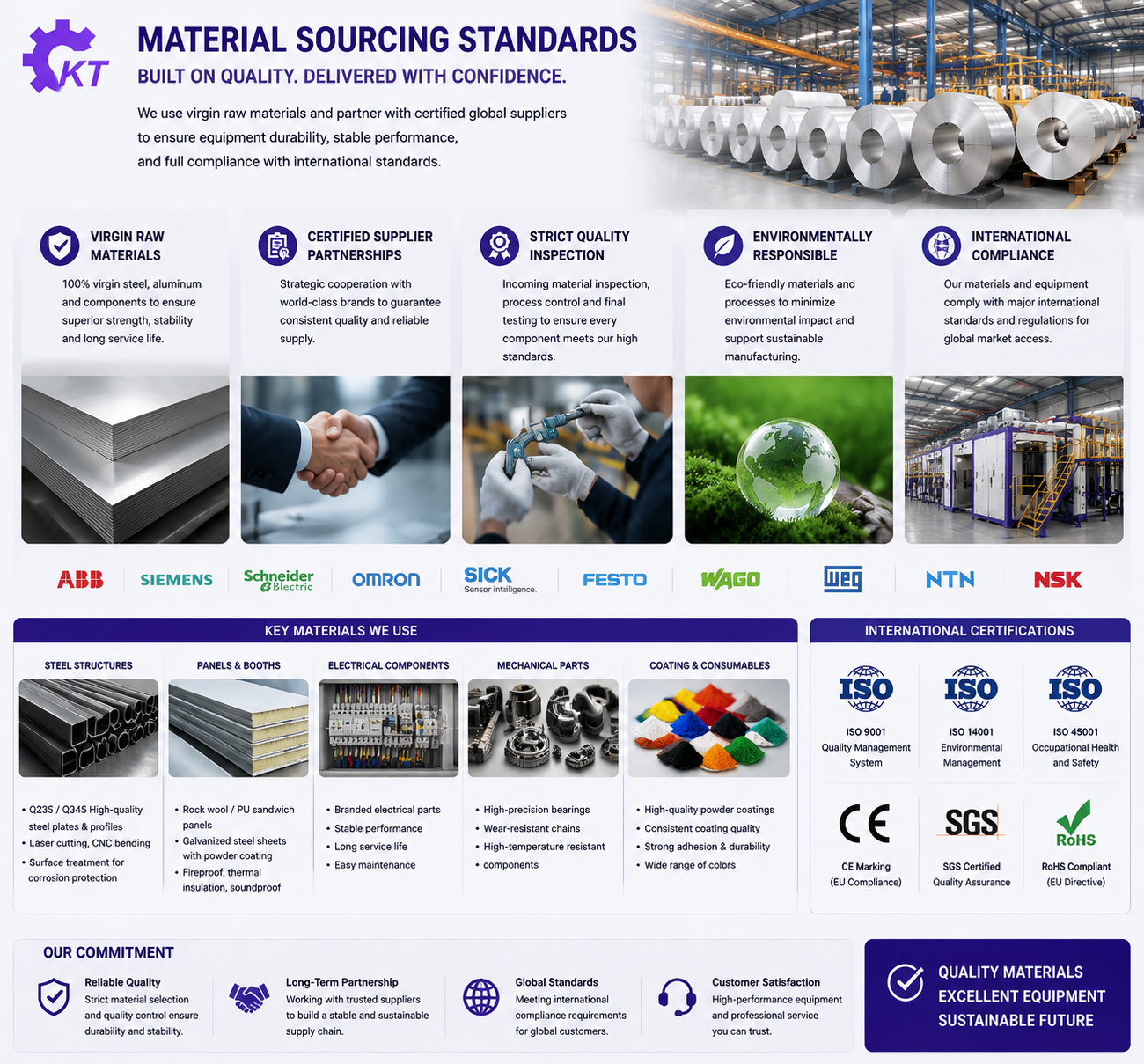
Material Sourcing Standards
Virgin raw materials and certified supplier partnerships improve equipment durability and support international compliance needs.
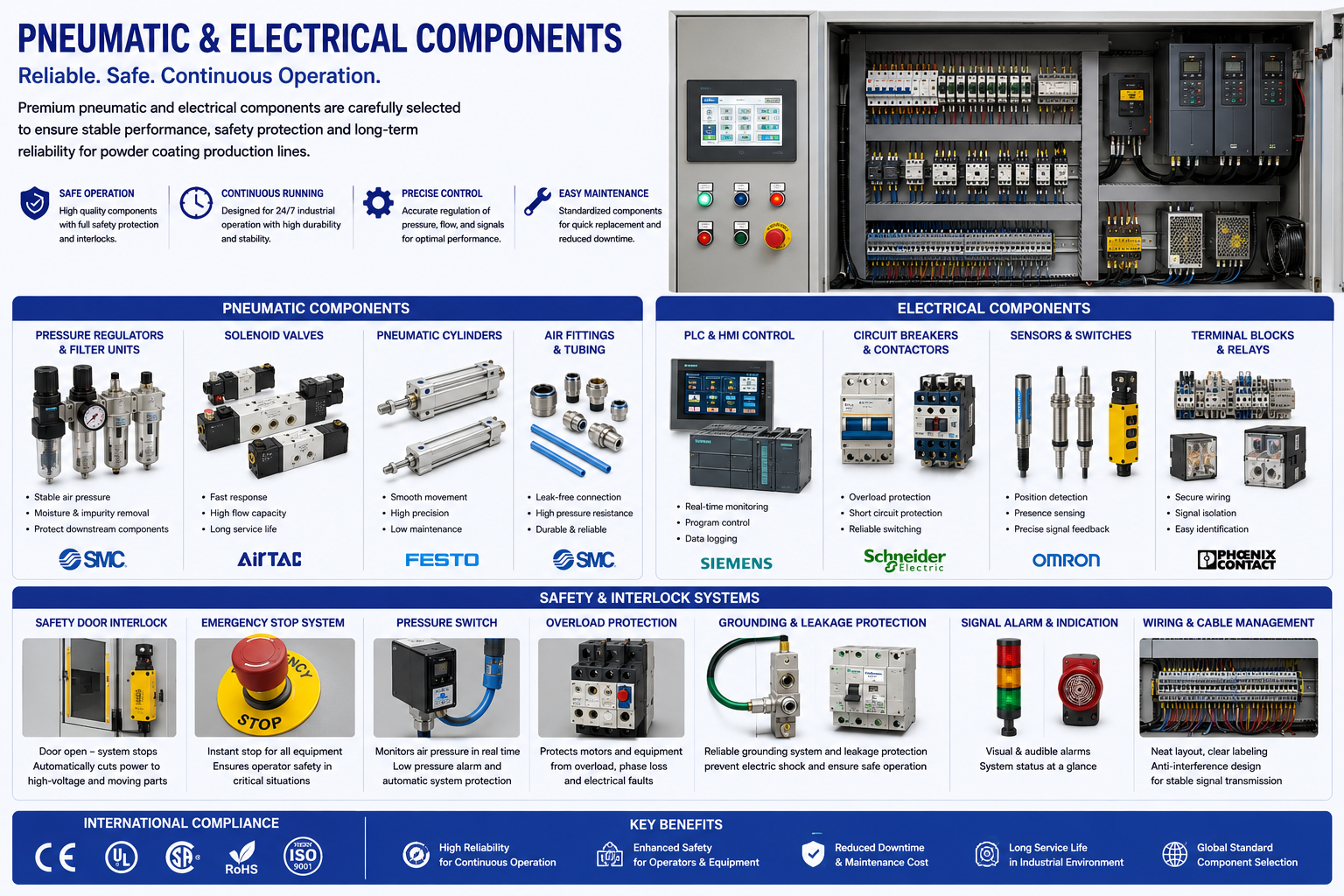
Pneumatic & Electrical Components
Pressure regulators, valves, interlocks, and electrical systems are selected for safe, continuous industrial operation.
Need a technical profile matched to your factory layout?
Share your workpiece size, daily output target, powder type, available floor space, and preferred automation level. Our engineering team can prepare a line configuration with cyclone size, spray booth layout, curing method, conveyor path, and utility requirements.
Request Detailed Technical Datasheet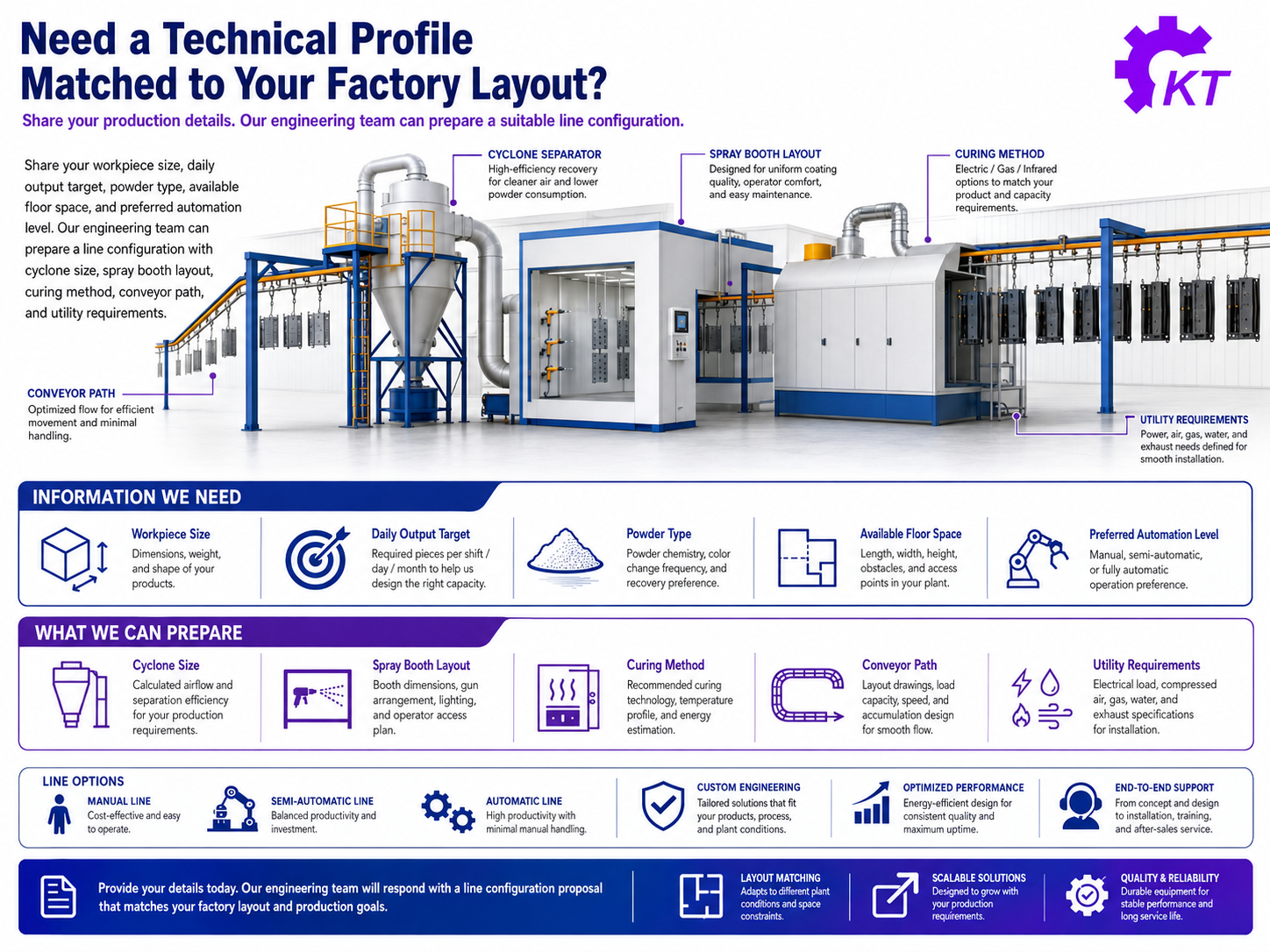
Complete Coating Process — From Raw Part to Finished Product
Understand the complete five-stage coating workflow and environmental compliance integration ensuring superior final product quality.
Stage 1: Pre-Treatment & Preparation
Metal parts enter the facility and undergo surface cleaning to remove oils, oxidation, and contaminants. Degreasing, chemical pickling, or mechanical abrasion procedures ensure optimal powder adhesion. Parts are racked onto conveyor fixtures designed for electrostatic spray pattern optimization. Environmental controls maintain humidity levels between 35% to 65% relative humidity, preventing moisture-related adhesion failures. Duration: 15 to 30 minutes depending on contamination level and part complexity.
Stage 2: Electrostatic Powder Spray Application
Charged powder particles are accelerated toward grounded workpiece surfaces, creating uniform, high-adhesion coating coverage. The spray system applies controlled powder thickness, typically 80 to 150 microns, with electrostatic technology achieving near-100% material utilization compared to 60% to 70% efficiency of conventional spray methods. Multi-gun configurations enable dual-sided coating or increased throughput. Duration: 3 to 8 minutes per part batch.
Stage 3: Cyclone Collection & Powder Recovery
Excess powder and atomized overspray are captured by the large cyclone collector system's powerful airflow. Centrifugal separation forces particulate matter toward the collection chamber hopper, achieving 99.5% powder recovery efficiency. Recirculation systems automatically return recovered powder to the spray booth storage system, minimizing material waste and reducing consumption costs by 25% to 40%. Duration: Continuous concurrent process during spray stage.
Stage 4: Curing & Cross-Linking
Coated parts transfer to electric or gas-fired curing ovens maintaining controlled temperature profiles between 180 to 230 degrees Celsius. Powder particles melt, flow, and cross-link through thermochemical polymerization, forming durable, glossy, or matte finish coatings with superior adhesion and corrosion resistance. Standard curing cycles require 10 to 25 minutes. Duration: 10 to 25 minutes.
Stage 5: Environmental Compliance & Air Treatment
Exhaust air from spray booths and curing ovens passes through secondary dust filtration and optional VOC treatment systems, ensuring compliance with local environmental regulations. Activated carbon filters, thermal oxidizers, or regenerative thermal oxidizers capture residual powder particles and volatile organic compounds. Treated air is safely discharged or recirculated. Duration: Continuous real-time process.
20+ Years of Proven Industrial Coating Expertise
Complete quality control through vertical integration and in-house manufacturing of all system components.
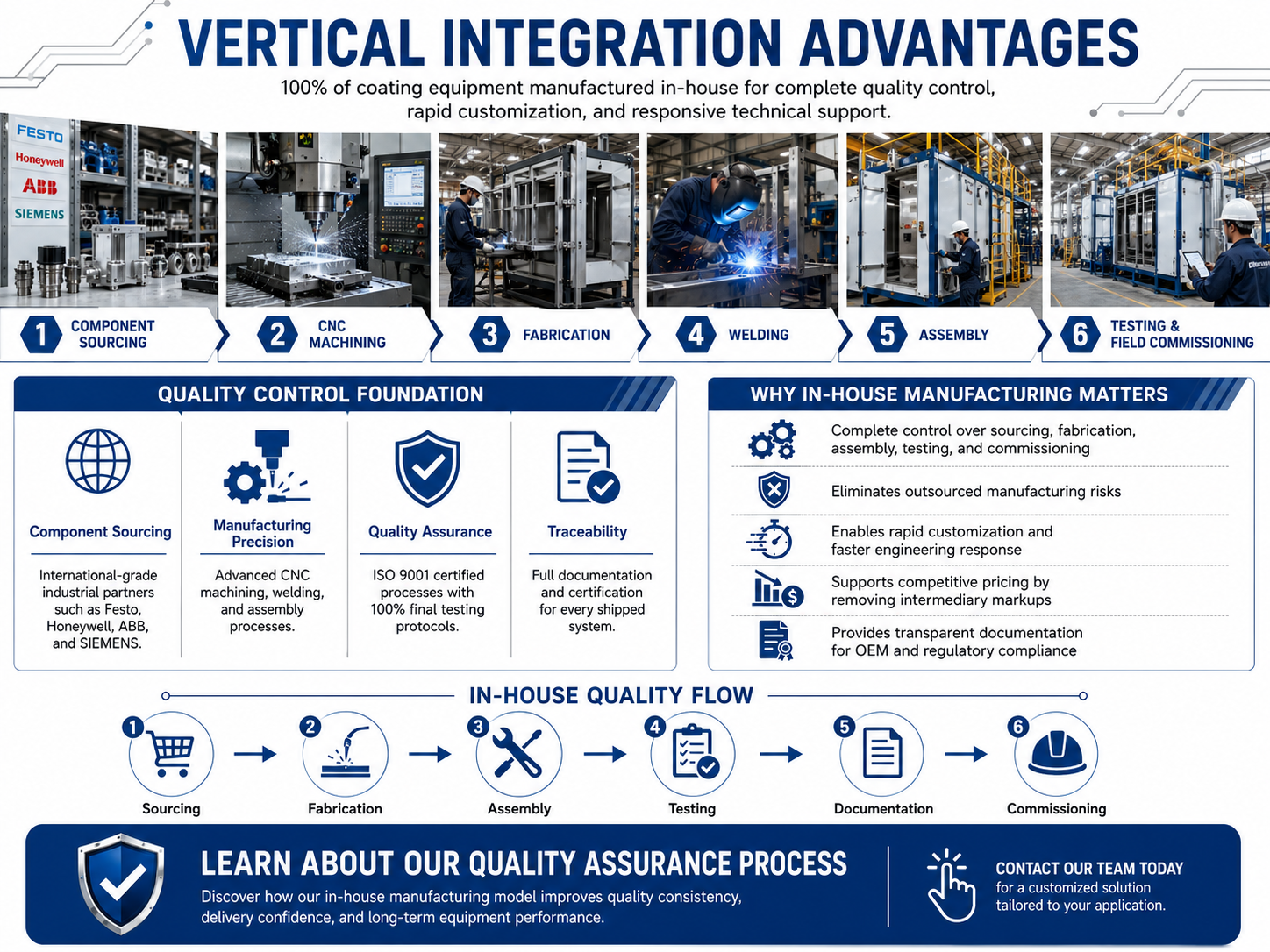
Vertical Integration Advantages
100% of coating equipment manufactured in-house, providing complete quality control over component sourcing, fabrication, assembly, testing, and field commissioning. This eliminates outsourced manufacturing risks while enabling rapid customization and responsive technical support.
Quality Control Foundation
- • Component Sourcing: International-grade industrial partners (Festo, Honeywell, ABB, SIEMENS)
- • Manufacturing Precision: Advanced CNC machining, welding, and assembly processes
- • Quality Assurance: ISO 9001 certified processes with 100% final testing protocols
- • Traceability: Full documentation and certification for every shipped system
Direct manufacturing relationships eliminate intermediary markups, enabling competitive pricing without compromising quality standards. Full traceability of all manufacturing processes, material certifications, and quality documentation provides transparent documentation for OEM and regulatory compliance.
Flexible Configuration Options
Scale your system to match exact production requirements through modular customization across capacity, industry-specific, environmental, and automation dimensions.
Production Capacity Scaling
Small-Scale Configuration: 1500 to 2500 tons annual capacity with single cyclone collector and compact spray booth footprint, ideal for job-shop metalworking or specialty furniture manufacturers. System occupies 800 to 1200 square meters of floor space.
Medium-Capacity Configuration: 3000 to 5000 tons annual capacity with dual cyclone collectors and expanded spray processing zones, supporting mid-volume appliance, building materials, or storage equipment producers. System occupies 1200 to 1800 square meters of floor space.
High-Output Configuration: 6000 to 8000 tons annual capacity with multi-stage cyclone systems and parallel spray processing capabilities, engineered for large-scale OEM suppliers. System occupies 1800 to 2500 square meters of floor space.
Modular Expansion Pathways: Future capacity increases accommodated through additional spray gun modules, expanded cyclone capacity, or secondary processing line integration without complete system replacement.
Industry-Specific Solutions
Furniture Industry Package: Optimized spray patterns for complex frame geometries, chair components, and table bases. Integrated powder color storage for 8 to 12 simultaneous color options. Quick changeover protocols enabling daily color switching. Specialized conveyor fixtures for furniture-specific part handling.
Home Appliance Configuration: High-precision spray parameters for smooth, consistent cosmetic finishes on large body panels and trim components. Dual-sided coating capability for simultaneous front and rear panel processing. Thickness uniformity controls meeting OEM aesthetic specifications. Advanced finish quality monitoring systems.
Building Materials Solution: Specialized profile coating modules for extrusion applications and linear component processing. Multi-stage spray zones accommodating both flat panels and complex geometric components. Extended curing protocols optimizing powder flow on architectural aluminum profiles. Precision spray angle adjustments for profile-specific coverage.
Environmental Upgrade Modules
VOC Treatment System: Integrated thermal oxidizer or regenerative oxidizer capturing volatile organic compounds from spray booth exhaust. Reduces atmospheric VOC emissions by 99% while recovering waste heat for facility HVAC efficiency. Compliance with EPA and local environmental regulations.
Wastewater Treatment Addition: Closed-loop water management system for spray booth water curtains. Particulate settlement and chemical treatment protocols meeting local water discharge regulations. Minimizes environmental impact and reduces water consumption by 60% to 70%.
Powder Recovery Enhancement: Secondary cyclone stages or cartridge filtration capturing ultrafine particles. Recirculation systems maximizing powder recovery rates to 99%+ efficiency, reducing material consumption by 30% to 40%. Integrated hopper management with automated discharge protocols.
Automation & Control Integration
Basic Automation: Manual spray operations with standard control panels, timer-based curing cycles, and basic parameter adjustments. Suitable for low-volume or specialty applications. Operator-friendly interface with minimal training requirements.
Smart Integration Configuration: Industrial PLC control systems with real-time parameter monitoring, historical data logging, predictive maintenance alerts, and production efficiency dashboards. Integration with customer ERP systems enabling production scheduling automation and traceability documentation. Mobile app access for remote monitoring and diagnostics.
Advanced Features: Automatic spray booth environmental compensation, predictive powder consumption tracking, integration with facility energy management systems, and comprehensive audit trail documentation for regulatory compliance.
Industrial-Grade Quality Assurance Backed by Two Decades of Expertise
Proven manufacturing excellence, international component standards, and comprehensive customer support relationships.
Vertical Integration Commitment
100% of coating equipment manufactured in-house, providing complete quality control over component sourcing, fabrication, assembly, testing, and field commissioning. Eliminates outsourced manufacturing risks while enabling rapid customization and responsive technical support.
International Component Standards
Electrostatic modules, pneumatic controls, electrical systems, and structural components sourced from Festo, Honeywell, ABB, SIEMENS, and equivalent tier-one industrial suppliers. System reliability supported by global spare parts availability and manufacturer technical support.
20+ Years Continuous Innovation
Two decades of market presence demonstrating sustainable business operations, technical capability maintenance, and customer satisfaction across global markets. Continuous investment in engineering advancement and manufacturing capability expansion.
Production Track Record
8000+ tons annual capacity indicating manufacturing sophistication, process repeatability, and ability to deliver complex custom systems on committed timelines. Production volume supports both standard configurations and highly specialized applications.
Global Client Portfolio
Proven partnerships with machinery manufacturers, furniture producers, appliance suppliers, building materials companies, storage equipment makers, elevator component suppliers, and specialized industrial coating users across Asia, Europe, and North America.
Full-Lifecycle Service Commitment
Support programs extending from initial needs assessment and technical design through installation, operator training, production optimization, preventive maintenance, and system expansion. Dedicated technical support team available 24/7 for troubleshooting.
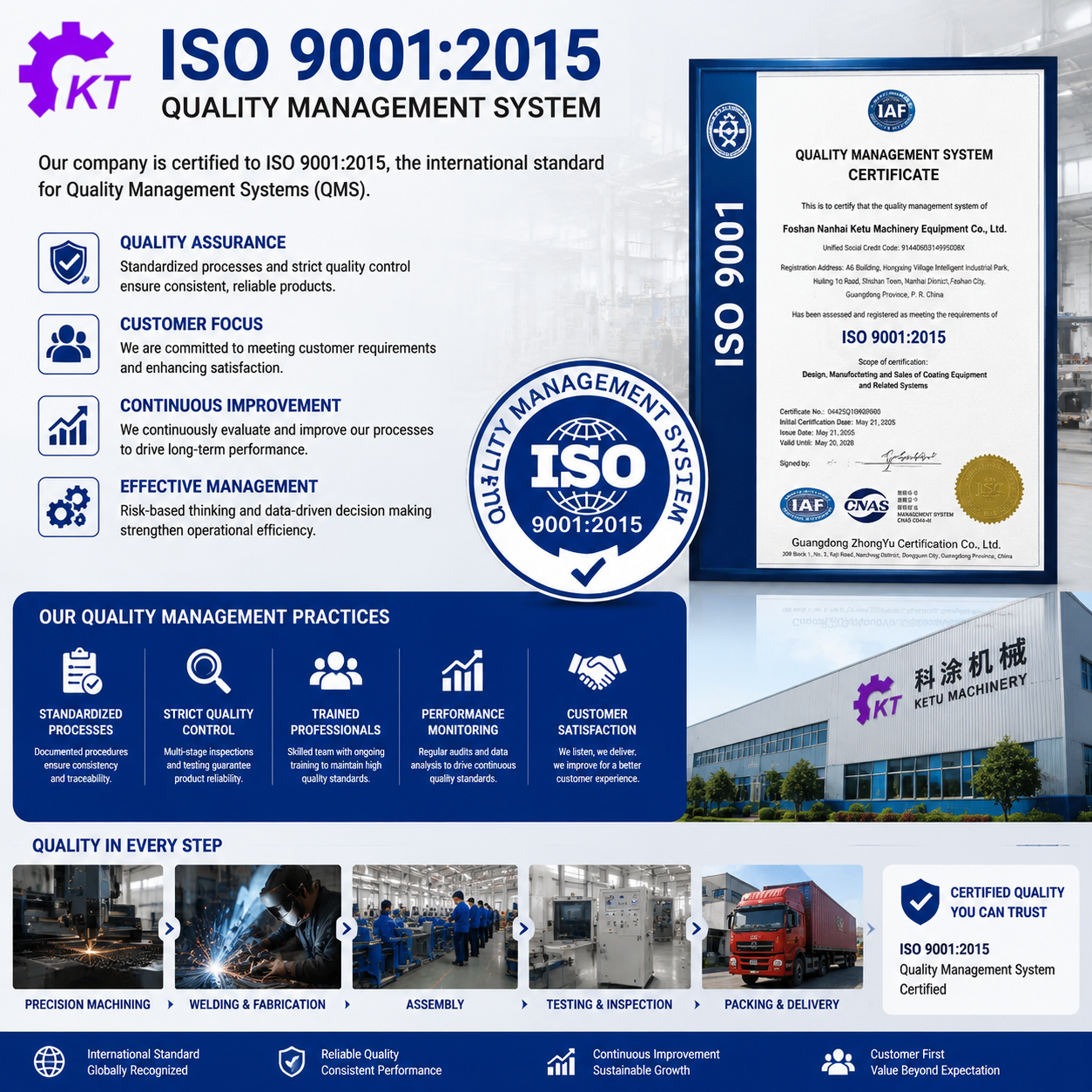
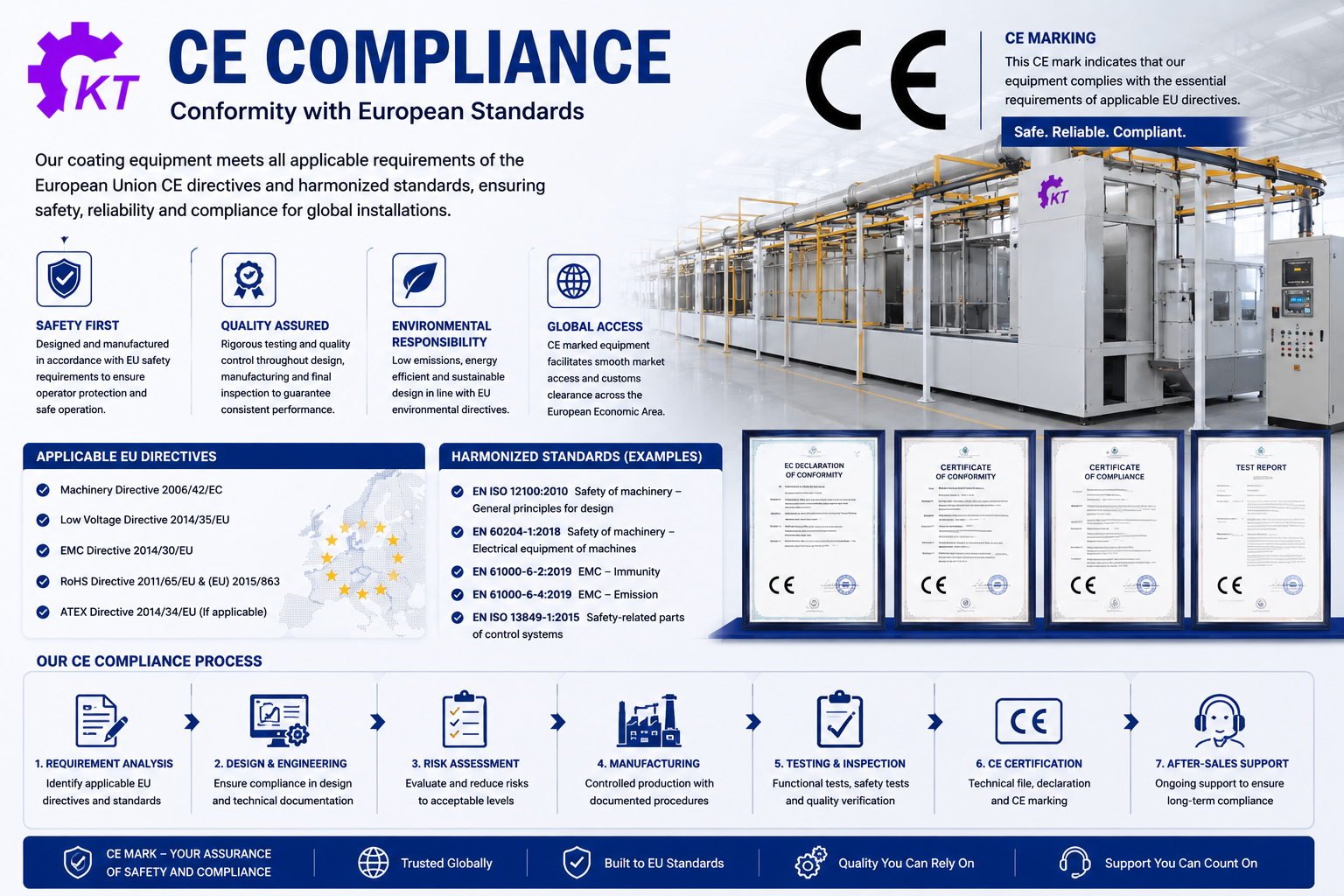
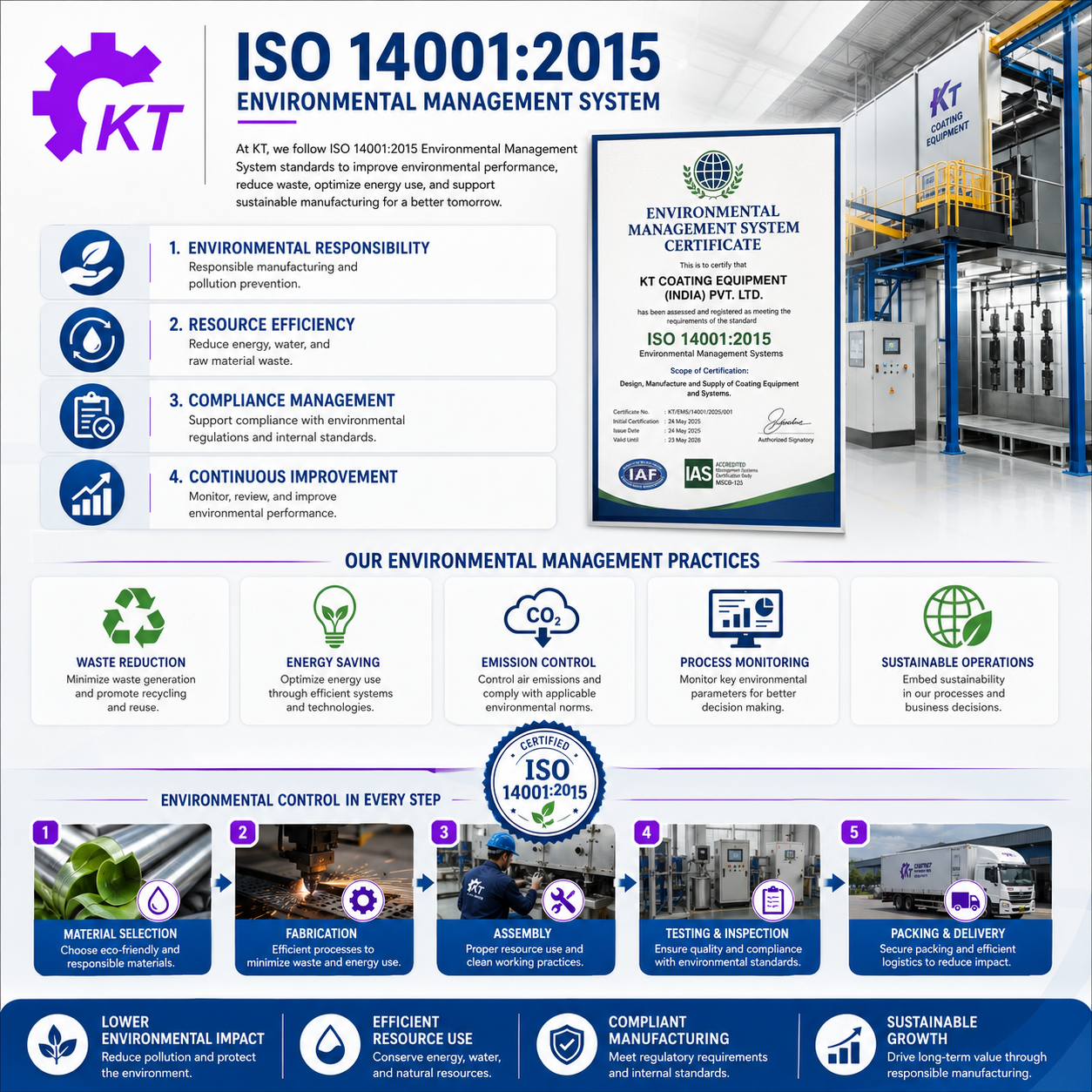
Certificates & Industry Recognition

Frequently Asked Questions
Essential technical and operational questions answered by our industry experts.
How does the large cyclone collector system differ from standard dust collection methods?
The large cyclone collector utilizes advanced centrifugal separation technology fundamentally different from conventional bag filtration or cartridge filter systems. When dust-laden air enters the conical barrel body, specialized inlet geometry creates high-velocity rotational airflow. Heavier powder particles experience centrifugal force pushing them toward the barrel wall, where they slide gravitationally into the hopper collection chamber while clean air discharges from the top outlet. This design achieves 99.5% dust recovery efficiency compared to 92% to 96% of standard bag filter systems.
Cyclone systems generate less pressure drop across the collection chamber, reducing energy consumption and enabling higher production throughput. The large cyclone configuration processes 15000 to 45000 cubic meters of airflow per hour versus 8000 to 15000 for smaller systems. Maintenance requirements are significantly reduced because cyclone systems have no filter media requiring regular replacement, translating to lower total cost of ownership over 10-year system lifespan.
How does electrostatic powder coating ensure superior finish quality compared to conventional spray methods?
Electrostatic powder coating utilizes charged particle acceleration technology creating electromagnetic attraction between powder particles and grounded workpiece surfaces. Charged particles are accelerated toward parts at precisely controlled velocities, ensuring consistent penetration into recesses, sharp edges, and complex geometries where conventional spray methods produce uneven coverage.
The electrostatic field enables micro-level thickness uniformity of plus or minus 25 microns across entire workpiece surface, preventing under-coated zones, drips, and finish defects characteristic of manual or air-assisted spray applications. Material utilization efficiency reaches 95% to 98% with electrostatic methods versus 60% to 70% with conventional techniques, meaning 25% to 40% less powder required for equivalent coverage. First-pass acceptance rates consistently exceed 98%.
Which industries are best suited for large cyclone collector coating systems?
Large cyclone systems serve six primary manufacturing verticals with distinct selection requirements:
- Furniture Manufacturing: Metal frames, outdoor seating, cabinet assemblies. Processing volumes 500 to 2000 pieces per day. Coating thickness 60 to 100 microns required.
- Home Appliance Production: Refrigerator cabinets, washing machine drums, air conditioning units. Daily throughput 800 to 3000 units. Complex recessed surfaces and corners demand superior electrostatic coverage.
- Elevator Components: Guide rails, car frames, cabin doors. High-volume standardized parts. Corrosion resistance and appearance uniformity critical for end-user satisfaction.
- Building Materials: Aluminum profiles, steel structural components, ceiling systems. Large-scale orders requiring consistent batch quality and rapid turnaround.
- Industrial Machinery: Motor housings, pump bodies, transmission casings. Tight dimensional tolerances and specialized finish requirements.
- Automotive Parts Suppliers: Brackets, fastener hardware, trim components. OEM specification compliance and zero-defect mandates.
What is the typical payback period for large cyclone collector line investment?
Return on investment timeline depends on baseline production volume, current coating method, and labor costs in your region. Our analysis of 45 customer installations across three years indicates average payback periods of 18 to 36 months.
Investment justification factors include: material waste reduction worth USD 8000 to 25000 annually through improved transfer efficiency; labor reduction of 2 to 4 full-time operators through automation; quality improvement eliminating rework costs of 3% to 8% of monthly revenue; and energy efficiency reducing electricity consumption 15% to 22% versus manual spray operations. First-year operational cost savings typically range USD 45000 to 120000 depending on current production baseline.
Can the large cyclone system be retrofitted to existing coating facilities?
Yes. Our modular design philosophy enables both integration into new production facilities and retrofit applications within existing manufacturing environments. Retrofitting requires facility assessment addressing floor space availability, electrical infrastructure capacity, compressed air supply specifications, and exhaust ducting routing.
Typical retrofit timeline spans 6 to 12 weeks from equipment arrival to full production commissioning. We provide detailed CAD facility layout plans, equipment positioning recommendations, ductwork specifications, and electrical connection diagrams. On-site installation supervision ensures seamless integration and minimal production downtime. We recommend scheduling retrofit during planned facility maintenance or production shutdown windows. Retrofit packages include temporary material handling solutions enabling parallel operation of legacy coating methods during transition period.
What powder coating colors and special finishes are available?
Our supply partnerships include access to 300-plus powder coating formulations covering standard RAL colors, metallic finishes, texture effects, and specialized industrial specifications.
Standard color availability: RAL Classic series, custom color matching from physical samples or Pantone references. Special finishes include: hammer-tone textured finishes providing visual depth and impact resistance; high-gloss finishes achieving 85+ gloss units; matte finishes for modern aesthetic applications; metallic effects with aluminum or mica particles; antimicrobial formulations for healthcare and food service environments; food-grade coatings compliant with FDA CFR 175.300. Specialty formulations typically require 4-week lead time for initial batch preparation.
What maintenance schedule and spare parts availability should be planned?
Preventive maintenance protocols ensure optimal system reliability and component lifespan. Recommended maintenance schedule encompasses:
Daily: Visual inspection of spray nozzles, filter status, air pressure readings. Weekly: Compressed air filter cartridge inspection and condensation drainage. Monthly: High-voltage electrode cleaning, hopper level verification, bearing lubrication. Quarterly: Comprehensive system performance diagnostics including airflow measurement, particle recovery efficiency testing, electrical safety verification. Annual: Major component inspection including motor brushes, capacitor banks, ducting for corrosion.
Common wearing components with recommended replacement intervals: spray electrodes every 12-18 months; capacitor banks every 18-24 months; bearing assemblies every 24-36 months; collector chamber gaskets annually. We maintain 24-month spare parts inventory including critical high-voltage components, replacement nozzles, filtration media, and mechanical seals. Emergency support available for critical system failures. Standard warranty covers two years parts and labor; extended warranties to five years available.
 English
  German
  Vietnamese
  French