What is Powder Coating Line? Complete Guide to Process, Components & Applications
Definition and Basic Concept
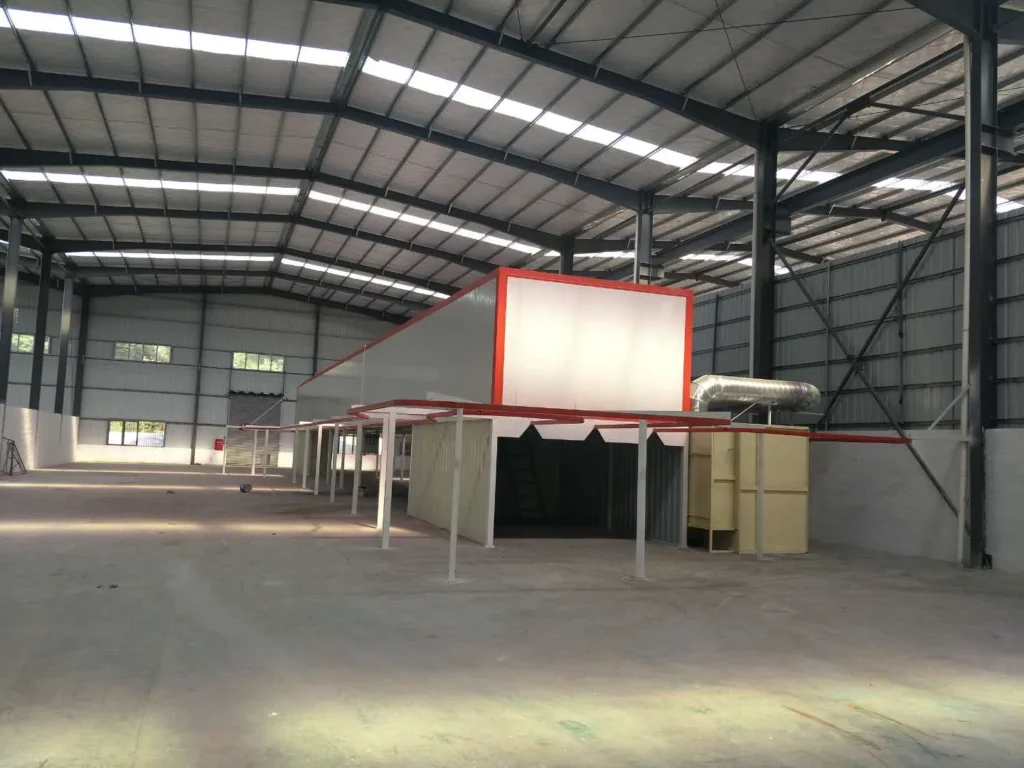
A powder coating line is a complete surface treatment system that uses electrostatic technology to apply dry powder coating to metal workpieces, followed by heating to form a durable, uniform finish. Unlike traditional liquid paint spraying, powder coating operates without solvents, making it environmentally cleaner, more efficient, and highly suitable for large-scale manufacturing.
The process is straightforward in concept but sophisticated in execution: workpieces receive a dry powder coating through static electrical attraction, then pass through a heating chamber where the powder melts, flows, and chemically hardens into a protective layer. This method has become the preferred choice across industries—from furniture and outdoor equipment to electrical cabinets, aluminum extrusions, and metal components—because it delivers superior adhesion, corrosion resistance, and finish consistency while minimizing waste.
From our experience at Ketu, we've worked with hundreds of manufacturers across multiple continents, and we've learned that understanding how a powder coating line actually works—not just what it does—is critical for anyone considering this investment. A powder coating line isn't simply a "paint machine." It's a carefully orchestrated system where every stage, from surface preparation to final cooling, directly impacts your product quality and production economics.
How Powder Coating Lines Work: Core Process Stages
Pre-treatment (Surface Preparation)
Pre-treatment is the foundation of the entire coating system. This is where many manufacturers encounter problems later, and it's also where many overlook optimization opportunities.
When a metal workpiece enters the line, its surface typically carries oil, dust, rust, oxidation, and residues from manufacturing. If these contaminants remain, the powder coating will not adhere properly, leading to peeling, poor corrosion resistance, and premature failure—no matter how perfect your spray and cure settings are.
The typical pre-treatment sequence involves:
- Alkaline degreasing – Removes oils, cutting fluids, and machining residues
- Water rinsing – Eliminates alkaline solution and dissolved contaminants
- Acid or mechanical treatment – Removes rust, scale, and oxidation layers
- Phosphating or conversion coating – Creates a microscopic chemical layer that enhances powder adhesion and corrosion protection
- Pure water rinsing – Removes salt and residual chemicals
- Air drying – Ensures the surface is completely dry before spraying
We've found that rushing pre-treatment—or worse, skipping it—is the single most common reason for coating failures in the field. Workpieces that pass through pre-treatment too quickly often still carry moisture, salt, or oil film. When powder is applied to these surfaces, it either doesn't stick properly or begins failing in months. Investing in thorough, well-maintained pre-treatment chemistry is investing in long-term product durability.
Electrostatic Powder Application
This is where the "magic" happens—and where most people think the real work occurs.
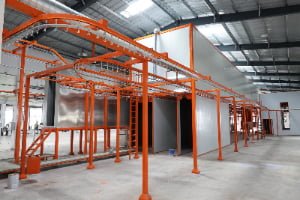
Once the workpiece is clean and dry, it moves into the spray booth. Here, powder coating particles are given a negative electrical charge by the spray gun's electrostatic system. Because the workpiece is grounded (electrically connected to earth), it carries a positive charge relative to the powder. The charged powder particles are attracted to the workpiece surface like a magnet, adhering evenly across all exposed surfaces.
The effectiveness of this stage depends on several critical factors:
- Workpiece grounding quality – If grounding is poor, powder won't adhere evenly or efficiently. Poor contact creates "dead zones" where coating is thin or missing
- Spray gun distance and angle – Too close causes powder buildup and uneven coverage; too far reduces transfer efficiency and increases powder waste
- Electrostatic voltage and current – These must be balanced to the workpiece geometry and powder type. High voltage can cause "kickback" where powder bounces off; low voltage fails to attract powder adequately
- Air pressure and powder flow – These control atomization and powder delivery rate
- Workpiece complexity – Complex shapes with deep recesses, narrow slots, or internal cavities create "Faraday cage effects" where electrical field lines struggle to reach, leaving thin or bare spots
From our work with manufacturers in furniture, cabinetry, and industrial equipment sectors, we've learned that most operators focus only on increasing spray gun pressure or voltage when transfer efficiency drops. The real solution usually lies in improving workpiece grounding, adjusting gun distance, or—critically—ensuring pre-treatment quality hasn't degraded.
One practical insight: if your powder transfer efficiency suddenly drops by 10-15% without obvious cause, check compressed air quality first. Water or oil contamination in air systems disrupts powder atomization and electrostatic charge, causing costly inefficiency and surface defects that appear hours or days later.
Curing/Baking Process
Curing transforms loose powder into a durable, hard coating through controlled heating.
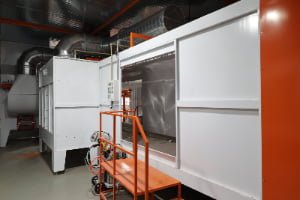
After powder is applied, the workpiece enters a curing oven (typically 170–220°C, depending on powder formulation). Inside, several things happen simultaneously:
- The powder particles begin to melt and flow, creating a smooth, continuous wet film across the surface
- The resin and hardening agent chemically react (crosslink), transforming the coating from a fluid to a solid
- The coating hardens and develops its final mechanical and chemical properties
Curing isn't a simple "bake until done" operation. Temperature must be controlled precisely, and residence time must match the workpiece size, material, and powder system. A thin steel bracket may cure in 8–12 minutes at 200°C, while a thick aluminum casting might need 15–20 minutes and slower heating to prevent internal stress.
Under-curing produces soft, sticky coating with poor adhesion, solvent resistance, and durability. Over-curing can cause color shift, brittleness, and loss of gloss. Each powder formulation has specific thermal requirements—which is why powder suppliers always specify cure windows rather than single temperatures.
We've observed that manufacturers often standardize cure time across all product types to simplify scheduling. This is a false economy. In our cabinet and furniture clients, we implemented temperature profiling to match cure parameters to actual workpiece mass and material. The result: first-pass quality improved by 18–22%, and energy consumption per part actually decreased because parts weren't over-baked.
Cooling and Unloading
After the oven, workpieces must cool to a safe handling temperature. This isn't wasted time—cooling affects final coating appearance and mechanical properties.
Rapid, uncontrolled cooling can cause:
- Surface crazing or stress cracking
- Reduced gloss or surface smoothness
- Trapped internal stresses that weaken the coating
Controlled cooling—whether passive (natural air circulation) or active (forced air)—allows the coating to cure uniformly, shrink gradually, and reach full hardness. Most industrial lines incorporate a cooling zone integrated into the conveyor system, with workpieces spending 5–15 minutes cooling before reaching the unload station.
Main Components of a Powder Coating Line
A complete powder coating line typically consists of these integrated systems:
| System | Function | Key Considerations |
|---|---|---|
| Pre-treatment unit | Cleans and chemically prepares surfaces | Maintains chemical concentrations, temperature, immersion time |
| Drying oven | Removes residual moisture (typically 80–120°C) | Must prevent re-oxidation; temperature must not scorch substrate |
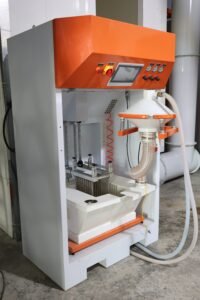
| Spray booth | Applies electrostatic powder coating | Powder recovery efficiency, booth cleanliness, operator ergonomics |
| Powder supply system | Delivers powder to spray guns with stable flow | Fluidization, air quality, consistent powder metering |
| Recovery system | Captures overspray powder for reuse | Cyclone or cartridge filters; separation efficiency typically 90–99% |
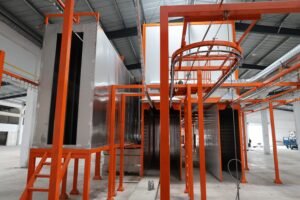
| Curing oven | Heats workpieces to fuse and harden powder | Precise temperature control, even heat distribution, energy efficiency |
| Cooling section | Allows safe handling before discharge | Natural or forced air circulation |
| Conveyor system | Moves workpieces through all stages | Stable speed, proper load capacity, reliable grounding contact |
| Electrical control system | Manages oven temperature, conveyor speed, spray parameters | PLC-based automation, real-time monitoring, recipe storage |
Powder Coating vs. Traditional Liquid Coating: Key Differences
| Aspect | Powder Coating | Liquid (Solvent-Based) Paint |
|---|---|---|
| Material form | Dry powder particles | Liquid suspension with solvent |
| Application method | Electrostatic attraction | Spray, brush, or dip; no electrostatic assist |
| VOC emissions | Near zero (environmental advantage) | High solvent evaporation (environmental & health hazard) |
| Transfer efficiency | 90–99% powder adheres; overspray recovered | 50–70% transfer; significant overspray loss |
| Coating thickness | Easily controlled; uniform 1.5–3 mm typical | Difficult to control; often irregular 0.5–1.5 mm |
| Curing time | Minutes (heat-accelerated) | Hours or days (solvent evaporation) |
| Material waste | Low; recovered powder reused | High; thinners, spill, evaporation |
| Adhesion | Excellent; chemically bonded | Good; mechanical interlocking only |
| Corrosion resistance | Superior (tight, chemically-bonded film) | Good but less reliable |
| Color consistency | Excellent batch-to-batch; easy color change | Subject to solvent ratio variations |
| Equipment cost | Higher upfront (spray booth, oven, recovery) | Lower upfront investment |
| Operating cost | Lower per part (material efficiency, energy) | Higher per part (material waste, extended curing) |
| Workplace safety | Better (no solvent fumes; dust management required) | Hazardous (solvent vapors, fire risk) |
From our perspective as a line manufacturer, the efficiency advantage of powder coating becomes most obvious at scale. A furniture company coating 50 units per day sees modest savings. A company coating 500–1000 units daily sees dramatic reductions in material cost, floor space, curing time, and regulatory burden. That's when powder coating transitions from optional to essential.
Advantages and Benefits of Powder Coating
Superior Durability and Adhesion
Powder coating creates a chemical bond with the substrate rather than simply sitting on the surface. This results in:
- Coatings that resist peeling, chipping, and flaking even under mechanical stress
- Excellent adhesion to properly pretreated steel, aluminum, and other metals
- Reliable corrosion protection—even in salt spray, humidity, and outdoor environments
Environmental and Regulatory Compliance
- Zero VOC emissions – No solvent evaporation means no air pollution and simplified regulatory compliance (EPA, REACH, local standards)
- No hazardous waste – Recovered overspray powder can be reused or safely disposed of without hazmat procedures
- Reduced workplace health risk – No solvent inhalation, dermatitis, or fire/explosion hazard from volatile fumes
Exceptional Economics at Scale
- Material efficiency – 90–99% of powder applied actually coats the workpiece; 1–10% recovered for reuse. Liquid paint achieves only 50–70% transfer
- Faster production – Minutes to cure versus hours for liquid paint; production lines move faster
- Lower labor cost – Single spray pass versus multiple coats with liquid paint; less touch-up and rework
- Reduced floor space – Compact curing ovens compared to extended liquid paint flash-off areas
Aesthetic and Quality Advantages
- Uniform finish – Powder coating naturally seeks even coverage; liquid paint is prone to runs, sags, and uneven thickness
- Superior color consistency – Batch-to-batch color variation is negligible with powder; liquid paint is sensitive to solvent ratio and environmental conditions
- Gloss and texture options – Available in high-gloss, satin, textured, and matte finishes; not limited to "wet look" options
- Complex geometry coverage – Electrostatic field reaches into corners, crevices, and internal surfaces better than liquid spray
Applications and Suitable Industries
Powder coating lines serve a diverse range of manufacturing sectors. Here are the primary markets where we see the strongest demand:
Electrical and Industrial Equipment
- Switchgear, control panels, circuit breaker cabinets
- Distribution cabinets, transformer housings
- Server racks, network enclosures
- Machine tool guards, safety equipment
Furniture Manufacturing
- Metal frames for office and residential furniture
- Outdoor furniture (steel and aluminum)
- Shelving systems, storage units
- Commercial furniture components
Metal Structures and Building Products
- Aluminum window and door frames
- Structural steel for construction
- Handrails, railings, decorative metalwork
- HVAC ductwork and components
Automotive and Transportation
- Chassis components, underbody parts
- Suspension parts, brackets
- Industrial vehicle bodies
- Trailer components
Home Appliances and Consumer Products
- Refrigerator and washer/dryer cabinets
- Air conditioning units
- Kitchen appliance housings
- Small appliance bases and frames
Retail and Display Equipment
- Point-of-sale fixtures
- Display stands and shelving
- Signage frames and structures
Aerospace and Defense (specialized)
- Aircraft interior components
- Military equipment housings
- Specialized high-performance coatings
The common thread across all these industries is consistent quality, high volume production, and the need for reliable corrosion and wear resistance. If your manufacturing involves metal workpieces, high-mix production, or strict quality standards, a powder coating line becomes economically and operationally essential.
Equipment Requirements and Factory Conditions
Successfully installing and operating a powder coating line requires more than just floor space. Here's what you actually need:
Space and Infrastructure
- Floor footprint – A typical small-to-medium line occupies 20–40 meters in length, 4–6 meters in width. Large, multi-station lines can extend 50+ meters
- Ceiling height – Minimum 3.5–4 meters; overhead space for conveyor suspension and upper ductwork
- Foundation – Level, level concrete; conveyor supports require vibration isolation and structural reinforcement
- Environmental control – Temperature stability (ideally 15–25°C); humidity ideally 40–60% relative humidity to prevent powder moisture absorption and curing issues
Utility Requirements
| Utility | Requirement | Notes |
|---|---|---|
| Electrical power | 380V 3-phase + 220V single-phase, 60–150 kVA typical | Sized for simultaneous oven + spray fan + conveyor load |
| Compressed air | 4–8 bar pressure; 500–1500 cubic meters/hour depending on line size | Must be dry (dew point -40°C) and oil-free; see below |
| Water supply | 2–4 bar pressure; typically 10–50 liters/minute | Used in pre-treatment; must be softened or deionized |
| Natural gas or electric heating | For oven: 50–150 kW electric or equivalent gas BTU | Sized to achieve target cure temperature in specified time |
| Exhaust/ventilation | 2000–5000 cubic meters/hour extraction | Connects oven exhaust, spray booth, recovery system to outdoor discharge |
Compressed Air Quality (Critical)
This deserves emphasis because compressed air quality directly impacts coating quality and equipment reliability.
Air must be:
- Dry (dew point below -40°C) – Moisture causes powder to clump, electrostatic failure, surface defects (pinholing, cratering)
- Oil-free – Oil contamination destroys powder flowability and creates surface defects
- Particle-free – Particulate contamination creates surface roughness and defects
Required components:
- Oil/water separator
- Refrigerated dryer (or desiccant dryer for critical applications)
- Multi-stage particle filters (5 µm final stage minimum)
- Automatic condensate drain
Skipping or undersizing any of these results in recurring coating failures that appear random but are actually traceable to air quality degradation.
Surface Preparation Materials
Pre-treatment requires reliable supply of:
- Alkaline degreaser
- Acid or chelate-based rust remover (if needed)
- Phosphating or conversion coating solution
- Deionized or soft water (depending on system)
Workspace and Safety
- Personnel area – Operators need clear access to spray booth, oven, and control stations; minimum 1.5-meter aisles
- Dust containment – Spray booth walls should be sealed; powder recovery system must be regularly cleaned
- Fire safety – Powder is combustible; proper grounding, bonding, and electrical safety measures are required
- First aid – Eye wash station and emergency shower (required in many jurisdictions)
Common Considerations for Setup and Operation
Initial Commissioning
When a powder coating line first arrives at your factory, proper commissioning is non-negotiable:
- Pre-treatment bath chemistry – Verify concentrations, temperature, and retention time match supplier specifications
- Temperature profiling – Record actual workpiece temperature at oven inlet, midpoint, and exit during trial runs. Adjust air circulation and burner output to achieve uniform temperature
- Electrostatic parameters – Calibrate spray gun voltage and current; test with sample workpieces under your actual product geometry
- Conveyor speed and timing – Run full cycles from pre-treatment through cooling; confirm workpiece position and timing at each stage
- Powder and recovered material – Establish baseline consumption, recovery rate, and reuse ratios
We've found that commissioning typically requires 2–4 weeks of focused effort before production stabilizes. Rushing this phase creates months of quality problems and inefficiency later.
Maintenance Program
Proper maintenance prevents costly downtime and preserves coating quality:
Daily:
- Inspect and clean spray booth interior; remove powder accumulation
- Verify oven temperature stability
- Check conveyor for obstructions or jamming
- Inspect for visible powder clumping in supply tanks
Weekly:
- Replace or clean spray gun nozzles if performance declines
- Inspect and clear any air filter blockages
- Check compressed air for oil or water leakage
- Verify all grounding connections are clean and tight
Monthly:
- Deep-clean spray booth surfaces and lighting
- Inspect and service filters in powder recovery system
- Test temperature profiling at multiple workpiece positions
- Verify electrical connections and control system responsiveness
- Drain and inspect pre-treatment baths for sludge or contamination
Quarterly:
- Inspect conveyor chain for wear; adjust tension if needed
- Verify oven door seals and insulation integrity
- Audit compressed air system for leaks and efficiency
- Check electrical components for corrosion or loose connections
Annually:
- Professional service of spray guns, powder pumps, and electrostatic generators
- Full oven inspection including burner or heating elements
- Filter replacement in compressed air dryer
- Pre-treatment bath replacement or major reconditioning
Troubleshooting Common Issues
Problem: Uneven powder coverage or thin coating
- Check pre-treatment; contamination on workpiece surface is the #1 cause
- Verify workpiece grounding quality; poor contact creates dead zones
- Adjust spray gun distance and angle
- Inspect electrostatic generator voltage output
Problem: Powder "kickback" or bouncing off workpiece
- Reduce electrostatic voltage slightly
- Decrease spray gun distance
- Check workpiece for sharp edges or points that may cause electrical field concentration
Problem: Color shift or inconsistency between batches
- Verify oven temperature consistency across the entire chamber
- Check powder batch numbers; confirm same formulation is being used
- Inspect for recovered powder contamination (mixed colors)
Problem: Defects after curing (bubbling, pinholes, cratering)
- Almost always trace back to pre-treatment or compressed air quality
- Verify water content in pre-treatment liquid hasn't increased
- Drain and inspect compressed air system for moisture or oil
- Check powder storage conditions (moisture absorption)
Problem: Low transfer efficiency or high powder waste
- Calibrate electrostatic parameters
- Inspect powder supply system for clumping or flow blockage
- Verify air pressure for atomization is stable
- Test grounding of workpiece and conveyor system
Operator Training
A powder coating line can be operated by technically competent personnel after proper training. Critical areas:
- Understanding pre-treatment chemistry and why each stage matters
- Safe operation of high-voltage electrostatic systems
- Recognizing signs of equipment malfunction or coating defects
- Proper shut-down and maintenance procedures
- Troubleshooting common issues without creating safety hazards
We typically recommend 1–2 weeks of on-site training for core operators, plus annual refresher training to reinforce proper procedures.
Economic Optimization
Once your line is running reliably, focus on optimization to improve your bottom line:
- Monitor material consumption – Track powder usage per part; recoverable vs. waste ratio. Industry best practice is <5% unrecoverable loss
- Energy efficiency – Optimize oven temperature profiles to use minimum energy while maintaining cure quality. Small reductions in oven setpoint can save 10–15% energy
- Throughput – Carefully adjust conveyor speed. Balance between adequate pre-treatment soak time, adequate spray time, and adequate cure time. Faster isn't always better if quality suffers
- Waste reduction – Minimize color changeovers; consolidate product runs by color when possible
- Preventive maintenance discipline – Invest in maintenance to prevent catastrophic failures that idle the entire line
Conclusion
A powder coating line is far more than a spray booth and oven. It's an integrated system where surface preparation, electrostatic application, precise curing, and careful cooling all work together to create durable, consistent, high-quality finished products. Understanding each stage—and the interconnections between them—is essential whether you're evaluating a line for purchase, commissioning a new installation, or optimizing an existing system.
From our years working with manufacturers across three continents, we've learned that the most successful powder coating operations share a common trait: respect for process fundamentals. Companies that invest in proper pre-treatment, maintain compressed air quality, follow disciplined maintenance routines, and train their operators well consistently achieve superior results and lower costs. Those that cut corners on any of these typically struggle with quality issues, waste, and equipment reliability.
If you're considering a powder coating line investment—or facing challenges with an existing system—the right approach is to understand your specific product requirements, factory conditions, and production goals, then design or optimize your line accordingly. A one-size-fits-all solution rarely delivers optimal results.
We at Ketu specialize in designing and commissioning powder coating lines tailored to your exact requirements. Whether you're coating electrical cabinets, furniture components, aluminum extrusions, or specialized industrial parts, we bring factory-level expertise to ensure your line delivers consistent quality, reliable uptime, and strong return on investment.
If you'd like to discuss your specific needs—whether initial assessment, system design, equipment selection, or optimization of an existing line—we're here to help.
Contact us today:
- WhatsApp / Mobile: +8618064668879
- Email: ketucoatingline@gmail.com
Let's explore how a properly designed powder coating line can transform your product quality and production efficiency.
 English
  German
  Vietnamese
  French