
Complete Guide to Welding Processes for Electrostatic Powder Coating Lines: From Process Selection to Quality Control
When you are considering purchasing or upgrading an electrostatic powder coating line, it is easy to focus on visible parameters such as spray gun power, oven temperature, powder recovery efficiency, and automation level. But from our years of factory practice, the factor that truly determines whether a production line can run stably for a long time is often the welding process that is not immediately visible.
We have seen many cases like this. The equipment performs well when it is first put into production. But after 3 to 6 months of operation, air leakage, deformation, abnormal noise, and even serious line speed reduction begin to appear. After disassembly and inspection, the cause is not a damaged spray gun or unstable oven temperature. The real problem is that the welded parts of the powder booth, curing oven, and conveyor system have quietly cracked under long-term thermal cycling and vibration. At that point, the repair cost is already much higher than the cost of controlling welding quality properly from the beginning.
Welding quality directly affects three things: structural airtightness, long-term durability, and stable operation of the whole line. Poor welding may not be obvious in the early stage, but it is a long-term hidden risk.

Why Welding Is Critical in Powder Coating Lines: The Key to Structural Stability and Long-Term Reliability
In our process of designing and manufacturing powder coating lines, the importance of welding can be seen in many details.
The first point is structural integrity. A powder coating line involves a large number of metal structural parts, from pretreatment tanks to curing ovens. Every welded joint carries stress during actual operation. The powder booth needs to withstand airflow pressure and vibration. The curing oven needs to withstand thermal stress and workpiece load. The conveyor chain needs to withstand long-term repetitive movement. If the welding quality is not good enough, these structural parts can develop small cracks under stress. These cracks may continue to expand and finally cause fracture or leakage.
The second point is airtightness. This is especially important for the curing oven. If the oven body is not tightly welded, hot air will continuously leak from the gaps. This leads to uneven oven temperature distribution, higher energy consumption, and insufficient curing of products. We once worked on a customer project with two ovens of the same configuration. One was welded properly, while the other had welding defects. As a result, the first oven had stable energy consumption, while the second oven consumed about 25% more energy and needed additional heat input regularly to maintain the required temperature. The extra cost the customer had to bear in order to avoid shutdown was far higher than the cost of investing in better welding quality at the beginning.
The third point is long-term reliability. In one of our overseas projects, the customer had very strict welding requirements. They not only checked the appearance of the welds but also required non-destructive testing, including UT scanning. After two years of operation, the failure rate of that line was close to zero. By contrast, another line with a similar configuration but weak welding quality control experienced several unexpected shutdowns in the first year. This shows that welding quality is not only a short-term issue. It is a direct investment in the stability of the whole line throughout its life cycle.
The fourth point is maintenance cost. Structural problems caused by poor welding usually require on-site repair. This brings downtime loss, transportation cost, technician travel cost, and sometimes the replacement of an entire module. On the other hand, if more effort is put into welding quality in the early stage, later maintenance pressure and hidden costs can be significantly reduced.
From our point of view, welding quality is an investment that may not show its value when nothing goes wrong, but becomes very expensive once a problem appears. Many purchasing teams tend to ignore this point during equipment selection. They focus only on equipment appearance and technical parameters. But in real use, stability and long-term cost are what finally matter most.
Key Welding Areas and Special Requirements in Powder Coating Lines
The main welded areas in an electrostatic powder coating line have different working conditions and requirements. Let us analyze them one by one.
Different Welding Requirements for Powder Booths, Curing Ovens, and Conveyor Systems
Powder booth welding mainly needs to withstand airflow pressure and pulse impact. The inside of the powder booth has high air velocity and a large amount of powder dust. The inner walls are often washed by airflow and recovered powder. If there are gaps or pores in the welded joints, they may not only cause leakage and affect negative pressure, but also allow powder to accumulate. In these areas, static electricity may build up, creating potential explosion risks. So the welds of a powder booth must have good airtightness. The weld bead should also be smooth to prevent powder from collecting in uneven weld areas.
Our practice is to use TIG welding for key welds of the powder booth, especially the joints between side panels and top panels, to ensure welding quality. Then we use compressed air to carry out airtightness testing. The test pressure is usually set at more than 1.5 times the actual working pressure of the powder booth. This helps us find small leakage points in advance.
Curing oven welding faces the harshest working conditions. The oven body needs to withstand temperatures above 200°C while maintaining good insulation and sealing performance. At high temperatures, the thermal expansion behavior of metal changes. Welding residual stress may gradually release during thermal cycling, which can cause weld cracking. This is one of the most common welding failure modes in curing ovens.
The key points of curing oven welding are: first, the weld bead must be deep enough to ensure full fusion; second, weld arrangement must be reasonable to avoid stress concentration; third, post-weld heat treatment should be carried out to relieve internal stress caused by welding. The upper and lower corner wrapping areas, as well as the left and right vertical corner wrapping areas of the oven body, are more likely to become stress concentration points. For these positions, we use multi-layer and multi-pass welding and strictly control interpass temperature to prevent the formation of hard and brittle structures caused by rapid cooling.
Conveyor system welding mainly needs to withstand dynamic stress. The conveyor chain moves repeatedly, and the load-bearing hangers vibrate continuously. Welded joints are more likely to develop fatigue cracks. This is especially true for the welds connecting the support frame and the main beam. If the quality is poor, cracks will gradually expand during long-term operation and may finally cause the whole support beam to break.
For conveyor systems, we usually use MAG welding. It is faster than TIG welding and provides sufficient strength. But for key load-bearing positions, we add radiographic testing or ultrasonic testing to ensure that there are no internal pores or slag inclusions in the weld. After welding, dynamic load testing is also carried out. This simulates actual working conditions and verifies that the welds will not develop new cracks during repeated operation.
Requirements for Airtightness, Heat Resistance, and Strength in Different Parts
In essence, welding requirements can be divided into three dimensions.
Airtightness requirements are the highest in curing ovens and powder booths. The curing oven needs to maintain uniform temperature distribution inside the chamber. Any leakage will take away heat energy, causing fuel waste and unstable temperature. The powder booth needs to maintain negative pressure balance to prevent powder dust from escaping. Welds in these two areas must be 100% leak-free. We usually use air pressure leak testing. The standard is to keep the pressure at 1 kg/cm² for 15 minutes, and no bubbles should appear at the welded joints.
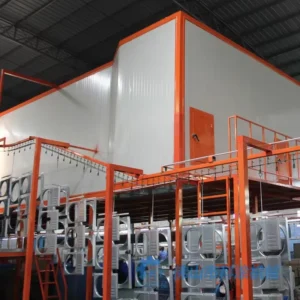
Heat resistance requirements are also the highest in the curing oven. The outer shell of the oven may reach 200°C or even higher. Welding materials must use heat-resistant steel, such as 310S or other high-alloy steels. Ordinary carbon steel electrodes may soften or fail during long-term high-temperature operation. When selecting welding materials, we choose the proper welding rod grade based on the maximum working temperature of the oven. For gas-fired ovens, where the internal temperature may exceed 220°C, we use nickel-based or cobalt-based high-temperature welding materials.
Strength requirements are the highest in the conveyor system and suspension mechanism. These parts carry the weight of workpieces and the impact of acceleration. The welding strength must reach the strength level of the base material. We usually require the tensile strength of the weld bead to be no less than 95% of the base material. Otherwise, the weld becomes the weakest point and is the first area likely to fail.
In practice, these three requirements often restrict each other. For example, achieving airtightness requires a full and smooth weld bead, but this may reduce welding speed and increase cost. Achieving heat resistance requires special welding materials, which also increases cost. Our solution is to use different welding processes and quality standards for different parts, instead of using one welding method for the whole line.
Comparison of Welding Processes for Powder Coating Lines: How to Choose TIG, MAG, and Laser Welding
This is a question many equipment suppliers and buyers care about. Different processes have different strengths and weaknesses. There is no absolute best process. There is only the most suitable process for a specific application.
Advantages and Application Scenarios of TIG Welding
TIG welding, or tungsten inert gas welding, is a precise welding process. The welding torch uses a tungsten electrode, an electric arc, and shielding gas, usually argon. Its main features are precise heat input control, good weld appearance, and a low tendency to generate pores.
In our production, TIG welding is mainly used in two areas.
The first area is the key parts of the curing oven. We use TIG welding for the splicing welds of the oven shell, especially the inner and outer corner areas and transition areas. The reason is simple. If these positions have any defects, such as pores, incomplete penetration, or slag inclusions, the defects may expand during long-term thermal cycling and finally cause leakage. TIG welding offers strong controllability. The welder can observe the arc process and adjust parameters in time to ensure full penetration. Our practice is to use double-sided welding for every key weld of the oven body, including front-side welding and back-side welding. This ensures complete fusion from inside to outside.
The second area is small-diameter pipeline welding that requires airtightness. For example, the connections between the air inlet pipe, air outlet pipe, and main body of the powder booth are also welded by TIG. Although these pipes are not large in diameter, they require high airtightness. TIG welding is slower, but it ensures quality.
The disadvantage of TIG welding is also obvious: it is slow. A 2-meter-long oven body weld may take 3 to 4 hours with TIG welding, while MAG welding may take only 1 hour. This directly increases the production cycle and cost. So for projects under strong delivery pressure, we cannot use TIG welding everywhere. We must use TIG welding in key areas and faster processes in other areas to balance quality and efficiency.
Efficiency and Limitations of MAG Welding
MAG welding, or metal active gas welding, is one of the most commonly used welding processes in industrial production. It uses a consumable electrode, or welding wire, instead of the tungsten electrode used in TIG welding. Its welding speed is much faster, with high efficiency and lower cost.
We use MAG welding widely for conveyor systems, support frames, workstation frames, and other structural parts. These parts require high strength, but their airtightness and heat resistance requirements are relatively lower. MAG welding is fully suitable for these applications. A support frame can usually be completed in 2 to 3 days. If all welding is done by TIG, it may take one week.
But MAG welding also has clear limitations.
First, weld quality stability depends heavily on the welder’s experience. During MAG welding, the welder cannot observe the arc as clearly as in TIG welding. The welder mainly controls the process by listening to the sound and judging the wire feeding condition. Beginners are more likely to make mistakes. Our requirement for MAG welders is at least 3 years of working experience, and they must be certified.
Second, pores and spatter are more likely to appear. Although this can be improved by adjusting shielding gas composition and welding parameters, it is difficult to eliminate completely. So MAG welding is not ideal for parts with high appearance requirements.
Third, MAG welding is sensitive to changes in base material thickness. If two steel plates with very different thicknesses are welded together, MAG welding may cause incomplete root penetration or an oversized molten pool.
So in our application, MAG welding is mainly used for parts with low appearance requirements, high strength requirements, and tight delivery schedules. Examples include powder booth bottom support frames, external curing oven frames, and conveyor chain support beams.
Cost-Benefit Analysis of Laser Welding and Other Processes
Laser welding, including fiber laser welding and CO2 laser welding, is being used more widely in industrial applications. Its advantages include high precision, small heat-affected zone, fast welding speed, and strong automation potential.
But in our powder coating line production, the application of laser welding is still limited. There are several reasons.
The first reason is high cost. Laser welding equipment requires a large investment. One machine may cost over one million yuan. When the cost is allocated to a single product, it may be more expensive unless the parts are standardized and produced in large quantities.
The second reason is limited applicability. Laser welding has requirements for base material thickness, light reflectivity, and surface finish. Our powder coating line structures are complex. They involve steel plates of different thicknesses and different surface conditions. It is difficult for laser welding to cover all these structures.
The third reason is quality control difficulty. In theory, laser welding has higher precision. But in a real workshop environment, reflection, heat dissipation, airflow, and other factors may affect the result. We tested several laser-welded samples and found that although the weld appearance was good, the internal porosity rate was sometimes higher than that of TIG welding.
At present, our laser welding applications are mainly concentrated in two fields. The first is thin sheet metal splicing, especially when the thickness is less than 2 mm. In this case, the precision advantage of laser welding is clear. The second is automated mass production, such as producing several thousand pieces of a standard part. For highly customized full-line products, laser welding is not yet our first choice.
In summary, our welding process selection logic is: use TIG welding for key parts to ensure quality, use MAG welding for large structural areas to improve efficiency, and consider laser welding for special processes such as thin sheet parts and automated production. This helps us achieve a practical balance between quality, efficiency, and cost.
| Welding Process | Suitable Parts | Advantages | Disadvantages | Cost |
|---|---|---|---|---|
| TIG Welding | Curing oven welds, pipeline connections, high-airtightness areas | Stable quality, fewer pores, high penetration rate | Slow speed, high labor intensity | Relatively high |
| MAG Welding | Support frames, structural frames, conveyor systems | Fast speed, high efficiency, low cost | Spatter risk, pore risk, poorer appearance | Low |
| Laser Welding | Thin sheet splicing, standardized mass production parts | High precision, high automation potential, small heat-affected zone | High equipment investment, limited application range | Very high |
Welding Materials and Quality Standards: International Certifications and Industry Specifications
Choosing the right welding process is only the first step. Welding materials and quality standards are equally important.
When selecting welding materials, we first consider the composition and working conditions of the base material. The main structure of a powder coating line usually uses Q235 ordinary carbon steel or Q345 low-alloy high-strength steel. For these materials, we select corresponding welding rods or wires. For example, for Q235 base material, we use E4303 or ER50 welding materials. For Q345 base material, we use E5015 or ER70 welding materials.
For high-temperature areas such as curing ovens, the situation is more complex. If the working temperature inside the oven exceeds 180°C, we do not use ordinary welding materials. Instead, we upgrade to stainless steel welding materials, such as 309S or 310S, or nickel-based welding materials. These materials have slower strength reduction at high temperatures and stronger oxidation resistance. Although their cost is higher, sometimes 5 to 10 times higher than ordinary welding materials, they help ensure that the welds will not fail during thermal cycling.
For welding quality standards, we refer to international standards and Chinese national specifications.
GB/T 5185 covers the classification and use of welding rods and defines basic performance indicators.
ISO 5817 defines the classification of welding imperfections in steel welds, including pores, slag inclusions, cracks, and other defects. We usually produce according to Grade B or Grade A standards and do not accept Grade C for key positions.
GB/T 12607 covers radiographic testing for weld non-destructive testing and is used for key weld inspection.
For projects exported to Europe or North America, customers often require stricter standards. These may include UT ultrasonic testing, radiographic testing, or even tensile sample testing. In one overseas project, the customer required radiographic inspection for every weld of the curing oven. This created a large workload and high cost, but the customer had a good reason. They wanted to ensure that the line could run stably for more than 10 years.
My personal view is that quality standards should match the customer’s application scenario and expected service life. If a production line is expected to run for 5 years, Grade B is usually enough. If the expected service life is more than 10 years, or if the line will operate in harsh environments such as high temperature, high humidity, or heavy pollution, Grade A or stricter standards should be selected, together with corresponding inspection methods. The early investment in quality standards often helps avoid major repair costs later.
Common Welding Defects in Powder Coating Lines and Prevention Methods
In actual production, we have encountered many welding defects. Some are caused by design problems, some by process execution, and some by materials or the working environment. I would like to share some of our inspection and prevention experience.
Causes and Control Methods for Pores, Cracks, and Deformation
Pores are the most common welding defect. They are usually caused by three reasons.
The first reason is impure shielding gas or insufficient gas flow. During welding, molten metal can easily contact air and form oxides. These oxides may be trapped in the weld bead and form pores. Our standard practice is to check shielding gas purity before welding. The purity should be above 99.99%. We also check the gas flow, usually set at 15 to 25 liters per minute, to ensure stable airflow around the welding torch. If welding is carried out in a windy area, we use shields for protection.
The second reason is oil, rust, or dirt on the surface of the base material or welding rod. These substances generate gas at high temperature. If the gas cannot escape, pores will form. Our rule is that the welding area must be cleaned with a grinder or wire brush before welding. The area within 5 cm on both sides of the weld must be completely clean, with no oil stains or rust.
The third reason is excessive welding speed or overly fast molten pool cooling. If the welding torch moves too fast, the molten pool does not have enough time to release gas before solidification. If the environmental temperature is too low or there is wind, the molten pool may also cool too quickly. Our solution is to select a reasonable welding speed according to plate thickness, usually 20 to 30 cm per minute. At the same time, the angle and distance between the welding torch and the base material must remain stable. This gives the molten pool enough time to release gas.
Cracks are more dangerous than pores. Once a crack appears, it may continue to expand under stress and thermal cycling, eventually causing weld failure. There are two main causes of cracks.
The first cause is cold cracking caused by rapid cooling. This is especially common in thick plate welding. The temperature difference between the weld bead and the surrounding cold metal is large. Rapid cooling of the weld bead can produce hard and brittle structures, which are prone to cracking. Our prevention method is to preheat thick plates before welding. The rule is: when the base material thickness exceeds 25 mm, the preheating temperature should be set at 100 to 150°C; when the thickness exceeds 50 mm, the preheating temperature should be above 200°C. Preheating slows down cooling and greatly reduces the risk of cold cracks.
The second cause is excessive welding stress. If the welding design is unreasonable, such as when the weld direction is parallel to the load direction or welds are too close to each other, stress concentration may occur. During solidification and cooling, the weld bead produces internal stress. If the stress is too high, hot cracks may appear. Our prevention method is to make the weld direction form a certain angle with the load direction, usually 30 to 45 degrees. At the same time, weld spacing and welding sequence should be arranged reasonably to allow stress release. After welding, heat treatment or stress-relief annealing should be carried out for thick plates or stress-concentrated areas. This can significantly reduce crack risk.
Deformation is also a common issue. Welding heat causes the base material to expand. Areas with higher local temperature expand more, while areas with lower temperature expand less. After cooling, residual deformation appears. For precision parts such as support frames and hangers, deformation may cause misalignment and jamming in the whole line.
There are several ways to control deformation. First, the welding sequence should be reasonable. We usually use symmetrical welding, starting from the center and moving toward both ends. This makes expansion more uniform. Second, fixtures should be used properly. During welding, the workpiece should be fixed with fixtures to prevent random deformation. Third, the welding method should be optimized. For the same weld, multi-layer and multi-pass welding creates less deformation than completing the weld in one heavy pass.
Non-Destructive Testing and Airtightness Verification
After welding is completed, we usually carry out non-destructive testing. Different inspection methods are used according to the importance of each part.
Airtightness testing is the most basic method and must be carried out for curing ovens and powder booths. The method is to use an air compressor to pressurize the welded part to the required pressure, usually 1.5 times the working pressure, and then observe whether bubbles appear or pressure drops. The standard is that the pressure drop should not exceed 5% within 30 minutes. If there is leakage, bubbles usually appear at the leakage point, making it easy to locate. This method is low-cost but very effective.
Radiographic testing, or RT, uses radiation to penetrate the weld and inspect internal defects. This method can detect pores, incomplete penetration, slag inclusions, and other defects. But the cost is high. Each weld may cost several hundred yuan to inspect, and professional equipment and qualified personnel are required. We usually carry out RT inspection on key curing oven welds, such as corner welds and long welds, with a coverage rate of about 30% to 50%.
Ultrasonic testing, or UT, uses ultrasonic waves passing through the weld to detect internal defects. It is faster and cheaper than RT and does not require radiation protection. But it requires experienced inspectors to judge the result. Our current practice is to use UT for initial inspection. If problems are found, RT is then used for detailed inspection. This improves inspection coverage while controlling cost.
Visual testing, or VT, is the most basic method. It checks whether there are obvious appearance defects, such as pores, slag inclusions, or undercut. VT cannot replace other inspection methods, but it can quickly eliminate clearly unqualified welds.
Our inspection principle is: full inspection for key parts and sampling inspection for general parts. Key parts include curing oven welds, powder booth corner welds, and main support frame welds. General parts include reinforcement plate welds and auxiliary bracket welds. This approach ensures quality without allowing inspection cost to become too high.
Welding Protection and Maintenance in High-Temperature Working Environments
The curing oven operates in a high-temperature environment for a long time. This creates special requirements for weld protection.
The first point is the selection of heat-resistant welding materials. As mentioned earlier, high-temperature areas require heat-resistant welding materials. But this alone is not enough. Post-weld heat treatment should also be considered. For parts welded with ordinary welding materials, stress-relief treatment should be carried out after welding. The annealing temperature is usually set near the lower limit recommended for the welding material. For example, ordinary low-carbon steel electrodes usually recommend an annealing temperature of about 620°C. This releases welding stress and prevents new cracks from forming during later high-temperature operation.
The second point is protective coating. After welding, the weld surface may have slag, spatter, oxide film, and other residues. If these are not cleaned, they may peel off under high temperature and thermal cycling. The exposed welds may then oxidize or corrode. Our practice is to grind the weld surface after welding, remove slag and spatter, and then apply high-temperature-resistant paint. This is usually a silicate-based or ceramic-based coating that can withstand more than 250°C. It effectively protects the weld from corrosion.
The third point is regular inspection. During operation, curing oven welds may gradually develop small cracks due to thermal stress. We recommend that customers carry out visual inspection every 6 months and UT or RT inspection every 12 months. Finding problems early helps prevent small defects from becoming major failures.
The final point is emergency response. If leakage is found in a weld during operation, the equipment should be stopped immediately for inspection. Do not continue forced operation. In a high-temperature environment, leakage can expand quickly. We once had a case where a customer found slight heat leakage in the oven body but did not repair it immediately. They continued operation for two weeks. As a result, the small leakage expanded into complete weld failure. The oven had to be disassembled and rewelded. The loss was much higher than early repair would have been.
Balancing Welding Process, Whole-Line Cost, Delivery Time, and Maintainability
When buyers choose a welding process, they often face a difficult choice: quality or speed, long-term reliability or short-term cost.
From our practice, these factors are not completely opposite. The key is to find a reasonable balance.
From the cost perspective, welding cost usually accounts for 15% to 25% of total equipment cost. If TIG welding is used everywhere, the cost may increase by 30% to 50%. If MAG welding is used everywhere, the cost is lower, but the quality risk increases. Our method is to classify parts according to importance. For example, welding cost for the curing oven may account for 40% of that section, welding cost for the powder booth may account for 20%, and other structures may account for 40%. We use the best process and materials for high-risk parts such as curing ovens, a balanced solution for medium-risk parts, and an economical solution for low-risk parts. In this way, the overall cost remains controllable while quality is protected.
From the delivery time perspective, welding process directly affects the production cycle. If the customer requires delivery in 3 months, the welding process must be fast, mainly using MAG welding, while quality must still meet the lower limit of the required standard. If the customer allows 6 months, more refined processes such as TIG welding can be used in more areas, and the quality standard can be higher. We explain this clearly during quotation. For urgent projects, we use a faster and more economical solution, but the quality standard may be adjusted accordingly, such as from ISO 5817 Grade B to Grade C. For projects with a longer production cycle, we can use a premium solution with higher quality standards.
From the maintainability perspective, this point is often ignored. Welding quality in the early stage directly affects maintenance cost later. Equipment with good welding quality rarely needs weld repair during operation. Equipment with poor welding quality may need repeated rewelding or module replacement, which greatly increases operating cost. Based on our data, a line with good welding quality has welding-related maintenance costs of about 2% to 3% of the purchase price over its whole life cycle of 5 to 10 years. A line with average welding quality may have maintenance costs of 6% to 8%.
Based on this view, I suggest that buyers should not focus only on the initial purchase price when selecting a powder coating line. They should understand the welding process and quality commitment clearly. A line that costs 5% to 10% more but has guaranteed welding quality is often more cost-effective than a cheaper line with weak welding quality. In the long run, it will save a lot of trouble.
When communicating with customers, we usually provide a welding process plan. This document clearly lists the welding process, welding materials, inspection methods, and quality standards for each part. Some customers want to cut inspection costs when they see them in the quotation. But our position is firm: inspection cost is insurance, not waste. Equipment without inspection only becomes truly expensive when failure occurs.
More Related Questions
Q: Will properly welded equipment have problems during transportation?
A: Yes, it can happen. Vibration and impact during long-distance transportation may create stress shocks in welds, especially welds with internal residual stress. Our practice is to carry out stress-relief heat treatment on welded parts before transportation. During transportation, we use wooden frames and foam protection for vulnerable welded areas. After the equipment arrives on site, another visual inspection and airtightness test should be carried out before installation to ensure that transportation has not caused new damage.
Q: Can curing oven welds be repaired by rewelding?
A: Yes, but the repair must be done properly. When a small crack is found in a weld, it is not enough to simply weld over the surface. The cracked area must first be gouged out until fresh metal is exposed, and then it should be rewelded. After welding, inspection must be carried out to ensure that the repair quality reaches the original standard. This process is more complicated than new welding, so it is always better to control the welding quality well from the beginning and avoid later repair.
Q: Are welding standards different in different countries?
A: Yes. Europe usually uses EN standards, the United States uses ASME standards, and China uses GB standards. These standards differ in weld classification, defect judgment, and inspection methods. For export products, the standards of the target country should be followed. For example, European customers usually require EN ISO 5817 Grade B or higher. American customers may not be extremely strict about weld appearance, but they often require higher internal quality, such as UT or RT inspection. When we take on a project, we confirm the customer’s country and standard requirements in advance, then develop the corresponding welding plan.
Conclusion
The welding quality of an electrostatic powder coating line determines whether the line can operate stably in a demanding production environment. Based on more than ten years of practical experience, we have found that many lines with high failure rates and high maintenance costs have root causes related to welding. The problem may be an unsuitable welding process or weak quality control.
When purchasing a powder coating line, you should not only look at visible parameters such as spray gun power, oven temperature, and automation level. You should also ask clearly: What welding process is used for this line? What processes and materials are used for key parts? How is quality inspection carried out? Is there a clear quality guarantee? The answers to these questions often reveal the real reliability of the equipment more clearly than the technical parameters alone.
If you are considering purchasing or upgrading an electrostatic powder coating line, you are welcome to contact us to discuss welding processes and quality solutions in detail. We can develop a customized welding solution based on your actual application scenario, including product type, capacity requirement, and working environment. Our goal is to help you buy not just a piece of equipment, but a production line that can create long-term value for your factory.
Contact Information:
WhatsApp: +8618064668879
Email: ketucoatingline@gmail.com
Our factory is always open for your visit and on-site verification.
 English
  German
  Vietnamese
  French