
How to Quickly Change Colors in Spray Equipment: A Complete Guide to Operations, Systems, and Best Practices
When you're running a multi-color production line, color changeover time directly impacts your bottom line. Every minute your spray booth sits idle is lost revenue. From my perspective working with pulverbeschichtung[^1] operations, I've seen facilities lose thousands in productivity simply because their color change process wasn't optimized—not because the equipment was broken, but because the procedure itself was inefficient.
The real challenge with fast color changes in elektrostatische Pulverbeschichtung[^2] isn't about moving quickly—it's about thorough cleaning. Most production delays I encounter come from residual powder contamination, not from slow changeover steps. When you skip proper booth purging or neglect the supply system clearing, the new color gets contaminated. You end up with color drift, off-specification parts, and costly rework. That's why I always tell clients: fast color changes only work when they're done right.
The speed at which you can transition between powder colors depends on three interconnected systems: your spray booth design, your powder recovery system, and your supply line configuration. If any one of these components isn't optimized for changeover efficiency, your entire line bogs down. This guide walks you through the operational procedures, system design factors, and practical strategies that actually reduce your color change time—without compromising quality.
Why Fast Color Changes Matter in Powder Coating Production
In contract coating facilities and manufacturing operations with multiple SKUs, color changeover represents a significant hidden cost. A typical manual color change might consume 20-40 minutes including cleaning, purging, and verification. For a facility running 8-10 color changes per shift across multiple production lines, that's 3-4 hours of pure downtime daily.
But the cost isn't just lost production time. When color changes are rushed or incomplete, you see color contamination—the new powder gets mixed with residual particles from the previous color. This shows up as speckles, haze, or noticeable color drift in the final coating. I've watched customers throw away entire batches because the color deviation exceeded specification. That's exponentially more expensive than taking an extra 5 minutes to do the purge correctly.
The other factor is safety and equipment preservation. Powder can build up in cURL Too many subrequests by single Worker invocation. To configure this limit, refer to https://developers.cloudflare.com/workers/wrangler/configuration/#limits[^3] nozzles, supply hoses, and recovery systems. If you don't clear this thoroughly between color runs, you'll eventually see blockages, inconsistent spray patterns, and equipment failures. I've seen operations that didn't maintain proper color change protocols end up with damaged atomization systems that cost $15,000+ to replace.
From a production planning perspective, fast color changes also improve scheduling flexibility. When you can reliably change colors in under 15 minutes, you can batch smaller orders together, respond faster to customer requests, and optimize your production calendar. This becomes especially valuable for custom coating services and OEMs that work with frequent product variations.
![electrostatic powder coating line in factory]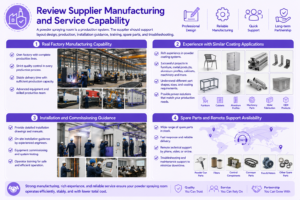
Understanding the Key Factors That Affect Color Change Speed
Fast color changes aren't controlled by one single step. They depend on the entire spray equipment system—from the spray booth surface to the powder recovery route, powder hose length, gun cleaning method, and operator workflow. When I evaluate a Pulverbeschichtungsanlage for color change efficiency, I usually look at five areas first: booth design, recovery system, powder supply system, spray guns, and cleaning procedure.
1. Spray Booth Interior Design
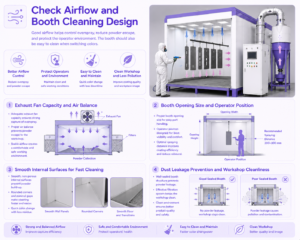
The spray booth is where most visible contamination problems start. If the booth has many corners, rough surfaces, open seams, or areas where powder can settle, the operator needs more time to clean it before the next color.
A smooth booth interior is always easier to clean. Stainless steel, high-quality coated panels, or engineered booth wall materials can reduce powder adhesion and make blow-off faster. In contrast, old booth panels with scratches, dents, or rough surfaces tend to hold residual powder. Even after air blowing, particles can stay hidden and later fall into the airflow during the next production run.
For frequent color changes, I recommend paying attention to:
- Smooth booth wall surfaces
- Minimal internal corners and ledges
- Easy-access booth doors
- Removable floor or collection parts
- Good booth lighting for contamination inspection
- Proper airflow balance to prevent powder settling in dead zones
A booth that looks clean from the outside may still have powder trapped around floor edges, duct openings, gun slots, and recovery inlets. These small areas often cause the most frustrating color contamination problems.
2. Powder Recovery System Type
The powder recovery system plays a major role in changeover speed. In many production lines, the spray booth itself can be cleaned relatively quickly, but the recovery system takes longer because powder passes through ducts, cyclones, filter cartridges, sieves, hoppers, and transfer hoses.
Different recovery systems affect color change speed differently.
| Recovery System Type | Color Change Speed | Main Advantage | Main Risk |
|---|---|---|---|
| Cartridge filter recovery | Slower | Simple structure, lower investment | Powder can remain in filters |
| Cyclone recovery system | Faster | Better for frequent color changes | cURL Too many subrequests by single Worker invocation. To configure this limit, refer to https://developers.cloudflare.com/workers/wrangler/configuration/#limits |
| cURL Too many subrequests by single Worker invocation. To configure this limit, refer to https://developers.cloudflare.com/workers/wrangler/configuration/#limits | Schnell | cURL Too many subrequests by single Worker invocation. To configure this limit, refer to https://developers.cloudflare.com/workers/wrangler/configuration/#limits | cURL Too many subrequests by single Worker invocation. To configure this limit, refer to https://developers.cloudflare.com/workers/wrangler/configuration/#limits |
| cURL Too many subrequests by single Worker invocation. To configure this limit, refer to https://developers.cloudflare.com/workers/wrangler/configuration/#limits | cURL Too many subrequests by single Worker invocation. To configure this limit, refer to https://developers.cloudflare.com/workers/wrangler/configuration/#limits | cURL Too many subrequests by single Worker invocation. To configure this limit, refer to https://developers.cloudflare.com/workers/wrangler/configuration/#limits | cURL Too many subrequests by single Worker invocation. To configure this limit, refer to https://developers.cloudflare.com/workers/wrangler/configuration/#limits |
cURL Too many subrequests by single Worker invocation. To configure this limit, refer to https://developers.cloudflare.com/workers/wrangler/configuration/#limits.
cURL Too many subrequests by single Worker invocation. To configure this limit, refer to https://developers.cloudflare.com/workers/wrangler/configuration/#limits
cURL Too many subrequests by single Worker invocation. To configure this limit, refer to https://developers.cloudflare.com/workers/wrangler/configuration/#limits.
cURL Too many subrequests by single Worker invocation. To configure this limit, refer to https://developers.cloudflare.com/workers/wrangler/configuration/#limits.
cURL Too many subrequests by single Worker invocation. To configure this limit, refer to https://developers.cloudflare.com/workers/wrangler/configuration/#limits
- cURL Too many subrequests by single Worker invocation. To configure this limit, refer to https://developers.cloudflare.com/workers/wrangler/configuration/#limits
- cURL Too many subrequests by single Worker invocation. To configure this limit, refer to https://developers.cloudflare.com/workers/wrangler/configuration/#limits
- cURL Too many subrequests by single Worker invocation. To configure this limit, refer to https://developers.cloudflare.com/workers/wrangler/configuration/#limits
- cURL Too many subrequests by single Worker invocation. To configure this limit, refer to https://developers.cloudflare.com/workers/wrangler/configuration/#limits
- cURL Too many subrequests by single Worker invocation. To configure this limit, refer to https://developers.cloudflare.com/workers/wrangler/configuration/#limits
- cURL Too many subrequests by single Worker invocation. To configure this limit, refer to https://developers.cloudflare.com/workers/wrangler/configuration/#limits
cURL Too many subrequests by single Worker invocation. To configure this limit, refer to https://developers.cloudflare.com/workers/wrangler/configuration/#limits.
cURL Too many subrequests by single Worker invocation. To configure this limit, refer to https://developers.cloudflare.com/workers/wrangler/configuration/#limits
cURL Too many subrequests by single Worker invocation. To configure this limit, refer to https://developers.cloudflare.com/workers/wrangler/configuration/#limits.
A proper gun cleaning routine should include:
- Stop powder feed before stopping airflow
- Blow through the gun body
- Remove and clean the nozzle
- Check the electrode area
- Inspect the powder outlet
- Clean external gun surfaces
- Confirm the spray pattern before production restarts
I always suggest using a test panel after color change. This is a simple step, but it prevents expensive mistakes. Spraying one small test piece is much cheaper than discovering contamination after a full batch has entered the curing oven.
5. Operator Training and Standard Procedure
Even the best spray equipment cannot deliver fast color changes if operators follow different methods every time. One operator may clean the booth carefully, while another may skip the cyclone cone or powder hose. This inconsistency leads to unstable coating quality.
The best solution is to create a written color change SOP. The procedure should define the exact cleaning order, responsible person, inspection standard, and restart condition.
A good SOP should answer:
- Who stops the powder feed?
- Who cleans the booth?
- Who cleans the spray guns?
- Who checks the recovery system?
- Who approves production restart?
- Which areas must be inspected before the next color?
- How many test panels are required?
When everyone follows the same process, color change time becomes predictable. This helps production managers plan batches more accurately and reduce unnecessary downtime.
Step-by-Step Procedure for Fast Color Change in Spray Equipment
Below is a practical color change process that works for many powder coating operations. The exact steps may vary depending on your booth type, recovery system, and automation level, but the logic remains the same: stop, clear, clean, inspect, reload, test, and restart.
Step 1: Plan the Color Sequence Before Production
Fast color change starts before the line is running. If production planning is poor, operators are forced to switch between difficult colors too often.
Whenever possible, arrange colors from light to dark:
- White
- Beige
- Light gray
- Silver
- Blue
- Red
- Dark gray
- Black
This sequence reduces visible contamination risk. Switching from white to black is usually easier than switching from black to white. If you must switch from dark to light, allow extra cleaning time and use stricter inspection.
For contract coating shops, color grouping can save a large amount of time. Instead of processing orders purely by delivery date, you can group similar colors together when the schedule allows.
Step 2: Stop Powder Feed and Clear the Work Area
Before cleaning begins, stop the powder feed system and let remaining parts move out of the spray zone. Do not begin booth cleaning while coated parts are still inside the booth, because blown powder can land on the workpiece surface.
cURL Too many subrequests by single Worker invocation. To configure this limit, refer to https://developers.cloudflare.com/workers/wrangler/configuration/#limits
- cURL Too many subrequests by single Worker invocation. To configure this limit, refer to https://developers.cloudflare.com/workers/wrangler/configuration/#limits
- cURL Too many subrequests by single Worker invocation. To configure this limit, refer to https://developers.cloudflare.com/workers/wrangler/configuration/#limits
- cURL Too many subrequests by single Worker invocation. To configure this limit, refer to https://developers.cloudflare.com/workers/wrangler/configuration/#limits
- cURL Too many subrequests by single Worker invocation. To configure this limit, refer to https://developers.cloudflare.com/workers/wrangler/configuration/#limits
- cURL Too many subrequests by single Worker invocation. To configure this limit, refer to https://developers.cloudflare.com/workers/wrangler/configuration/#limits
- cURL Too many subrequests by single Worker invocation. To configure this limit, refer to https://developers.cloudflare.com/workers/wrangler/configuration/#limits
cURL Too many subrequests by single Worker invocation. To configure this limit, refer to https://developers.cloudflare.com/workers/wrangler/configuration/#limits.
cURL Too many subrequests by single Worker invocation. To configure this limit, refer to https://developers.cloudflare.com/workers/wrangler/configuration/#limits
cURL Too many subrequests by single Worker invocation. To configure this limit, refer to https://developers.cloudflare.com/workers/wrangler/configuration/#limits.
cURL Too many subrequests by single Worker invocation. To configure this limit, refer to https://developers.cloudflare.com/workers/wrangler/configuration/#limits
- cURL Too many subrequests by single Worker invocation. To configure this limit, refer to https://developers.cloudflare.com/workers/wrangler/configuration/#limits
- cURL Too many subrequests by single Worker invocation. To configure this limit, refer to https://developers.cloudflare.com/workers/wrangler/configuration/#limits
- cURL Too many subrequests by single Worker invocation. To configure this limit, refer to https://developers.cloudflare.com/workers/wrangler/configuration/#limits
- cURL Too many subrequests by single Worker invocation. To configure this limit, refer to https://developers.cloudflare.com/workers/wrangler/configuration/#limits
- cURL Too many subrequests by single Worker invocation. To configure this limit, refer to https://developers.cloudflare.com/workers/wrangler/configuration/#limits
cURL Too many subrequests by single Worker invocation. To configure this limit, refer to https://developers.cloudflare.com/workers/wrangler/configuration/#limits.
cURL Too many subrequests by single Worker invocation. To configure this limit, refer to https://developers.cloudflare.com/workers/wrangler/configuration/#limits
cURL Too many subrequests by single Worker invocation. To configure this limit, refer to https://developers.cloudflare.com/workers/wrangler/configuration/#limits.
cURL Too many subrequests by single Worker invocation. To configure this limit, refer to https://developers.cloudflare.com/workers/wrangler/configuration/#limits.
cURL Too many subrequests by single Worker invocation. To configure this limit, refer to https://developers.cloudflare.com/workers/wrangler/configuration/#limits
- cURL Too many subrequests by single Worker invocation. To configure this limit, refer to https://developers.cloudflare.com/workers/wrangler/configuration/#limits
- Hose connection points
- Hose bends
- Gun powder passage
- Nozzle and electrode assembly
- Gun holder or reciprocator area
Compressed air should be dry and clean. Wet or oily air can cause powder clumping, hose contamination, and unstable spraying. If your factory often has powder blocking problems, check the air dryer and filtration system, not only the spray gun.
Step 5: Clean the Spray Booth Interior
Clean the booth from top to bottom. This prevents powder from falling onto already-cleaned areas.
A typical booth cleaning order is:
- Ceiling and upper wall area
- Gun openings and side walls
- Booth doors and viewing windows
- Floor and lower collection area
- Recovery inlet and duct connection
- External booth entrance and exit area
Use air blowing carefully. High-pressure air can remove powder quickly, but it can also push powder into seams, gaps, or nearby equipment if airflow is not controlled. In some areas, soft brushes or vacuum cleaning may be more effective.
For fast color change booths, the design should allow operators to reach key cleaning areas without climbing, bending excessively, or disassembling too many parts. If cleaning access is difficult, operators will naturally skip areas when production is under pressure.
Step 6: Clean the Recovery System
This is one of the most important steps. If the recovery system is not clean, old powder can re-enter the booth after the new color starts.
For a cyclone recovery system, inspect and clean:
- Cyclone inlet duct
- Cyclone inner wall
- Cone bottom
- Powder collection bucket
- Rotary valve or discharge point
- Transfer hose
- Secondary filter area
For a cartridge filter system, inspect:
- Filter cartridge surface
- Filter chamber corners
- Powder drawer or collection bin
- Pulse cleaning condition
- Exhaust airflow stability
Cartridge filters are more difficult for frequent color changes because fine powder can remain on the filter surface. Some factories use dedicated filters for specific color families, especially for white, black, metallic, or texture powders.
Step 7: Load the New Powder
After the booth, recovery system, guns, hoses, and hopper are cleaned, load the new powder. Before starting production, confirm that the powder matches the production order.
Check:
- Powder color code
- Pulverart
- cURL Too many subrequests by single Worker invocation. To configure this limit, refer to https://developers.cloudflare.com/workers/wrangler/configuration/#limits
- cURL Too many subrequests by single Worker invocation. To configure this limit, refer to https://developers.cloudflare.com/workers/wrangler/configuration/#limits
- cURL Too many subrequests by single Worker invocation. To configure this limit, refer to https://developers.cloudflare.com/workers/wrangler/configuration/#limits
- Required coating thickness
- cURL Too many subrequests by single Worker invocation. To configure this limit, refer to https://developers.cloudflare.com/workers/wrangler/configuration/#limits
cURL Too many subrequests by single Worker invocation. To configure this limit, refer to https://developers.cloudflare.com/workers/wrangler/configuration/#limits.
cURL Too many subrequests by single Worker invocation. To configure this limit, refer to https://developers.cloudflare.com/workers/wrangler/configuration/#limits
cURL Too many subrequests by single Worker invocation. To configure this limit, refer to https://developers.cloudflare.com/workers/wrangler/configuration/#limits.
cURL Too many subrequests by single Worker invocation. To configure this limit, refer to https://developers.cloudflare.com/workers/wrangler/configuration/#limits
- cURL Too many subrequests by single Worker invocation. To configure this limit, refer to https://developers.cloudflare.com/workers/wrangler/configuration/#limits
- cURL Too many subrequests by single Worker invocation. To configure this limit, refer to https://developers.cloudflare.com/workers/wrangler/configuration/#limits
- cURL Too many subrequests by single Worker invocation. To configure this limit, refer to https://developers.cloudflare.com/workers/wrangler/configuration/#limits
- cURL Too many subrequests by single Worker invocation. To configure this limit, refer to https://developers.cloudflare.com/workers/wrangler/configuration/#limits
- cURL Too many subrequests by single Worker invocation. To configure this limit, refer to https://developers.cloudflare.com/workers/wrangler/configuration/#limits
- cURL Too many subrequests by single Worker invocation. To configure this limit, refer to https://developers.cloudflare.com/workers/wrangler/configuration/#limits
- cURL Too many subrequests by single Worker invocation. To configure this limit, refer to https://developers.cloudflare.com/workers/wrangler/configuration/#limits
cURL Too many subrequests by single Worker invocation. To configure this limit, refer to https://developers.cloudflare.com/workers/wrangler/configuration/#limits.
cURL Too many subrequests by single Worker invocation. To configure this limit, refer to https://developers.cloudflare.com/workers/wrangler/configuration/#limits
cURL Too many subrequests by single Worker invocation. To configure this limit, refer to https://developers.cloudflare.com/workers/wrangler/configuration/#limits.
cURL Too many subrequests by single Worker invocation. To configure this limit, refer to https://developers.cloudflare.com/workers/wrangler/configuration/#limits
cURL Too many subrequests by single Worker invocation. To configure this limit, refer to https://developers.cloudflare.com/workers/wrangler/configuration/#limits.
cURL Too many subrequests by single Worker invocation. To configure this limit, refer to https://developers.cloudflare.com/workers/wrangler/configuration/#limits.
cURL Too many subrequests by single Worker invocation. To configure this limit, refer to https://developers.cloudflare.com/workers/wrangler/configuration/#limits
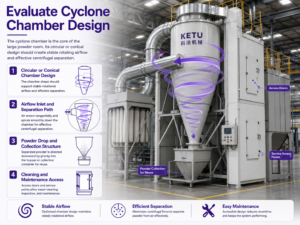
For multi-color production, a cyclone recovery system is often more suitable than a simple filter recovery system. The cyclone separates most overspray powder before the air reaches the secondary filter. This reduces powder loading on filters and makes color change easier.
A good cyclone system should have:
- High separation efficiency
- Smooth internal surface
- Easy cone cleaning
- Quick powder discharge
- Stable airflow
- Good connection with the booth
- Secondary filter protection
For companies coating furniture, metal cabinets, aluminum profiles, shelves, machinery parts, and appliance components, cyclone recovery can improve both powder utilization and changeover efficiency.
Automatic Powder Center
An automatic powder center can reduce manual work during color changes. It may include automatic powder feeding, powder level control, sieve integration, cleaning programs, and automatic hose purging.
The main advantage is consistency. Instead of relying entirely on manual cleaning, the system helps standardize the process. This is especially useful for factories with multiple shifts or operators with different experience levels.
Quick-Release Components
Small design details can save a lot of time. Quick-release pumps, hoses, nozzles, filter drawers, and powder containers reduce disassembly and cleaning time.
When choosing spray equipment, ask the supplier to show how these parts are removed and cleaned. A system may look good in photos, but if the operator needs too much time to access key parts, color change will still be slow.
Best Practices to Reduce Color Change Time Without Sacrificing Quality
Use Dedicated Parts for Sensitive Colors
Some colors are more difficult than others. White, silver, metallic, transparent, and light texture powders are sensitive to contamination. If your factory runs these colors often, consider using dedicated hoses, pumps, or even dedicated booth accessories.
This may look like an extra cost, but it can save a lot of time and reduce rejection risk.
Keep Compressed Air Clean and Dry
Compressed air quality directly affects powder flow and cleaning performance. Wet air can make powder stick to hoses and gun passages. Oil contamination can create coating defects and powder clumping.
Your air system should include:
- Air compressor
- Dryer
- Filter
- Öl-Wasser-Trennanlage
- Pressure regulator
- Regular drainage and maintenance
If powder does not purge smoothly, check the air system before blaming the spray equipment.
Separate Recovered Powder by Color
Recovered powder should be managed carefully. Do not allow recovered powder from one color to mix with another. Use sealed, labeled containers and define rules for reuse.
For high-quality coating requirements, some factories only reuse recovered powder within the same color batch or mix it with virgin powder at a controlled ratio. The exact method depends on the coating specification and customer quality requirements.
Train Operators With Visual Standards
Operators should know what “clean enough” means. Instead of only saying “clean the booth,” provide visual standards.
For example:
- No visible powder on booth walls
- No powder in booth floor corners
- No old powder inside gun nozzles
- No powder in hopper bottom
- Test panel must show no speckles under inspection light
cURL Too many subrequests by single Worker invocation. To configure this limit, refer to https://developers.cloudflare.com/workers/wrangler/configuration/#limits.
cURL Too many subrequests by single Worker invocation. To configure this limit, refer to https://developers.cloudflare.com/workers/wrangler/configuration/#limits
cURL Too many subrequests by single Worker invocation. To configure this limit, refer to https://developers.cloudflare.com/workers/wrangler/configuration/#limits.
cURL Too many subrequests by single Worker invocation. To configure this limit, refer to https://developers.cloudflare.com/workers/wrangler/configuration/#limits
- cURL Too many subrequests by single Worker invocation. To configure this limit, refer to https://developers.cloudflare.com/workers/wrangler/configuration/#limits
- cURL Too many subrequests by single Worker invocation. To configure this limit, refer to https://developers.cloudflare.com/workers/wrangler/configuration/#limits
- cURL Too many subrequests by single Worker invocation. To configure this limit, refer to https://developers.cloudflare.com/workers/wrangler/configuration/#limits
- cURL Too many subrequests by single Worker invocation. To configure this limit, refer to https://developers.cloudflare.com/workers/wrangler/configuration/#limits
- cURL Too many subrequests by single Worker invocation. To configure this limit, refer to https://developers.cloudflare.com/workers/wrangler/configuration/#limits
cURL Too many subrequests by single Worker invocation. To configure this limit, refer to https://developers.cloudflare.com/workers/wrangler/configuration/#limits.
cURL Too many subrequests by single Worker invocation. To configure this limit, refer to https://developers.cloudflare.com/workers/wrangler/configuration/#limits
cURL Too many subrequests by single Worker invocation. To configure this limit, refer to https://developers.cloudflare.com/workers/wrangler/configuration/#limits
cURL Too many subrequests by single Worker invocation. To configure this limit, refer to https://developers.cloudflare.com/workers/wrangler/configuration/#limits.
cURL Too many subrequests by single Worker invocation. To configure this limit, refer to https://developers.cloudflare.com/workers/wrangler/configuration/#limits
cURL Too many subrequests by single Worker invocation. To configure this limit, refer to https://developers.cloudflare.com/workers/wrangler/configuration/#limits.
cURL Too many subrequests by single Worker invocation. To configure this limit, refer to https://developers.cloudflare.com/workers/wrangler/configuration/#limits
cURL Too many subrequests by single Worker invocation. To configure this limit, refer to https://developers.cloudflare.com/workers/wrangler/configuration/#limits.
cURL Too many subrequests by single Worker invocation. To configure this limit, refer to https://developers.cloudflare.com/workers/wrangler/configuration/#limits
cURL Too many subrequests by single Worker invocation. To configure this limit, refer to https://developers.cloudflare.com/workers/wrangler/configuration/#limits.
cURL Too many subrequests by single Worker invocation. To configure this limit, refer to https://developers.cloudflare.com/workers/wrangler/configuration/#limits
cURL Too many subrequests by single Worker invocation. To configure this limit, refer to https://developers.cloudflare.com/workers/wrangler/configuration/#limits.
cURL Too many subrequests by single Worker invocation. To configure this limit, refer to https://developers.cloudflare.com/workers/wrangler/configuration/#limits
If your factory plans to run multiple colors frequently, color change performance should be considered before buying the equipment—not after installation.
Ask your equipment supplier these questions:
- How long does a normal color change take with this booth?
- Is the booth designed for occasional or frequent color changes?
- What parts must be removed during cleaning?
- Can the powder hoses be purged automatically?
- Is the recovery system cyclone-based or filter-based?
- How easy is it to clean the cyclone cone or filter chamber?
- Are quick-release parts included?
- Can we use dedicated powder circuits for special colors?
- How is recovered powder handled?
- Can the system be customized for our production layout and color schedule?
A good spray equipment supplier should not only quote the machine price. They should understand your product size, color quantity, daily output, powder type, booth layout, recovery requirements, and labor conditions.
Practical Example: Multi-Color Production for Metal Furniture and Cabinets
For metal furniture, electrical cabinets, shelves, aluminum profiles, and machinery parts, color changes are common because customers often request different colors, textures, and finishes.
In these industries, the coating line usually needs to balance three goals:
- Stable coating quality
- Efficient powder recovery
- Short color change downtime
For a small production workshop, a manual spray booth with proper cleaning access may be enough. For medium and large factories, a cyclone recovery booth or semi-automatic powder coating line can reduce downtime and improve consistency. For high-frequency color change production, quick color change booth design, powder center integration, and standardized SOP become very important.
The best solution depends on the actual workpiece size, production capacity, color quantity, factory space, budget, and coating quality requirements. There is no universal system that fits every factory. A customized layout is usually the most reliable approach.
Fast Color Change Checklist for Powder Coating Lines
Before restarting production after a color change, use this checklist:
- Old powder removed from hopper or powder box
- Powder hose purged
- Spray gun cleaned
- Nozzle and electrode checked
- Booth walls cleaned
- Booth floor cleaned
- Recovery inlet cleaned
- Cyclone or filter system checked
- Powder container correctly labeled
- New powder verified
- Test panel sprayed
- Test panel approved
- Production record updated
This checklist may seem basic, but it helps reduce operator mistakes. In a busy production environment, simple checklists often prevent expensive quality issues.
Conclusion: Fast Color Change Is a System, Not a Shortcut
Quick color change in spray equipment is not about rushing the operator. It is about designing the right system, following the right procedure, and keeping every powder path clean.
If the booth is difficult to clean, the recovery system holds residual powder, the hoses are too long, or the operators do not follow a standard process, color change will always be slow and unstable. But when the booth design, powder recovery system, supply center, spray guns, and SOP are properly matched, color change time can be reduced without sacrificing coating quality.
For factories running multiple colors, the goal should not simply be “change faster.” The real goal is to change colors quickly, cleanly, and repeatably. That is what protects coating quality, reduces rework, saves powder, and improves production flexibility.
cURL Too many subrequests by single Worker invocation. To configure this limit, refer to https://developers.cloudflare.com/workers/wrangler/configuration/#limits.
 German
  English
  Vietnamese
  French