
4 Key Equipment Components Needed for a Small Painting Line: Complete Setup Guide
When you decide to set up a small Pulverbeschichtungsanlage[^1], the first challenge isn't complexity—it's knowing exactly what components you actually need. Too many factory owners either buy equipment piecemeal from different suppliers (leading to integration headaches) or get oversold on unnecessary add-ons. The reality is simpler: a small painting line needs just four essential components working together. Get these right, and you have a stable, cost-effective production system. Miss one, and you'll face quality problems or runaway operating costs that no amount of tweaking later will fix.
A small powder coating line requires four equally critical components: a pre-treatment system to clean and prepare workpieces, an electrostatic spray booth[^2] for precise powder application, a curing oven to heat-set the coating, and a powder recovery system for environmental compliance and material reuse. These four elements form a closed-loop workflow—each feeds directly into the next, and the quality of your final product depends on how well all four work together, not just on having good equipment in one stage.
This guide walks you through each component, what to look for when selecting equipment, and the real mistakes we see small factories make during setup. We'll also address why cutting corners on any single component almost always costs more in the long run than investing properly upfront.
What Is a Small Painting Line and Why Does It Matter?
Ein kleines Pulverbeschichtungsanlage A small powder coating line is typically designed for factories with lower daily volumes (often 20–100+ pieces per day, depending on workpiece size) but production that's regular enough to justify automation over hand-spraying everything. The term "small" doesn't mean crude or temporary—it means the equipment footprint and energy consumption are scaled to match moderate throughput, not high-speed mass production.
What makes a small line different from a large production line isn't really the four components themselves; it's how they're configured. The front-to-back workflow is identical: incoming parts → cleaned and dried → sprayed with powder → heated to cure → cooled and finished. The difference is in speed, production volume targets, and how forgiving the line is when setup varies.
We work with a lot of small factories that underestimate the importance of a proper small line setup. They think, "If I can spray by hand, why do I need a whole line?" The answer is consistency. A hand-spray operator can't apply powder uniformly day after day, and coating thickness will vary piece to piece. That means some parts have excellent corrosion resistance and others fail salt-spray testing. A small line, properly configured, delivers the same film thickness and appearance across every part, every shift, every month. That's what your customers are really paying for—not cheaper coating, but reliable coating.
The 4 Key Equipment Components: Overview and Workflow
Complete Process Flow of a Small Painting Line
Understand the workflow first, because it explains why each component matters.
Step 1: Pretreatment (Front-End System)
Raw metal parts (steel, aluminum, etc.) arrive with oil, dust, rust, or oxide layers. The pretreatment system removes all of that. In a small line, this typically means a series of tanks or spray-wash stations: degreaser, rinse, acid or alkaline cleaner, conversion coating[^3] (phosphate or chromate layer), final rinse, and then drying. The conversion coating is crucial—it's not just about cleanliness; it creates a microscopic layer that helps powder adhere and resists corrosion. If pretreatment is skipped or done poorly, even the best spray booth can't rescue your coating quality. Adhesion fails, salt-spray tests fail, and you're left blaming the powder when the real problem was upstream.
Step 2: Drying (Often Part of Pretreatment Module)
After spray-wash pretreatment, workpieces are still wet. They must be completely dry before entering the spray booth. Any residual moisture becomes trapped under the powder coating, causing pinholes, micro-bubbles, and adhesion loss. A small line typically uses a heated drying oven or an air-dry section with hot-air circulation to evaporate all surface moisture.
Step 3: Electrostatic Spray (Spray Booth)
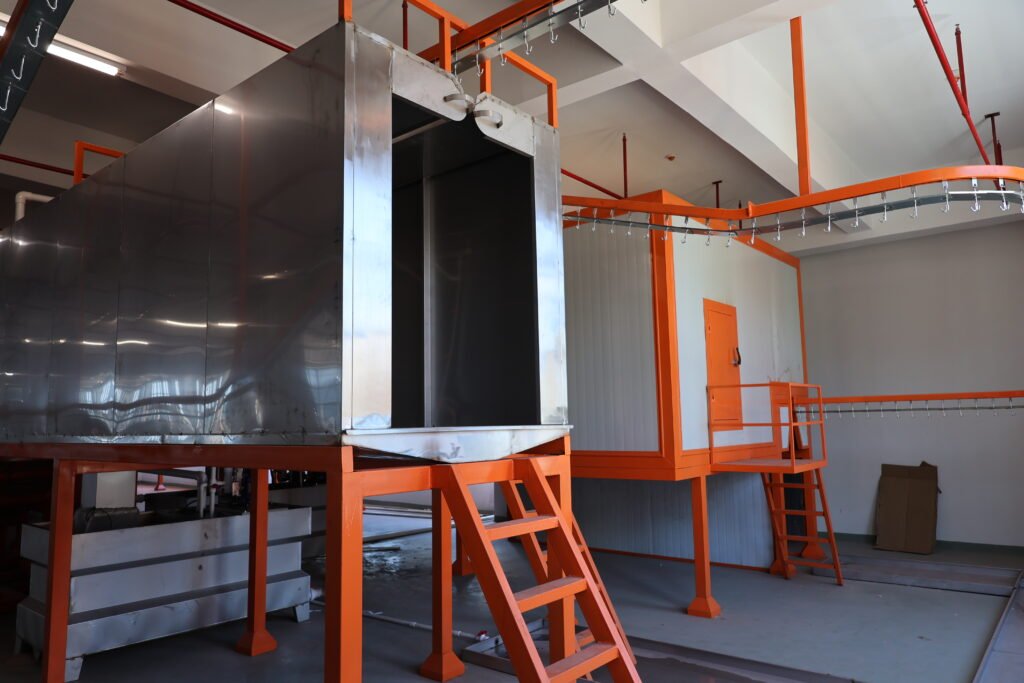
Dry parts enter the spray booth where powder is sprayed onto the surface. Electrostatic guns charge the powder particles, and because the workpiece is grounded, the charged powder is attracted to the surface and adheres uniformly. The booth contains the powder cloud, prevents it from spreading into the factory, and channels air through filters so powder can be recovered and reused. In a small line, this might be a manual spray booth (operator moves the gun) or a semi-automatic setup with simple mechanical scanning. Either way, the booth must maintain stable air velocity, consistent spraying distance, and reliable recovery.
Step 4: Curing (Fixed Oven)
Sprayed parts enter a heating oven where the powder melts, flows, and undergoes a chemical cross-linking reaction. This creates the final durable coating. Temperature and time matter enormously: too low or too short, and the coating is soft and weak; too high or too long, and the coating can discolor, become brittle, or the substrate warps. A small line oven is usually smaller than a large production oven but must still maintain uniform temperature throughout, or parts at the cooler end won't cure properly.
Step 5: Cooling and Unload
Parts exit the oven, cool to a safe handling temperature, and are removed. Some small lines include passive air cooling; others just rely on time.
Throughout this workflow, the powder recovery system sits alongside the spray booth, capturing overspray powder so it can be filtered, cleaned, and reused. This keeps operating costs down and meets environmental regulations.
Why These 4 Components Are Non-Negotiable
Each component is a single point of failure. Neglect any one, and your line either won't run or produces scrap.
Pretreatment Failure → Poor substrate preparation → Coating adhesion fails, parts corrode, customer rejects them.
Spray Booth Failure → Uneven powder distribution or air leaks → Coating thickness varies, coverage is incomplete, environmental dust escapes.
Curing Oven Failure → Undertime or temperature drop → Powder doesn't fully cure, coating is soft, customers complain about durability.
Recovery System Failure → Powder waste escapes to atmosphere → Environmental violations, regulatory fines, powder costs skyrocket.
We've seen small factories try to skip or drastically downsize one component "to save money." It never works. The cost of scrap, rework, and eventual regulatory penalties always exceeds the upfront savings.
Vorbehandlungssystem: Foundation for Quality Coating
cURL Too many subrequests by single Worker invocation. To configure this limit, refer to https://developers.cloudflare.com/workers/wrangler/configuration/#limits
cURL Too many subrequests by single Worker invocation. To configure this limit, refer to https://developers.cloudflare.com/workers/wrangler/configuration/#limits"
cURL Too many subrequests by single Worker invocation. To configure this limit, refer to https://developers.cloudflare.com/workers/wrangler/configuration/#limits
- cURL Too many subrequests by single Worker invocation. To configure this limit, refer to https://developers.cloudflare.com/workers/wrangler/configuration/#limits cURL Too many subrequests by single Worker invocation. To configure this limit, refer to https://developers.cloudflare.com/workers/wrangler/configuration/#limits.
- cURL Too many subrequests by single Worker invocation. To configure this limit, refer to https://developers.cloudflare.com/workers/wrangler/configuration/#limits cURL Too many subrequests by single Worker invocation. To configure this limit, refer to https://developers.cloudflare.com/workers/wrangler/configuration/#limits.
- cURL Too many subrequests by single Worker invocation. To configure this limit, refer to https://developers.cloudflare.com/workers/wrangler/configuration/#limits cURL Too many subrequests by single Worker invocation. To configure this limit, refer to https://developers.cloudflare.com/workers/wrangler/configuration/#limits.
cURL Too many subrequests by single Worker invocation. To configure this limit, refer to https://developers.cloudflare.com/workers/wrangler/configuration/#limits
- cURL Too many subrequests by single Worker invocation. To configure this limit, refer to https://developers.cloudflare.com/workers/wrangler/configuration/#limits cURL Too many subrequests by single Worker invocation. To configure this limit, refer to https://developers.cloudflare.com/workers/wrangler/configuration/#limits.
- cURL Too many subrequests by single Worker invocation. To configure this limit, refer to https://developers.cloudflare.com/workers/wrangler/configuration/#limitscURL Too many subrequests by single Worker invocation. To configure this limit, refer to https://developers.cloudflare.com/workers/wrangler/configuration/#limits.
- cURL Too many subrequests by single Worker invocation. To configure this limit, refer to https://developers.cloudflare.com/workers/wrangler/configuration/#limits cURL Too many subrequests by single Worker invocation. To configure this limit, refer to https://developers.cloudflare.com/workers/wrangler/configuration/#limits.
- Umwandlungsbeschichtungstank cURL Too many subrequests by single Worker invocation. To configure this limit, refer to https://developers.cloudflare.com/workers/wrangler/configuration/#limits.
- cURL Too many subrequests by single Worker invocation. To configure this limit, refer to https://developers.cloudflare.com/workers/wrangler/configuration/#limits cURL Too many subrequests by single Worker invocation. To configure this limit, refer to https://developers.cloudflare.com/workers/wrangler/configuration/#limits.
- cURL Too many subrequests by single Worker invocation. To configure this limit, refer to https://developers.cloudflare.com/workers/wrangler/configuration/#limitscURL Too many subrequests by single Worker invocation. To configure this limit, refer to https://developers.cloudflare.com/workers/wrangler/configuration/#limits.
cURL Too many subrequests by single Worker invocation. To configure this limit, refer to https://developers.cloudflare.com/workers/wrangler/configuration/#limits.
Key Selection Parameters and Common Mistakes
Parameter 1: Tank Volume and Part Loading
If your daily batch is 50 parts per day, each 60 cm long and weighing 2 kg, you need enough tank capacity to immerse all 50 parts at once (or handle them in smaller batches throughout the day). If your tanks are too small, you'll either have to run batches too frequently (inefficient) or skip full immersion (poor pretreatment). Tanks should be oversized by ~20% for safety.
Parameter 2: Temperature Control
Degreaser tanks must hold 50–60°C; conversion tanks typically 35–45°C. Without heating, reaction rates drop and soak times become impractical. Without thermostat control, temperatures drift and pretreatment quality becomes inconsistent. Use immersion heaters with thermostat control.
Parameter 3: Agitation or Spraying vs. Soaking
In a small line, you have two options: soak tanks (parts sit in solution) or spray wash (high-pressure jets). Spray is faster and uses less solution volume, but requires careful nozzle positioning and can miss internal cavities. Soak is slower but more thorough. Most small lines use soak for pretreatment, then finish with a rinse spray.
Parameter 4: Water Quality for Final Rinse
This is where we see the most mistakes. Factory tap water often contains calcium, magnesium, and chlorides. If you use tap water for the final rinse, these minerals stay on the part and interfere with adhesion. The final rinse should use deionized water[^4] (DI water) or distilled water. Cost: maybe 5–10 cents more per part. Benefit: adhesion failures drop by 50%.
Common Mistake 1: Skipping Pretreatment Entirely or Using Only Degreaser
We've seen small factories that just degrease and rinse, then skip straight to spraying. They think pretreatment is optional because "we're not making aerospace parts." Then their coating fails salt-spray testing or corrodes within a year. Adhesion failure, delamination, spot corrosion—all trace back to no conversion coating. Don't do this.
Common Mistake 2: Using the Same Rinse Water for Multiple Batches
Some factories try to save water by reusing rinse water from batch to batch. This defeats the purpose of rinsing. Salts and conversion solution accumulate in the rinse tank and get deposited back on parts. Use fresh or recycled rinse water, not reused rinse water.

Common Mistake 3: Underestimating Drying Time
After final rinse, parts must be bone-dry before entering the spray booth. "Mostly dry" isn't good enough. Residual moisture trapped under powder creates pinholes and reduces adhesion. A small drying oven or hot-air tunnel should dry parts to <2% moisture content. Time varies by part size (small parts: 10–15 minutes; large parts: 20–30 minutes). Don't rush this step.
Common Mistake 4: Poor Tank Maintenance
Pretreatment tanks are chemical workhorses. If you don't monitor solution concentration, temperature, and contamination, chemistry degrades and pretreatment fails. Degreaser gets saturated with oil; conversion solution loses activity; rinse tanks accumulate sludge. Establish a routine: check pH and concentration weekly, change solutions per manufacturer specs (typically every 2–4 weeks for degreaser; monthly for conversion solution; weekly or as-needed for rinse tanks).
Spray Application Equipment: Precision and Consistency
Spray Gun Types and Performance Requirements
The spray booth is where the visual appeal and uniformity of your coating are created. A poor spray setup shows instantly: uneven coverage, thick edges, thin patches, excessive overspray, poor color match.
For a small line, you have two main spray gun options:
Manual Spray Booth (Operator-Held Guns)
An operator stands inside or outside the booth holding an electrostatic spray gun, aiming at parts on a conveyor or manually positioned. Gun motion is human-controlled. Pros: very flexible for different part shapes; low equipment cost. Cons: operator skill matters enormously; consistency depends on training; coating thickness varies based on operator fatigue or carelessness.
Semi-Automatic Spray Booth (Reciprocating or Scanning Equipment)
A mechanical arm or frame moves the spray gun in a preset pattern—up and down, back and forth—while parts pass on a conveyor. Gun parameters (distance, angle, powder flow rate) are fixed. Pros: much more consistent; doesn't tire; repeatable film thickness. Cons: higher equipment cost; less flexible for shape variation; setup takes longer if you switch part types frequently.
For a truly small line with just 20–30 parts per day, manual spray is acceptable if your operator is trained well. For anything above 50 parts per day, or if your parts have complex shapes, a semi-automatic spray system is worth the investment because it reduces rejects and rework.
Key Gun Specifications to Confirm:
- Spray pattern and atomization: The gun should produce a fine, uniform powder cloud. Coarse atomization = thick uneven coating; over-atomized powder = poor coverage and excessive overspray.
- cURL Too many subrequests by single Worker invocation. To configure this limit, refer to https://developers.cloudflare.com/workers/wrangler/configuration/#limits: Typically 60–90 kV. Higher voltage = stronger attraction to the workpiece, but risk of wrapping (powder going around edges) or back-ionization if air is humid.
- Pulverflussrate: Measured in grams per minute. Should be adjustable so you can tune film thickness. Typical range: 80–150 g/min for small parts.
- Air supply requirements: Spray guns need clean, dry compressed air. Most require 4–6 bar (58–87 psi) and 40–60 cfm (cubic feet per minute). If your air compressor can't supply this, powder spray becomes erratic.
Air Supply System and Quality Standards
This is the invisible foundation that makes or breaks spray consistency, and we see it overlooked constantly in small shops.
Compressed air quality is critical because:
- cURL Too many subrequests by single Worker invocation. To configure this limit, refer to https://developers.cloudflare.com/workers/wrangler/configuration/#limits cURL Too many subrequests by single Worker invocation. To configure this limit, refer to https://developers.cloudflare.com/workers/wrangler/configuration/#limits.
- Oil carryover cURL Too many subrequests by single Worker invocation. To configure this limit, refer to https://developers.cloudflare.com/workers/wrangler/configuration/#limits.
- cURL Too many subrequests by single Worker invocation. To configure this limit, refer to https://developers.cloudflare.com/workers/wrangler/configuration/#limits cURL Too many subrequests by single Worker invocation. To configure this limit, refer to https://developers.cloudflare.com/workers/wrangler/configuration/#limits.
cURL Too many subrequests by single Worker invocation. To configure this limit, refer to https://developers.cloudflare.com/workers/wrangler/configuration/#limits
- cURL Too many subrequests by single Worker invocation. To configure this limit, refer to https://developers.cloudflare.com/workers/wrangler/configuration/#limitscURL Too many subrequests by single Worker invocation. To configure this limit, refer to https://developers.cloudflare.com/workers/wrangler/configuration/#limits.
- Air pressurecURL Too many subrequests by single Worker invocation. To configure this limit, refer to https://developers.cloudflare.com/workers/wrangler/configuration/#limits.
- cURL Too many subrequests by single Worker invocation. To configure this limit, refer to https://developers.cloudflare.com/workers/wrangler/configuration/#limitscURL Too many subrequests by single Worker invocation. To configure this limit, refer to https://developers.cloudflare.com/workers/wrangler/configuration/#limits cURL Too many subrequests by single Worker invocation. To configure this limit, refer to https://developers.cloudflare.com/workers/wrangler/configuration/#limitscURL Too many subrequests by single Worker invocation. To configure this limit, refer to https://developers.cloudflare.com/workers/wrangler/configuration/#limits.
- cURL Too many subrequests by single Worker invocation. To configure this limit, refer to https://developers.cloudflare.com/workers/wrangler/configuration/#limitscURL Too many subrequests by single Worker invocation. To configure this limit, refer to https://developers.cloudflare.com/workers/wrangler/configuration/#limits.
- cURL Too many subrequests by single Worker invocation. To configure this limit, refer to https://developers.cloudflare.com/workers/wrangler/configuration/#limitscURL Too many subrequests by single Worker invocation. To configure this limit, refer to https://developers.cloudflare.com/workers/wrangler/configuration/#limits.
cURL Too many subrequests by single Worker invocation. To configure this limit, refer to https://developers.cloudflare.com/workers/wrangler/configuration/#limits
cURL Too many subrequests by single Worker invocation. To configure this limit, refer to https://developers.cloudflare.com/workers/wrangler/configuration/#limits.
cURL Too many subrequests by single Worker invocation. To configure this limit, refer to https://developers.cloudflare.com/workers/wrangler/configuration/#limits
cURL Too many subrequests by single Worker invocation. To configure this limit, refer to https://developers.cloudflare.com/workers/wrangler/configuration/#limits.

cURL Too many subrequests by single Worker invocation. To configure this limit, refer to https://developers.cloudflare.com/workers/wrangler/configuration/#limits
Thermal Design and Throughput Planning
The curing oven is where powder transforms from a loose coating into a hard, durable finish. Temperature, time, and uniformity are everything.
Powder coatings typically cure at 200–230°C (388–446°F). The process happens in two stages:
- Schmelz- und Fließeigenschaften (~2–5 minutes at target temp): Powder particles fuse into a continuous liquid film.
- Cross-linking Reaction (~5–15 minutes at target temp): The resin and hardener chemically bond, creating durability and hardness.
The oven must:
- Reach the target temperature quickly (within 30–40 minutes of startup for a small oven).
- Maintain uniform temperature throughout (variation <±10°C). If one side is hotter, parts cure unevenly and color shifts.
- Hold temperature stable under load (parts absorb heat; if the oven can't maintain setpoint, cure times become inconsistent).
Oven Sizing for a Small Line:
Oven length and capacity depend on your target line speed and part size.
Example: You want 30 parts per day, each 60 cm long. Assume 5-hour production day. Throughput = 30 ÷ 5 = 6 parts per hour = 1 part every 10 minutes. Typical dwell time in oven (entry to exit) = 15–25 minutes depending on part mass. So the oven needs to hold at least 2–3 parts in flight at any time (2.5 × 10 = 25 minutes ÷ 10 = 2.5 parts).
If each part is 60 cm long and you stack them edge-to-edge, you need at least 120–180 cm of conveyor length inside the oven. In practice, add 20% safety margin: ~210 cm internal length.
Key Oven Parameters:
- Internal dimensions: Length (cm) = (Desired dwell time in minutes ÷ 10) × part length + 20% margin.
- Width and height: Must accommodate your largest part, plus 5–10 cm clearance on each side for air circulation.
- Heating method: Electric heating (faster, cleaner) or gas heating (lower operating cost but requires ventilation and gas line). For a small line, electric is typically easier.
- Air circulation: Oven must have a fan that continuously recirculates hot air. Without circulation, one side of the oven is hotter than the other (especially the top vs. bottom), and parts cure unevenly.
- Temperaturkontrolle: Should have a thermostat with ±5°C accuracy. For very small lines, a simple on-off thermostat is acceptable; for semi-automated lines, a PID controller[^6] with data logging is better (helps you troubleshoot and prove cure consistency).
Common Sizing Errors and How to Avoid Them
Mistake 1: Choosing an Oven That's Too Small
Small factory owners often calculate oven length based on part length alone, forgetting to account for dwell time. They buy a 1-meter oven for 60 cm parts, assume they can run 1 part per minute, and get surprised when the system bottlenecks. The oven fills up with parts in queue, and nothing gets through. Solution: add at least 50% extra length beyond the minimum calculated, so the oven doesn't become a constraint.
Mistake 2: Underestimating Heat Loss from Large Part Loads
When you load parts into a cold oven, the parts absorb thermal energy. If the oven isn't sized with enough heating capacity (kW), the temperature will sag below your setpoint. Parts then under-cure. Example: An oven rated for 10 kg of steel per hour might only be able to handle 5 kg if parts are loaded continuously. Check the oven manufacturer's specifications for maximum thermal load (kg/hour), and don't exceed it.
Mistake 3: Poor Air Circulation Design
If the oven has no internal recirculation fan, or the fan is undersized, heat stratifies: hotter at the top, cooler at the bottom. Top surfaces of parts cure fine; bottom surfaces under-cure. Signs: parts placed bottom-up show soft coating; parts placed top-up are fine. Solution: Ensure the oven has a powerful circulation fan and baffles that distribute air evenly. The fan should run continuously, even in standby, to maintain uniformity.

Mistake 4: Inadequate Thermometer Coverage
Small ovens might have just one temperature sensor. If it's located near the inlet, it might read correctly while dead zones exist elsewhere. Recommendation: Place at least two temperature sensors—one mid-oven, one at the exit. Log temperatures during operation to spot drift.
Mistake 5: Confusing "Oven Temperature" with "Part Temperature"
The oven air can be 220°C, but if parts are thick or have poor thermal contact with the conveyor, the inside of the part might only reach 190°C—insufficient for full cure. For critical applications (high-performance coatings), use an infrared thermometer to check actual part surface temperature, not just oven setpoint.
Powder Recovery System: Cost Control and Environmental Compliance
cURL Too many subrequests by single Worker invocation. To configure this limit, refer to https://developers.cloudflare.com/workers/wrangler/configuration/#limits
cURL Too many subrequests by single Worker invocation. To configure this limit, refer to https://developers.cloudflare.com/workers/wrangler/configuration/#limits
-
cURL Too many subrequests by single Worker invocation. To configure this limit, refer to https://developers.cloudflare.com/workers/wrangler/configuration/#limitscURL Too many subrequests by single Worker invocation. To configure this limit, refer to https://developers.cloudflare.com/workers/wrangler/configuration/#limits.
-
UmweltkonformitätcURL Too many subrequests by single Worker invocation. To configure this limit, refer to https://developers.cloudflare.com/workers/wrangler/configuration/#limits.
-
FarbkonsistenzcURL Too many subrequests by single Worker invocation. To configure this limit, refer to https://developers.cloudflare.com/workers/wrangler/configuration/#limits.
cURL Too many subrequests by single Worker invocation. To configure this limit, refer to https://developers.cloudflare.com/workers/wrangler/configuration/#limits
cURL Too many subrequests by single Worker invocation. To configure this limit, refer to https://developers.cloudflare.com/workers/wrangler/configuration/#limits
cURL Too many subrequests by single Worker invocation. To configure this limit, refer to https://developers.cloudflare.com/workers/wrangler/configuration/#limits.
cURL Too many subrequests by single Worker invocation. To configure this limit, refer to https://developers.cloudflare.com/workers/wrangler/configuration/#limits
- cURL Too many subrequests by single Worker invocation. To configure this limit, refer to https://developers.cloudflare.com/workers/wrangler/configuration/#limits.
- cURL Too many subrequests by single Worker invocation. To configure this limit, refer to https://developers.cloudflare.com/workers/wrangler/configuration/#limits.
- cURL Too many subrequests by single Worker invocation. To configure this limit, refer to https://developers.cloudflare.com/workers/wrangler/configuration/#limits.
cURL Too many subrequests by single Worker invocation. To configure this limit, refer to https://developers.cloudflare.com/workers/wrangler/configuration/#limits
- cURL Too many subrequests by single Worker invocation. To configure this limit, refer to https://developers.cloudflare.com/workers/wrangler/configuration/#limits.
- cURL Too many subrequests by single Worker invocation. To configure this limit, refer to https://developers.cloudflare.com/workers/wrangler/configuration/#limits.
cURL Too many subrequests by single Worker invocation. To configure this limit, refer to https://developers.cloudflare.com/workers/wrangler/configuration/#limits
- cURL Too many subrequests by single Worker invocation. To configure this limit, refer to https://developers.cloudflare.com/workers/wrangler/configuration/#limits.
- cURL Too many subrequests by single Worker invocation. To configure this limit, refer to https://developers.cloudflare.com/workers/wrangler/configuration/#limits.
- cURL Too many subrequests by single Worker invocation. To configure this limit, refer to https://developers.cloudflare.com/workers/wrangler/configuration/#limits.
- cURL Too many subrequests by single Worker invocation. To configure this limit, refer to https://developers.cloudflare.com/workers/wrangler/configuration/#limits.
cURL Too many subrequests by single Worker invocation. To configure this limit, refer to https://developers.cloudflare.com/workers/wrangler/configuration/#limits
How it works: Air passes through a pleated filter cartridge (similar to a car air filter, but larger). Powder is trapped on the outside of the pleats; clean air passes through. As powder accumulates, the filter gets clogged; a periodic backflush (pulsed air in reverse) shakes off the powder cake so it falls into a hopper below.
cURL Too many subrequests by single Worker invocation. To configure this limit, refer to https://developers.cloudflare.com/workers/wrangler/configuration/#limits
- Very fine filtration (can capture ultra-fine powder).
- Compact footprint.
- Excellent for clean air discharge (meets
 German
  English
  Vietnamese
  French