
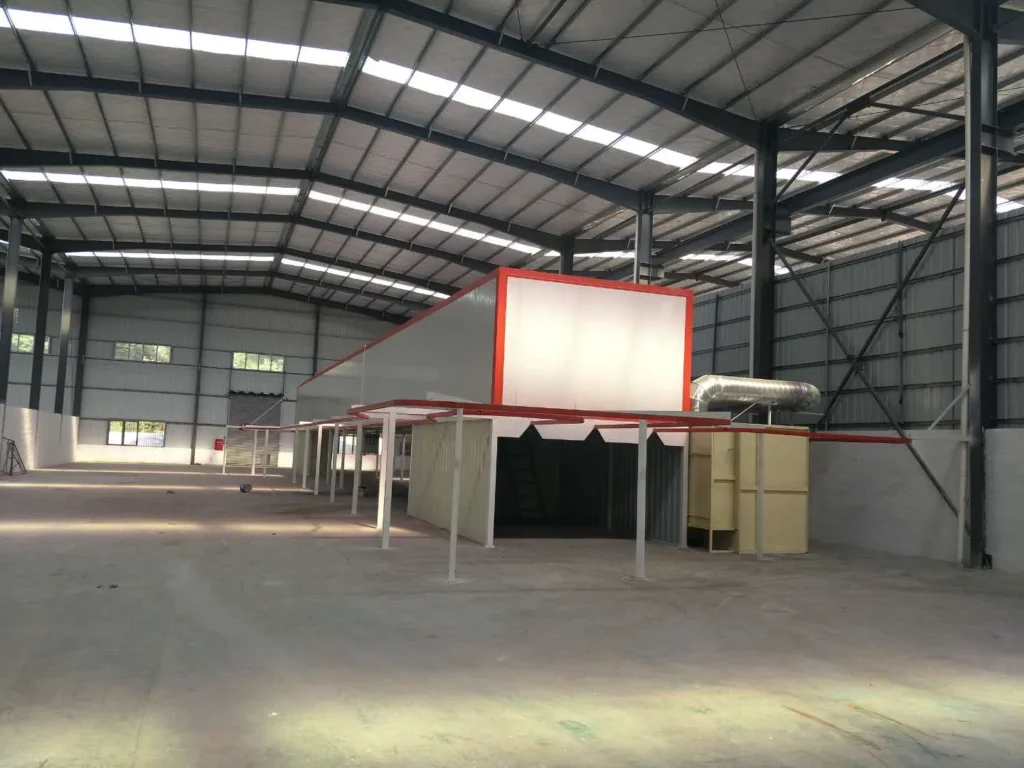
Common Powder Room Classifications and Their Characteristics in Powder Coating Production Lines
The Role of Powder Rooms in Electrostatic Powder Coating Lines
When you step into any powder coating facility, the powder room is often where the real magic happens. It's the chamber where atomized powder particles meet airflow, where static electricity[^1] does its work, and where unused powder gets separated and recovered. But here's what many manufacturers discover too late: choosing the wrong powder room doesn't just affect spray quality—it impacts your entire production economics.
A powder spray room is essentially the heart of a static electrostatic coating system. It's not just a box with guns and filters. The design of your powder room directly determines three critical outcomes: how much powder actually sticks to your workpieces, how much recoverable powder you waste, and how quickly you can switch colors without losing production time.
From our experience working with sheet metal cabinet makers, furniture manufacturers, and aluminum profile plants across multiple countries, we've seen what happens when clients cut corners here. They start with a budget-friendly backpack-filter system to save initial costs, then spend the next two years struggling with inconsistent coating quality, frequent filter replacements, and production delays during color changes. By year two, they're retrofitting to a cyclone system anyway—except now they've spent more on workarounds than a proper system would have cost upfront.
The powder room selection isn't really an isolated equipment decision. It's the decision that determines whether your entire line runs at 70% efficiency or 95% efficiency.
![electrostatic powder coating booth setup]
Powder Room Classification Standards and Dimensions
Powder rooms aren't classified by random industry whim. They're organized along a few clear technical dimensions, and understanding these dimensions helps you make sense of why one type costs more than another, and whether that cost actually matters for your operation.
Separation Principle
The first major distinction is how the room separates powder from air. Some use gravity and impact force, others rely entirely on centrifugal force[^2], and the most sophisticated systems use multiple-stage filtration. This isn't academic—it's the difference between recovering 60% of your unused powder and recovering 95% of it.
Recovery Efficiency
Recovery rates directly translate to material waste and operating costs. A system that recovers 60% means you're throwing away 40% of your powder with the exhaust air. Over a year, that compounds into serious money, especially on premium powder formulations used for outdoor furniture or high-corrosion environments.
Automation and Color-Change Speed
Some powder rooms require manual color purging that takes 20-30 minutes and operator attention. Others can switch colors in 5 minutes with a button press. If you're doing frequent color runs—which is common for cabinet makers and furniture builders—this difference eats production hours every single day.
Space Footprint and Installation Complexity
A backpack system fits in tighter spaces and needs less infrastructure. Large cyclone systems demand more height, floor space, and dedicated ductwork. Secondary recovery cabinets add another layer of footprint but unlock much higher recovery efficiency.
Operational Noise and Maintenance Burden
Some powder rooms are louder, some need filter changes every few weeks, others go months between maintenance. These aren't theoretical specs—they're actual operational costs that accumulate month after month.
Common Powder Room Types: Structure, Principles, and Key Characteristics
Backpack Powder Rooms: Principles and Performance Characteristics
The backpack powder room is the entry point. It's simple: a spray booth with a large filter element that hangs like a backpack, compressed air pulses dust from the filter surface periodically, and separated powder falls back into collection hoppers.
How it works:
Powder-laden air enters the chamber, passes through the backpack filter media, and fine powder sticks to the filter surface while cleaned air exits. When pressure drop reaches a threshold, compressed air pulses reverse-flow through the filter, dislodging accumulated powder back into the room below.
Real-world performance:
- Powder recovery rate: 60-70% (theoretical best case 80%)
- Color change time: 20-30 minutes per color due to manual purging required
- Typical recovery cycle: Filter cleaning happens every 2-4 hours during active spraying
- Footprint: Compact—fits in smaller facilities
- Operator skill needed: Low to moderate
- Maintenance frequency: Filter replacement every 3-6 months depending on volume
Where it makes sense:
Small batch operations. Job shops doing 5-10 different colors per week. Facilities where initial capital is extremely constrained. Operations with low spray volume (under 100 units per day).
Where it breaks down:
The moment you're doing high-volume runs with multiple colors, backpack systems become a bottleneck. One of our European clients was spraying 300 metal cabinets daily across 8 colors. With a backpack room, they were losing 2-3 hours per shift to color-change purging alone. That's 25-40% of their production capacity sitting idle during changeovers. When they upgraded to a cyclone[^3] system, that purge time dropped to 10-15 minutes total. The upgrade paid for itself in 8 months through recovered production time.
Large Cyclone Powder Rooms: High-Recovery Design and Applications
The large cyclone room is where efficiency jumps significantly. Instead of filtering through media, powder gets separated through centrifugal force as air spirals through a conical chamber.
How it works:
Air carrying powder enters tangentially into a cylindrical chamber, creating a vortex. Powder particles hit the outer wall due to centrifugal force and slide down into collection hoppers at the bottom. Clean air spirals up and exits the top. No filter media to clog, no reverse-pulse cleaning needed.
Real-world performance:
- Powder recovery rate: 90-95%
- Color change time: 5-10 minutes (just blow out the system)
- Maintenance: Minimal; mainly checking collection hoppers
- Footprint: Requires more height (typically 3.5-4 meters) and floor space
- Operator skill: Low—very straightforward operation
- Filter element lifespan: No consumable filters; cyclone chamber lasts years
Where it excels:
High-volume production. Frequent color changes. Any facility spraying more than 200 units daily. Operations where material waste directly impacts margins (aluminum profiles, outdoor furniture). Environments where downtime is expensive.
Real project insight:
We supplied a large cyclone system to an Indian aluminum extrusion company last year. Their previous backpack setup was wasting approximately 35% of powder per shift. With cyclone separation achieving 93% recovery, they reduced powder consumption by the equivalent of three full days of production waste per month. Across their annual powder budget of roughly $180,000, that's nearly $45,000 in recovered value—before even considering the production time gained from faster color changes.
Independent Spray Booths: Advanced Separation Systems
Independent spray booths are standalone enclosures designed for flexibility and isolation. Rather than being part of a larger production line, they're self-contained spray environments with integrated separation and recovery.
How it works:
Workpieces enter a dedicated spray chamber, powder application happens in a controlled space, and the booth's own ventilation system handles air separation. Powder gets collected in on-site hoppers or fed to external secondary recovery.
Real-world performance:
- Powder recovery rate: 70-85% (varies by booth design)
- Color change: 10-20 minutes typically
- Footprint: Moderate to large; self-contained unit
- Best for: Flexible batching, multiple product types, or facilities running semi-automated operations
- Maintenance: Moderate; depends on filtration method used inside booth
Where they're deployed:
When you need to spray different product families without integrating into a rigid production line. Custom job shops. Operations that need to alternate between manual and semi-automated spraying. Situations where booth isolation is important for air quality or operator safety.
Secondary Recovery Cabinets: Environmental and Economic Optimization
Secondary recovery cabinets represent the highest tier of powder conservation. They're always paired with a primary separation system (usually a cyclone), catching ultra-fine powder particles that escape the primary stage.
How it works:
Air exiting the primary separator still carries fine powder particles. This air passes through a secondary cabinet equipped with bag filters or cartridge filters. A sophisticated pulse-cleaning[^4] system removes accumulated ultra-fine powder and returns it to inventory.
Real-world performance:
- Additional recovery: Captures 5-15% more powder beyond primary separation
- Total system recovery: 95-99% possible with cyclone + secondary cabinet
- Operating cost impact: Reduces powder waste to nearly zero
- Energy requirement: Moderate additional pressure drop
- Maintenance: Filter changes every 6-12 months depending on volume
- Investment: 40-60% additional cost vs. standalone cyclone
Where secondary recovery becomes critical:
High-value powders. Outdoor furniture or aluminum where coating consistency is premium product differentiation. Any operation where the powder material cost per unit exceeds $50-100. Facilities in regions with strict environmental regulations on air discharge. Operations running 24/7 where waste reduction compounds into substantial savings.
Economic reality check:
We worked with a Turkish outdoor furniture manufacturer running secondary recovery. Their powder cost was approximately $6 per kg, and they were processing roughly 40,000 units per month. Without secondary recovery, they'd lose about 2-3% of powder to air discharge—roughly $28,000 annually. The secondary cabinet cost them $52,000 installed. Payback happened in 22 months. But here's what really matters: they're now bidding on premium contracts requiring 99%+ powder capture for environmental compliance. That secondary cabinet opened market doors that a standalone cyclone couldn't access.
| Powder Room Type | Recovery Rate | Color Change Time | Capital Cost | Maintenance Burden | Best Application |
|---|---|---|---|---|---|
| Backpack Filter | 60-75% | 20-30 min | Low | Medium | Small batch, low volume |
| Large Cyclone | 90-95% | 5-10 min | Medium | Low | High-volume production |
| Independent Booth | 70-85% | 10-20 min | Medium-High | Medium | Flexible batching |
| Cyclone + Secondary | 95-99% | 5-10 min | High | Low-Medium | Premium applications, strict regulations |
Performance Comparison: Recovery Rate, Color Change Efficiency, and Operating Costs
Recovery rate is where the financial reality becomes obvious. Let's run the numbers on a realistic scenario.
Assume a facility spraying 250 metal cabinets per day, each requiring 2 kg of powder. That's 500 kg of powder consumption daily. At $5/kg average powder cost, that's $2,500/day in powder expense, or roughly $650,000 annually.
- With 70% recovery (backpack): You're losing 30%, or $195,000 worth of powder annually down the exhaust
- With 92% recovery (cyclone): You're losing 8%, or $52,000 worth of powder annually
- With 98% recovery (cyclone + secondary): You're losing 2%, or $13,000 worth of powder annually
The difference between backpack and cyclone alone is $143,000/year in recovered material. Even if the cyclone system costs $80,000 more than a backpack setup, it pays for itself in less than one year through material recovery alone.
Color change efficiency multiplies the advantage. With a backpack system, color purging takes 25-30 minutes. You need to run the system empty, blow compressed air through to clear old powder, wait for air to clear, then load new powder and verify spray pattern. That's roughly 30 minutes of non-productive spray chamber time.
In a 10-hour shift with eight color changes, you lose 4 hours (40% of production capacity) to color-change procedures. A cyclone system reduces that to 8 minutes per change—roughly 1 hour total per shift. That's 3 hours of recovered production daily, or 30% additional effective capacity from the same physical equipment.
Operating costs layer on top of material recovery:
| Cost Factor | Backpack | Cyclone | Cyclone + Secondary |
|---|---|---|---|
| Annual powder waste (@ $650k annual budget) | $195,000 | $52,000 | $13,000 |
| Filter cartridge replacement (annual) | $8,000 | $0 | $4,000 |
| Pressure drop / fan energy premium | +12% | Baseline | +15% |
| Downtime for maintenance (hours/year) | 40-60 | 10-15 | 15-20 |
| Labor cost of color changes (hours/year) | 240 | 40 | 40 |
For a medium-sized operation, cyclone + secondary recovery can cost $5,000-7,000 more annually to operate than a backpack system, but saves $130,000+ in recovered powder value and gained production time. The math heavily favors moving up the quality tier.
How to Select the Right Powder Room: Matching Products, Output, and Color Frequency
Powder room selection is about matching three variables to your operation's realities. Most purchasing decisions go wrong because buyers optimize for one variable (usually upfront cost) and ignore the other two.
Step 1: Define your product profile
What are you actually coating? Cabinet bodies create different dust patterns than aluminum profiles, which create different patterns than intricate outdoor furniture parts. Simpler flat or box-like geometries (cabinets, sheet metal brackets) tolerate lower recovery rates because overspray is more predictable. Complex shapes with edges, holes, and recesses (furniture, intricate castings) benefit more from primary cyclone recovery because they generate more fines.
Ask yourself: What percentage of my coating spray actually sticks to the workpiece? Industry baselines range from 65% (complex geometries) to 85% (simple flat parts). If your overspray is high, investing in better recovery becomes more valuable.
Step 2: Calculate your actual daily spray duration and volume
Not just theoretical units per day—actual spray gun time. A facility spraying 200 cabinets daily but spending 3 hours of that on color changes and setup is really only spraying maybe 5-6 hours actively. That changes the economic calculation entirely.
If you're spraying less than 100 hours per month, a backpack system might be acceptable. If you're spraying 150+ hours per month with consistent high-volume runs, a cyclone becomes economically mandatory regardless of upfront cost concerns.
Step 3: Assess your color change frequency
This is the variable that often tips the decision more than people expect.
- 1-2 colors per day: Backpack rooms work fine; color purging is 1-2 times daily
- 3-5 colors per day: Cyclone systems start looking essential; the cumulative purge time savings compound
- 6+ colors per day: You absolutely need cyclone-level speed; backpack purging would become your production constraint
From our experience, furniture makers and kitchen component suppliers typically hit 5-7 color changes per day. That alone justifies cyclone investment for most facilities in that category.
Step 4: Evaluate powder material costs and consumption patterns
If your powder is commodity-grade at $2-3/kg and your production volume is moderate (under 150 units/day), recovery efficiency is less critical. If you're spraying premium automotive powder at $8-12/kg or using specialty outdoor coatings at $6-8/kg, every percentage point of recovery suddenly matters tremendously.
Calculate your annual powder spend. If it exceeds $400,000, invest in secondary recovery. If it's $200,000-400,000, a primary cyclone makes strong economic sense. If it's under $200,000, backpack might be acceptable.
Step 5: Consider local environmental and regulatory requirements[^5]
This is where many international projects get surprising. Environmental regulations in Europe, parts of Asia, and increasingly in the Middle East impose strict limits on air discharge particulate. Some regions require 95%+ powder capture as a baseline. If you're exporting equipment or operating in regulated jurisdictions, this isn't a choice—it's a requirement that drives toward cyclone + secondary from the start.
We encountered this with an Algerian cabinet manufacturer last year. Their initial instinct was to minimize upfront cost with a backpack system. But when they reviewed local environmental compliance standards, the regulations actually mandated secondary recovery for powder coating facilities. The "cheap" backpack option became non-compliant on day one. Forward-looking design from the start saved them retrofit costs later.
Powder Room Selection Pitfalls and Why Matching the Entire Production Line Matters
Here's what we see go wrong most often: clients optimize the powder room in isolation instead of as part of an integrated system.
Pitfall 1: Oversizing Recovery Without Matching Input Air Volume
This is surprisingly common. A facility installs a high-capacity cyclone room but feeds it from undersized air handling. The result: insufficient air velocity means separation efficiency drops. You're paying for 95% recovery capacity but only getting 70% actual performance because the system isn't being fed properly. The cyclone and the upstream air supply must be designed as one integrated unit.
Pitfall 2: Underestimating Color Change Impact on Production Scheduling
We worked with a sheet metal company that calculated production based purely on spray gun speed. They figured a 250-unit daily target. But with their eight standard colors and frequent custom requests, actual spray time per color averaged only 45 minutes. Color purging consumed 25 minutes per change. Their real capacity was closer to 180 units daily, not 250. A faster color-change powder room (cyclone vs. backpack) would have added the missing 70 units of daily capacity—no additional spray guns, no additional operators, just better room design.
Pitfall 3: Disconnecting Powder Room Performance from Coating Quality
This is subtle but important. A low-recovery backpack system isn't just wasting powder—it's also degrading spray quality over time. As filters load with powder, airflow resistance increases. This changes spray pattern, reduces atomization, and degrades coating uniformity. By the time you notice quality issues, you're already running a compromised system. Cyclone rooms maintain consistent airflow and spray quality throughout their duty cycle because they don't rely on clogging filters.
Pitfall 4: Forgetting That Powder Room Capacity Must Match Conveyor Capacity
Your spray room can only be as productive as your transport line feeding it. If your conveyor moves one workpiece through every 90 seconds, but your powder room can only handle one workpiece per 120 seconds, you have a bottleneck. Conversely, if you oversize the powder room but your conveyor[^6] speed can't keep up, you've invested in unused capacity.
From our experience, the most common mismatch is underestimating conveyor requirements while over-investing in spray equipment. The powder room needs to be matched to your actual line throughput, not theoretical maximum.
Pitfall 5: Ignoring Environmental Performance as a Future Requirement
Many manufacturers select powder rooms based on current local regulations, then face costly retrofits when standards tighten. Secondary recovery systems that seem expensive today become mandatory compliance requirements in 5-10 years as environmental regulations continue tightening globally.
Practical Recommendations: Powder Room Choices for Different Enterprise Scales and Product Types
For Small Operations (Under 100 Units/Day)
Recommended: Backpack filter powder room with single-stage separation
Rationale: Capital efficiency matters most at this scale. A backpack system costs roughly $20,000-30,000 complete, versus $50,000+ for a cyclone. At lower volumes, the material waste differential (roughly $30,000-40,000 annually) gets offset partially by lower operating complexity.
Caveat: Only if you're spraying 1-2 colors per day consistently. If color variety is high, the purge time penalty becomes unacceptable.
Setup example: Small metal fabrication shop, 80 units/day, primarily two colors (primer + topcoat).
For Medium Operations (100-300 Units/Day)
Recommended: Primary cyclone powder room, no secondary recovery initially
Rationale: At this volume tier, the annual powder waste from a backpack system ($80,000-120,000) makes cyclone investment economically obvious. Material recovery pays the equipment cost within 18-24 months. Operator simplicity and color-change speed become production bottlenecks that matter.
Optional addition: Secondary recovery cabinet if your powder costs exceed $5/kg and color variety is high (5+ daily changes).
Setup example: Cabinet maker, 200 units/day, average 4 colors daily, competitive powder pricing at $4.50/kg. Cyclone-only system makes economic sense. Secondary recovery justified if they move into premium outdoor lines at higher margins.
For Large Operations (300+ Units/Day) or Premium Products
Recommended: Cyclone primary + secondary recovery cabinet
Rationale: At this scale, both annual waste dollars ($150,000+) and production time (5+ hours daily lost to inefficient color changes with backpack systems) are substantial. Secondary recovery adds maybe 10-15% more to annual material recovery but becomes a compliance requirement in many jurisdictions anyway.
Investment alignment: Total system cost ($95,000-130,000) represents only 2-4 months of recovered material value for a high-volume operation. It's a no-brainer economic decision.
Setup example: Aluminum extrusion facility, 400+ profiles daily, 6-8 colors weekly, premium outdoor-grade powders at $7-9/kg. Secondary recovery is essential both for economics and environmental compliance.
For Operations with High Color Variety or Custom Work
Recommended: Cyclone room minimum; secondary recovery if material costs exceed $500,000 annually
Rationale: The color-change speed advantage of cyclone rooms (8 minutes vs. 25-30 minutes) directly translates to capacity multiplier for batch-oriented shops. A job shop doing 12-15 color changes per day is genuinely gaining 3-4 hours of productive capacity daily by moving from backpack to cyclone—that's real production expansion without equipment multiplication.
Setup example: Custom furniture manufacturer, 150-200 units daily but with 8-12 different colors per day. Cyclone room enables 25-30% higher daily throughput through faster changeovers alone, with secondary recovery capturing environmental compliance upside.
Conclusion: Matching the Whole System, Not Just One Component
The powder room isn't an isolated choice. It's the foundation that determines whether your entire powder coating[^7] line operates at 60% efficiency or 95% efficiency.
From our experience working with manufacturers across three continents, the pattern is consistent: clients who properly match powder room selection to their specific product type, volume, color frequency, and powder costs typically see:
- 20-35% reduction in annual powder material waste
- 15-30% increase in effective production capacity (through faster color changes alone)
- 40-60% reduction in scheduled maintenance time
- Environmental compliance today rather than retrofit costs tomorrow
The initial capital difference between a backpack system and a cyclone system ($25,000-40,000) looks significant in isolation. When you calculate it against recovered material value, reclaimed production time, and avoided future retrofits, it disappears into statistical noise within 12-18 months.
Your decision should match these three factors: What products are you coating? How many units move through your line daily? What's your actual color-change frequency? Answer those three questions honestly, and the right powder room type becomes obvious.
If you're evaluating powder room options for a new or upgraded coating line, we're happy to discuss your specific operating parameters. From our factory experience serving sheet metal shops, cabinet makers, furniture manufacturers, and aluminum profile plants, we can help you avoid the most common selection mistakes and build a system that actually delivers the efficiency and quality you're paying for.
Contact us to discuss your coating line requirements:
- WhatsApp: +8618925987762
- Email: ketucoatingline@gmail.com
We'll help you match the right powder room to your operation—not the most expensive option, but the right one for your products, volumes, and market demands.
[^1]: Static electricity is an electric charge at rest on an object's surface, used in electrostatic powder coating to attract charged powder particles to grounded workpieces.
[^2]: Centrifugal force is the apparent outward-pushing force experienced in circular motion, used in cyclone separators to drive powder particles outward for collection.
[^3]: A cyclone separator is a device that uses rotational airflow to separate particles from air by directing them to the outer walls through centrifugal effect.
[^4]: Pulse-cleaning systems use periodic bursts of compressed air to dislodge accumulated powder from filter media, typically used in baghouse and secondary recovery equipment.
[^5]: ISO standards provide internationally recognized specifications for manufacturing, environmental safety, and product quality across industries worldwide.
[^6]: A conveyor system is a mechanical device that transports workpieces or materials continuously through a production line at controlled speeds.
[^7]: Powder coating is a dry finishing process where finely atomized particles of pigmented resin are electrostatically applied to surfaces and thermally cured.
 English
  German
  Vietnamese
  French