

Powder Coating Oven Selection Guide: Types, Key Parameters & Expert Recommendations
Why Powder Coating Oven Selection Matters More Than You Think
You're investing in a powder coating line. You've researched spray booths, powder supplies, and recovery systems. But then you get to the curing oven, and it feels like an afterthought—just "pick a size and pick a heat source."
That's a mistake.
From our years working with cabinet makers, furniture manufacturers, and aluminum processors, we've learned that the curing oven often determines whether your entire line succeeds or fails. A poorly chosen oven won't just disappoint you with defects; it can derail your whole operation.
This guide cuts through the noise. We'll walk you through oven types, the parameters that actually matter, and how to match your choice to your real production scale.
Types of Powder Coating Ovens: Electric vs. Gas vs. Oil
You have three main heating options. Each has trade-offs, and the right choice depends on your volume, energy costs, and facility constraints.

Electric Heating Ovens: Best for Small-to-Medium Operations
How they work
Electric heating uses resistance heating elements (usually nichrome wire or similar) mounted inside the oven chamber. Hot air is circulated via a fan to ensure uniform temperature distribution.
Key advantages
- Fastest warm-up time: An empty oven typically reaches 200°C in 30–40 minutes
- Precise temperature control: ±3–5°C accuracy is standard, which helps with color consistency
- No combustion byproducts: The oven interior stays cleaner longer
- Easy color changes: Less powder residue means faster changeovers
- Simple operation: Minimal technical training required
- Lower maintenance: No burner service, no combustion system checks
Limitations
- Higher unit energy cost: Electricity is typically 25–35% more expensive per kWh than natural gas
- Continuous draw: Once running, energy consumption stays constant regardless of load
- Heating element replacement: Frequent element failures if quality is poor or water is present in compressed air
- Limited scalability: Not ideal for continuous, high-volume production
Why we recommend this
We installed a 96kW electric oven for an electrical cabinet manufacturer who sprayed only 5 hours per day, producing 400–500 units monthly. Despite a single furnace being smaller, the fast warm-up, clean interior, and easy color switching (they had 4–5 standard colors) made electric far more practical than gas. The total cost of ownership was better because they avoided fuel system complexity and frequent cleaning.
Best suited for:
- Monthly volumes under 5,000 units
- Multiple color SKUs requiring frequent switches
- Facilities with stable, three-phase electric supply
- Products where coating uniformity and precision are critical (e.g., high-end furniture, precision cabinets)
Gas-Fired Ovens: Ideal for High-Volume Production
How they work
Natural gas burners heat air that is then circulated inside the chamber. Some designs use direct-fire heating; others use a heat exchanger for better control and cleaner air.
Key advantages
- Lower per-unit heat cost: Natural gas is typically 30–40% cheaper than electricity in most regions
- Continuous high output: Sustained production at high volumes without energy spikes
- Scalability: Easier to add burner capacity as production grows
- Faster recovery: Between heavy loads, the oven can reheat quickly
- Established infrastructure: Most industrial facilities already have gas lines
Limitations
- Higher upfront investment: Burners, gas lines, and ventilation systems are expensive
- Combustion byproducts: Requires good exhaust system design; moisture and unburned gases can leave residue inside
- More maintenance: Burner inspection, nozzle cleaning, and annual safety checks
- Regulatory complexity: Local codes may require permits, inspections, and compliance monitoring
- Slower startup: Takes longer to reach stable operating temperature than electric
- Less precise control: Temperature variance typically ±5–8°C unless high-end controls are added
Best suited for:
- Monthly volumes above 5,000–10,000 units
- Continuous or near-continuous production schedules
- Facilities where gas supply is already available
- Cost-sensitive operations where energy cost dominates
Oil-Fired Ovens: When Other Options Aren't Available
How they work
Heating oil is burned in a combustion chamber, and the heat is transferred to air that circulates inside the oven.
Key advantages
- No gas infrastructure required: Useful in regions without natural gas availability
- Portable fuel supply: Can store oil on-site
- Sustained high temperature capability: Can maintain very high setpoints if needed
Limitations
- Highest maintenance burden: Oil system requires frequent filter changes, nozzle cleaning, and combustion analysis
- Highest fuel cost: Oil is usually more expensive than both gas and electricity
- Combustion odor and residue: Oil-fired systems tend to leave more buildup inside the oven
- Environmental sensitivity: Spills and emissions are heavily regulated
- Slow ignition and recovery: Restart time is slower than gas or electric
When to use
Only if your region lacks natural gas and electricity cost is prohibitive. Otherwise, avoid.
Critical Parameters That Actually Impact Coating Quality
Selecting a heat source is just step one. The oven's internal design matters far more than you might think.

Temperature Uniformity and Why Hot Spots Destroy Your Finish
The real problem
Your powder recipe is formulated for a specific temperature range—say, 200±10°C. If one corner of your oven runs at 195°C and another at 215°C, coatings won't flow smoothly in the hot zone and won't fully cure in the cool zone.
What this causes:
- Uneven gloss: Parts of the workpiece look matte; others look glossy
- Color variation: Subtle shifts in hue across a batch
- Adhesion failure: Cooler zones don't cure fully and fail adhesion tests
- Dimensional inconsistency: Different flow rates create thickness variation
How to evaluate it
Ask the oven supplier for temperature maps. Reputable manufacturers should have data showing temperature variance across the chamber floor, center, and ceiling. Look for:
- Variance ≤±5°C across the entire chamber (this is industry standard)
- Horizontal uniformity: All points at the same plane should be within 2–3°C of each other
- Vertical gradient: Gradual, predictable temperature rise from floor to ceiling (not sudden spikes)
Our perspective
We've seen factories blame spray technique or powder quality for defects that actually came from oven hot spots. The spray booth looks perfect, the powder is fresh, but every 5th or 6th part shows color variation. The culprit? A dead heater section or poor air circulation. Install temperature probes at multiple points during commissioning, and log the data continuously. You'll spot problems early.
Heating Speed, Dwell Time, and Cooling Control
Why it matters
Your production schedule depends on three things:
- Ramp-up time: How long from ambient to setpoint
- Dwell time: How long the part must stay at target temperature for full cure
- Cool-down: How quickly the part can cool enough to handle
If your oven takes 90 minutes to cure and cool a cabinet, but your conveyor is designed for 60-minute cycles, you have a bottleneck.
Typical parameters:
- Electric ovens: 30–40 min ramp (empty oven), 10–20 min dwell (depending on part mass), 15–30 min cool
- Gas ovens: 45–60 min ramp, 10–20 min dwell, 20–40 min cool
- Part thickness matters: A 1.5mm cabinet takes 10 min dwell; a 5mm manifold block might need 20 min
What to ask suppliers:
- What's the actual ramp time with a full load (not empty oven)?
- What dwell time do they recommend for your specific part weight?
- Is there active cooling, or just open-door natural cooling?
- What's the realistic cycle time you can expect?
Our advice
Don't just accept the number in the brochure. Request a test run with a representative part. Measure actual time from entry to safe-to-handle exit. Many ovens perform worse than rated once loaded.
Insulation Thickness and Energy Efficiency
Why it matters
Thin insulation = heat loss = higher energy consumption = higher operating costs over 5–10 years.
Standard specifications:
- Budget ovens: 50–75mm of rockwool or fiberglass
- Mid-range: 100mm of high-quality rockwool
- Premium: 100–150mm of premium ceramic fiber board or similar
What to check:
- Outer surface temperature: Should not exceed room temperature + 10°C when running at setpoint
- Insulation material type: Ceramic fiber board performs better than basic rockwool but costs more
- Vapor barrier: Should be present to prevent moisture ingress into insulation
- Sealing at joints: Gaps around doors, shelves, and access panels are heat leak points
Energy cost example:
A 100kW oven running 8 hours/day:
- Poor insulation (75mm): ~10% heat loss = 10kW extra draw = 80 kWh/day extra
- Good insulation (100mm): ~6% loss = 6kW extra = 48 kWh/day extra
- Difference: 32 kWh/day × 250 working days × $0.12/kWh = $960/year savings with better insulation
- Over 5 years, that's $4,800—often enough to justify the upfront cost difference
How to Match Oven Configuration to Your Production Scale
This is where most selection mistakes happen. Factories either over-specify (wasting money) or under-specify (creating bottlenecks).
Small Factories (< 500 pieces/month)
Typical profile:
- 20–100 pieces per week
- Multiple colors or product variants
- Manual or semi-automatic spray
- Limited capital budget
- Space is constrained
Oven recommendation:
- Type: Electric heating
- Chamber size: 2–3 meters long, 1.5–2m wide
- Capacity: 20–50 kW
- Dwell time: 10–15 minutes at 180–200°C
- Features: PLC temperature control, manual or gravity-fed cooling
Why electric: - Fast warm-up minimizes idle time
- Precise control suits variety production
- No complex gas infrastructure
- Easy to operate and maintain
Configuration example:
For a small metalwork shop doing custom brackets and small enclosures:
- 2.5m oven length × 1.5m width
- 40kW electric heating
- 10-minute dwell at 200°C
- Manual conveyor or roller entry/exit
- Estimated cost: $25,000–$40,000
Target your constraint
At this volume, your bottleneck is likely spray capacity, not cure time. Ensure your oven doesn't slow down your sprayers. A 15-minute dwell is usually safe.
Medium Manufacturers (500–5,000 pieces/month)
Typical profile:
- 50–300 pieces per week
- 2–4 product types or colors
- Semi-automatic spray (powered gun, conveyor)
- Some capital available
- Production efficiency matters
Oven recommendation:
- Type: Either electric (if 500–2,000/month) or gas (if 2,500+/month)
- Chamber size: 4–6 meters long, 2–2.5m wide
- Capacity: 60–120 kW electric or 200,000–300,000 BTU gas
- Dwell time: 10–20 minutes at 200°C
- Features: Automated temperature logging, zone-based heating (optional), active cooling or heat exchanger
Breakeven point:
Above ~2,000 units/month, gas starts to make economic sense. Below, electric is simpler.
Configuration example:
For a cabinet maker doing 200 units/month in 3 colors:
- 5m oven × 2m width
- 90 kW electric heating with active recirculation fan
- Automated conveyor entry/exit
- 12-minute dwell at 200°C
- Estimated cycle: 50 minutes (spray + cure + cool)
- Output: ~6 complete cycles/shift = ~30 units/shift
Energy consideration:
At 200 operating days/year and 5 hours/day:
- 90kW × 5h × 200 days = 90,000 kWh/year
- Cost at $0.12/kWh = $10,800/year
If you switch to gas (assume 70% efficiency, $8/MMBtu):
- Equivalent heat: 90kW ÷ 0.70 = ~130 kW thermal output
- Gas burned: 130 ÷ (3.412 × efficiency) = ~38,000 BTU/hour
- Cost: ~$8,000–$9,000/year
- Annual savings: $1,800–$2,800
Large-Scale Operations (5,000+ pieces/month)
Typical profile:
- 300+ pieces per week
- 1–2 dominant product types
- Fully automated spray (multi-gun, indexed conveyor)
- High capital budget
- Efficiency and consistency are paramount
Oven recommendation:
- Type: Gas-fired (almost always)
- Chamber size: 8–12+ meters long, 2.5–3.5m wide
- Capacity: 300,000–600,000+ BTU
- Dwell time: 10–15 minutes at 200°C
- Features: Multi-zone temperature control, heat recovery, automatic logging, exhaust optimization, cleanout ports
Why gas at this scale:
- Energy cost per unit is critical; gas wins decisively
- High volume justifies complex controls
- Heat recovery systems become cost-effective
- Burner reliability is proven at scale
Configuration example:
For an aluminum extrusion supplier doing 8,000 units/month:
- 10m oven × 3m width, 2-stage heating (preheat + cure zones)
- 400,000 BTU gas burner (150 kW thermal output)
- Fully automated conveyor with PLC control
- 12-minute dwell at 200°C
- Heat exchanger for incoming air
- Estimated cycle: 30 minutes total
- Output: ~16 cycles/shift = ~180 units/shift = 3,600 units/month per shift
Energy cost:
- 150 kW thermal output, 8 hours/day, 250 working days
- Gas consumption: ~180 MMBtu/year
- Cost at $8/MMBtu = ~$1,440/year (compared to ~$14,400 if electric)
- Annual savings: ~$13,000 vs. equivalent electric
New vs. Used Ovens: Making the Right Cost Decision
The appeal of used
A used gas oven might cost $20,000 vs. $60,000 new. That's tempting.
The hidden costs
- Burner condition unknown: A worn burner costs $3,000–$5,000 to replace and may be unreliable during critical production
- Refractory and insulation damage: Can't be fully assessed without partial disassembly; repairs are expensive
- Control system obsolescence: 10-year-old PLC controls may be hard to source parts for; migration to modern systems can cost $10,000+
- No warranty: Any failure in year one is entirely your cost
- Shipping damage: Used ovens often suffer transport damage that manifests months into operation
- Hidden combustion issues: Gas ovens with poor exhaust can leave corrosive residue; cleaning/remediation is labor-intensive
The math often doesn't work
A "cheap" used oven costing $20,000 can easily incur $5,000–$10,000 in hidden repairs within the first 18 months. Add downtime (factory halted while oven is serviced), and the effective cost-per-unit-produced often exceeds buying new.
Our recommendation
- New: Standard choice. 3–5 year payback via energy savings and reliability
- Used: Only if the seller provides full history, recent service records, and you inspect with a qualified technician
- Refurbished: Middle ground if available; buy from reputable refurbishers with 1-year warranty
Integration with Your Complete Powder Coating Line
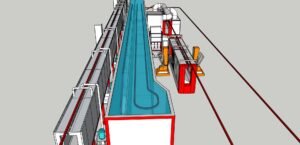
An oven doesn't exist in isolation. It must work as part of a system.
Coordination with Spray Booth and Powder Supply
The common mistakes:
- Oven cycle time doesn't match spray time: You spray for 3 minutes but the oven needs 15 minutes to cure. Parts pile up waiting.
- Oven entrance/exit temperature mismatched: If the oven cools too slowly, exiting parts are too hot to handle; if too fast, they're sluggish to cure.
- Powder carryover: If spray booth sags too long before the oven, powder settles unevenly.
What to verify:
- Conveyor sync: Spray dwell time + cure dwell time + cool time = total line cycle
- Temperature at entrance: Ambient or preheated? (Preheat saves energy and ensures faster cure)
- Powder settle time: Ideally <2 minutes between spray and oven entry
- Capacity balance: If spray booth can handle 40 units/hour but oven does 30/hour, 25% of spray capacity is wasted
Conveyor Systems and Layout Optimization
Key design choices:
| Aspect | Implication |
|---|---|
| Conveyor speed | Faster = higher output but reduced dwell time; slower = longer dwell but lower capacity |
| Oven length | Longer oven allows slower conveyor (longer dwell) at same speed, improving cure uniformity |
| Entrance design | Smooth entry (no sharp edges) prevents powder disturbance; preheating adds cost but improves quality |
| Exit strategy | Gravity-fed cooling saves space but limits control; active heat exchanger allows precise cooling |
| Layout footprint | L-shaped or inline? Space constraints often force compromises |
Our recommendation for layout:
If space allows, design for linear flow: spray booth → oven entrance → long oven chamber → exit → cool zone → pack. This minimizes handling and damage. If space is tight, L-shaped or even U-shaped is acceptable, but adds conveyor complexity.
Key Factors Beyond Equipment: Installation, Service & Support
Buying the oven is 40% of the battle. Installation and ongoing support are equally critical.
Installation Quality
What to insist on:
- On-site assembly by qualified technicians: Not just delivered and bolted together
- Foundation inspection: Poor concrete foundations cause alignment issues
- Temperature mapping during commissioning: Document that all zones are within spec
- Conveyor timing verification: Ensure line synchronization before you run production
- Safety testing: Verify all interlocks, emergency stops, and overtemp protection work
Typical timeline: 3–5 days for a medium-sized line
Ongoing Support & Spare Parts
Questions to ask before buying:
- What's the lead time for replacement heating elements?
- Can they service remotely via phone/video, or do they send technicians?
- What's the warranty coverage? (Typically 1 year parts, 2 years labor for major components)
- Do they stock common wear items (thermocouples, heating elements, fans)?
- What's the annual maintenance cost estimate?
Red flag:
If a supplier can't tell you the typical failure rate of their heating elements or can't provide a spare parts list, move on.
Common Mistakes to Avoid (And What They Cost You)
Based on our field experience:
Mistake 1: Choosing based on upfront price alone
Cost: Often $10,000–$20,000 extra in repairs over 5 years, plus downtime and lost production.
Prevention: Factor in energy cost, maintenance, and reliability ratings.
Mistake 2: Ignoring temperature uniformity
Cost: Chronic defects (color variation, adhesion failure) that require rework. At scale, rework can eat 5–10% of output.
Prevention: Request temperature maps; verify during commissioning.
Mistake 3: Undersizing for future growth
Cost: Within 2–3 years, you need to replace or upgrade the oven anyway. Double investment.
Prevention: Buy 20–30% larger than your current need to give headroom.
Mistake 4: Poor integration with spray booth timing
Cost: Either idle oven time or bottlenecked spray booth. If spray is bottlenecked, you're wasting $15,000–$30,000/year in lost capacity.
Prevention: Model the entire line cycle before you specify ovens.
Mistake 5: Inadequate commissioning
Cost: Problems emerge weeks into production; fixes are expensive because the factory is already live.
Prevention: Insist on 2–3 days of supervised testing with real parts before handoff.
Making Your Final Selection: A Practical Checklist
Use this before you commit to an oven.
Production Volume & Schedule
- [ ] Monthly volume (pieces)
- [ ] Daily production target (units/day)
- [ ] Working days/month
- [ ] Seasonal variation (does volume swing?)
- [ ] Future volume forecast (3-year projection)
Product Specifications
- [ ] Typical workpiece size (L × W × H)
- [ ] Material type (steel, aluminum, stainless, composite)
- [ ] Average weight per unit
- [ ] Thickness/mass distribution
- [ ] Heat sensitivity (can it tolerate 220°C without distortion?)
- [ ] Color range (single or multi-color)
- [ ] Batch size (1 unit, 5 units, 20 units per spray run?)
Facility Constraints
- [ ] Available floor space (L × W × H)
- [ ] Electrical supply: 208V 3-phase? 380V 3-phase? 460V?
- [ ] Gas supply available? If yes, PSI and BTU/hour rating?
- [ ] Compressed air: CFM available? Pressure stability?
- [ ] Ventilation/exhaust capacity (cubic feet/minute)?
- [ ] Ambient temperature (air-conditioned, outdoor, unheated)?
- [ ] Humidity range?
Oven Type Decision
- [ ] Electric: Makes sense? (Yes if volume < 2,000/month or multiple colors)
- [ ] Gas: Makes sense? (Yes if volume > 5,000/month or cost-focused)
- [ ] Ramp time acceptable?
- [ ] Dwell time acceptable?
- [ ] Cool-down rate acceptable?
Quality & Reliability
- [ ] Temperature uniformity spec (±5°C or better)?
- [ ] Heating element lifespan and replacement cost?
- [ ] Control system modern (PLC vs. analog)?
- [ ] Datalogger for traceability?
- [ ] Warranty terms (length, coverage, labor)?
- [ ] Supplier reputation (references from similar users)?
Integration
- [ ] Oven entrance/exit height compatible with conveyor?
- [ ] Dwell time syncs with spray booth cycle?
- [ ] Conveyor speed (in./sec or m/min) works with oven length?
- [ ] Cool-zone footprint accounted for in layout?
- [ ] Exhaust routing planned (roof vent, side wall, vertical)?
Service & Support
- [ ] Supplier offers on-site commissioning?
- [ ] Spare parts available within 48 hours?
- [ ] Remote support capability?
- [ ] Training included?
- [ ] Annual maintenance cost estimate provided?
Financial
- [ ] Upfront cost (equipment + installation)?
- [ ] Annual energy cost estimate?
- [ ] Typical maintenance cost/year?
- [ ] Total cost of ownership over 5 years?
- [ ] ROI based on energy savings or capacity gain?
 English
  German
  Vietnamese
  French