
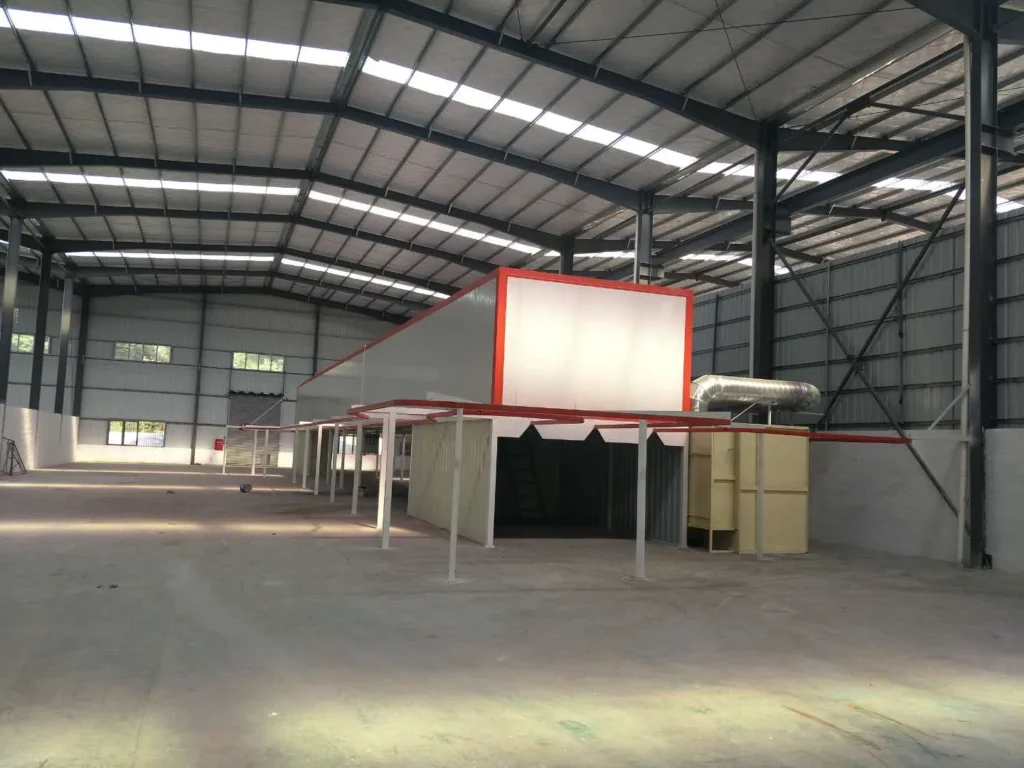
The Relationship Between Dây chuyền sơn tĩnh điện Speed and Production Efficiency: How to Find the Balance Between Quality and Capacity
In the customer projects we have handled, one of the most common misunderstandings is this: factory managers or purchasing teams often ask, “How many meters per minute can your powder coating line run at the fastest speed?”
They directly assume that the faster the line speed, the higher the production capacity.
But reality is often different. Many factories blindly increase conveyor speed, only to find that their output does not really improve. Instead, they begin to face problems such as uneven film thickness, reduced adhesion, and higher defect rates.
From KETU’s years of experience in powder coating line design and modification, I have learned that the relationship between powder coating line speed and production efficiency is not simply linear. The real factor that determines capacity is the balance between pretreatment, spraying, curing, powder recovery, and other key sections of the whole line.
This article will help you understand this relationship clearly. I will explain, based on real project experience, why speed does not equal efficiency, and how to find the best line speed for your own products.
Speed Does Not Equal Efficiency: The Core Misunderstanding About Powder Coating Lines
How common is this misunderstanding?
In the modification projects we have handled, about 60% of customers initially wanted to “increase conveyor speed.” Their logic was very simple: if the line speed increases from 4 m/min to 8 m/min, production capacity should double.
But in actual production, the situation is very different.
The consequences of blindly increasing line speed
When conveyor speed increases quickly, the workpiece stays in the spray booth for a shorter time. The spray guns need to complete the same amount of coating work in a much shorter period.
If spray gun parameters, air pressure, and the powder supply system are not adjusted at the same time, the most direct result is insufficient powder application. This leads to reduced film thickness.
We once served a cabinet manufacturing company. The customer wanted to increase capacity by raising the line speed from 5 m/min to 10 m/min. During the first two weeks after the modification, the coating thickness dropped from the standard 80-100 μm to 50-70 μm, which failed to meet the anti-corrosion requirement.
After inspection, we found that the problem was not only insufficient spraying time. Their pretreatment drying oven had also not been upgraded accordingly. As a result, moisture remained on the workpiece surface, which directly affected the powder adhesion rate.
Why the whole line must work together
Every section of an electrostatic powder coating line is like one part of a chain. If you only increase conveyor speed while ignoring the capacity of other sections, the whole line will suffer from the “weakest link” effect. The shortest board determines the real capacity of the whole system.
When I design a powder coating line, I always consider these questions:
Can the pretreatment drying section fully dry the workpieces within the required time?
Can the spray gun atomization stability support a denser spraying rhythm?
Does the curing oven have enough heat capacity to cure more workpieces within the same time?
Can the powder recovery system maintain separation efficiency under high-frequency spraying?
Only when all these sections can match the required line speed can the whole production line truly run efficiently.
How Line Speed Affects Coating Quality: The Balance Between Film Thickness, Adhesion, and Surface Defects
To truly understand line speed, you must first understand the three key quality indicators affected by line speed.
The direct relationship with film thickness
The relationship between film thickness and line speed is the most direct. The faster the line speed, the shorter the time the workpiece stays inside the spray booth. Under the same spray gun parameters, less powder will be applied.
Here is a simple example. Suppose a workpiece is 1 m wide, the spray booth is 5 m long, and the line speed is 5 m/min. Then the workpiece stays inside the spray booth for 60 seconds. If the line speed increases to 10 m/min, the residence time becomes 30 seconds.
To achieve the same film thickness within 30 seconds, the powder output of the spray guns must double. But whether the spray guns can stably double the powder output depends on the powder supply system, compressed air quality, powder fluidity, and many other factors.
My suggestion is: do not look only at the film thickness value. You should also check film thickness uniformity and first-pass yield.
Some factories blindly increase powder output to maintain film thickness at high speed. As a result, powder builds up on the edges, orange peel appears on the surface, and the rework rate increases.
The hidden risk of adhesion
When the line speed becomes faster, pretreatment quality may also be reduced. This is something many people ignore.
When conveyor speed increases, the residence time of the workpiece in each pretreatment section, such as degreasing, rust removal, phosphating, and drying, becomes shorter. If these sections are not upgraded at the same time, the surface cleanliness and conversion film thickness will decrease. This finally leads to poor adhesion.
For example, the degreasing tank may need a higher liquid temperature. The wear rate of the solution may increase, requiring more frequent replacement. The drying oven may need better temperature and airflow matching. If these details are not controlled, adhesion problems will appear.
cURL Too many subrequests by single Worker invocation. To configure this limit, refer to https://developers.cloudflare.com/workers/wrangler/configuration/#limits.
cURL Too many subrequests by single Worker invocation. To configure this limit, refer to https://developers.cloudflare.com/workers/wrangler/configuration/#limits.
cURL Too many subrequests by single Worker invocation. To configure this limit, refer to https://developers.cloudflare.com/workers/wrangler/configuration/#limits
cURL Too many subrequests by single Worker invocation. To configure this limit, refer to https://developers.cloudflare.com/workers/wrangler/configuration/#limits
- cURL Too many subrequests by single Worker invocation. To configure this limit, refer to https://developers.cloudflare.com/workers/wrangler/configuration/#limitscURL Too many subrequests by single Worker invocation. To configure this limit, refer to https://developers.cloudflare.com/workers/wrangler/configuration/#limits
- Độ dày lớp màng không đềucURL Too many subrequests by single Worker invocation. To configure this limit, refer to https://developers.cloudflare.com/workers/wrangler/configuration/#limits
- cURL Too many subrequests by single Worker invocation. To configure this limit, refer to https://developers.cloudflare.com/workers/wrangler/configuration/#limitscURL Too many subrequests by single Worker invocation. To configure this limit, refer to https://developers.cloudflare.com/workers/wrangler/configuration/#limits
- cURL Too many subrequests by single Worker invocation. To configure this limit, refer to https://developers.cloudflare.com/workers/wrangler/configuration/#limitscURL Too many subrequests by single Worker invocation. To configure this limit, refer to https://developers.cloudflare.com/workers/wrangler/configuration/#limits
cURL Too many subrequests by single Worker invocation. To configure this limit, refer to https://developers.cloudflare.com/workers/wrangler/configuration/#limits.

cURL Too many subrequests by single Worker invocation. To configure this limit, refer to https://developers.cloudflare.com/workers/wrangler/configuration/#limits
cURL Too many subrequests by single Worker invocation. To configure this limit, refer to https://developers.cloudflare.com/workers/wrangler/configuration/#limits.
cURL Too many subrequests by single Worker invocation. To configure this limit, refer to https://developers.cloudflare.com/workers/wrangler/configuration/#limits
cURL Too many subrequests by single Worker invocation. To configure this limit, refer to https://developers.cloudflare.com/workers/wrangler/configuration/#limits
cURL Too many subrequests by single Worker invocation. To configure this limit, refer to https://developers.cloudflare.com/workers/wrangler/configuration/#limits.
cURL Too many subrequests by single Worker invocation. To configure this limit, refer to https://developers.cloudflare.com/workers/wrangler/configuration/#limits.
cURL Too many subrequests by single Worker invocation. To configure this limit, refer to https://developers.cloudflare.com/workers/wrangler/configuration/#limits
cURL Too many subrequests by single Worker invocation. To configure this limit, refer to https://developers.cloudflare.com/workers/wrangler/configuration/#limits.
cURL Too many subrequests by single Worker invocation. To configure this limit, refer to https://developers.cloudflare.com/workers/wrangler/configuration/#limits.
cURL Too many subrequests by single Worker invocation. To configure this limit, refer to https://developers.cloudflare.com/workers/wrangler/configuration/#limits.
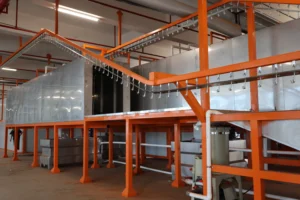
My suggestion is: if you want to increase line speed, first check and upgrade the hot air circulation capacity and temperature uniformity of the drying oven. This can be improved by increasing the power of the hot air circulation fan and optimizing the air inlet and outlet design.
Spray Gun Atomization Stability and Curing Oven Temperature Field Uniformity
The stability of these two systems directly determines the upper limit of your coating quality.
Spray gun side
The core parameters of electrostatic spray guns include voltage, usually 60-90 kV; current, usually 10-20 μA; and powder output. When line speed increases, the coordination between these three parameters becomes more important.
If the voltage is too high, discharge and powder accumulation may easily occur at the corners of the workpiece. If the voltage is too low, powder application efficiency decreases. Powder output must be precisely controlled. It should not be blindly increased just because the spraying time is shorter, otherwise powder accumulation and orange peel may appear.
In one of our projects, the line speed needed to increase from 5 m/min to 7 m/min. We optimized the spray gun parameters in detail. The voltage was adjusted from 75 kV to 72 kV, the powder output increased by 15% instead of simply increasing by 40%, and the gun distance was adjusted from 200 mm to 180 mm. This ensured film thickness while avoiding edge problems.
Curing oven side
The influence of curing oven temperature field uniformity on overall efficiency is seriously underestimated.
Many factories only verify oven temperature uniformity under empty-load conditions during design. But in real production, when many workpieces enter the oven, heat distribution changes. Under high line speed, workpiece density becomes higher, and uneven temperature distribution inside the oven becomes more obvious.
A standard approach is to place multiple temperature measurement points inside the curing oven, at least 6-8 points, and monitor and adjust them through the temperature control system in real time. If the temperature field is not uniform, workpieces in different positions will have different curing levels, which finally affects coating consistency.
I suggest that if you want to increase line speed, first carry out a thermal imaging inspection of the curing oven to check the actual temperature difference at different points during operation. If the difference exceeds ±10°C, you should consider adjusting the hot air circulation system or increasing heating power.
Powder Supply System and Compressed Air Quality
These two systems may look like “auxiliary systems,” but they are actually key factors that determine the stability of the whole line.
Powder supply
When line speed increases, the spray guns need a more frequent and more stable powder supply. The fluidizing plate, powder pump, powder hose, and other components of the powder supply system all face higher working frequency.
If the fluidizing plate design inside the powder hopper is not reasonable, powder may clump during high-frequency supply. If the suction capacity of the powder pump is limited, powder interruption may occur. If powder accumulates or the powder hose is worn, blockage may appear.
In an aluminum profile project in India, the customer’s original powder supply system was designed for 6 m/min. When they wanted to increase the line speed to 9 m/min, we carried out a full powder supply system evaluation.
The result showed that the powder pump flow rate was not enough to support higher-frequency spraying. The solution was to upgrade the powder pump model and add a standby powder hopper to ensure continuous powder supply.
Không khí nén
This is the most easily ignored section, but it is often the root cause of coating defects.
Compressed air must meet three conditions: dry, with a dew point of ≤ -40°C; oil-free; and particle-free. When line speed increases, the spray guns use more atomizing air, so the requirement for air quality becomes stricter.
If the compressed air contains water or oil, defects will be quickly amplified under high-frequency spraying. The most common problems are craters and pinholes. I once saw a case where a factory increased line speed from 4 m/min to 6 m/min, and the crater defect rate increased from 2% to 8%. The final diagnosis showed that the filter element of their air dryer had not been replaced for 6 months.
My suggestion
If you want to modify a powder coating line, you must upgrade the compressed air system at the same time. This includes:
- Choose a refrigerated dryer or adsorption dryer instead of a simple cooling tank
- Use three-stage filtration: coarse filtration, fine filtration, and ultra-fine filtration
- Replace filter elements regularly
- Install an air storage tank to ensure stable air supply
- Regularly test air quality, including moisture, oil, and particles
This investment does not take a large share of the whole modification cost, usually around 5-8%, but the benefits are significant.
Recommended Line Speed for Different Product Types
By now, you should understand why “the faster the line speed, the better” is a false assumption.
So the next question is: cURL Too many subrequests by single Worker invocation. To configure this limit, refer to https://developers.cloudflare.com/workers/wrangler/configuration/#limits
cURL Too many subrequests by single Worker invocation. To configure this limit, refer to https://developers.cloudflare.com/workers/wrangler/configuration/#limits.
cURL Too many subrequests by single Worker invocation. To configure this limit, refer to https://developers.cloudflare.com/workers/wrangler/configuration/#limits
cURL Too many subrequests by single Worker invocation. To configure this limit, refer to https://developers.cloudflare.com/workers/wrangler/configuration/#limits.
cURL Too many subrequests by single Worker invocation. To configure this limit, refer to https://developers.cloudflare.com/workers/wrangler/configuration/#limits.
cURL Too many subrequests by single Worker invocation. To configure this limit, refer to https://developers.cloudflare.com/workers/wrangler/configuration/#limits
cURL Too many subrequests by single Worker invocation. To configure this limit, refer to https://developers.cloudflare.com/workers/wrangler/configuration/#limits.
cURL Too many subrequests by single Worker invocation. To configure this limit, refer to https://developers.cloudflare.com/workers/wrangler/configuration/#limits.
cURL Too many subrequests by single Worker invocation. To configure this limit, refer to https://developers.cloudflare.com/workers/wrangler/configuration/#limits.
cURL Too many subrequests by single Worker invocation. To configure this limit, refer to https://developers.cloudflare.com/workers/wrangler/configuration/#limits
- cURL Too many subrequests by single Worker invocation. To configure this limit, refer to https://developers.cloudflare.com/workers/wrangler/configuration/#limits.
- cURL Too many subrequests by single Worker invocation. To configure this limit, refer to https://developers.cloudflare.com/workers/wrangler/configuration/#limits.
- cURL Too many subrequests by single Worker invocation. To configure this limit, refer to https://developers.cloudflare.com/workers/wrangler/configuration/#limits.
cURL Too many subrequests by single Worker invocation. To configure this limit, refer to https://developers.cloudflare.com/workers/wrangler/configuration/#limits.
cURL Too many subrequests by single Worker invocation. To configure this limit, refer to https://developers.cloudflare.com/workers/wrangler/configuration/#limits
cURL Too many subrequests by single Worker invocation. To configure this limit, refer to https://developers.cloudflare.com/workers/wrangler/configuration/#limits.
cURL Too many subrequests by single Worker invocation. To configure this limit, refer to https://developers.cloudflare.com/workers/wrangler/configuration/#limits.
cURL Too many subrequests by single Worker invocation. To configure this limit, refer to https://developers.cloudflare.com/workers/wrangler/configuration/#limits
cURL Too many subrequests by single Worker invocation. To configure this limit, refer to https://developers.cloudflare.com/workers/wrangler/configuration/#limits.
cURL Too many subrequests by single Worker invocation. To configure this limit, refer to https://developers.cloudflare.com/workers/wrangler/configuration/#limits.
cURL Too many subrequests by single Worker invocation. To configure this limit, refer to https://developers.cloudflare.com/workers/wrangler/configuration/#limits.
cURL Too many subrequests by single Worker invocation. To configure this limit, refer to https://developers.cloudflare.com/workers/wrangler/configuration/#limits.
We once worked on a project for an outdoor furniture company in Turkey. Their products were intended for the European market and required weather resistance of more than 5 years. We set the line speed at 5 m/min and used special powder, a polyester-polyurethane mixed powder, together with an optimized curing curve of 180°C for 15 minutes. As a result, their products performed very well in third-party weather resistance testing.
Aluminum Profiles and Precision Parts: 6-10 m/min
Aluminum profiles are a special category. On the surface, they seem suitable for higher line speed. But in reality, they require the highest process precision.
Typical products include architectural aluminum window frames, heat sinks, and industrial aluminum profiles.
Why is the range so wide, from 6-10 m/min?
Aluminum profile manufacturers usually face higher capacity pressure than other product manufacturers. Many aluminum processing companies require daily output of 50-100 tons, so they must improve output through higher line speed. But aluminum is also very sensitive to the powder coating process. powder coating process.
The key indicator is film thickness tolerance. If the film thickness of aluminum profiles is out of tolerance, whether too thick or too thin, the product may be rejected by the customer. A coating that is too thick may affect assembly. A coating that is too thin may affect corrosion resistance. Industry standards usually require a film thickness of 40-80 μm, with a tolerance of ±10 μm.
Within the range of 6-10 m/min, this target can be achieved through refined process parameter control:
- 6-7 m/min: suitable for profiles with strict film thickness requirements and complex shapes
- 7-9 m/min: suitable for regular profiles and medium production capacity demand
- 9-10 m/min: only suitable for simple shapes and fully stabilized process parameters
In an aluminum profile project in India, the customer initially wanted to run the line at 12 m/min. But after on-site evaluation, considering product complexity and pretreatment line length, we recommended an optimal speed of 8 m/min.
At this speed, by optimizing conveyor rhythm, spray gun layout, and curing oven configuration, their capacity increased from 35 pieces per hour to 50 pieces per hour. At the same time, film thickness uniformity and first-pass yield both improved significantly.
Comparison Table
| Loại sản phẩm | Recommended Line Speed | Film Thickness Requirement | Core Indicator | Key Risk |
|---|---|---|---|---|
| Switchgear cabinets / anti-corrosion products | 5-8 m/min | 80-120 μm | Consistency, anti-corrosion performance | Pretreatment quality, surface defects |
| Nội thất ngoài trời | 4-6 m/min | 100-150 μm | Weather resistance, fine surface finish | Leveling effect, sufficient curing |
| Aluminum profiles / precision parts | 6-10 m/min | 40-80 μm | Film thickness tolerance, continuous capacity | Uneven film thickness, spray gun stability |
How to Diagnose Whether Your Powder Coating Line Is Truly Inefficient
In many modification projects we have handled, factories initially believed that their line was “not efficient enough.” But after diagnosis, the real problem was often not slow line speed. Instead, one section had become a bottleneck and reduced the overall capacity.
I suggest using the following method for self-diagnosis.
Step 1: Review current production data
cURL Too many subrequests by single Worker invocation. To configure this limit, refer to https://developers.cloudflare.com/workers/wrangler/configuration/#limits
- cURL Too many subrequests by single Worker invocation. To configure this limit, refer to https://developers.cloudflare.com/workers/wrangler/configuration/#limits
- cURL Too many subrequests by single Worker invocation. To configure this limit, refer to https://developers.cloudflare.com/workers/wrangler/configuration/#limits
- cURL Too many subrequests by single Worker invocation. To configure this limit, refer to https://developers.cloudflare.com/workers/wrangler/configuration/#limits
- cURL Too many subrequests by single Worker invocation. To configure this limit, refer to https://developers.cloudflare.com/workers/wrangler/configuration/#limits
- cURL Too many subrequests by single Worker invocation. To configure this limit, refer to https://developers.cloudflare.com/workers/wrangler/configuration/#limits
cURL Too many subrequests by single Worker invocation. To configure this limit, refer to https://developers.cloudflare.com/workers/wrangler/configuration/#limits“
cURL Too many subrequests by single Worker invocation. To configure this limit, refer to https://developers.cloudflare.com/workers/wrangler/configuration/#limits.
cURL Too many subrequests by single Worker invocation. To configure this limit, refer to https://developers.cloudflare.com/workers/wrangler/configuration/#limits
cURL Too many subrequests by single Worker invocation. To configure this limit, refer to https://developers.cloudflare.com/workers/wrangler/configuration/#limits.
cURL Too many subrequests by single Worker invocation. To configure this limit, refer to https://developers.cloudflare.com/workers/wrangler/configuration/#limits
cURL Too many subrequests by single Worker invocation. To configure this limit, refer to https://developers.cloudflare.com/workers/wrangler/configuration/#limits.
cURL Too many subrequests by single Worker invocation. To configure this limit, refer to https://developers.cloudflare.com/workers/wrangler/configuration/#limits
cURL Too many subrequests by single Worker invocation. To configure this limit, refer to https://developers.cloudflare.com/workers/wrangler/configuration/#limits.
cURL Too many subrequests by single Worker invocation. To configure this limit, refer to https://developers.cloudflare.com/workers/wrangler/configuration/#limits
cURL Too many subrequests by single Worker invocation. To configure this limit, refer to https://developers.cloudflare.com/workers/wrangler/configuration/#limits.
cURL Too many subrequests by single Worker invocation. To configure this limit, refer to https://developers.cloudflare.com/workers/wrangler/configuration/#limits
cURL Too many subrequests by single Worker invocation. To configure this limit, refer to https://developers.cloudflare.com/workers/wrangler/configuration/#limits.
cURL Too many subrequests by single Worker invocation. To configure this limit, refer to https://developers.cloudflare.com/workers/wrangler/configuration/#limits.
cURL Too many subrequests by single Worker invocation. To configure this limit, refer to https://developers.cloudflare.com/workers/wrangler/configuration/#limits.
cURL Too many subrequests by single Worker invocation. To configure this limit, refer to https://developers.cloudflare.com/workers/wrangler/configuration/#limits.
cURL Too many subrequests by single Worker invocation. To configure this limit, refer to https://developers.cloudflare.com/workers/wrangler/configuration/#limits.
Step 4: Set the modification priority
Not every section is worth modifying. Based on the diagnosis result, you can follow this priority order.
Priority 1, immediate modification: sections that affect first-pass yield.
Examples include unstable pretreatment quality, spray gun parameter drift, and insufficient curing.
Priority 2, planned modification: sections that have become capacity bottlenecks.
Examples include limited drying oven capacity and insufficient spray booth workstations.
Priority 3, optional upgrade: non-critical sections that improve efficiency.
Examples include improving powder recovery rate and optimizing conveyor structure.
Systematic Upgrade Solutions for Improving Powder Coating Line Capacity
Once you confirm where the bottleneck is, the next step is to create an upgrade plan. The key is not to make blind changes, but to plan systematically.
Determine Where the Real Capacity Bottleneck Is
My suggestion is to first carry out a complete process flow evaluation.
This is not simply checking equipment parameters. It means simulating real production and recording the actual residence time of each workpiece in each section.
Take a standard cabinet powder coating line as an example:
- Loading: 1-2 minutes, manual
- Pretreatment: 8-10 minutes, including degreasing, phosphating, and other steps
- Drying: 6-8 minutes
- Spraying: 8-12 minutes, depending on workpiece shape and film thickness
- Curing: 15-20 minutes, depending on powder system and product requirements
- Cooling: 5 minutes
- Unloading: 1-2 minutes, manual
In this process, the step that takes the longest time is the bottleneck.
Usually, the curing oven is the most common bottleneck. This is because curing cannot be freely accelerated. Temperature and time are fixed process requirements. So the direction of improving capacity is often: optimize other sections so that the workpieces can enter the curing oven more efficiently.
Necessary Investment and Sequence for Whole-Line Coordinated Upgrading
Once the bottleneck is identified, the upgrade sequence becomes very important. I suggest following this logic.
Stage 1: Preliminary investment to ensure quality
If pretreatment, drying, and similar sections are unstable, directly increasing speed will only create more defects. So the first step should include:
- Upgrade pretreatment solution management by adding automatic detection and replenishment systems
- Optimize the hot air circulation of the drying oven by increasing fan power or adjusting air inlet design
- Stabilize spray gun parameters by adding automatic monitoring systems
The investment in this stage is usually around RMB 150,000-300,000, excluding equipment replacement. But it can bring a 10-20% improvement in first-pass yield.
Stage 2: Core investment to expand capacity
After quality becomes stable, you can consider increasing capacity. This includes:
- Evaluate whether more spray workstations are needed, such as upgrading from 2 spray guns to 3-4 spray guns
- Check whether curing oven capacity is the bottleneck, and consider upgrading or adding a new oven if necessary
- cURL Too many subrequests by single Worker invocation. To configure this limit, refer to https://developers.cloudflare.com/workers/wrangler/configuration/#limits
cURL Too many subrequests by single Worker invocation. To configure this limit, refer to https://developers.cloudflare.com/workers/wrangler/configuration/#limits.
cURL Too many subrequests by single Worker invocation. To configure this limit, refer to https://developers.cloudflare.com/workers/wrangler/configuration/#limits
cURL Too many subrequests by single Worker invocation. To configure this limit, refer to https://developers.cloudflare.com/workers/wrangler/configuration/#limits
- cURL Too many subrequests by single Worker invocation. To configure this limit, refer to https://developers.cloudflare.com/workers/wrangler/configuration/#limits
- cURL Too many subrequests by single Worker invocation. To configure this limit, refer to https://developers.cloudflare.com/workers/wrangler/configuration/#limits
- cURL Too many subrequests by single Worker invocation. To configure this limit, refer to https://developers.cloudflare.com/workers/wrangler/configuration/#limits
cURL Too many subrequests by single Worker invocation. To configure this limit, refer to https://developers.cloudflare.com/workers/wrangler/configuration/#limits.
My suggestion
cURL Too many subrequests by single Worker invocation. To configure this limit, refer to https://developers.cloudflare.com/workers/wrangler/configuration/#limits.
cURL Too many subrequests by single Worker invocation. To configure this limit, refer to https://developers.cloudflare.com/workers/wrangler/configuration/#limits
cURL Too many subrequests by single Worker invocation. To configure this limit, refer to https://developers.cloudflare.com/workers/wrangler/configuration/#limits cURL Too many subrequests by single Worker invocation. To configure this limit, refer to https://developers.cloudflare.com/workers/wrangler/configuration/#limits.
cURL Too many subrequests by single Worker invocation. To configure this limit, refer to https://developers.cloudflare.com/workers/wrangler/configuration/#limits.
cURL Too many subrequests by single Worker invocation. To configure this limit, refer to https://developers.cloudflare.com/workers/wrangler/configuration/#limits.
cURL Too many subrequests by single Worker invocation. To configure this limit, refer to https://developers.cloudflare.com/workers/wrangler/configuration/#limits.
cURL Too many subrequests by single Worker invocation. To configure this limit, refer to https://developers.cloudflare.com/workers/wrangler/configuration/#limits, cURL Too many subrequests by single Worker invocation. To configure this limit, refer to https://developers.cloudflare.com/workers/wrangler/configuration/#limits.
cURL Too many subrequests by single Worker invocation. To configure this limit, refer to https://developers.cloudflare.com/workers/wrangler/configuration/#limits.
cURL Too many subrequests by single Worker invocation. To configure this limit, refer to https://developers.cloudflare.com/workers/wrangler/configuration/#limits
- cURL Too many subrequests by single Worker invocation. To configure this limit, refer to https://developers.cloudflare.com/workers/wrangler/configuration/#limits
- cURL Too many subrequests by single Worker invocation. To configure this limit, refer to https://developers.cloudflare.com/workers/wrangler/configuration/#limits
- cURL Too many subrequests by single Worker invocation. To configure this limit, refer to https://developers.cloudflare.com/workers/wrangler/configuration/#limits
Medium term, 6-18 months
- Increase line speed in small stages after quality becomes stable, usually by 0.5-1 m/min each time
- After each speed increase, monitor production data continuously for one month to confirm that no new defects have been introduced
- Adjust line speed according to market order conditions. Moderate speed increase can be used in peak season, while a more conservative speed can be restored in low season
Long term, more than 18 months
- Invest in automation and intelligence, shifting the focus from “increasing speed” to “reducing cost and improving consistency”
- Build data-driven process management to achieve dynamic parameter optimization
- Develop new product applications and expand the suitable line speed range
The core of this strategy is: do not pursue one fixed “optimal line speed.” Instead, adjust flexibly according to product type, market demand, and actual production capability while maintaining stable quality.
Kết luận
Let us return to the first question: what is the relationship between production line speed and production efficiency?
The answer is: there is no simple linear relationship. Efficiency is determined by the balance of all sections of the whole line, not by line speed alone.
Blindly increasing speed can cause uneven film thickness, reduced adhesion, and higher defect rates. In the end, efficiency may actually decrease.
The correct approach is:
-
Diagnose the bottleneck: check pretreatment, drying, spraying, curing, and other sections one by one to find the shortest board in the “barrel”
-
Adjust according to product type: different products have different optimal line speed ranges. Switchgear cabinets usually suit 5-8 m/min, outdoor furniture suits 4-6 m/min, and aluminum profiles suit 6-10 m/min
-
Optimize the whole system: do not only change line speed. Spray gun parameters, curing oven configuration, compressed air quality, and other factors must be optimized together
-
Maintain long-term balance: the goal is not maximum line speed, but maximum production capacity under the condition of high first-pass yield
If you are considering modifying or optimizing your own powder coating line, I suggest starting with diagnosis instead of directly increasing speed. KETU’s technical team can help you carry out a complete process flow evaluation, find the real bottleneck, and create a targeted upgrade plan.
Liên hệ với chúng tôi
If you want to learn more about powder coating line speed optimization, process modification, or professional diagnosis based on your product type, please contact KETU through the following methods:
- WhatsApp / WeChat: +8618064668879
- Email: ketucoatingline@gmail.com
We can provide a complete process evaluation report and modification proposal based on your products, factory conditions, and capacity targets.
 Vietnamese
  English
  German
  French