
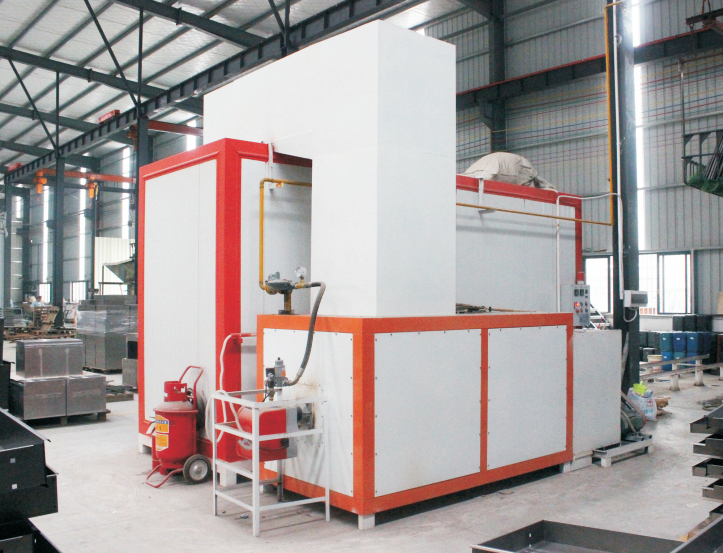
The Difference Between Bridge Type Oven and Tunnel Oven: Structure, Performance, and Selection Guide
When we work with manufacturers on their sơn tĩnh điện phủ bột[^1] production lines, one of the first questions we hear is: "Should we use a bridge type oven or a tunnel oven for our curing process?" This decision isn't trivial. The type of curing oven you choose directly affects your coating quality, production capacity, energy consumption, and long-term operational costs. After years of designing and implementing static powder coating lines for customers across cabinet manufacturing, furniture production, and aluminum profile industries, we've learned that there's no universally "better" choice—only the right choice for your specific production scenario.
The purpose of this guide is to help you understand the fundamental differences between these two curing systems, weigh their trade-offs honestly, and make an informed decision that aligns with your production workflow, workpiece characteristics, and cost objectives.
What Are Bridge Type and Tunnel Ovens: Basic Definitions and Key Structural Differences
Bridge type ovens and tunnel ovens are two fundamentally different approaches to powder coating curing, and their differences begin with structure.
Bridge type ovens operate on a batch principle. The workpiece enters the heating chamber, remains stationary for a fixed period while being heated to the designated curing temperature, and then exits. Think of it like a conventional oven in a kitchen—you place the item inside, wait for it to cook, then remove it. The "bridge" refers to the overhead structure that typically supports the heating elements and convection system. The chamber is enclosed but not continuously flowing; instead, it cycles through heating and cooling phases.
Lò ống, by contrast, operate on a continuous production principle. Workpieces move steadily through the tunnel on a conveyor system[^2], progressing through different temperature zones as they travel. The oven maintains a constant internal temperature profile, and items are continuously fed in one end and exit the other. This is more like an assembly line oven where the production never stops.
From a structural standpoint, bridge type ovens are typically smaller in footprint and more modular—you can stack multiple workpieces or position them strategically within the chamber. Tunnel ovens require more linear factory space because the entire tunnel must be accessible for conveyor operation, but they achieve higher throughput because production is uninterrupted.
The heating mechanisms differ too. Bridge type ovens usually rely on electric heating elements or gas burners that heat the enclosed air, which then circulates via fans to warm the workpiece uniformly. Tunnel ovens often use a combination of direct heating zones and sophisticated air recirculation systems to maintain precise temperature gradients along the length of the tunnel.
 )
)
How Do They Work: Operating Principles and Heat Distribution Methods
Understanding the operating logic of each oven type is essential because it reveals where their true performance differences emerge.
Bridge Type Oven Operating Cycle
A bridge type oven cycle proceeds in clear stages:
-
Loading phase: Operators or automatic systems load the coated workpieces onto the elevator or conveyor that carries them into the heating chamber.
-
Heating phase: Once inside, the oven raises internal temperature to the target range (typically 170–220°C for most polyester and epoxy powders, depending on formulation). The heating elements and circulation fans work together to distribute heat evenly throughout the chamber. This phase typically lasts 10–20 minutes, depending on workpiece mass and oven power.
-
Holding phase: The workpiece remains at the target temperature long enough for the powder coating to undergo its chemical reaction—resin melting, flow-leveling, and cross-linking[^3]. This is where the actual curing happens.
-
Cooling phase: The oven gradually cools or workpieces are removed to ambient temperature.
-
Unloading phase: Cooled workpieces exit the chamber.
The key insight: during the entire cycle, the workpiece is stationary. Temperature is applied uniformly from all directions. There's no conveyor speed pressure, no timing constraint on how long the part stays in the heat.
Heat distribution in bridge type ovens relies on hot air circulation. Fans push heated air through multiple circulation paths within the chamber, ensuring that corners, recesses, and vertical surfaces all receive consistent thermal exposure. Because the air recirculates many times during the holding phase, temperature stratification is minimized—the workpiece experiences relatively uniform heating regardless of its position in the chamber.
Tunnel Oven Continuous Operation
A tunnel oven operates fundamentally differently:
-
Continuous loading: Workpieces are fed onto the conveyor at a steady, synchronized rate. As soon as one item exits the cooling zone, the next is ready to enter the preheating zone.
-
Progressive heating zonescURL Too many subrequests by single Worker invocation. To configure this limit, refer to https://developers.cloudflare.com/workers/wrangler/configuration/#limits.
-
cURL Too many subrequests by single Worker invocation. To configure this limit, refer to https://developers.cloudflare.com/workers/wrangler/configuration/#limitscURL Too many subrequests by single Worker invocation. To configure this limit, refer to https://developers.cloudflare.com/workers/wrangler/configuration/#limits.
-
cURL Too many subrequests by single Worker invocation. To configure this limit, refer to https://developers.cloudflare.com/workers/wrangler/configuration/#limitscURL Too many subrequests by single Worker invocation. To configure this limit, refer to https://developers.cloudflare.com/workers/wrangler/configuration/#limits.
cURL Too many subrequests by single Worker invocation. To configure this limit, refer to https://developers.cloudflare.com/workers/wrangler/configuration/#limits cURL Too many subrequests by single Worker invocation. To configure this limit, refer to https://developers.cloudflare.com/workers/wrangler/configuration/#limits.
cURL Too many subrequests by single Worker invocation. To configure this limit, refer to https://developers.cloudflare.com/workers/wrangler/configuration/#limits cURL Too many subrequests by single Worker invocation. To configure this limit, refer to https://developers.cloudflare.com/workers/wrangler/configuration/#limits. cURL Too many subrequests by single Worker invocation. To configure this limit, refer to https://developers.cloudflare.com/workers/wrangler/configuration/#limits.
 )
)
cURL Too many subrequests by single Worker invocation. To configure this limit, refer to https://developers.cloudflare.com/workers/wrangler/configuration/#limits
cURL Too many subrequests by single Worker invocation. To configure this limit, refer to https://developers.cloudflare.com/workers/wrangler/configuration/#limits.
cURL Too many subrequests by single Worker invocation. To configure this limit, refer to https://developers.cloudflare.com/workers/wrangler/configuration/#limits
cURL Too many subrequests by single Worker invocation. To configure this limit, refer to https://developers.cloudflare.com/workers/wrangler/configuration/#limits.
cURL Too many subrequests by single Worker invocation. To configure this limit, refer to https://developers.cloudflare.com/workers/wrangler/configuration/#limits cURL Too many subrequests by single Worker invocation. To configure this limit, refer to https://developers.cloudflare.com/workers/wrangler/configuration/#limits.
cURL Too many subrequests by single Worker invocation. To configure this limit, refer to https://developers.cloudflare.com/workers/wrangler/configuration/#limits.
cURL Too many subrequests by single Worker invocation. To configure this limit, refer to https://developers.cloudflare.com/workers/wrangler/configuration/#limits.
cURL Too many subrequests by single Worker invocation. To configure this limit, refer to https://developers.cloudflare.com/workers/wrangler/configuration/#limits
cURL Too many subrequests by single Worker invocation. To configure this limit, refer to https://developers.cloudflare.com/workers/wrangler/configuration/#limits.
cURL Too many subrequests by single Worker invocation. To configure this limit, refer to https://developers.cloudflare.com/workers/wrangler/configuration/#limits.
cURL Too many subrequests by single Worker invocation. To configure this limit, refer to https://developers.cloudflare.com/workers/wrangler/configuration/#limits: tunnel ovens are designed for steady state. If your production volume drops by 20%, you can't simply run the oven at 80% capacity—the oven still maintains full heating throughout the entire tunnel, consuming nearly as much energy. This is why tunnel ovens favor manufacturers with stable, high-volume demand and the operational discipline to keep the line running predictably.
We've observed this repeatedly with our clients. One aluminum profile manufacturer in India chose a tunnel oven because their quarterly output was consistently 3,000+ profiles. But a furniture company in Turkey chose a bridge type oven because their orders fluctuated between 200–500 pieces per month depending on season and regional demand.
The decision framework: If your average production is below 30 pieces per hour and demand varies month-to-month, bridge type is usually more cost-effective. If you consistently need 50+ pieces per hour and can maintain steady feeding, tunnel type delivers better economics.
| Capacity Metric | Bridge Type | Tunnel Type |
|---|---|---|
| Typical hourly output | 15–30 pieces | 40–120+ pieces |
| Thời gian chu trình | 15–25 minutes | Continuous (3–5 min residence) |
| Flexibility with product changes | High (no reconfiguration) | Low (requires speed/zone adjustment) |
| Seasonal demand handling | Efficient (fewer cycles = lower energy) | Less efficient (oven maintains full load) |
| Minimum batch size | Flexible (1–10+ pieces per batch) | Optimized for continuous flow |
| Scalability during downturns | Good (reduce batch frequency) | Challenging (fixed heating cost) |
Workpiece Compatibility: Size, Shape, and Material Considerations
Not all curing ovens are equally suited to all workpieces. The geometry and material of what you're coating significantly influences which oven type works better.
Bridge Type Adaptability
Bridge type ovens handle geometric complexity and size variation exceptionally well. Why? Because workpieces are stationary, and the heating is applied from multiple directions simultaneously.
For cabinet bodies (a common application we work with), a bridge type oven is ideal. Cabinet doors, sides, backs, and internal structures all receive uniform heating regardless of their orientation. If a cabinet has internal compartments or shelving, the oven's circulating air eventually reaches all internal surfaces because the workpiece isn't moving—the air has time to penetrate.
For aluminum profiles with complex cross-sections—fins, channels, deep recesses—bridge type ovens handle them well because there's no time pressure. The oven dwells long enough for heat to reach even the deepest internal geometries.
For mixed-size batches, bridge type shines. You can load a small bracket alongside a large frame in the same cycle. The heating chamber accommodates size variation without requiring rebalancing of the conveyor or adjustment of heating zones.
Material compatibility is also broader with bridge type ovens. Whether you're curing substrate materials with high or low thermal conductivity[^4]—steel, aluminum, composite, or plastic—the stationary approach allows the oven to maintain consistent final temperatures because it just holds the workpiece at the setpoint long enough for thermal equilibrium to be reached.
cURL Too many subrequests by single Worker invocation. To configure this limit, refer to https://developers.cloudflare.com/workers/wrangler/configuration/#limits
cURL Too many subrequests by single Worker invocation. To configure this limit, refer to https://developers.cloudflare.com/workers/wrangler/configuration/#limits.
cURL Too many subrequests by single Worker invocation. To configure this limit, refer to https://developers.cloudflare.com/workers/wrangler/configuration/#limits. cURL Too many subrequests by single Worker invocation. To configure this limit, refer to https://developers.cloudflare.com/workers/wrangler/configuration/#limits.
cURL Too many subrequests by single Worker invocation. To configure this limit, refer to https://developers.cloudflare.com/workers/wrangler/configuration/#limits cURL Too many subrequests by single Worker invocation. To configure this limit, refer to https://developers.cloudflare.com/workers/wrangler/configuration/#limits.
cURL Too many subrequests by single Worker invocation. To configure this limit, refer to https://developers.cloudflare.com/workers/wrangler/configuration/#limits. cURL Too many subrequests by single Worker invocation. To configure this limit, refer to https://developers.cloudflare.com/workers/wrangler/configuration/#limits.
cURL Too many subrequests by single Worker invocation. To configure this limit, refer to https://developers.cloudflare.com/workers/wrangler/configuration/#limits cURL Too many subrequests by single Worker invocation. To configure this limit, refer to https://developers.cloudflare.com/workers/wrangler/configuration/#limits.
cURL Too many subrequests by single Worker invocation. To configure this limit, refer to https://developers.cloudflare.com/workers/wrangler/configuration/#limits cURL Too many subrequests by single Worker invocation. To configure this limit, refer to https://developers.cloudflare.com/workers/wrangler/configuration/#limits.
cURL Too many subrequests by single Worker invocation. To configure this limit, refer to https://developers.cloudflare.com/workers/wrangler/configuration/#limits
- cURL Too many subrequests by single Worker invocation. To configure this limit, refer to https://developers.cloudflare.com/workers/wrangler/configuration/#limits
- cURL Too many subrequests by single Worker invocation. To configure this limit, refer to https://developers.cloudflare.com/workers/wrangler/configuration/#limits
- cURL Too many subrequests by single Worker invocation. To configure this limit, refer to https://developers.cloudflare.com/workers/wrangler/configuration/#limits
- cURL Too many subrequests by single Worker invocation. To configure this limit, refer to https://developers.cloudflare.com/workers/wrangler/configuration/#limits
- cURL Too many subrequests by single Worker invocation. To configure this limit, refer to https://developers.cloudflare.com/workers/wrangler/configuration/#limits
cURL Too many subrequests by single Worker invocation. To configure this limit, refer to https://developers.cloudflare.com/workers/wrangler/configuration/#limits
cURL Too many subrequests by single Worker invocation. To configure this limit, refer to https://developers.cloudflare.com/workers/wrangler/configuration/#limits.
cURL Too many subrequests by single Worker invocation. To configure this limit, refer to https://developers.cloudflare.com/workers/wrangler/configuration/#limits
Bridge type ovens cURL Too many subrequests by single Worker invocation. To configure this limit, refer to https://developers.cloudflare.com/workers/wrangler/configuration/#limits.
Typical temperature stability: ±2–3°C within the chamber.
Lò ống must maintain multiple temperature zones, each with its own setpoint and control loop. This is more complex. Zone 1 might be 100°C (preheating), Zone 2 at 180°C, Zone 3 at 220°C (peak curing), Zone 4 at 150°C, and Zone 5 at 100°C (cooling). Each zone has independent heating elements and thermostatic control.
The challenge: if one zone's heating element drifts or a control sensor becomes intermittently faulty, the entire temperature profile becomes unstable, and workpieces experience variable cure conditions.
Typical temperature stability in well-maintained tunnel ovens: ±2–5°C per zone, but synchronization between zones is critical.
Practical implication: Bridge type ovens are more forgiving. If you're curing polyester powder that requires exactly 200°C for 15 minutes to achieve full cross-linking[^5], a bridge type oven is simpler to calibrate and maintain in spec. Tunnel ovens work well too, but they require more rigorous sensor maintenance and zone-by-zone tuning.
Heat Distribution Evenness
Bridge type ovens distribute heat radially from circulation fans. Air is forced through the chamber, flowing around and over workpieces from multiple directions. If the oven is well-designed, temperature variance within the chamber is typically 3–5°C between the warmest and coolest zones.
Tuy nhiên, there's one caveat we've observed: if workpieces are stacked too densely, or if the air circulation design has dead zones, certain positions can be slightly cooler. This is why loading discipline matters—you can't just cram as many pieces as physically possible into a bridge type oven; you need to respect airflow paths.
Lò ống have a different challenge. Workpieces on the conveyor move through a temperature gradient. A piece on the conveyor center experiences different heating than one at the edge. Additionally, if the conveyor is running slightly faster or slower than calibrated, residence time changes, and parts exit the peak temperature zone earlier or later than intended.
We've worked with projects where tunnel oven owners discovered that parts at the conveyor edge were receiving inconsistent coating quality because the air circulation pattern wasn't symmetric. The solution required repositioning air inlets and outlet baffles, plus sometimes reducing conveyor speed slightly to ensure more uniform heating.
Impact on Final Product Quality
Coating uniformity và adhesion are directly affected by temperature evenness.
When a powder coating is heated to its cure temperature and held there, the resin particles melt, flow, and cross-link. If the temperature at the surface is 200°C but the interior is only 180°C, the surface may fully cure while the interior is still undergoing flow-leveling. This creates a discontinuity in cross-link density, reducing adhesion and impact resistance.
Bridge type ovens tend to produce more consistent cured coatings because all surfaces of the workpiece are held at the same temperature simultaneously. We've measured adhesion test results on cabinets cured in bridge type ovens: typical values are 3–4B on the ASTM D3359[^6] tape adhesion test, indicating strong cross-linking throughout the film thickness.
Lò ống, when properly designed and maintained, also produce excellent adhesion—often matching bridge type. But if the tunnel has thermal dead spots, or if parts aren't loaded consistently, adhesion variance increases. We've seen batch-to-batch adhesion variability of 2–3 grades (e.g., some parts at 3B, others at 2B) in tunnel ovens with maintenance issues.
Ngoại hình is also affected. Proper temperature uniformity allows the powder to flow and level smoothly, producing a uniform gloss and color. Uneven heating can cause localized over-flow (glossy streaks) or incomplete leveling (matte patches), reducing aesthetic appeal and perceived quality.
For high-end applications—furniture destined for premium retail channels, cabinets for critical infrastructure, aluminum profiles for architectural use—the superior thermal uniformity of bridge type ovens often justifies their lower throughput.
Operating Costs and Long-Term Economics: Energy, Maintenance, and Reliability
The true decision point for many manufacturers is total cost of ownership (TCO), not just equipment purchase price.
Energy Consumption and Efficiency
This is the most common misconception we encounter: "Tunnel ovens are more efficient because they're continuous."
Actually, the relationship is more nuanced.
Bridge type ovens consume energy during the heating phase (perhaps 30–40 kW while heating a 2m × 1.5m × 2m chamber to 200°C), but this happens cyclically. If you run 3 batches per hour, and each batch requires 10 minutes of active heating followed by 10 minutes of low-power cooling, the oven's average power draw is moderate.
Crucially, if demand drops, you simply run fewer cycles. A 30% reduction in output means fewer heating cycles, proportionally lower energy use.
Lò ống maintain steady-state heating throughout the entire working day. If the tunnel is 6 meters long with zones maintained at an average 150°C, the heating system is consuming power continuously—perhaps 50–80 kW steady state. Even if production volume drops 30%, the tunnel still needs to maintain full temperature in all zones to remain ready for the next workpiece. Energy reduction is minimal (maybe 10–15%) because you're not turning off zones; you're just running fewer parts through.
From our experience with aluminum profile and cabinet manufacturers:
- Bridge type oven: 40–60 kWh per 8-hour shift (for typical batch cycles)
- Tunnel oven: 300–450 kWh per 8-hour shift (depending on tunnel length and heating system)
cURL Too many subrequests by single Worker invocation. To configure this limit, refer to https://developers.cloudflare.com/workers/wrangler/configuration/#limits.
cURL Too many subrequests by single Worker invocation. To configure this limit, refer to https://developers.cloudflare.com/workers/wrangler/configuration/#limitscURL Too many subrequests by single Worker invocation. To configure this limit, refer to https://developers.cloudflare.com/workers/wrangler/configuration/#limits.
cURL Too many subrequests by single Worker invocation. To configure this limit, refer to https://developers.cloudflare.com/workers/wrangler/configuration/#limits
Bridge type ovens cURL Too many subrequests by single Worker invocation. To configure this limit, refer to https://developers.cloudflare.com/workers/wrangler/configuration/#limits
- cURL Too many subrequests by single Worker invocation. To configure this limit, refer to https://developers.cloudflare.com/workers/wrangler/configuration/#limits
- cURL Too many subrequests by single Worker invocation. To configure this limit, refer to https://developers.cloudflare.com/workers/wrangler/configuration/#limits
- cURL Too many subrequests by single Worker invocation. To configure this limit, refer to https://developers.cloudflare.com/workers/wrangler/configuration/#limits
- cURL Too many subrequests by single Worker invocation. To configure this limit, refer to https://developers.cloudflare.com/workers/wrangler/configuration/#limits
cURL Too many subrequests by single Worker invocation. To configure this limit, refer to https://developers.cloudflare.com/workers/wrangler/configuration/#limits.
cURL Too many subrequests by single Worker invocation. To configure this limit, refer to https://developers.cloudflare.com/workers/wrangler/configuration/#limits.
Lò ống are mechanically more complex. Multiple heating zones mean more heating elements, more thermostats, more control circuits. The conveyor system adds mechanical wear. Common maintenance includes:
- cURL Too many subrequests by single Worker invocation. To configure this limit, refer to https://developers.cloudflare.com/workers/wrangler/configuration/#limits
- cURL Too many subrequests by single Worker invocation. To configure this limit, refer to https://developers.cloudflare.com/workers/wrangler/configuration/#limits
- cURL Too many subrequests by single Worker invocation. To configure this limit, refer to https://developers.cloudflare.com/workers/wrangler/configuration/#limits
- cURL Too many subrequests by single Worker invocation. To configure this limit, refer to https://developers.cloudflare.com/workers/wrangler/configuration/#limits
cURL Too many subrequests by single Worker invocation. To configure this limit, refer to https://developers.cloudflare.com/workers/wrangler/configuration/#limits.
cURL Too many subrequests by single Worker invocation. To configure this limit, refer to https://developers.cloudflare.com/workers/wrangler/configuration/#limits.
cURL Too many subrequests by single Worker invocation. To configure this limit, refer to https://developers.cloudflare.com/workers/wrangler/configuration/#limitscURL Too many subrequests by single Worker invocation. To configure this limit, refer to https://developers.cloudflare.com/workers/wrangler/configuration/#limits.
cURL Too many subrequests by single Worker invocation. To configure this limit, refer to https://developers.cloudflare.com/workers/wrangler/configuration/#limits
Bridge type ovens cURL Too many subrequests by single Worker invocation. To configure this limit, refer to https://developers.cloudflare.com/workers/wrangler/configuration/#limits.
Additionally, if product mix changes, you simply load the next product type; no reconfiguration needed.
Lò ống have less tolerance for degradation because the system is tightly coupled. If conveyor speed drifts 5% slower, all workpieces spend 5% more time in the oven, potentially over-curing. If a zone temperature drifts low, parts exit under-cured. The system is optimized for a specific operating point, and deviations from that point cascade through the line.
Downtime risk is higher with tunnel ovens during unexpected failures because you can't easily "limp along" with reduced performance—the entire system must operate within spec or production quality suffers.
How to Choose: Decision Criteria, Production Line Integration, and Space Requirements
By now, the choice should be becoming clearer, but let's consolidate the decision framework.
Assessing Your Production Workflow and Conveyor System
Start by asking: What does your current production line look like?
If you already have a powder sprayIf you already have a powder spraying system with a manual or semi-automatic conveyance (operators spray pieces on a handheld rail, or pieces move slowly on a simple chain), a bridge type oven integrates easily. Spray operation can run at its own pace; cured pieces are simply transferred to the bridge oven in batches. There's no need to synchronize spraying speed with oven speed.
If you have (or plan to invest in) a fully automated cURL Too many subrequests by single Worker invocation. To configure this limit, refer to https://developers.cloudflare.com/workers/wrangler/configuration/#limits[^7] booth with programmable gun coordinates, auto-loader, and auto-unloader, a tunnel oven might be more synergistic. The entire line runs at a synchronized speed, and the oven operates as one continuous stage. In this scenario, the automation investment justifies the tunnel oven integration.
However, we've also designed hybrid systems where an automated spray booth feeds a bridge type oven (operating in timed batches) very efficiently. The key is that the spray booth doesn't need to wait for the oven—it can spray its own pace and stage parts for the next batch cycle.
Integration question to ask yourself: Do you have (or can you implement) tight synchronization between spraying and curing, or do you prefer buffering/staging between these operations?
Factory Layout and Installation Footprint
This is often the deciding factor we overlook initially.
Bridge type ovens have a small footprint. A typical chamber is 2–3 meters long, 1.5–2 meters wide, 2–2.5 meters tall. You can sometimes position them against a wall or in a corner. If your factory space is constrained, bridge type is often the only practical option.
Lò ống are long and linear. A tunnel oven capable of 60+ pieces/hour might be 6–8 meters long. It occupies a clear runway through your factory—no wall mounting, no tight corners. If your production space is only 10 meters × 8 meters, a 6-meter tunnel oven consumes 60% of your available linear space.
We worked with a furniture company in Brazil that wanted a tunnel oven for higher throughput but discovered their factory was only 12 meters deep with a 4-meter ceiling. A 6-meter tunnel oven would have blocked material flow to their warehouse. They chose a bridge type oven instead, accepted a lower throughput, and doubled their shifts during peak season—a decision that made financial and operational sense given their constraints.
Height and clearance also matter. Bridge type ovens can often fit in spaces with 3-meter ceiling clearance. Tunnel ovens with recirculation ducts and exhaust stacks might need 3.5–4 meters.
Multi-Product vs. High-Volume Production Models
Multi-product, small-batch model: You spray cabinets for Customer A on Monday, brackets for Customer B on Tuesday, and aluminum frames for Customer C on Wednesday. Product sizes, geometries, and sometimes even materials vary.
→ Bridge type oven is the clear choice. You load each new product type without reconfiguration. Temperature and cycle time stay the same (or adjust slightly). Your production rhythm is flexible.
High-volume, single-family model: You spray the same cabinet body style for a single large customer, 500+ units per month, with consistent demand week-to-week.
→ Tunnel oven is advantageous. The conveyor speed is optimized for your part geometry and size. The feeding is continuous. You hit your daily/monthly targets efficiently.
Mixed model (and increasingly common): You have a stable base load of one or two main products (e.g., 60% cabinets) plus secondary orders (40% miscellaneous brackets, frames, etc.).
→ Bridge type oven often wins because it handles the variability without performance loss. You run primary product batches during your main shift, and secondary products flex onto additional or partial shifts. The oven's simplicity and adaptability make this operation straightforward.
Selection Framework by Industry and Workpiece Type
Our experience across different sectors has crystallized some patterns:
| Industry | Typical Workpiece | cURL Too many subrequests by single Worker invocation. To configure this limit, refer to https://developers.cloudflare.com/workers/wrangler/configuration/#limits | cURL Too many subrequests by single Worker invocation. To configure this limit, refer to https://developers.cloudflare.com/workers/wrangler/configuration/#limits | cURL Too many subrequests by single Worker invocation. To configure this limit, refer to https://developers.cloudflare.com/workers/wrangler/configuration/#limits |
|---|---|---|---|---|
| cURL Too many subrequests by single Worker invocation. To configure this limit, refer to https://developers.cloudflare.com/workers/wrangler/configuration/#limits cURL Too many subrequests by single Worker invocation. To configure this limit, refer to https://developers.cloudflare.com/workers/wrangler/configuration/#limits | cURL Too many subrequests by single Worker invocation. To configure this limit, refer to https://developers.cloudflare.com/workers/wrangler/configuration/#limits | cURL Too many subrequests by single Worker invocation. To configure this limit, refer to https://developers.cloudflare.com/workers/wrangler/configuration/#limits | cURL Too many subrequests by single Worker invocation. To configure this limit, refer to https://developers.cloudflare.com/workers/wrangler/configuration/#limits | cURL Too many subrequests by single Worker invocation. To configure this limit, refer to https://developers.cloudflare.com/workers/wrangler/configuration/#limits. |
| Nội thất (ngoài trời) | cURL Too many subrequests by single Worker invocation. To configure this limit, refer to https://developers.cloudflare.com/workers/wrangler/configuration/#limits | cURL Too many subrequests by single Worker invocation. To configure this limit, refer to https://developers.cloudflare.com/workers/wrangler/configuration/#limits | cURL Too many subrequests by single Worker invocation. To configure this limit, refer to https://developers.cloudflare.com/workers/wrangler/configuration/#limits | cURL Too many subrequests by single Worker invocation. To configure this limit, refer to https://developers.cloudflare.com/workers/wrangler/configuration/#limits. |
| Hợp kim nhôm | cURL Too many subrequests by single Worker invocation. To configure this limit, refer to https://developers.cloudflare.com/workers/wrangler/configuration/#limits | cURL Too many subrequests by single Worker invocation. To configure this limit, refer to https://developers.cloudflare.com/workers/wrangler/configuration/#limits | cURL Too many subrequests by single Worker invocation. To configure this limit, refer to https://developers.cloudflare.com/workers/wrangler/configuration/#limits | cURL Too many subrequests by single Worker invocation. To configure this limit, refer to https://developers.cloudflare.com/workers/wrangler/configuration/#limits. |
| cURL Too many subrequests by single Worker invocation. To configure this limit, refer to https://developers.cloudflare.com/workers/wrangler/configuration/#limits | cURL Too many subrequests by single Worker invocation. To configure this limit, refer to https://developers.cloudflare.com/workers/wrangler/configuration/#limits | cURL Too many subrequests by single Worker invocation. To configure this limit, refer to https://developers.cloudflare.com/workers/wrangler/configuration/#limits | cURL Too many subrequests by single Worker invocation. To configure this limit, refer to https://developers.cloudflare.com/workers/wrangler/configuration/#limits | cURL Too many subrequests by single Worker invocation. To configure this limit, refer to https://developers.cloudflare.com/workers/wrangler/configuration/#limits. |
| cURL Too many subrequests by single Worker invocation. To configure this limit, refer to https://developers.cloudflare.com/workers/wrangler/configuration/#limits | cURL Too many subrequests by single Worker invocation. To configure this limit, refer to https://developers.cloudflare.com/workers/wrangler/configuration/#limits | Medium-to-high volume, limited product variation | cURL Too many subrequests by single Worker invocation. To configure this limit, refer to https://developers.cloudflare.com/workers/wrangler/configuration/#limits | Relatively consistent size; steady demand; cost/piece important. |
| Các bộ phận ô tô | Engine covers, brackets, clips | Very high volume, strict specification tolerance | cURL Too many subrequests by single Worker invocation. To configure this limit, refer to https://developers.cloudflare.com/workers/wrangler/configuration/#limits | Volume dominates; tight dimensional control required; consistency critical. |
| Decorative/Architectural | Railings, trim, panels, ornamental pieces | Medium volume, high aesthetic quality | cURL Too many subrequests by single Worker invocation. To configure this limit, refer to https://developers.cloudflare.com/workers/wrangler/configuration/#limits | Appearance quality paramount; product variety higher; throughput secondary. |
How to Make the Final Decision: A Practical Selection Matrix
To crystallize your decision, rate your operation on these dimensions (score 1–5, where 1 = Bridge Type advantage, 5 = Tunnel Type advantage):
- Average production volume per month: (1 = under 2,000 pieces; 5 = over 10,000 pieces)
- Production stability: (1 = highly variable; 5 = very consistent, month-to-month)
- Product variety: (1 = many product types; 5 = single/dual product family)
- Available factory floor space: (1 = very constrained; 5 = generous linear space)
- Quality/appearance criticality: (1 = cost/throughput is priority; 5 = appearance/uniformity is priority)
- Thermal mass variability in workpieces: (1 = high variability; 5 = very consistent)
Add your scores.
- 6–15 points: Bridge type oven is likely optimal.
- 16–24 points: Consider bridge type, but tunnel type may work with proper setup.
- 25–30 points: Tunnel type oven is likely optimal.
Kết luận
The choice between bridge type and tunnel ovens isn't about which technology is "better"—it's about matching technology to your factory's reality. Bridge type ovens excel at flexibility, quality, energy efficiency at moderate volumes, and simplicity. Tunnel ovens excel at throughput, consistency in steady-state conditions, and cost-per-piece at high volumes.
Over our years working with manufacturers across cabinet, furniture, and aluminum industries, we've learned that many companies choose tunnel ovens based on theoretical throughput but find their actual utilization closer to bridge type economics because their production demand isn't as consistent as originally projected. Conversely, some companies underestimate future growth and choose bridge type, then find themselves capacity-constrained and wishing they'd invested in a tunnel oven.
The most important thing is to base your decision on honest assessment of your production forecast, product mix, factory constraints, and cost structure—not on industry averages or competitor choices.
If you're evaluating curing oven options for your dây chuyền sơn bột, we recommend discussing your specific production scenario with equipment specialists who have experience across different industries. At Ketu, we've designed custom coating solutions for cabinet manufacturers, furniture producers, and aluminum fabricators. We understand how bridge and tunnel ovens integrate into complete production workflows, and we're happy to help you model out the economics for your situation.
We also welcome the opportunity to show you working examples. Several of our customers operate bridge type ovens efficiently at 25–40 pieces/hour, and others run tunnel lines at 80–120+ pieces/hour. Seeing these systems in real operation—watching actual production, inspecting finished parts, understanding the rhythm of the workflow—often clarifies which approach is right for you.
If you'd like to discuss your production requirements and explore which curing oven approach makes sense for your factory, we're here to help. Contact us via WhatsApp at +8618925987762 or email ketucoatingline@gmail.com, and let's talk through your specific scenario. We're confident we can help you make a decision you'll feel confident about for years to come.
[^1]: A dry coating applied electrostatically to a surface, which is then cured through heating in an oven to form a hard protective and decorative finish.
[^2]: A mechanical system consisting of pulleys, rollers, or belts that continuously moves objects from one point to another in industrial production.
[^3]: Chemical bonds formed between polymer chains that increase the durability, hardness, and solvent resistance of a coating material.
[^4]: The physical property of a material that measures its ability to conduct heat through itself.
[^5]: Chemical bonds formed between polymer chains that increase the durability, hardness, and solvent resistance of a coating material.
cURL Too many subrequests by single Worker invocation. To configure this limit, refer to https://developers.cloudflare.com/workers/wrangler/configuration/#limits.
cURL Too many subrequests by single Worker invocation. To configure this limit, refer to https://developers.cloudflare.com/workers/wrangler/configuration/#limits.
 Vietnamese
  English
  German
  French