
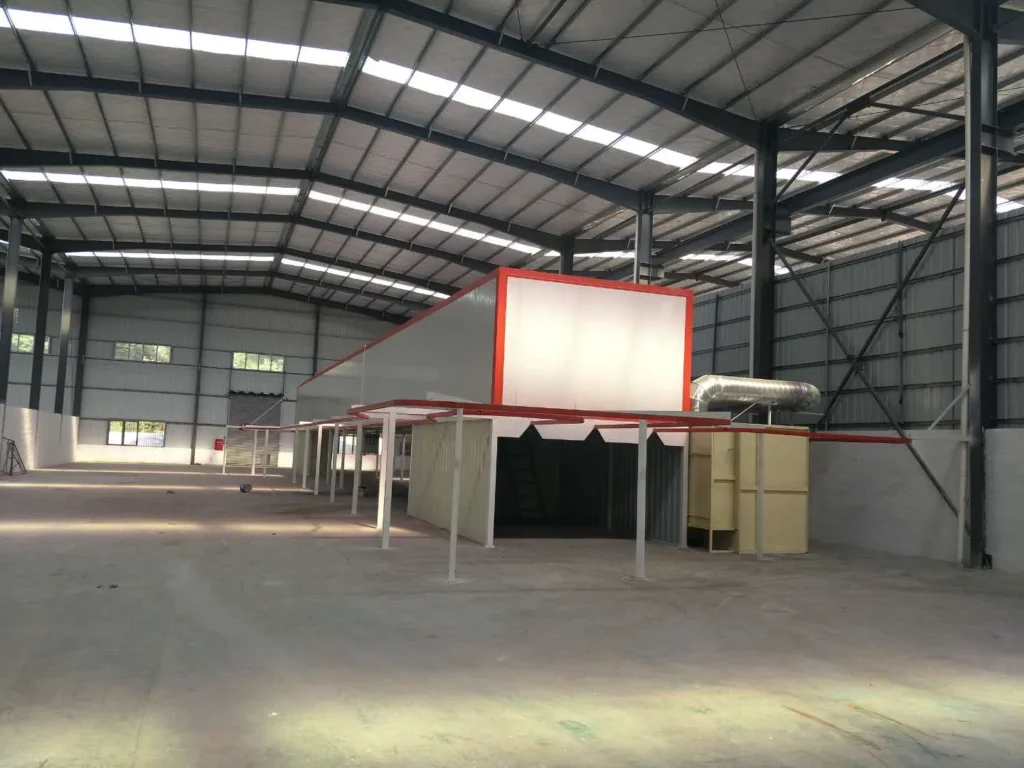
Aluminum Profile Vertical Powder Coating Process: Complete Guide to Line Design, Workflow & Performance Optimization
When we talk about vertical powder coating for aluminum profiles, most people assume it's simply a matter of rotating the workpiece 90 degrees. In reality, it's a complete system redesign that affects everything—from front-treatment stability and drying sufficiency to spray gun positioning, powder recovery, and oven temperature fields. From our experience working on aluminum profile projects, vertical orientation looks deceptively simple but demands meticulous attention to every stage of the process.
Vertical powder coating for aluminum profiles uses a standing position to spray the workpiece surface, allowing gravity to aid coating flow and improving thickness uniformity for complex profiles with internal cavities. This method is particularly suited for long-length or hollow-section aluminum with high surface quality requirements, where the vertical stance naturally reduces Faraday cage effects in interior corners through optimized gun angles and multiple spray passes. Compared to horizontal spraying, vertical coating reduces powder waste, improves transfer efficiency, and ensures consistent finish—making it ideal for architectural, furniture, and industrial aluminum applications where coating uniformity and cost efficiency are critical.
The decision to adopt vertical orientation should never be based on "it looks more efficient" alone. We've seen projects succeed brilliantly and fail quietly depending on whether the entire line architecture was truly adapted to vertical dynamics. This guide reflects what we've learned from real aluminum profile production scenarios.
What Is Vertical Powder Coating for Aluminum Profiles and Why Does It Matter?
Definition and Key Differences from Horizontal or Angled Coating
Vertical powder coating positions aluminum profiles upright during the entire spray and cure cycle. The workpiece hangs or stands perpendicular to the spray gun, with gravity acting downward along the length of the profile rather than across its cross-section.
In horizontal or angled setups, gravity pulls powder downward across the workpiece face, creating natural accumulation at the bottom edges and uneven film thickness. Vertical orientation reverses this dynamic: powder must resist gravity's pull along the profile's length, giving us better control over how the coating flows and settles.
The physical difference seems minor. The practical impact is substantial. When an aluminum profile stands vertically, powder particles experience a different deposition pattern. Instead of "falling" onto a flat surface, they adhere to the top and sides of the profile and must flow downward along the length. This requires us to rethink spray pressure, gun angles, dwell time, and the conveyance system entirely.
From our projects, the most important distinction is this: vertical coating is not just horizontal coating rotated 90 degrees. It's a different process with different rules.
When to Choose Vertical Coating Over Other Methods
Vertical coating makes sense for aluminum profiles under these conditions:
Profile geometry: If your aluminum has a complex cross-section—I-beams, channel sections, U-profiles, or hollow tubes—vertical spray naturally helps powder reach interior surfaces. Gravity aids flow into recesses that would be "dead zones" in horizontal spray.
Length-to-width ratio: Profiles longer than 2 meters often benefit from vertical handling. The input/output logistics are cleaner, and the profile doesn't need to be repositioned mid-production to ensure full coverage.
Surface quality requirements: Architectural aluminum, automotive components, and premium furniture typically demand very uniform coating. Vertical orientation's natural gravity-assisted flow often delivers finer, more consistent finishes than manual repositioning in other orientations.
Production volume: If you're running 500+ profiles per day with consistent dimensions, vertical automation becomes economically sensible. The line speed and parameter consistency you gain offset the upfront system investment.
Hollow or internally treated profiles: If your aluminum profile will be sealed or has internal chambers, vertical spray reduces the risk of powder or liquid entrapment compared to horizontal methods.
However, vertical coating is not the answer for everything. Very short profiles (under 500 mm), extremely thick-walled sections, or profiles requiring post-coating machining might be better handled horizontally or manually.
![aluminum profile vertical spray gun positioning]
Product Suitability and Technical Constraints for Vertical Coating
Ideal Aluminum Profile Dimensions and Shapes
From our experience, vertical coating performs best within these parameter ranges:
Chiều dài: 1 meter to 6 meters is the practical sweet spot. Below 1 meter, handling complexity increases relative to production volume. Above 6 meters, structural rigidity, support point design, and drying challenges multiply.
Cross-section width: 20 mm to 300 mm works well. Narrower sections require lighter supports and more precise gun positioning. Wider sections might benefit from multiple spray passes to ensure coverage uniformity.
Wall thickness: 1 mm to 6 mm. Thinner walls cool faster in the oven and are easier to handle structurally. Thicker walls retain heat longer and may show uneven curing if the oven temperature field isn't carefully optimized.
Cross-section complexitycURL Too many subrequests by single Worker invocation. To configure this limit, refer to https://developers.cloudflare.com/workers/wrangler/configuration/#limits.
cURL Too many subrequests by single Worker invocation. To configure this limit, refer to https://developers.cloudflare.com/workers/wrangler/configuration/#limitscURL Too many subrequests by single Worker invocation. To configure this limit, refer to https://developers.cloudflare.com/workers/wrangler/configuration/#limits.
cURL Too many subrequests by single Worker invocation. To configure this limit, refer to https://developers.cloudflare.com/workers/wrangler/configuration/#limits
cURL Too many subrequests by single Worker invocation. To configure this limit, refer to https://developers.cloudflare.com/workers/wrangler/configuration/#limits.
cURL Too many subrequests by single Worker invocation. To configure this limit, refer to https://developers.cloudflare.com/workers/wrangler/configuration/#limits: Most vertical conveyor systems max out at 30–50 kg per profile. Beyond that, the hoist, chain, and support structures become disproportionately expensive, and handling precision degrades.
cURL Too many subrequests by single Worker invocation. To configure this limit, refer to https://developers.cloudflare.com/workers/wrangler/configuration/#limitscURL Too many subrequests by single Worker invocation. To configure this limit, refer to https://developers.cloudflare.com/workers/wrangler/configuration/#limits.
cURL Too many subrequests by single Worker invocation. To configure this limit, refer to https://developers.cloudflare.com/workers/wrangler/configuration/#limitscURL Too many subrequests by single Worker invocation. To configure this limit, refer to https://developers.cloudflare.com/workers/wrangler/configuration/#limits.
cURL Too many subrequests by single Worker invocation. To configure this limit, refer to https://developers.cloudflare.com/workers/wrangler/configuration/#limitscURL Too many subrequests by single Worker invocation. To configure this limit, refer to https://developers.cloudflare.com/workers/wrangler/configuration/#limits.
cURL Too many subrequests by single Worker invocation. To configure this limit, refer to https://developers.cloudflare.com/workers/wrangler/configuration/#limits
cURL Too many subrequests by single Worker invocation. To configure this limit, refer to https://developers.cloudflare.com/workers/wrangler/configuration/#limits.
cURL Too many subrequests by single Worker invocation. To configure this limit, refer to https://developers.cloudflare.com/workers/wrangler/configuration/#limitscURL Too many subrequests by single Worker invocation. To configure this limit, refer to https://developers.cloudflare.com/workers/wrangler/configuration/#limits.
Tuy nhiên, cURL Too many subrequests by single Worker invocation. To configure this limit, refer to https://developers.cloudflare.com/workers/wrangler/configuration/#limits. cURL Too many subrequests by single Worker invocation. To configure this limit, refer to https://developers.cloudflare.com/workers/wrangler/configuration/#limits.
cURL Too many subrequests by single Worker invocation. To configure this limit, refer to https://developers.cloudflare.com/workers/wrangler/configuration/#limitscURL Too many subrequests by single Worker invocation. To configure this limit, refer to https://developers.cloudflare.com/workers/wrangler/configuration/#limits.
cURL Too many subrequests by single Worker invocation. To configure this limit, refer to https://developers.cloudflare.com/workers/wrangler/configuration/#limits: Before spray, if any moisture or process residue is trapped inside a hollow profile, vertical orientation doesn't help; it can actually make it worse. Gravity can push liquid or vapor deeper into the cavity. This is why pre-treatment and drying are non-negotiable for vertical aluminum coating. We learned this the hard way.
| Yếu tố | Impact on Vertical Coating | Mitigation |
|---|---|---|
| Profile length > 4 m | Sagging risk, uneven spray angle | Add mid-span support or reduce line speed for better dwell |
| Complex internal geometry | Better cavity coverage but thickness variation | Plan for multi-pass spray; extend dwell time by 20–30% |
| Dư lượng xử lý bề mặt | Moisture traps in cavities, causes defects | Increase drying time by 15–25%; verify dry-off in oven entrance |
| Thin walls (< 1.5 mm) | Rapid cooling, potential undercure | Preheat slightly in oven entrance or increase fixed temp 5–10°C |
| Varying profile weight | Inconsistent hanging tension, spray angle drift | Use load cells or mechanical stops to standardize hang height |
Complete Workflow: Step-by-Step Vertical Coating Process
Pre-treatment and Drying Requirements for Vertical Orientation
Pre-treatment is the foundation. For vertical profiles, it's also the most critical bottleneck.
Tẩy dầu mỡ: Use alkaline or solvent-based methods appropriate to your aluminum alloy. Vertical profiles benefit from immersion or spray-immersion hybrid systems, where liquid reaches all surfaces. Key point: with vertical profiles, ensure spray pressure is sufficient to reach internal surfaces. We typically use 3–4 bar spray pressure for this stage.

Rửa sạch: Multi-stage rinsing is non-negotiable. Any residual caustic or salt trapped inside a cavity will cause blooming, loss of adhesion, or corrosion later. For vertical profiles, dedicate extra tank passes to rinsing. If possible, use countercurrent rinse (profile moves one direction, rinse liquid flows the opposite direction) to maximize dislodging of residue.
Phosphating hoặc lớp phủ chuyển đổi: This is where aluminum-specific chemistry matters. Zirconium or titanium-based conversion coatings are preferred for aluminum over traditional chromate systems. These form a very thin (0.5–2 micron) crystalline layer that drastically improves powder adhesion.
When applying via spray, ensure uniform coverage. With vertical profiles, the undersides and interior recesses receive less spray pressure naturally. Increase nozzle count or spray duration for these areas.
Xả cuối cùng: Often overlooked, but critical. Any phosphating residue or water droplets left on the surface when the profile enters the dryer will cause defects. Use deionized water for the final rinse to minimize mineral deposits.
Sấy khô: This is where vertical orientation adds real complexity. Water and process residue will flow downward inside vertical profiles. If your drying isn't thorough, you'll have moisture pooling at the bottom of cavities or channels.
From our experience, vertical profile drying requires:
- Nhiệt độ: 80–100°C for aluminum (adjust based on alloy). Too hot risks warping thin profiles; too cool leaves residual moisture.
- Thời gian lưu: 8–15 minutes minimum, depending on profile depth and wall thickness. For profiles with deep cavities, add 25–30% extra dwell time compared to horizontal profile specs.
- Air circulation: Horizontal or angled air jets to dislodge water droplets from recesses. Purely vertical hot air isn't enough; you need directional movement to push water out.
- Exit verification: Before profiles enter the spray booth, spot-check them for moisture using a simple humidity indicator or by visual inspection for water beads. Don't rely on time alone; verify.
Powder Application and Gun Layout in Vertical Position
cURL Too many subrequests by single Worker invocation. To configure this limit, refer to https://developers.cloudflare.com/workers/wrangler/configuration/#limits.
cURL Too many subrequests by single Worker invocation. To configure this limit, refer to https://developers.cloudflare.com/workers/wrangler/configuration/#limits:
cURL Too many subrequests by single Worker invocation. To configure this limit, refer to https://developers.cloudflare.com/workers/wrangler/configuration/#limits.
cURL Too many subrequests by single Worker invocation. To configure this limit, refer to https://developers.cloudflare.com/workers/wrangler/configuration/#limits
- cURL Too many subrequests by single Worker invocation. To configure this limit, refer to https://developers.cloudflare.com/workers/wrangler/configuration/#limits cURL Too many subrequests by single Worker invocation. To configure this limit, refer to https://developers.cloudflare.com/workers/wrangler/configuration/#limits.
- cURL Too many subrequests by single Worker invocation. To configure this limit, refer to https://developers.cloudflare.com/workers/wrangler/configuration/#limits cURL Too many subrequests by single Worker invocation. To configure this limit, refer to https://developers.cloudflare.com/workers/wrangler/configuration/#limits.
cURL Too many subrequests by single Worker invocation. To configure this limit, refer to https://developers.cloudflare.com/workers/wrangler/configuration/#limits.
cURL Too many subrequests by single Worker invocation. To configure this limit, refer to https://developers.cloudflare.com/workers/wrangler/configuration/#limits:
cURL Too many subrequests by single Worker invocation. To configure this limit, refer to https://developers.cloudflare.com/workers/wrangler/configuration/#limits
- cURL Too many subrequests by single Worker invocation. To configure this limit, refer to https://developers.cloudflare.com/workers/wrangler/configuration/#limits.
- cURL Too many subrequests by single Worker invocation. To configure this limit, refer to https://developers.cloudflare.com/workers/wrangler/configuration/#limits.
- cURL Too many subrequests by single Worker invocation. To configure this limit, refer to https://developers.cloudflare.com/workers/wrangler/configuration/#limits.
cURL Too many subrequests by single Worker invocation. To configure this limit, refer to https://developers.cloudflare.com/workers/wrangler/configuration/#limits:
cURL Too many subrequests by single Worker invocation. To configure this limit, refer to https://developers.cloudflare.com/workers/wrangler/configuration/#limits
- cURL Too many subrequests by single Worker invocation. To configure this limit, refer to https://developers.cloudflare.com/workers/wrangler/configuration/#limitscURL Too many subrequests by single Worker invocation. To configure this limit, refer to https://developers.cloudflare.com/workers/wrangler/configuration/#limits.
- cURL Too many subrequests by single Worker invocation. To configure this limit, refer to https://developers.cloudflare.com/workers/wrangler/configuration/#limits cURL Too many subrequests by single Worker invocation. To configure this limit, refer to https://developers.cloudflare.com/workers/wrangler/configuration/#limits.
- cURL Too many subrequests by single Worker invocation. To configure this limit, refer to https://developers.cloudflare.com/workers/wrangler/configuration/#limits cURL Too many subrequests by single Worker invocation. To configure this limit, refer to https://developers.cloudflare.com/workers/wrangler/configuration/#limits.
Each pass adds 30–60 seconds of cycle time, but it's often cheaper than fixing defects later.
Curing and Cooling Stages
Vertical profiles undergo curing differently than horizontal ones because heat distribution changes when the workpiece orientation changes.
Preheat zone (if equipped): 5–10 minutes at 60–80°C. This helps evaporate any residual moisture from pre-treatment and begins softening the powder. For vertical profiles, ensure hot air circulates around the entire perimeter; don't rely on stratification.
Main cure zone: 180–200°C for most polyester or epoxy-polyester powders (verify with your powder supplier's data sheet). Dwell time depends on profile thickness:
- Thin walls (< 2 mm): 12–15 minutes
- Medium walls (2–4 mm): 15–20 minutes
- Thick walls (> 4 mm): 20–25 minutes
Temperature uniformity: This is critical for vertical profiles. If the top of the profile reaches 200°C but the bottom (due to shadowing or poor air circulation) stays at 160°C, the bottom won't cure fully. Undercured coatings fail adhesion tests and salt spray tests.
We typically monitor temperature using 3–5 thermocouples positioned at different heights and cross-sectional locations inside the oven. If temperature variance exceeds ±5°C, adjust fan speed, inlet temperature, or profile density (pieces per minute).
Khu vực làm mát: After exiting the oven, profiles are extremely hot and brittle. Rapid cooling can cause thermal stress and micro-cracking in the coating. Ideally, use an ambient-air cooling section (10–15 minutes) before profiles are handled or stacked.
In constrained facilities, a forced-air cooler set to 40–50°C can speed this up to 5–8 minutes without shocking the coating.
Critical tip from our experience: Do not stack hot profiles directly on top of each other. This traps heat and moisture between layers, causing soft spots and poor adhesion on the contact surfaces. Use cooling racks with spacing, or space profiles out on conveyor belts during cooling.
Equipment Design and System Requirements for Vertical Lines
Conveyor and Positioning System for Vertical Handling
Vertical orientation demands a conveyor system fundamentally different from typical horizontal lines.

Hoist and chain design:
Vertical profiles are suspended from above. The hoist mechanism (usually a chain or cable) must:
- Support dynamic loads (static profile weight + inertia during acceleration/deceleration).
- Maintain consistent height to preserve spray gun distance and angle.
- Allow smooth, jerk-free motion to avoid powder clouds and adhesion issues.
We typically use overhead monorail systems with motorized trolleys, where each trolley supports a single profile via a multi-point hanging fixture. Load capacity per trolley ranges from 25–50 kg depending on design.
Profile orientation fixtures:
The fixture grips or suspends the profile while keeping it perfectly vertical. For different profile types, you need:
- V-blocks or cradles for round or tubular profiles
- Channel fixtures for I-beams or flat bars
- Adjustable clamps for profiles with variable cross-sections
The fixture must not deform the profile under load, not trap liquid or powder residue, and be quick-release for easy profile changeover.
Tốc độ băng chuyền:
Vertical line speed is tied to dwell time in each zone (pre-treatment, drying, spray, cure). A typical vertical aluminum profile line runs at:
- Tiền xử lý: 1–2 m/min
- Sấy khô: 0.5–1 m/min (slowest, because drying is the bottleneck)
- SpraycURL Too many subrequests by single Worker invocation. To configure this limit, refer to https://developers.cloudflare.com/workers/wrangler/configuration/#limits
- ChữacURL Too many subrequests by single Worker invocation. To configure this limit, refer to https://developers.cloudflare.com/workers/wrangler/configuration/#limits
cURL Too many subrequests by single Worker invocation. To configure this limit, refer to https://developers.cloudflare.com/workers/wrangler/configuration/#limits.
cURL Too many subrequests by single Worker invocation. To configure this limit, refer to https://developers.cloudflare.com/workers/wrangler/configuration/#limits:
cURL Too many subrequests by single Worker invocation. To configure this limit, refer to https://developers.cloudflare.com/workers/wrangler/configuration/#limits.
cURL Too many subrequests by single Worker invocation. To configure this limit, refer to https://developers.cloudflare.com/workers/wrangler/configuration/#limits
cURL Too many subrequests by single Worker invocation. To configure this limit, refer to https://developers.cloudflare.com/workers/wrangler/configuration/#limits.
cURL Too many subrequests by single Worker invocation. To configure this limit, refer to https://developers.cloudflare.com/workers/wrangler/configuration/#limits:
cURL Too many subrequests by single Worker invocation. To configure this limit, refer to https://developers.cloudflare.com/workers/wrangler/configuration/#limits
- cURL Too many subrequests by single Worker invocation. To configure this limit, refer to https://developers.cloudflare.com/workers/wrangler/configuration/#limits
- cURL Too many subrequests by single Worker invocation. To configure this limit, refer to https://developers.cloudflare.com/workers/wrangler/configuration/#limits
- cURL Too many subrequests by single Worker invocation. To configure this limit, refer to https://developers.cloudflare.com/workers/wrangler/configuration/#limits
- cURL Too many subrequests by single Worker invocation. To configure this limit, refer to https://developers.cloudflare.com/workers/wrangler/configuration/#limits
cURL Too many subrequests by single Worker invocation. To configure this limit, refer to https://developers.cloudflare.com/workers/wrangler/configuration/#limits.
cURL Too many subrequests by single Worker invocation. To configure this limit, refer to https://developers.cloudflare.com/workers/wrangler/configuration/#limits:
cURL Too many subrequests by single Worker invocation. To configure this limit, refer to https://developers.cloudflare.com/workers/wrangler/configuration/#limits.
cURL Too many subrequests by single Worker invocation. To configure this limit, refer to https://developers.cloudflare.com/workers/wrangler/configuration/#limits:
cURL Too many subrequests by single Worker invocation. To configure this limit, refer to https://developers.cloudflare.com/workers/wrangler/configuration/#limits
- cURL Too many subrequests by single Worker invocation. To configure this limit, refer to https://developers.cloudflare.com/workers/wrangler/configuration/#limits
- cURL Too many subrequests by single Worker invocation. To configure this limit, refer to https://developers.cloudflare.com/workers/wrangler/configuration/#limits
- cURL Too many subrequests by single Worker invocation. To configure this limit, refer to https://developers.cloudflare.com/workers/wrangler/configuration/#limits
cURL Too many subrequests by single Worker invocation. To configure this limit, refer to https://developers.cloudflare.com/workers/wrangler/configuration/#limits.
Chất lượng khí nén:
Vertical spray is more sensitive to air quality than horizontal spray because:
- Powder particles travel longer distances (up, down, sideways) before settling
- Any moisture or oil in air causes powder to clump or bridge in supply lines
- Pressure fluctuations affect vertical powder trajectory more noticeably
Specify air quality per ISO 8573-1: Class 2-4-4 minimum (0.5 µm particles, < 3 mg/m³ oil, < 4°C dew point). Install filtration and a refrigerated dryer.
Powder Recovery and Filtration Under Vertical Conditions
Gravity works against us in recovery. Unsprayed powder and overspray naturally fall straight down in vertical spray zones. Without proper recovery design, this powder accumulates on booth floor, creating slip hazards, fire risks, and waste.
Thu gom chính:
Use a slotted floor or collection plenum beneath the spray zone. Gravity pulls overspray straight down into collection ducts. A 22 kW centrifugal fan creates suction (3000–5000 Pa pressure drop) to pull air and powder downward through filters.
Cyclone or multi-barrel separator:
Before the air exits to the environment, separate powder from air using a large cyclone (diameter 1–1.5 m, height 2.5–3.5 m) or multi-barrel cyclone assembly. Recycles 90–95% of powder back to the supply hopper.
Lọc thứ cấp:
After the cyclone, use a fabric filter cartridge or bag filter (area 20–40 m², depending on air volume) to catch fine powder and ensure clean air exit. For vertical lines with high powder loading, consider a pleated cartridge filter (higher dirt-holding capacity) over flat-bag filters.
Powder reuse loop:
Collected powder from the cyclone's hopper is reintroduced to the primary supply tank via a flexible screw conveyor or fluidizing hopper. This reduces powder waste by 40–60% compared to single-pass spray.
Critical tip: Inspect filter cartridges weekly. Vertical lines generate higher powder dust clouds due to longer particle flight paths. Clogged filters reduce recovery efficiency dramatically, forcing more powder to the environment and increasing fugitive dust.
Oven Temperature Field Design for Vertical Workpieces
Vertical profiles present unique oven challenges. A profile 4 meters tall, suspended in the center of an oven chamber, creates airflow asymmetries that horizontal belt-conveyor ovens don't face.
Hot air distribution:
Standard ovens use side-mounted heaters and fans to drive hot air across the conveyor. For vertical profiles:
- Sử dụng top and bottom heater/fan units to push hot air downward and upward, ensuring the entire profile surface sees uniform temperature.
- Avoid dead zones at profile corners or internal cavities where air stagnates.
- Install baffles or flow directors to guide air toward shadowed areas.
Temperature monitoring:
Mount at least 5 thermocouples inside the oven at different heights and cross-sectional positions:
- Near the oven entrance (preheat zone)
- Middle of the cure zone, at the profile's top surface
- Middle of the cure zone, at the profile's bottom surface
- Middle of the cure zone, inside a cavity (if the profile has recesses)
- Near the oven exit
Log temperatures continuously. If any thermocouple reads > ±5°C different from the setpoint, adjust fan speed, inlet temperature, or profile density.
cURL Too many subrequests by single Worker invocation. To configure this limit, refer to https://developers.cloudflare.com/workers/wrangler/configuration/#limits:
Vertical profiles spend longer in the oven (20–25 minutes) than horizontal profiles (12–15 minutes) for equivalent thickness. This is partly due to lower thermal conductivity in standing posture (less air circulation across thin walls) and partly due to thicker overall sections. Account for this when sizing oven length.
Oven entrance and exit:
The preheat zone (first 2–3 meters) should be slightly lower temperature (80–100°C) to avoid shocking thin profiles and to evaporate residual drying moisture. The main cure zone ramps to 180–200°C. A cool-down zone at the exit (if space allows) prevents thermal stress on the coating.
Coating Quality and Uniformity: Managing Key Challenges
Film Thickness Consistency in Vertical Orientation
Achieving ±25 µm film thickness uniformity on vertical profiles is harder than on horizontal ones, but essential for quality.
Thickness variation sources:
- cURL Too many subrequests by single Worker invocation. To configure this limit, refer to https://developers.cloudflare.com/workers/wrangler/configuration/#limitscURL Too many subrequests by single Worker invocation. To configure this limit, refer to https://developers.cloudflare.com/workers/wrangler/configuration/#limits.
- cURL Too many subrequests by single Worker invocation. To configure this limit, refer to https://developers.cloudflare.com/workers/wrangler/configuration/#limitscURL Too many subrequests by single Worker invocation. To configure this limit, refer to https://developers.cloudflare.com/workers/wrangler/configuration/#limits.
- Thời gian lưucURL Too many subrequests by single Worker invocation. To configure this limit, refer to https://developers.cloudflare.com/workers/wrangler/configuration/#limits.
- cURL Too many subrequests by single Worker invocation. To configure this limit, refer to https://developers.cloudflare.com/workers/wrangler/configuration/#limitscURL Too many subrequests by single Worker invocation. To configure this limit, refer to https://developers.cloudflare.com/workers/wrangler/configuration/#limits.

cURL Too many subrequests by single Worker invocation. To configure this limit, refer to https://developers.cloudflare.com/workers/wrangler/configuration/#limits:
cURL Too many subrequests by single Worker invocation. To configure this limit, refer to https://developers.cloudflare.com/workers/wrangler/configuration/#limits
- cURL Too many subrequests by single Worker invocation. To configure this limit, refer to https://developers.cloudflare.com/workers/wrangler/configuration/#limitscURL Too many subrequests by single Worker invocation. To configure this limit, refer to https://developers.cloudflare.com/workers/wrangler/configuration/#limits.
- cURL Too many subrequests by single Worker invocation. To configure this limit, refer to https://developers.cloudflare.com/workers/wrangler/configuration/#limitscURL Too many subrequests by single Worker invocation. To configure this limit, refer to https://developers.cloudflare.com/workers/wrangler/configuration/#limits.
- cURL Too many subrequests by single Worker invocation. To configure this limit, refer to https://developers.cloudflare.com/workers/wrangler/configuration/#limitscURL Too many subrequests by single Worker invocation. To configure this limit, refer to https://developers.cloudflare.com/workers/wrangler/configuration/#limits.
- Chất lượng bộtcURL Too many subrequests by single Worker invocation. To configure this limit, refer to https://developers.cloudflare.com/workers/wrangler/configuration/#limits.
cURL Too many subrequests by single Worker invocation. To configure this limit, refer to https://developers.cloudflare.com/workers/wrangler/configuration/#limits:
| cURL Too many subrequests by single Worker invocation. To configure this limit, refer to https://developers.cloudflare.com/workers/wrangler/configuration/#limits | cURL Too many subrequests by single Worker invocation. To configure this limit, refer to https://developers.cloudflare.com/workers/wrangler/configuration/#limits | cURL Too many subrequests by single Worker invocation. To configure this limit, refer to https://developers.cloudflare.com/workers/wrangler/configuration/#limits | cURL Too many subrequests by single Worker invocation. To configure this limit, refer to https://developers.cloudflare.com/workers/wrangler/configuration/#limits |
|---|---|---|---|
| cURL Too many subrequests by single Worker invocation. To configure this limit, refer to https://developers.cloudflare.com/workers/wrangler/configuration/#limits | ±45 µm | ±60 µm | Acceptable for non-critical parts |
| Two-pass, no adjustment | ±25 µm | ±40 µm | Sufficient for most architectural aluminum |
| Two-pass, cavity-specific gun | ±20 µm | ±25 µm | Best practice for premium parts |
| Three-pass, optimized angles | ±15 µm | ±20 µm | Necessary for aerospace or automotive specs |
Addressing the Faraday Cage Effect on Complex Profiles
The Faraday cage effect occurs when complex internal geometries block electrostatic field lines, preventing powder from reaching certain recesses.
Why it happens on vertical profiles:
When a profile stands vertically and has deep internal channels or cavities, the electrostatic field is strongest near the profile's outer edges. Internal surfaces are "shielded" by the profile's own conductive material. Powder sprayed downward may not penetrate into deep recesses because the electric field can't reach there.
Severity by geometry:
- Simple hollow tubes: Minimal Faraday effect; interior is easy to reach.
- U-channels or I-beams: Moderate effect; undersides of internal ledges are hard to coat.
- Complex multi-cavity sections: Severe effect; innermost surfaces may receive almost no powder unless special measures are taken.
Mitigation techniques we use:
-
Lower electrostatic voltage: Reduce from 85 kV to 70 kV. This shortens the effective electrostatic range, forcing powder closer to the gun. Counterintuitively, this sometimes improves cavity coverage because powder spends more time near the gun before being deflected by the field, allowing it to move into recesses under gravity.
-
Điều chỉnh góc súng phun: Point spray guns specifically at cavity openings, even if it means some angle off the ideal perpendicular. A gun angled 30–45° into a cavity is more effective than a perpendicular gun aimed at the profile's flat face.
-
Reduce powder flow: Lower powder flux (fewer particles) reduces re-powder/back-ionization effects that push fresh powder away from the surface. Counterintuitively, less powder can sometimes improve cavity coverage.
-
Multi-pass strategy: First pass uses standard angle and voltage. Second pass, reduce voltage and adjust gun angle to specifically target cavities. Third pass (if needed) is even lower voltage, even more focused angle.
-
Friction gun (tribostatic) option: Instead of electrostatic charge, friction guns mechanically charge powder by rubbing it against a specialized electrode as it exits the gun. Friction guns are less affected by Faraday cage but have lower transfer efficiency overall and are more sensitive to humidity.
From our experience: For most aluminum profiles, a 2–3 pass electrostatic approach with angle adjustment solves 80–90% of Faraday cage issues. Only for extremely complex geometries do we recommend friction guns or hybrid approaches.
Preventing Sag, Drips, and Water Accumulation
Vertical profiles are subject to unique defects that horizontal profiles rarely see.
Sag:
cURL Too many subrequests by single Worker invocation. To configure this limit, refer to https://developers.cloudflare.com/workers/wrangler/configuration/#limits.
Phòng tránh:
- cURL Too many subrequests by single Worker invocation. To configure this limit, refer to https://developers.cloudflare.com/workers/wrangler/configuration/#limits.
- cURL Too many subrequests by single Worker invocation. To configure this limit, refer to https://developers.cloudflare.com/workers/wrangler/configuration/#limits.
- cURL Too many subrequests by single Worker invocation. To configure this limit, refer to https://developers.cloudflare.com/workers/wrangler/configuration/#limits.
cURL Too many subrequests by single Worker invocation. To configure this limit, refer to https://developers.cloudflare.com/workers/wrangler/configuration/#limits:
cURL Too many subrequests by single Worker invocation. To configure this limit, refer to https://developers.cloudflare.com/workers/wrangler/configuration/#limits.
Phòng tránh:
- cURL Too many subrequests by single Worker invocation. To configure this limit, refer to https://developers.cloudflare.com/workers/wrangler/configuration/#limits.
- cURL Too many subrequests by single Worker invocation. To configure this limit, refer to https://developers.cloudflare.com/workers/wrangler/configuration/#limits.
- cURL Too many subrequests by single Worker invocation. To configure this limit, refer to https://developers.cloudflare.com/workers/wrangler/configuration/#limits.
- cURL Too many subrequests by single Worker invocation. To configure this limit, refer to https://developers.cloudflare.com/workers/wrangler/configuration/#limits.
cURL Too many subrequests by single Worker invocation. To configure this limit, refer to https://developers.cloudflare.com/workers/wrangler/configuration/#limits:
cURL Too many subrequests by single Worker invocation. To configure this limit, refer to https://developers.cloudflare.com/workers/wrangler/configuration/#limits
- cURL Too many subrequests by single Worker invocation. To configure this limit, refer to https://developers.cloudflare.com/workers/wrangler/configuration/#limits.
- cURL Too many subrequests by single Worker invocation. To configure this limit, refer to https://developers.cloudflare.com/workers/wrangler/configuration/#limits.
- cURL Too many subrequests by single Worker invocation. To configure this limit, refer to https://developers.cloudflare.com/workers/wrangler/configuration/#limits.
Phòng tránh:
- cURL Too many subrequests by single Worker invocation. To configure this limit, refer to https://developers.cloudflare.com/workers/wrangler/configuration/#limitscURL Too many subrequests by single Worker invocation. To configure this limit, refer to https://developers.cloudflare.com/workers/wrangler/configuration/#limits.
- cURL Too many subrequests by single Worker invocation. To configure this limit, refer to https://developers.cloudflare.com/workers/wrangler/configuration/#limitscURL Too many subrequests by single Worker invocation. To configure this limit, refer to https://developers.cloudflare.com/workers/wrangler/configuration/#limits.
- cURL Too many subrequests by single Worker invocation. To configure this limit, refer to https://developers.cloudflare.com/workers/wrangler/configuration/#limitscURL Too many subrequests by single Worker invocation. To configure this limit, refer to https://developers.cloudflare.com/workers/wrangler/configuration/#limits.
- cURL Too many subrequests by single Worker invocation. To configure this limit, refer to https://developers.cloudflare.com/workers/wrangler/configuration/#limits: Spot-check exiting profiles from the dry-off zone. If you see water beads, extend dry-off time.
Production Capacity, Line Speed, and Cost-Benefit Analysis
Calculating Optimal Line Speed and Dwell Time
Line speed is constrained by the slowest process stage. For vertical aluminum profile coating, that's usually drying or curing.
Dwell time calculation:
-
Tiền xử lý: Typically 8–12 minutes (includes spray soak, multiple rinses, conversion coating). This is usually the fastest stage.
-
Sấy khô: 10–18 minutes for vertical aluminum (vs. 8–12 for horizontal). The extra time is because moisture trapped in cavities takes longer to evaporate.
-
Spray: 2–5 minutes (depends on profile complexity; single-pass = 2 min, multi-pass = 4–5 min).
-
Chữa: 18–25 minutes at 200°C (vs. 12–18 for horizontal). Vertical profiles conduct heat less efficiently due to their orientation.
-
Làm mát: 5–10 minutes (optional; depends on handling requirements downstream).
Thời gian chu trình tổng cộng: 43–70 minutes per profile, depending on specifications.
Line speed calculation:
If your total cycle time is 60 minutes and your conveyor line is 25 meters long:
Line speed = (25 m) / (60 min) = 0.42 m/min
If you want to achieve 20 profiles per 8-hour shift:
Profiles per shift = (8 hrs × 60 min/hr) / (60 min/profile) = 8 profiles per shift
This is very low and suggests your production target may not justify a fully automated vertical line; manual or semi-automated horizontal spray might be more cost-effective.
Throughput Expectations and ROI Compared to Manual or Horizontal Systems
Manual spray (operator holds gun, sprays each profile):
- Throughput: 5–10 profiles/hour (depends on operator skill and profile complexity)
- Quality: Highly variable (±60–100 µm thickness, uneven finish)
- Cost: Low capital (spray gun, compressor, booth), high labor (operator wages)
- ROI: Slow; labor is expensive, quality issues reduce sellable output
Horizontal automated line:
- Throughput: 15–25 profiles/hour
- Quality: Better (±30–50 µm thickness, more consistent)
- Cost: Medium capital (conveyor, multiple guns, oven), medium labor (line operator)
- ROI: 3–5 years typical
Vertical automated line:
- Throughput: 8–15 profiles/hour (slower than horizontal due to longer dwell times for drying/curing)
- Quality: Best (±15–25 µm thickness, uniform finish, good cavity coverage)
- Cost: Higher capital (complex fixtures, vertical conveyance, multiple spray zones), low labor
- ROI: 4–7 years typical (longer than horizontal due to lower throughput, but justified if quality premium is high)
When vertical makes financial sense:
-
Premium market: Your aluminum profiles sell for 20–40% higher price due to superior finish quality. Vertical lines deliver that quality consistently. ROI improves to 3–4 years.
-
cURL Too many subrequests by single Worker invocation. To configure this limit, refer to https://developers.cloudflare.com/workers/wrangler/configuration/#limitscURL Too many subrequests by single Worker invocation. To configure this limit, refer to https://developers.cloudflare.com/workers/wrangler/configuration/#limits.
-
cURL Too many subrequests by single Worker invocation. To configure this limit, refer to https://developers.cloudflare.com/workers/wrangler/configuration/#limitscURL Too many subrequests by single Worker invocation. To configure this limit, refer to https://developers.cloudflare.com/workers/wrangler/configuration/#limits.
-
cURL Too many subrequests by single Worker invocation. To configure this limit, refer to https://developers.cloudflare.com/workers/wrangler/configuration/#limitscURL Too many subrequests by single Worker invocation. To configure this limit, refer to https://developers.cloudflare.com/workers/wrangler/configuration/#limits.
cURL Too many subrequests by single Worker invocation. To configure this limit, refer to https://developers.cloudflare.com/workers/wrangler/configuration/#limits
cURL Too many subrequests by single Worker invocation. To configure this limit, refer to https://developers.cloudflare.com/workers/wrangler/configuration/#limits.
cURL Too many subrequests by single Worker invocation. To configure this limit, refer to https://developers.cloudflare.com/workers/wrangler/configuration/#limits:
- Manual spraycURL Too many subrequests by single Worker invocation. To configure this limit, refer to https://developers.cloudflare.com/workers/wrangler/configuration/#limits
- cURL Too many subrequests by single Worker invocation. To configure this limit, refer to https://developers.cloudflare.com/workers/wrangler/configuration/#limitscURL Too many subrequests by single Worker invocation. To configure this limit, refer to https://developers.cloudflare.com/workers/wrangler/configuration/#limits
- cURL Too many subrequests by single Worker invocation. To configure this limit, refer to https://developers.cloudflare.com/workers/wrangler/configuration/#limitscURL Too many subrequests by single Worker invocation. To configure this limit, refer to https://developers.cloudflare.com/workers/wrangler/configuration/#limits
cURL Too many subrequests by single Worker invocation. To configure this limit, refer to https://developers.cloudflare.com/workers/wrangler/configuration/#limits:
cURL Too many subrequests by single Worker invocation. To configure this limit, refer to https://developers.cloudflare.com/workers/wrangler/configuration/#limits
- cURL Too many subrequests by single Worker invocation. To configure this limit, refer to https://developers.cloudflare.com/workers/wrangler/configuration/#limitscURL Too many subrequests by single Worker invocation. To configure this limit, refer to https://developers.cloudflare.com/workers/wrangler/configuration/#limits.
- cURL Too many subrequests by single Worker invocation. To configure this limit, refer to https://developers.cloudflare.com/workers/wrangler/configuration/#limitscURL Too many subrequests by single Worker invocation. To configure this limit, refer to https://developers.cloudflare.com/workers/wrangler/configuration/#limits.
cURL Too many subrequests by single Worker invocation. To configure this limit, refer to https://developers.cloudflare.com/workers/wrangler/configuration/#limits
- cURL Too many subrequests by single Worker invocation. To configure this limit, refer to https://developers.cloudflare.com/workers/wrangler/configuration/#limits: 160,000 kg powder input; 16,000 kg lost to overspray. Cost at $8/kg = $128,000/year wasted.
- 90% efficiency: 177,778 kg powder input; 11,111 kg lost to overspray. Cost at $8/kg = $88,888/year wasted.
Savings: ~$40,000/year just from improved transfer efficiency.
With powder recovery systems (cyclone + secondary filtration), you can recycle 85–95% of overspray, further reducing net material cost.
Material cost summary for vertical line:
| Thành phần | cURL Too many subrequests by single Worker invocation. To configure this limit, refer to https://developers.cloudflare.com/workers/wrangler/configuration/#limits | Ghi chú |
|---|---|---|
| Fresh powder (net after recovery) | $50–80K | Depends on coverage, efficiency, powder cost |
| Compressed air (for spray + drying) | $15–25K | Continuous 22 kW compressor |
| Energy (oven heat) | $40–60K | Electric or gas, depending on local rates |
| Pre-treatment chemicals | $8–12K | Alkaline degreaser, conversion coating, rinse |
| Filter cartridges, compressor filters | $3–5K | Consumables |
| Total annual material + utility | $116–182K | For 1,000 profiles/year |
If your margin on each profile is $200–500 after material costs, the line becomes profitable at 500–1,000 profiles/year.
Critical Success Factors and Implementation Checklist
Pre-treatment System Stability and Drying Sufficiency
From our experience, this is where most vertical coating problems originate.
Pre-treatment system requirements:
-
Tank volume: Minimum 1 m³ per spray circuit. Larger tanks (2–3 m³) maintain more stable chemistry and temperature.
-
Alkaline degreaser concentration: 4–6% (baume scale depends on product). Check weekly with pH/titration strips. Drift outside this range causes either incomplete degreasing or surface etching.
-
Phủ chuyển đổi: Maintain per supplier specs (usually 2–4% active zirconium or titanium compound). Weekly testing is mandatory; old or degraded conversion chemistry causes adhesion failure.
-
Tank temperaturecURL Too many subrequests by single Worker invocation. To configure this limit, refer to https://developers.cloudflare.com/workers/wrangler/configuration/#limits.
-
cURL Too many subrequests by single Worker invocation. To configure this limit, refer to https://developers.cloudflare.com/workers/wrangler/configuration/#limitscURL Too many subrequests by single Worker invocation. To configure this limit, refer to https://developers.cloudflare.com/workers/wrangler/configuration/#limits.
cURL Too many subrequests by single Worker invocation. To configure this limit, refer to https://developers.cloudflare.com/workers/wrangler/configuration/#limits: -
cURL Too many subrequests by single Worker invocation. To configure this limit, refer to https://developers.cloudflare.com/workers/wrangler/configuration/#limitscURL Too many subrequests by single Worker invocation. To configure this limit, refer to https://developers.cloudflare.com/workers/wrangler/configuration/#limits
cURL Too many subrequests by single Worker invocation. To configure this limit, refer to https://developers.cloudflare.com/workers/wrangler/configuration/#limits
cURL Too many subrequests by single Worker invocation. To configure this limit, refer to https://developers.cloudflare.com/workers/wrangler/configuration/#limits.
-
Air circulationcURL Too many subrequests by single Worker invocation. To configure this limit, refer to https://developers.cloudflare.com/workers/wrangler/configuration/#limits.
-
cURL Too many subrequests by single Worker invocation. To configure this limit, refer to https://developers.cloudflare.com/workers/wrangler/configuration/#limitscURL Too many subrequests by single Worker invocation. To configure this limit, refer to https://developers.cloudflare.com/workers/wrangler/configuration/#limits.
-
Temperature uniformitycURL Too many subrequests by single Worker invocation. To configure this limit, refer to https://developers.cloudflare.com/workers/wrangler/configuration/#limits.
-
cURL Too many subrequests by single Worker invocation. To configure this limit, refer to https://developers.cloudflare.com/workers/wrangler/configuration/#limitscURL Too many subrequests by single Worker invocation. To configure this limit, refer to https://developers.cloudflare.com/workers/wrangler/configuration/#limits.
cURL Too many subrequests by single Worker invocation. To configure this limit, refer to https://developers.cloudflare.com/workers/wrangler/configuration/#limits
Chất lượng khí nén cURL Too many subrequests by single Worker invocation. To configure this limit, refer to https://developers.cloudflare.com/workers/wrangler/configuration/#limits
- cURL Too many subrequests by single Worker invocation. To configure this limit, refer to https://developers.cloudflare.com/workers/wrangler/configuration/#limitscURL Too many subrequests by single Worker invocation. To configure this limit, refer to https://developers.cloudflare.com/workers/wrangler/configuration/#limits
- cURL Too many subrequests by single Worker invocation. To configure this limit, refer to https://developers.cloudflare.com/workers/wrangler/configuration/#limitscURL Too many subrequests by single Worker invocation. To configure this limit, refer to https://developers.cloudflare.com/workers/wrangler/configuration/#limits
- cURL Too many subrequests by single Worker invocation. To configure this limit, refer to https://developers.cloudflare.com/workers/wrangler/configuration/#limitscURL Too many subrequests by single Worker invocation. To configure this limit, refer to https://developers.cloudflare.com/workers/wrangler/configuration/#limits
- cURL Too many subrequests by single Worker invocation. To configure this limit, refer to https://developers.cloudflare.com/workers/wrangler/configuration/#limits: ≤ 0.3 mg/m³ (ISO Class 2)
Quality check procedure:
- Install an air quality monitor (particle counter + hygrometer + oil detector) downstream of the compressor. Log daily.
- Replace compressor filters when pressure drop exceeds 0.3 bar.
- Drain water from compressor tank and dryer separator daily.
- If humidity spikes (rain, high ambient humidity), run dryer for 2–4 hours extra before spraying.
Powder selection for vertical coating:
- Particle size: 30–60 µm (check supplier data). Smaller particles are lighter, less affected by gravity; larger particles settle faster.
- Bulk density: 0.9–1.1 g/cm³. Lower density powders are softer to apply and easier to recover; higher density powders pack tighter in supply hoppers.
- Moisture content: ≤ 0.5% (factory standard). If powder sits in humid environment, moisture rises to 1–2%, causing clumping and application problems.
- Charge-to-mass ratio (C/M): 20–40 µC/mg is typical. Too high (> 50 µC/mg) causes back-ionization and poor cavity coverage. Too low (< 15 µC/mg) causes low transfer efficiency.
Powder shelf life:
Fresh powder is best. After 6 months in a warm/humid storage area, assume 10–15% loss in charging efficiency. After 12 months, discard or use only for non-critical applications.
Automation Synchronization and Process Parameter Consistency
Vertical lines depend on precise timing and synchronization.
Key synchronization points:
-
Fixture loading → Pre-treatment entry: Fixture must be positioned at entry height and stabilized before hydraulic push or chain engages. Misalignment causes spillage.
-
Pre-treatment → Drying transfer: No delay between stages. If a wet profile sits idle, water evaporates unevenly (surface dries, cavities stay wet).
-
Drying → Spray transfer: Ensure dryer outlet temp is stable (> 80°C) before profile enters spray. If entry is too cool, condensation forms and spray fails.
 Vietnamese
  English
  German
  French