
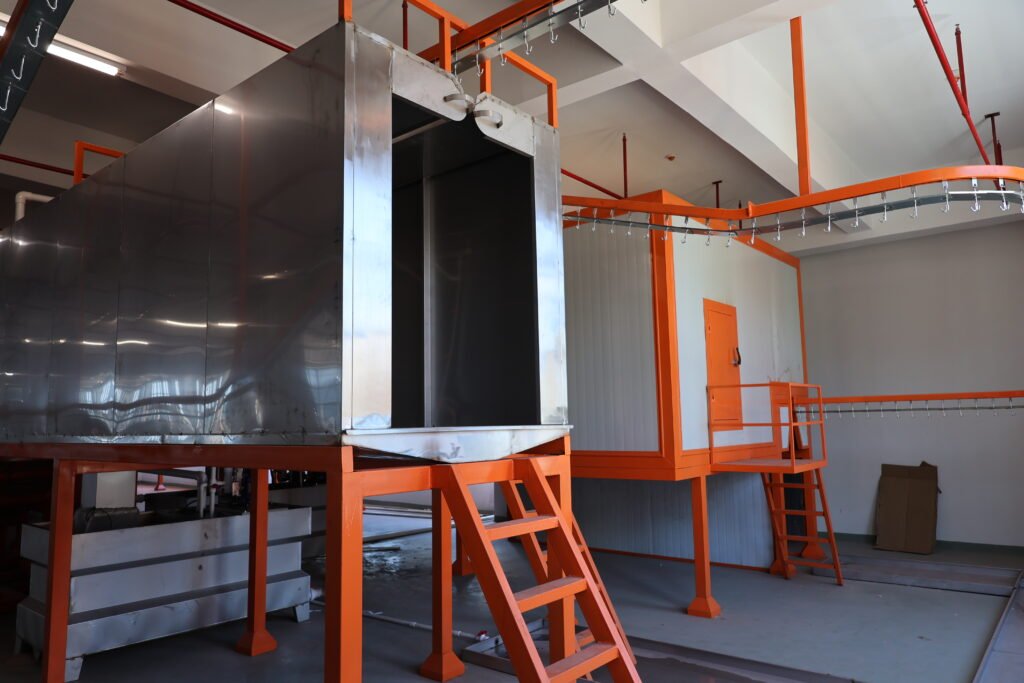
Principles to Be Followed When Designing Spray Equipment
When you're planning a powder coating production line, the first question isn't "which brand of spray room should I buy?" It's actually deeper: what fundamental design principles ensure this equipment will perform reliably, safely, and cost-effectively over years of operation?
From our experience building electrostatic powder coating lines for cabinet manufacturers, furniture makers, and aluminum profile producers, we've learned that equipment designed around core principles outperforms those built around cost or convenience. And more importantly, we've seen what happens when suppliers skip these principles—customers end up with high defect rates, energy waste, and equipment that's unstable in production.
The core design principle is this: a spray coating line must balance three simultaneous demands—adapting to your specific workpiece, delivering consistent coating quality, and managing operational costs—while never compromising on safety or environmental compliance. This isn't theoretical. We've designed over 200 coating lines across multiple industries, and every successful project followed these same foundational principles.
Let us walk you through the engineering logic that should guide every spray equipment design decision.
Why Spray Equipment Design Principles Matter: Impact on Quality, Efficiency, and Safety
A spray coating line isn't just equipment that applies color to metal. It's an integrated system where every component—pre-treatment tanks, conveyor speed, spray booth construction, curing oven temperature profile, powder recovery efficiency, electrical controls—directly influences your final product quality, production cost, and workplace safety.
We've worked with clients in Algeria, Turkey, and India who initially thought of spray equipment in isolation: "I need a spray gun," "I need a curing oven," "I need a conveyor." What changed their perspective was seeing how poor design integration in any single area cascades into failures across the entire line.
For example, one cabinet manufacturer we advised had invested in an expensive spray system but was still experiencing attachment failures and salt-fog test failures. The problem wasn't the spray equipment itself—it was that pre-treatment design was rushed, and the conveyor speed didn't allow adequate drying before the spray stage. The coating was being applied to partially wet, contaminated surfaces. Once we redesigned the pre-treatment section and adjusted timing, the same spray equipment performed flawlessly.
This is why design principles matter. They force you to ask the right questions upfront rather than troubleshoot failures after installation.
Core Design Principles for Spray Equipment: A Three-Dimensional Framework
From our practical experience, every spray line design must operate within three interdependent dimensions. If you neglect any one, the entire system suffers.
Work Piece Adaptation and Production Matching
Your spray line exists for one reason: to coat your specific products at your required volume with your required quality standards.
Too many suppliers design from the equipment backward—they have a standard configuration and try to fit customer needs into it. We design from the workpiece forward.
This means understanding:
- Exact workpiece dimensions (length, width, height, weight distribution). An aluminum profile requires different handling than a 1500mm × 1100mm × 1200mm cabinet.
- Hanger/fixture requirements. Can your workpiece hang freely, or does it need specific support points? Poor fixture design means uneven spray coverage and coating runs.
- Actual production speed needed. Not the theoretical maximum—the speed your operation actually requires to meet delivery schedules. Overspeeding causes thin coatings; underspeeding wastes energy and kills productivity.
- Color change frequency. If you're spraying 10 different colors per day, your system needs fast recovery and quick cleaning. If it's one color per shift, different optimization applies.
- Space and utility constraints. Your facility may have limited headroom, limited power supply, or specific drainage requirements. A line designed without these constraints won't fit.
When we worked with an aluminum profile manufacturer in India, they initially focused on spray gun precision. What we focused on was: Can this conveyor system maintain stable speed and positioning for 5-meter profiles under their specific weight load? Once we confirmed the input stage was stable, everything downstream worked better—less deflection, more uniform coating thickness, fewer rejects.
Quality Stability and Coating Consistency
Coating consistency is impossible without design stability at every stage. cURL Too many subrequests by single Worker invocation. To configure this limit, refer to https://developers.cloudflare.com/workers/wrangler/configuration/#limits.
cURL Too many subrequests by single Worker invocation. To configure this limit, refer to https://developers.cloudflare.com/workers/wrangler/configuration/#limits
-
cURL Too many subrequests by single Worker invocation. To configure this limit, refer to https://developers.cloudflare.com/workers/wrangler/configuration/#limits. cURL Too many subrequests by single Worker invocation. To configure this limit, refer to https://developers.cloudflare.com/workers/wrangler/configuration/#limits.
-
cURL Too many subrequests by single Worker invocation. To configure this limit, refer to https://developers.cloudflare.com/workers/wrangler/configuration/#limits. cURL Too many subrequests by single Worker invocation. To configure this limit, refer to https://developers.cloudflare.com/workers/wrangler/configuration/#limits.
-
cURL Too many subrequests by single Worker invocation. To configure this limit, refer to https://developers.cloudflare.com/workers/wrangler/configuration/#limits. cURL Too many subrequests by single Worker invocation. To configure this limit, refer to https://developers.cloudflare.com/workers/wrangler/configuration/#limits.
-
cURL Too many subrequests by single Worker invocation. To configure this limit, refer to https://developers.cloudflare.com/workers/wrangler/configuration/#limits. cURL Too many subrequests by single Worker invocation. To configure this limit, refer to https://developers.cloudflare.com/workers/wrangler/configuration/#limits.
cURL Too many subrequests by single Worker invocation. To configure this limit, refer to https://developers.cloudflare.com/workers/wrangler/configuration/#limits cURL Too many subrequests by single Worker invocation. To configure this limit, refer to https://developers.cloudflare.com/workers/wrangler/configuration/#limits. cURL Too many subrequests by single Worker invocation. To configure this limit, refer to https://developers.cloudflare.com/workers/wrangler/configuration/#limits.
cURL Too many subrequests by single Worker invocation. To configure this limit, refer to https://developers.cloudflare.com/workers/wrangler/configuration/#limits
cURL Too many subrequests by single Worker invocation. To configure this limit, refer to https://developers.cloudflare.com/workers/wrangler/configuration/#limits cURL Too many subrequests by single Worker invocation. To configure this limit, refer to https://developers.cloudflare.com/workers/wrangler/configuration/#limits.
cURL Too many subrequests by single Worker invocation. To configure this limit, refer to https://developers.cloudflare.com/workers/wrangler/configuration/#limits cURL Too many subrequests by single Worker invocation. To configure this limit, refer to https://developers.cloudflare.com/workers/wrangler/configuration/#limits.
cURL Too many subrequests by single Worker invocation. To configure this limit, refer to https://developers.cloudflare.com/workers/wrangler/configuration/#limits
- cURL Too many subrequests by single Worker invocation. To configure this limit, refer to https://developers.cloudflare.com/workers/wrangler/configuration/#limits. cURL Too many subrequests by single Worker invocation. To configure this limit, refer to https://developers.cloudflare.com/workers/wrangler/configuration/#limits.
- Spray booth airflow. A poorly designed extraction system either wastes air (high energy cost) or recirculates contaminated air (powder accumulation, defects). We calculate airflow requirements based on actual workpiece size and spray timing—not oversized guesses.
- Curing oven heating. This is often the single largest energy consumer. Design choices—oven insulation, burner type, hot air circulation efficiency, line speed—can reduce energy consumption by 20-30%.
- Powder recovery. A cyclone recovery system that achieves 95% recovery is dramatically different (in cost and waste) from one at 85%. We optimize cyclone sizing, secondary recovery stages, and filter efficiency.
Capital efficiency means your investment is right-sized. A fully automated line with 50 spray guns costs 5× more than necessary if you only need 20 gun positions. A 200kW oven is wasteful if a 120kW design meets your cure requirements.
We tell clients: The cheapest equipment is the one that does exactly what you need—no more, no less. Oversizing wastes money on purchase and operation. Undersizing causes bottlenecks, quality loss, and retrofit costs.
Pre-treatment and Conveyor System Design: The Foundation of Quality Outcomes
Everything that follows—spray quality, curing success, adhesion durability—depends on what you do before the spray booth.
We cannot overstate this. Pre-treatment is where coating performance is actually determined.
A proper pre-treatment line includes:
- Degreasing stage (alkaline wash, heated if possible, with adequate immersion or spray time)
- Xả nước (to remove degreasing chemicals)
- Surface preparation (acid dip for ferrous metals, or mechanical preparation like sandblasting for some applications)
- Phosphate conversion coating (for steel) or zirconium/titanium conversion (for aluminum)—this creates a microscopic crystalline layer that anchors powder adhesion
- Xả cuối cùng (to remove conversion byproducts)
- Rửa sạch bằng nước tinh khiết (if salt-fog performance matters)
- Drying stage (with controlled temperature and airflow to remove all moisture)
The design principle here is: every stage must have adequate time, temperature, and chemical concentration. Rushing any stage degrades everything that follows.
For a cabinet manufacturer, we typically allocate:
- Degreasing: 8–12 minutes
- Rinsing: 3–5 minutes total
- Conversion: 5–8 minutes
- Final rinse: 2–3 minutes
- Drying: 10–15 minutes
That's 40–50 minutes of total pre-treatment time. A design that cuts this to 20 minutes might look faster, but adhesion and durability suffer dramatically.
Conveyor system design must match pre-treatment design. Your line speed (distance per minute) must allow workpieces to spend the required time in each tank. A 1-meter-per-minute speed may be too fast for proper soaking; a 0.2-meter-per-minute speed may be inefficient for your volume target.
The conveyor must also:
- cURL Too many subrequests by single Worker invocation. To configure this limit, refer to https://developers.cloudflare.com/workers/wrangler/configuration/#limits cURL Too many subrequests by single Worker invocation. To configure this limit, refer to https://developers.cloudflare.com/workers/wrangler/configuration/#limits cURL Too many subrequests by single Worker invocation. To configure this limit, refer to https://developers.cloudflare.com/workers/wrangler/configuration/#limits
- cURL Too many subrequests by single Worker invocation. To configure this limit, refer to https://developers.cloudflare.com/workers/wrangler/configuration/#limits cURL Too many subrequests by single Worker invocation. To configure this limit, refer to https://developers.cloudflare.com/workers/wrangler/configuration/#limits cURL Too many subrequests by single Worker invocation. To configure this limit, refer to https://developers.cloudflare.com/workers/wrangler/configuration/#limits
- cURL Too many subrequests by single Worker invocation. To configure this limit, refer to https://developers.cloudflare.com/workers/wrangler/configuration/#limits cURL Too many subrequests by single Worker invocation. To configure this limit, refer to https://developers.cloudflare.com/workers/wrangler/configuration/#limits cURL Too many subrequests by single Worker invocation. To configure this limit, refer to https://developers.cloudflare.com/workers/wrangler/configuration/#limits
- cURL Too many subrequests by single Worker invocation. To configure this limit, refer to https://developers.cloudflare.com/workers/wrangler/configuration/#limits cURL Too many subrequests by single Worker invocation. To configure this limit, refer to https://developers.cloudflare.com/workers/wrangler/configuration/#limits cURL Too many subrequests by single Worker invocation. To configure this limit, refer to https://developers.cloudflare.com/workers/wrangler/configuration/#limits
cURL Too many subrequests by single Worker invocation. To configure this limit, refer to https://developers.cloudflare.com/workers/wrangler/configuration/#limits.
cURL Too many subrequests by single Worker invocation. To configure this limit, refer to https://developers.cloudflare.com/workers/wrangler/configuration/#limits
cURL Too many subrequests by single Worker invocation. To configure this limit, refer to https://developers.cloudflare.com/workers/wrangler/configuration/#limits
cURL Too many subrequests by single Worker invocation. To configure this limit, refer to https://developers.cloudflare.com/workers/wrangler/configuration/#limits cURL Too many subrequests by single Worker invocation. To configure this limit, refer to https://developers.cloudflare.com/workers/wrangler/configuration/#limits cURL Too many subrequests by single Worker invocation. To configure this limit, refer to https://developers.cloudflare.com/workers/wrangler/configuration/#limits.
cURL Too many subrequests by single Worker invocation. To configure this limit, refer to https://developers.cloudflare.com/workers/wrangler/configuration/#limits
-
cURL Too many subrequests by single Worker invocation. To configure this limit, refer to https://developers.cloudflare.com/workers/wrangler/configuration/#limits. cURL Too many subrequests by single Worker invocation. To configure this limit, refer to https://developers.cloudflare.com/workers/wrangler/configuration/#limits.
cURL Too many subrequests by single Worker invocation. To configure this limit, refer to https://developers.cloudflare.com/workers/wrangler/configuration/#limits.
-
Spray booth geometry. The shape, size, and internal surface treatment affect air circulation, powder recovery, and spray pattern uniformity. A poorly designed booth creates dead spots where powder accumulates, creating color variation and dust contamination.
-
Gun positioning and angle. Multiple guns must be positioned so every surface receives uniform coverage. For a cabinet with recessed panels, you might need guns at different angles to penetrate properly.
-
Spray timing and sequence. On an automated line, the spray gun program must move smoothly, maintain consistent distance, and allow adequate dwell time on complex surfaces.
-
Powder supply stability. Powder must flow at constant rate (not pulsing). The supply system design—fluidized bed, pneumatic conveying, pressure regulation—directly affects spray consistency.
Curing Adequacy and Process Timing
Curing isn't just "heating until it's hard." Powder needs precise thermal treatment to achieve cross-linking and final properties.
The design must account for:
- Ramp time: How fast does the workpiece need to reach cure temperature? Slower heating (preventing thermal shock) often gives better surface finish than rapid heating.
- Thời gian ngâm: Once at cure temperature, how long must it stay there for chemical cross-linking to complete? Typical ranges are 10–20 minutes depending on powder chemistry, but you must know your powder supplier's specification—not guess.
- Thermal uniformity: Every part of every workpiece must reach the target temperature. Thick steel objects in the center may lag behind thin edges. Oven design must account for this.
- Thời gian làm mát: Rapid cooling can cause gloss loss or deformation. Many lines benefit from a controlled-cooling section before workpieces exit.
From our experience, the most common curing failure is undercuring due to line speed being too fast. A 1-meter-per-minute conveyor may look productive, but if powder needs 15 minutes at 200°C to fully cross-link and your oven is only 10 meters long, you're undercuring systematically.
We designed a solution for a Turkish furniture client by analyzing their actual required dwell time (16 minutes), specifying an oven length of 8 meters with a 0.5-meter-per-minute line speed. Same production rate as their old speed, but now with complete curing. Adhesion and durability improved dramatically.
Safety, Environmental Compliance, and Dust Control in Equipment Design
Safety and environmental compliance are not add-ons. They're fundamental design constraints that must be addressed from day one.
Dây chuyền sơn tĩnh điện bộts create three main hazards:
-
Powder dust explosion risk. Suspended powder in confined spaces can ignite. Design must prevent powder concentration buildup.
Mitigations:
- Continuous, adequate ventilation (minimum air changes calculated for powder generation rate)
- Dust collection systems with proper filtration and spark detection
- Grounding and bonding of all conductive surfaces
- Elimination of ignition sources (hot surfaces, open flames)
-
Static electricity hazards. Spray guns generate high voltage intentionally. Improper grounding can cause operator shock.
Mitigations:
- All workpieces and fixtures must be reliably grounded
- Spray booth must have proper electrical bonding
- Operator controls must be isolated or interlocked
-
Thermal and mechanical hazards. cURL Too many subrequests by single Worker invocation. To configure this limit, refer to https://developers.cloudflare.com/workers/wrangler/configuration/#limits.
Mitigations:
- cURL Too many subrequests by single Worker invocation. To configure this limit, refer to https://developers.cloudflare.com/workers/wrangler/configuration/#limits
- cURL Too many subrequests by single Worker invocation. To configure this limit, refer to https://developers.cloudflare.com/workers/wrangler/configuration/#limits
- cURL Too many subrequests by single Worker invocation. To configure this limit, refer to https://developers.cloudflare.com/workers/wrangler/configuration/#limits
cURL Too many subrequests by single Worker invocation. To configure this limit, refer to https://developers.cloudflare.com/workers/wrangler/configuration/#limits cURL Too many subrequests by single Worker invocation. To configure this limit, refer to https://developers.cloudflare.com/workers/wrangler/configuration/#limits. cURL Too many subrequests by single Worker invocation. To configure this limit, refer to https://developers.cloudflare.com/workers/wrangler/configuration/#limits.
cURL Too many subrequests by single Worker invocation. To configure this limit, refer to https://developers.cloudflare.com/workers/wrangler/configuration/#limits
- cURL Too many subrequests by single Worker invocation. To configure this limit, refer to https://developers.cloudflare.com/workers/wrangler/configuration/#limits cURL Too many subrequests by single Worker invocation. To configure this limit, refer to https://developers.cloudflare.com/workers/wrangler/configuration/#limits.
- cURL Too many subrequests by single Worker invocation. To configure this limit, refer to https://developers.cloudflare.com/workers/wrangler/configuration/#limits cURL Too many subrequests by single Worker invocation. To configure this limit, refer to https://developers.cloudflare.com/workers/wrangler/configuration/#limits.
- cURL Too many subrequests by single Worker invocation. To configure this limit, refer to https://developers.cloudflare.com/workers/wrangler/configuration/#limits cURL Too many subrequests by single Worker invocation. To configure this limit, refer to https://developers.cloudflare.com/workers/wrangler/configuration/#limits.
- Tiêu thụ năng lượng: cURL Too many subrequests by single Worker invocation. To configure this limit, refer to https://developers.cloudflare.com/workers/wrangler/configuration/#limits.
cURL Too many subrequests by single Worker invocation. To configure this limit, refer to https://developers.cloudflare.com/workers/wrangler/configuration/#limits
cURL Too many subrequests by single Worker invocation. To configure this limit, refer to https://developers.cloudflare.com/workers/wrangler/configuration/#limits.
cURL Too many subrequests by single Worker invocation. To configure this limit, refer to https://developers.cloudflare.com/workers/wrangler/configuration/#limits.
cURL Too many subrequests by single Worker invocation. To configure this limit, refer to https://developers.cloudflare.com/workers/wrangler/configuration/#limits
-
cURL Too many subrequests by single Worker invocation. To configure this limit, refer to https://developers.cloudflare.com/workers/wrangler/configuration/#limits cURL Too many subrequests by single Worker invocation. To configure this limit, refer to https://developers.cloudflare.com/workers/wrangler/configuration/#limits
- cURL Too many subrequests by single Worker invocation. To configure this limit, refer to https://developers.cloudflare.com/workers/wrangler/configuration/#limits
- Rinse + dry: 20 min
- Spray time: 3 min
- Cure time: 15 min
- Cool/rest: 5 min
- Total: 53 minutes per workpiece
-
Calculate conveyor speed: If your oven is 10 meters long and cure time is 15 minutes, speed = 10m ÷ 15min = 0.67 m/min
-
Design each section length to match that speed:
- Pre-treatment tank 10m long at 0.67 m/min = 15 min residence (correct if you need 10 min immersion + 5 min transition)
- Drying section 13m long at 0.67 m/min = 20 min (correct)
- Spray booth 2m long at 0.67 m/min = 3 min (tight but workable for simple geometry)
- Curing oven 10m long at 0.67 m/min = 15 min (correct)
If you don't do this math, you end up with a line that either starves later stages (front end too slow) or creates a queue at the oven (spray too fast).
For an Indian aluminum profile client, we discovered their inherited line had been designed without this calculation. Pre-treatment was 8 meters, spray booth 4 meters, but oven only 6 meters. At their desired line speed, profiles weren't spending enough time curing. We redesigned the oven to 12 meters—simple, but essential.
Industry-Specific Design Considerations: Tailoring Solutions for Different Product Categories
The same fundamental principles apply everywhere, but their emphasis changes based on product category.
Sheet Metal Cabinets and Corrosion-Resistant Applications
Cabinet manufacturers (electrical cabinets, network enclosures, control boxes) prioritize:
- Adhesion durability. Cabinets are often installed outdoors or in harsh industrial environments. Salt-fog test performance (typically 500–1000 hours) is mandatory. This means pre-treatment and cure design must be flawless—no shortcuts.
- Surface consistency. A matte black cabinet next to a glossy black cabinet looks unprofessional. Design must deliver uniform gloss across the batch.
- Edge coverage. Cabinet edges are vulnerable to corrosion. The spray design must ensure edges and inside surfaces receive adequate coverage.
- Handling without marking. Once cured, cabinets must not be marred by subsequent handling. Design includes cool-down staging and careful stacking guidance.
Our approach: We emphasize pre-treatment robustness (typically 50+ minute cycle), verify adhesion with test panels before full production, and design spray coverage to include all edges at adequate thickness (minimum 80 micrometers, often 100–150).
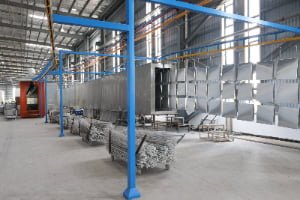
Outdoor Furniture and Weather Resistance
Furniture (chairs, tables, outdoor loungers) requires:
- Fine surface finish. Consumers see and feel the surface. Gloss, smoothness, and color consistency matter for market appeal.
- Adhesion + flexibility. Furniture experiences thermal cycling and stress from use. Coating must remain adhered even with workpiece flexing. This typically requires specific powder formulations (polyurethane or polyester blends) and cure profiles that we align with.
- Rapid color changes. Furniture makers often produce multiple colors per shift. Design must enable fast color changeover without contamination.
cURL Too many subrequests by single Worker invocation. To configure this limit, refer to https://developers.cloudflare.com/workers/wrangler/configuration/#limits.
cURL Too many subrequests by single Worker invocation. To configure this limit, refer to https://developers.cloudflare.com/workers/wrangler/configuration/#limits
cURL Too many subrequests by single Worker invocation. To configure this limit, refer to https://developers.cloudflare.com/workers/wrangler/configuration/#limits
- cURL Too many subrequests by single Worker invocation. To configure this limit, refer to https://developers.cloudflare.com/workers/wrangler/configuration/#limits. cURL Too many subrequests by single Worker invocation. To configure this limit, refer to https://developers.cloudflare.com/workers/wrangler/configuration/#limits.
- cURL Too many subrequests by single Worker invocation. To configure this limit, refer to https://developers.cloudflare.com/workers/wrangler/configuration/#limits. cURL Too many subrequests by single Worker invocation. To configure this limit, refer to https://developers.cloudflare.com/workers/wrangler/configuration/#limits.
- cURL Too many subrequests by single Worker invocation. To configure this limit, refer to https://developers.cloudflare.com/workers/wrangler/configuration/#limits. cURL Too many subrequests by single Worker invocation. To configure this limit, refer to https://developers.cloudflare.com/workers/wrangler/configuration/#limits.
- cURL Too many subrequests by single Worker invocation. To configure this limit, refer to https://developers.cloudflare.com/workers/wrangler/configuration/#limits. cURL Too many subrequests by single Worker invocation. To configure this limit, refer to https://developers.cloudflare.com/workers/wrangler/configuration/#limits.
cURL Too many subrequests by single Worker invocation. To configure this limit, refer to https://developers.cloudflare.com/workers/wrangler/configuration/#limits.
cURL Too many subrequests by single Worker invocation. To configure this limit, refer to https://developers.cloudflare.com/workers/wrangler/configuration/#limits
cURL Too many subrequests by single Worker invocation. To configure this limit, refer to https://developers.cloudflare.com/workers/wrangler/configuration/#limits
| cURL Too many subrequests by single Worker invocation. To configure this limit, refer to https://developers.cloudflare.com/workers/wrangler/configuration/#limits | cURL Too many subrequests by single Worker invocation. To configure this limit, refer to https://developers.cloudflare.com/workers/wrangler/configuration/#limits | Những điều cần chú ý |
|---|---|---|
| Tiền xử lý | cURL Too many subrequests by single Worker invocation. To configure this limit, refer to https://developers.cloudflare.com/workers/wrangler/configuration/#limits | cURL Too many subrequests by single Worker invocation. To configure this limit, refer to https://developers.cloudflare.com/workers/wrangler/configuration/#limits |
| Băng chuyền | cURL Too many subrequests by single Worker invocation. To configure this limit, refer to https://developers.cloudflare.com/workers/wrangler/configuration/#limits | cURL Too many subrequests by single Worker invocation. To configure this limit, refer to https://developers.cloudflare.com/workers/wrangler/configuration/#limits |
| Buồng phun sương | cURL Too many subrequests by single Worker invocation. To configure this limit, refer to https://developers.cloudflare.com/workers/wrangler/configuration/#limits | cURL Too many subrequests by single Worker invocation. To configure this limit, refer to https://developers.cloudflare.com/workers/wrangler/configuration/#limits |
| Lò sấy đóng cứng | What's the time-temperature profile? How is thermal uniformity assured? | Cure curve from powder supplier, thermal mapping plan |
| Powder recovery | What's the target recovery rate? How is moisture in recovered powder managed? | Specific % recovery rate, storage design, contamination prevention |
| Dust control | How is dust explosion prevented? What filtration is specified? | Ventilation calculation, filter sizing, grounding diagram |
| Line balance | Is the design timed so no stage starves or queues? | Residence time for each section, reconciliation with line speed |
| Testing plan | What validation happens before you take delivery? | Test panel results, full-line commissioning plan, training schedule |
Any proposal that's vague on these points is a warning sign. We provide detailed engineering specs for all of them because we believe design transparency builds confidence.
Kết luận
Spray equipment design is an engineering discipline, not an art form. The principles we've outlined—workpiece adaptation, quality stability, cost optimization, safety, environmental compliance, timing synchronization, and industry tailoring—aren't suggestions. They're the foundation of equipment that performs, that operators trust, and that delivers real value over years of production.
From our experience across cabinet, furniture, and aluminum profile manufacturers in Algeria, Turkey, and India, we've seen that clients who insist on principle-driven design end up with lower defect rates, better energy efficiency, fewer unexpected maintenance costs, and higher employee confidence in the equipment.
If you're planning a spray coating line—whether you're replacing an aging system or building capacity for new products—the decisions you make about design principles determine your success more than brand names or flashy features.
We're always available to discuss your specific requirements and walk through how these principles apply to your products and production environment. Contact us to explore a design proposal that's built on engineering rigor, not compromises.
WhatsApp: +8618925987762
Email: ketucoatingline@gmail.com
 Vietnamese
  English
  German
  French