
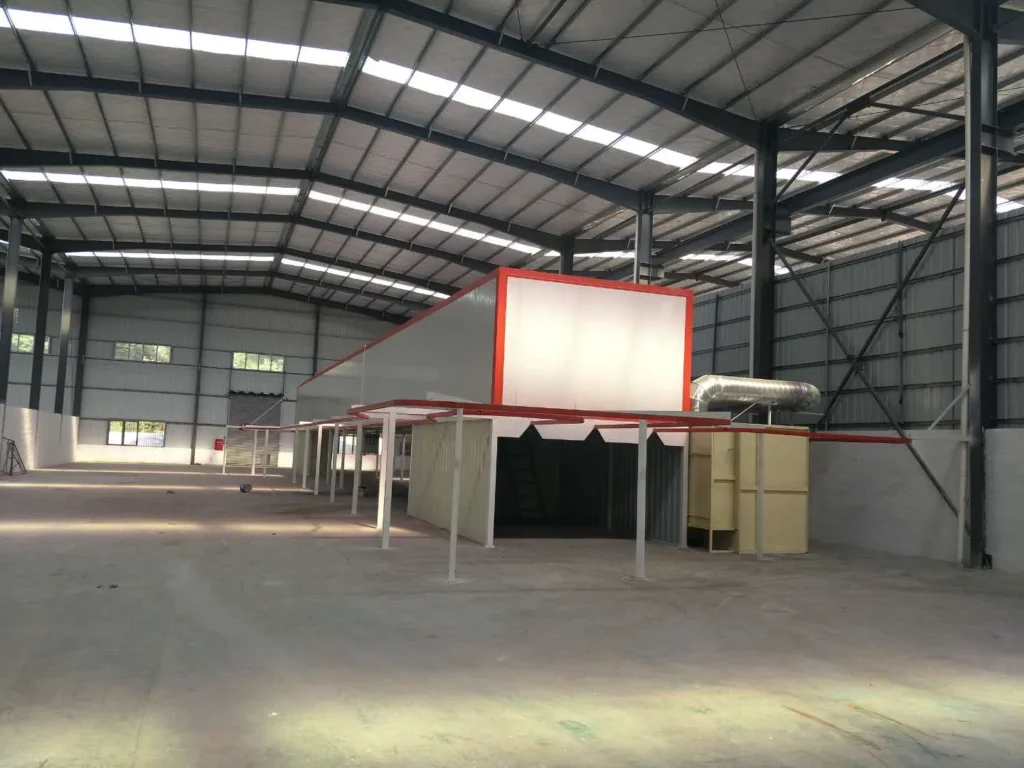
Lò Sấy Phủ Bột – An Introduction: What It Is, How It Works & Why It Matters
What Is a Powder Coating Oven & Why Does It Matter?
A powder coating oven is a specialized heating system designed to cure powder-coated workpieces by applying controlled temperature over a set duration. It's the critical final stage in the powder coating process—the equipment that transforms dry powder particles adhering to a workpiece surface into a durable, protective, and visually appealing coating.
At its core, a powder coating oven does more than simply "dry" the coating. It initiates a chemical transformation: the resin and hardening agents in the powder melt, flow across the surface, and undergo cross-linking reactions, ultimately forming a continuous, hard, and long-lasting paint film.

From our experience working with cabinet manufacturers, furniture makers, and metal fabricators, we've learned that many companies focus heavily on pre-treatment and spray application—and rightly so. However, the oven is where product quality either gets locked in or compromised. A poorly calibrated or undersized oven can undermine all the care taken in earlier stages. Conversely, the right oven configuration delivers consistent, defect-free coatings that meet customer expectations for appearance and durability.
cURL Too many subrequests by single Worker invocation. To configure this limit, refer to https://developers.cloudflare.com/workers/wrangler/configuration/#limits
- Determines final coating hardness, adhesion, and gloss
- Affects defect rates (under-curing causes soft, easily damaged coatings; over-curing causes brittleness or color shift)
- Impacts production throughput and energy efficiency
- Must match the specific powder chemistry and workpiece material
How Does a Powder Coating Oven Work? The Complete Process
The Four Stages of Curing (Melting, Flow, Cross-linking, Cooling)
When a powder-coated workpiece enters the oven, it undergoes a precise thermal journey:
1. Heating & Melting (Initial Stage)
The workpiece temperature rises as hot air circulates. At a certain threshold (typically 170–230°C depending on powder type), the dry powder particles begin to soften and fuse into a liquid film. This stage is critical: if temperature is too low or rises too slowly, the powder may remain granular; if too high, the resin can yellow or become brittle.
2. Flow & Leveling (Intermediate Stage)
As the temperature continues to rise, the molten coating flows and self-levels, filling micro-gaps and surface irregularities. This creates the smooth, uniform appearance. The workpiece geometry, powder viscosity, and air circulation all influence how well this phase progresses. Poor leveling often indicates inadequate temperature, insufficient dwell time, or uneven heat distribution.
3. Cross-linking (Chemical Reaction Stage)
This is where thermosetting occurs. The resin's molecular chains chemically bond (cross-link) with the hardening agents, forming a three-dimensional network. This reaction is temperature-dependent and time-dependent. Once complete, the coating becomes hard, insoluble, and mechanically resistant. This stage is why we stress the importance of hitting the correct temperature setpoint and maintaining it for the required duration.
4. Cooling (Final Stage)
The workpiece exits the oven and cools naturally or with forced air. As temperature drops, the coating hardens further. Cooling must be controlled—sudden temperature shock can cause stress, warping, or adhesion problems, particularly on thin-walled or aluminum parts.
Our observation from thousands of line hours: The most common quality failures trace back to improper execution of these stages. Rushing the process, mismatching powder chemistry to oven parameters, or failing to measure actual workpiece temperature (rather than relying only on air temperature) are the top culprits.

Key Heating Methods: Electric vs. Gas-Fired Ovens
The way an oven generates and distributes heat directly affects cure quality, energy efficiency, and operating cost.
Electric-Heated Ovens
- Heat Source: Electric heating elements (typically stainless steel tubular elements) generate heat directly
- Distribution: Hot air circulation via centrifugal or axial fans
- Phạm vi nhiệt độ: Typically 170–250°C
- Ramp-up Time: 30–50 minutes to reach steady state
- Ưu điểm:
- Precise temperature control (±5°C typical)
- Minimal maintenance for the heating system
- Suitable for small to mid-size production runs
- Easy to operate; no gas infrastructure required
- Nhược điểm:
- Higher ongoing electricity cost at large scale
- Slower ramp-up than gas systems
- cURL Too many subrequests by single Worker invocation. To configure this limit, refer to https://developers.cloudflare.com/workers/wrangler/configuration/#limits
- cURL Too many subrequests by single Worker invocation. To configure this limit, refer to https://developers.cloudflare.com/workers/wrangler/configuration/#limits cURL Too many subrequests by single Worker invocation. To configure this limit, refer to https://developers.cloudflare.com/workers/wrangler/configuration/#limits
cURL Too many subrequests by single Worker invocation. To configure this limit, refer to https://developers.cloudflare.com/workers/wrangler/configuration/#limits
- Heat Source: cURL Too many subrequests by single Worker invocation. To configure this limit, refer to https://developers.cloudflare.com/workers/wrangler/configuration/#limits
- Distribution: cURL Too many subrequests by single Worker invocation. To configure this limit, refer to https://developers.cloudflare.com/workers/wrangler/configuration/#limits
- Phạm vi nhiệt độ: cURL Too many subrequests by single Worker invocation. To configure this limit, refer to https://developers.cloudflare.com/workers/wrangler/configuration/#limits
- Ramp-up Time: 15–25 minutes
- Ưu điểm:
- cURL Too many subrequests by single Worker invocation. To configure this limit, refer to https://developers.cloudflare.com/workers/wrangler/configuration/#limits
- cURL Too many subrequests by single Worker invocation. To configure this limit, refer to https://developers.cloudflare.com/workers/wrangler/configuration/#limits
- cURL Too many subrequests by single Worker invocation. To configure this limit, refer to https://developers.cloudflare.com/workers/wrangler/configuration/#limits
- cURL Too many subrequests by single Worker invocation. To configure this limit, refer to https://developers.cloudflare.com/workers/wrangler/configuration/#limits
- Nhược điểm:
- cURL Too many subrequests by single Worker invocation. To configure this limit, refer to https://developers.cloudflare.com/workers/wrangler/configuration/#limits
- cURL Too many subrequests by single Worker invocation. To configure this limit, refer to https://developers.cloudflare.com/workers/wrangler/configuration/#limits
- cURL Too many subrequests by single Worker invocation. To configure this limit, refer to https://developers.cloudflare.com/workers/wrangler/configuration/#limits
- cURL Too many subrequests by single Worker invocation. To configure this limit, refer to https://developers.cloudflare.com/workers/wrangler/configuration/#limits
- cURL Too many subrequests by single Worker invocation. To configure this limit, refer to https://developers.cloudflare.com/workers/wrangler/configuration/#limits cURL Too many subrequests by single Worker invocation. To configure this limit, refer to https://developers.cloudflare.com/workers/wrangler/configuration/#limits
cURL Too many subrequests by single Worker invocation. To configure this limit, refer to https://developers.cloudflare.com/workers/wrangler/configuration/#limits cURL Too many subrequests by single Worker invocation. To configure this limit, refer to https://developers.cloudflare.com/workers/wrangler/configuration/#limits.
| Tiêu chí | Lò Điện | cURL Too many subrequests by single Worker invocation. To configure this limit, refer to https://developers.cloudflare.com/workers/wrangler/configuration/#limits |
|---|---|---|
| cURL Too many subrequests by single Worker invocation. To configure this limit, refer to https://developers.cloudflare.com/workers/wrangler/configuration/#limits | Cao hơn | Thấp hơn |
| Độ chính xác nhiệt độ | ±5°C | cURL Too many subrequests by single Worker invocation. To configure this limit, refer to https://developers.cloudflare.com/workers/wrangler/configuration/#limits |
| cURL Too many subrequests by single Worker invocation. To configure this limit, refer to https://developers.cloudflare.com/workers/wrangler/configuration/#limits | 30–50 min | 15–25 min |
| Độ phức tạp bảo trì | Thấp | Moderate–High |
| Vốn đầu tư ban đầu | Vừa phải | Cao hơn |
| Space Requirement | Vừa phải | Requires exhaust system |
| Best Production Profile | Batch/Mixed | High-volume continuous |
Main Types of Powder Coating Ovens & How to Choose
Convection Ovens (Most Common)
Convection ovens circulate heated air using fans, distributing heat uniformly across the workpiece. This is the industry standard for most powder coating applications.
How It Works:
Air is heated by electric elements or a gas burner, then forced through distribution ducts into the oven chamber. The moving air transfers heat to the workpiece and circulates out, returning to be reheated in a closed loop.
Ưu điểm:
- Reliable, predictable, and well-understood technology
- Good temperature uniformity when properly designed
- Flexible; works with most powder formulations
- Relatively easy maintenance and operation
Hạn chế:
- Slower heat transfer than infrared (longer dwell time required)
- Requires good air distribution design to avoid hot/cold spots
- Not ideal for very thick or thermally massive parts
- Air circulation can create dust patterns on highly textured surfaces
Suitable For:
Cabinet and metal furniture manufacturing, standard metal parts, any shop prioritizing reliability over speed.
Infrared Ovens (Speed & Efficiency)
Infrared ovens emit radiant heat (electromagnetic radiation) that directly heats the workpiece surface without needing air circulation.
How It Works:
Infrared heating elements (ceramic or quartz) are positioned above or around the chamber. They emit long-wave or medium-wave infrared radiation that is absorbed by the workpiece material, raising surface temperature rapidly.
Ưu điểm:
- Dramatically faster ramp-up (5–10 minutes possible)
- Excellent for thin metal or heat-sensitive substrates
- Lower energy loss compared to convection (no air circulation losses)
- Compact design; smaller footprint than convection ovens
Hạn chế:
- More sensitive to workpiece shape and color (dark surfaces absorb more heat)
- Risk of uneven curing if positioning is poor
- More expensive equipment upfront
- Not suitable for all powder types; some cure better with convection
- Shadowing effects on recessed or complex geometries
Suitable For:
High-speed automotive or appliance lines, thin-walled components, operations where cycle time is the primary constraint.
Batch vs. Continuous Systems
Batch Ovens:
Workpieces enter, door closes, oven cures all parts together, door opens, parts exit. Typical for smaller shops or facilities with mixed products.
- Start/stop cycle; intermittent operation
- cURL Too many subrequests by single Worker invocation. To configure this limit, refer to https://developers.cloudflare.com/workers/wrangler/configuration/#limits
- cURL Too many subrequests by single Worker invocation. To configure this limit, refer to https://developers.cloudflare.com/workers/wrangler/configuration/#limits
- cURL Too many subrequests by single Worker invocation. To configure this limit, refer to https://developers.cloudflare.com/workers/wrangler/configuration/#limits
cURL Too many subrequests by single Worker invocation. To configure this limit, refer to https://developers.cloudflare.com/workers/wrangler/configuration/#limits
cURL Too many subrequests by single Worker invocation. To configure this limit, refer to https://developers.cloudflare.com/workers/wrangler/configuration/#limits.
- cURL Too many subrequests by single Worker invocation. To configure this limit, refer to https://developers.cloudflare.com/workers/wrangler/configuration/#limits
- cURL Too many subrequests by single Worker invocation. To configure this limit, refer to https://developers.cloudflare.com/workers/wrangler/configuration/#limits
- cURL Too many subrequests by single Worker invocation. To configure this limit, refer to https://developers.cloudflare.com/workers/wrangler/configuration/#limits
- cURL Too many subrequests by single Worker invocation. To configure this limit, refer to https://developers.cloudflare.com/workers/wrangler/configuration/#limits
- cURL Too many subrequests by single Worker invocation. To configure this limit, refer to https://developers.cloudflare.com/workers/wrangler/configuration/#limits
From our project experience: cURL Too many subrequests by single Worker invocation. To configure this limit, refer to https://developers.cloudflare.com/workers/wrangler/configuration/#limits.
cURL Too many subrequests by single Worker invocation. To configure this limit, refer to https://developers.cloudflare.com/workers/wrangler/configuration/#limits
cURL Too many subrequests by single Worker invocation. To configure this limit, refer to https://developers.cloudflare.com/workers/wrangler/configuration/#limits
cURL Too many subrequests by single Worker invocation. To configure this limit, refer to https://developers.cloudflare.com/workers/wrangler/configuration/#limits
cURL Too many subrequests by single Worker invocation. To configure this limit, refer to https://developers.cloudflare.com/workers/wrangler/configuration/#limits.
cURL Too many subrequests by single Worker invocation. To configure this limit, refer to https://developers.cloudflare.com/workers/wrangler/configuration/#limits
- cURL Too many subrequests by single Worker invocation. To configure this limit, refer to https://developers.cloudflare.com/workers/wrangler/configuration/#limits
- cURL Too many subrequests by single Worker invocation. To configure this limit, refer to https://developers.cloudflare.com/workers/wrangler/configuration/#limits
- cURL Too many subrequests by single Worker invocation. To configure this limit, refer to https://developers.cloudflare.com/workers/wrangler/configuration/#limits
- cURL Too many subrequests by single Worker invocation. To configure this limit, refer to https://developers.cloudflare.com/workers/wrangler/configuration/#limits
cURL Too many subrequests by single Worker invocation. To configure this limit, refer to https://developers.cloudflare.com/workers/wrangler/configuration/#limits cURL Too many subrequests by single Worker invocation. To configure this limit, refer to https://developers.cloudflare.com/workers/wrangler/configuration/#limits.
Chamber Size & Production Volume
Sizing Factors:
- Chiều dài: Must accommodate the conveyor speed and cure time. If your powder requires 10 minutes cure at 200°C, and your line speed is 1 m/min, you need at least a 10-meter oven chamber.
- Chiều rộng & Chiều cao: Must fit your largest workpiece with clearance (typically 150–200 mm on all sides for air circulation).
- Thermal Load: Total mass and color of parts entering per minute affects how quickly the oven can maintain setpoint temperature.
Throughput Planning:
A 5m × 2m × 2m convection oven at 1 m/min speed ≈ 5 minute dwell ≈ 12 parts/hour (if parts are spaced 0.5m apart). Doubling speed halves dwell time and can cause under-curing. Adding a second oven or switching to gas heating (faster thermal recovery) may be necessary.
Khuyến nghị của chúng tôi:
Don't undersizing. It's tempting to order the minimum oven to save capital, but a cramped oven with insufficient dwell time will deliver defect rates that cost far more in rework and customer returns.
Energy Efficiency & Operating Costs
Key Metrics:
- Thermal Efficiency: What percentage of input energy reaches the product? Convection ovens typically achieve 40–60%; well-designed infrared systems can reach 70–80%.
- Insulation Quality: 100 mm of mineral fiber insulation (mineral wool) is standard. Thicker (150 mm) reduces heat loss but increases size and cost.
- Exhaust Volume: Lower exhaust (more recirculation) saves energy but risks incomplete air changes and potential fume accumulation.
Operational Cost Drivers:
- Idle/warm-up energy: An oven running 8 hours/day but only producing 4 hours burns energy standing by. Consider overnight shutdown or setback.
- Air circulation: Oversized fans waste energy. Right-sized CFM (cubic feet per minute) is critical.
- Temperature differential: Running 200°C in a 30°C plant costs more than 200°C in a 20°C environment. Shop climate control pays off.
Payback Thinking:
A gas oven costs $30k–50k more upfront than electric but might save $5–10k/year in energy. Payback is 3–5 years for high-volume users. For batch operations, electric often remains superior lifetime cost.
| Thông số kỹ thuật | Impact on Quality | Impact on Cost |
|---|---|---|
| Temperature Precision (±5°C vs ±15°C) | Critical for gloss, hardness, adhesion | Minimal upfront; affects defect rates |
| Chamber Length (5m vs 10m) | Determines cure time; under-sizing causes failures | Doubles capital; may reduce energy/shift |
| Insulation Thickness (100mm vs 150mm) | Marginal quality gain | ~10% higher cost; ~10–15% lower operating cost |
| Gas vs. Electric | Minimal quality difference | 20–40% lower OpEx over 5 years for continuous production |
Common Curing Problems & How to Avoid Them
cURL Too many subrequests by single Worker invocation. To configure this limit, refer to https://developers.cloudflare.com/workers/wrangler/configuration/#limits
cURL Too many subrequests by single Worker invocation. To configure this limit, refer to https://developers.cloudflare.com/workers/wrangler/configuration/#limits
cURL Too many subrequests by single Worker invocation. To configure this limit, refer to https://developers.cloudflare.com/workers/wrangler/configuration/#limits
- cURL Too many subrequests by single Worker invocation. To configure this limit, refer to https://developers.cloudflare.com/workers/wrangler/configuration/#limits
- cURL Too many subrequests by single Worker invocation. To configure this limit, refer to https://developers.cloudflare.com/workers/wrangler/configuration/#limits
- cURL Too many subrequests by single Worker invocation. To configure this limit, refer to https://developers.cloudflare.com/workers/wrangler/configuration/#limits
- cURL Too many subrequests by single Worker invocation. To configure this limit, refer to https://developers.cloudflare.com/workers/wrangler/configuration/#limits
- cURL Too many subrequests by single Worker invocation. To configure this limit, refer to https://developers.cloudflare.com/workers/wrangler/configuration/#limits
Nguyên nhân chính:
- cURL Too many subrequests by single Worker invocation. To configure this limit, refer to https://developers.cloudflare.com/workers/wrangler/configuration/#limits
- cURL Too many subrequests by single Worker invocation. To configure this limit, refer to https://developers.cloudflare.com/workers/wrangler/configuration/#limits
- cURL Too many subrequests by single Worker invocation. To configure this limit, refer to https://developers.cloudflare.com/workers/wrangler/configuration/#limits
- cURL Too many subrequests by single Worker invocation. To configure this limit, refer to https://developers.cloudflare.com/workers/wrangler/configuration/#limits
- cURL Too many subrequests by single Worker invocation. To configure this limit, refer to https://developers.cloudflare.com/workers/wrangler/configuration/#limits
cURL Too many subrequests by single Worker invocation. To configure this limit, refer to https://developers.cloudflare.com/workers/wrangler/configuration/#limits
- cURL Too many subrequests by single Worker invocation. To configure this limit, refer to https://developers.cloudflare.com/workers/wrangler/configuration/#limits
- cURL Too many subrequests by single Worker invocation. To configure this limit, refer to https://developers.cloudflare.com/workers/wrangler/configuration/#limits
- cURL Too many subrequests by single Worker invocation. To configure this limit, refer to https://developers.cloudflare.com/workers/wrangler/configuration/#limits
- cURL Too many subrequests by single Worker invocation. To configure this limit, refer to https://developers.cloudflare.com/workers/wrangler/configuration/#limits
- cURL Too many subrequests by single Worker invocation. To configure this limit, refer to https://developers.cloudflare.com/workers/wrangler/configuration/#limits
cURL Too many subrequests by single Worker invocation. To configure this limit, refer to https://developers.cloudflare.com/workers/wrangler/configuration/#limits
cURL Too many subrequests by single Worker invocation. To configure this limit, refer to https://developers.cloudflare.com/workers/wrangler/configuration/#limits
- cURL Too many subrequests by single Worker invocation. To configure this limit, refer to https://developers.cloudflare.com/workers/wrangler/configuration/#limits
- cURL Too many subrequests by single Worker invocation. To configure this limit, refer to https://developers.cloudflare.com/workers/wrangler/configuration/#limits
- Gloss drops from specification
- In some powder systems, coating flakes or chips more easily
- Part warping or dimensional distortion (especially thin-walled aluminum)
Nguyên nhân chính:
- Oven temperature set too high
- Workpiece dwelling longer than needed
- Temperature controller drift (setpoint reads 200°C but actual is 220°C)
- Wrong powder loaded (using a higher-cure-temp powder by mistake)
- Insufficient air circulation causing localized hot spots
cURL Too many subrequests by single Worker invocation. To configure this limit, refer to https://developers.cloudflare.com/workers/wrangler/configuration/#limits
- Lower setpoint by 5–10°C and observe effect
- Verify controller accuracy with a calibrated thermometer
- Reduce dwell time slightly; ovens run more efficiently at their design speed
- Always verify powder spec before loading the hopper
- Check oven interior for debris or blockages that create hot spots
- Ensure inlet and exhaust are clean; clogging reduces circulation
Our Field Experience: The most common error is confusing under-curing with adhesion or surface prep problems. A customer might blame the oven when the real issue is uncleaned oil on the pre-treatment line. Before adjusting the oven, always verify pre-treatment is clean and dry.
Temperature Uniformity & Heat Distribution Issues
Why Uniformity Matters:
Workpieces at different positions in the oven experience different temperatures. Parts near the inlet may be hotter; parts near the outlet cooler. If the spread exceeds ±10°C from the setpoint, some parts will under-cure while others over-cure.
Common Patterns:
- Inlet too hot, outlet too cool: Indicates poor baffle design or inadequate mixing in the air stream. Hot air rushes in and exits quickly without recirculation.
- Left side hotter than right: Suggests uneven burner or element operation, blocked distribution ducts, or asymmetric fan output.
- Top of chamber hotter: Hot air naturally rises; if no baffles direct flow downward, parts on the lower shelves cool faster.
Diagnosis:
- Place calibrated temp sensors at 9 points (corners, edges, center) at product height
- Run the oven empty for 30 minutes to reach steady state
- Record temperatures at each point
- Acceptable range: ±10°C from mean
Corrective Actions:
- Install or adjust baffles and dampers to force more uniform air circulation
- Clean all inlet ducts and air distribution tubes (dust accumulation reduces flow)
- Verify burner or heating element output (replace if failing)
- Consider adding a secondary air recirculation fan if the oven is very long
- In severe cases, redesign the duct work (costly but necessary for high-precision work)
Powder Coating Ovens vs. Traditional Paint Curing Methods
Traditional spray painting (solvent-based or water-based) has been the benchmark for decades. Understanding how powder ovens compare is important for anyone evaluating the switch:
| Yếu tố | Lò Sấy Phủ Bột | cURL Too many subrequests by single Worker invocation. To configure this limit, refer to https://developers.cloudflare.com/workers/wrangler/configuration/#limits |
|---|---|---|
| Cure Temperature | cURL Too many subrequests by single Worker invocation. To configure this limit, refer to https://developers.cloudflare.com/workers/wrangler/configuration/#limits | cURL Too many subrequests by single Worker invocation. To configure this limit, refer to https://developers.cloudflare.com/workers/wrangler/configuration/#limits |
| Thời gian đóng rắn | cURL Too many subrequests by single Worker invocation. To configure this limit, refer to https://developers.cloudflare.com/workers/wrangler/configuration/#limits | cURL Too many subrequests by single Worker invocation. To configure this limit, refer to https://developers.cloudflare.com/workers/wrangler/configuration/#limits |
| Độ dày Lớp phủ | cURL Too many subrequests by single Worker invocation. To configure this limit, refer to https://developers.cloudflare.com/workers/wrangler/configuration/#limits | cURL Too many subrequests by single Worker invocation. To configure this limit, refer to https://developers.cloudflare.com/workers/wrangler/configuration/#limits |
| cURL Too many subrequests by single Worker invocation. To configure this limit, refer to https://developers.cloudflare.com/workers/wrangler/configuration/#limits | cURL Too many subrequests by single Worker invocation. To configure this limit, refer to https://developers.cloudflare.com/workers/wrangler/configuration/#limits | cURL Too many subrequests by single Worker invocation. To configure this limit, refer to https://developers.cloudflare.com/workers/wrangler/configuration/#limits |
| Phát thải VOC | cURL Too many subrequests by single Worker invocation. To configure this limit, refer to https://developers.cloudflare.com/workers/wrangler/configuration/#limits | cURL Too many subrequests by single Worker invocation. To configure this limit, refer to https://developers.cloudflare.com/workers/wrangler/configuration/#limits |
| cURL Too many subrequests by single Worker invocation. To configure this limit, refer to https://developers.cloudflare.com/workers/wrangler/configuration/#limits | cURL Too many subrequests by single Worker invocation. To configure this limit, refer to https://developers.cloudflare.com/workers/wrangler/configuration/#limits | cURL Too many subrequests by single Worker invocation. To configure this limit, refer to https://developers.cloudflare.com/workers/wrangler/configuration/#limits |
| Tùy chọn độ bóng | cURL Too many subrequests by single Worker invocation. To configure this limit, refer to https://developers.cloudflare.com/workers/wrangler/configuration/#limits | cURL Too many subrequests by single Worker invocation. To configure this limit, refer to https://developers.cloudflare.com/workers/wrangler/configuration/#limits |
| Ảnh hưởng đến Môi trường | Thấp | cURL Too many subrequests by single Worker invocation. To configure this limit, refer to https://developers.cloudflare.com/workers/wrangler/configuration/#limits |
| cURL Too many subrequests by single Worker invocation. To configure this limit, refer to https://developers.cloudflare.com/workers/wrangler/configuration/#limits | Lower long-term (powder recovery) | cURL Too many subrequests by single Worker invocation. To configure this limit, refer to https://developers.cloudflare.com/workers/wrangler/configuration/#limits |
| cURL Too many subrequests by single Worker invocation. To configure this limit, refer to https://developers.cloudflare.com/workers/wrangler/configuration/#limits | Cao | Lower (more operator skill needed) |
| Complex Geometry Handling | Good (electrostatic control) | Difficult (runs, sags, coverage gaps) |
Why Powder + Oven Outperforms:
- Thickness Control: Powder adheres as a discrete layer; thickness is controllable and uniform. Paint runs if too thick.
- Độ bền: Cross-linked thermoset coating is harder and more chemical-resistant than air-dried paint.
- Speed: 15 minutes in an oven beats 24-hour air dry.
- Waste: Overspray powder recovers (95%+); paint overspray is waste.
- Môi trường: Near-zero VOC emissions vs. significant solvent release.
When Traditional Paint Still Makes Sense:
- Very small batch or one-off parts (oven investment not justified)
- Complex assemblies already wet-painted (rework piece)
- Outdoor on-site painting (no infrastructure for powder)
- Customer contractual requirement for specific paint system
Which Industries Rely on Powder Coating Ovens?
From our field projects, these sectors are the most consistent users of powder systems—and most demanding about oven performance:
1. Electrical Enclosures & Cabinet Manufacturing
- Products: Switchgear, distribution boards, electrical control boxes
- Requirements: Corrosion resistance, consistent gloss, high surface uniformity
- Volume: Often high; continuous lines common
- Oven Focus: Temperature uniformity, fast cycle time
2. Outdoor Furniture
- Products: Park benches, seating, structural frames
- Requirements: UV resistance (outdoor durability), aesthetic finish, durability
- Challenges: Powder chemistry must support weathering; over-curing risks color shift
- Oven Focus: Precise temperature to lock in powder cure without degradation
3. Aluminum & Metal Structural Fabrication
- Products: Frames, railings, architectural elements, window frames
- Requirements: Adhesion on non-ferrous metals, aesthetic appeal, corrosion protection
- Challenges: Aluminum heats quickly; risk of warping if oven design is poor
- Oven Focus: Even temperature distribution, thermal management for thin walls
4. Appliances & Consumer Electronics
- Products: Refrigerators, washers, microwave housings, control panels
- Requirements: High gloss, no defects, consistent color lot-to-lot
- Volume: Very high; 100+ units per hour
- cURL Too many subrequests by single Worker invocation. To configure this limit, refer to https://developers.cloudflare.com/workers/wrangler/configuration/#limits
cURL Too many subrequests by single Worker invocation. To configure this limit, refer to https://developers.cloudflare.com/workers/wrangler/configuration/#limits
- cURL Too many subrequests by single Worker invocation. To configure this limit, refer to https://developers.cloudflare.com/workers/wrangler/configuration/#limits
- cURL Too many subrequests by single Worker invocation. To configure this limit, refer to https://developers.cloudflare.com/workers/wrangler/configuration/#limits
- cURL Too many subrequests by single Worker invocation. To configure this limit, refer to https://developers.cloudflare.com/workers/wrangler/configuration/#limits
- cURL Too many subrequests by single Worker invocation. To configure this limit, refer to https://developers.cloudflare.com/workers/wrangler/configuration/#limits
cURL Too many subrequests by single Worker invocation. To configure this limit, refer to https://developers.cloudflare.com/workers/wrangler/configuration/#limits
- cURL Too many subrequests by single Worker invocation. To configure this limit, refer to https://developers.cloudflare.com/workers/wrangler/configuration/#limits
- cURL Too many subrequests by single Worker invocation. To configure this limit, refer to https://developers.cloudflare.com/workers/wrangler/configuration/#limits
- cURL Too many subrequests by single Worker invocation. To configure this limit, refer to https://developers.cloudflare.com/workers/wrangler/configuration/#limits
- cURL Too many subrequests by single Worker invocation. To configure this limit, refer to https://developers.cloudflare.com/workers/wrangler/configuration/#limits
cURL Too many subrequests by single Worker invocation. To configure this limit, refer to https://developers.cloudflare.com/workers/wrangler/configuration/#limits cURL Too many subrequests by single Worker invocation. To configure this limit, refer to https://developers.cloudflare.com/workers/wrangler/configuration/#limits.
cURL Too many subrequests by single Worker invocation. To configure this limit, refer to https://developers.cloudflare.com/workers/wrangler/configuration/#limits
cURL Too many subrequests by single Worker invocation. To configure this limit, refer to https://developers.cloudflare.com/workers/wrangler/configuration/#limits
cURL Too many subrequests by single Worker invocation. To configure this limit, refer to https://developers.cloudflare.com/workers/wrangler/configuration/#limits
- cURL Too many subrequests by single Worker invocation. To configure this limit, refer to https://developers.cloudflare.com/workers/wrangler/configuration/#limits
- cURL Too many subrequests by single Worker invocation. To configure this limit, refer to https://developers.cloudflare.com/workers/wrangler/configuration/#limits
- cURL Too many subrequests by single Worker invocation. To configure this limit, refer to https://developers.cloudflare.com/workers/wrangler/configuration/#limits
- cURL Too many subrequests by single Worker invocation. To configure this limit, refer to https://developers.cloudflare.com/workers/wrangler/configuration/#limits
- cURL Too many subrequests by single Worker invocation. To configure this limit, refer to https://developers.cloudflare.com/workers/wrangler/configuration/#limits
cURL Too many subrequests by single Worker invocation. To configure this limit, refer to https://developers.cloudflare.com/workers/wrangler/configuration/#limits
- Get the powder supplier's technical datasheet
- Identify the minimum and maximum cure temperature
- Note the recommended dwell time at temperature
- Understand any sensitivity to over-curing (some powders yellow if over-cooked)
3. Select Heating Method Based on Operations
- If continuous high-volume: gas-fired oven is usually more cost-effective long-term
- If batch or mixed-volume: electric oven offers better control and flexibility
- If very fast cycle required: consider infrared (but verify powder compatibility)
4. Size the Chamber Correctly
- Length = (desired dwell time in minutes) × (line speed in m/min)
- Width/height = largest workpiece + 200 mm clearance
- Oversize is better than undersize; adds flexibility without much cost penalty
5. Demand Temperature Measurement at Product Level
- Insist on thermocouples installed at product height, not just in air
- Require a uniformity mapping at commissioning (9-point grid)
- Get acceptance criteria in writing (e.g., ±10°C from setpoint)
6. Plan for Air Distribution Quality
- Request detailed duct drawings showing baffles and air flow
- Ask how the supplier handles long chambers (>6m)
- Verify exhaust sizing; under-sized exhaust chokes the system
 Vietnamese
  English
  German
  French