
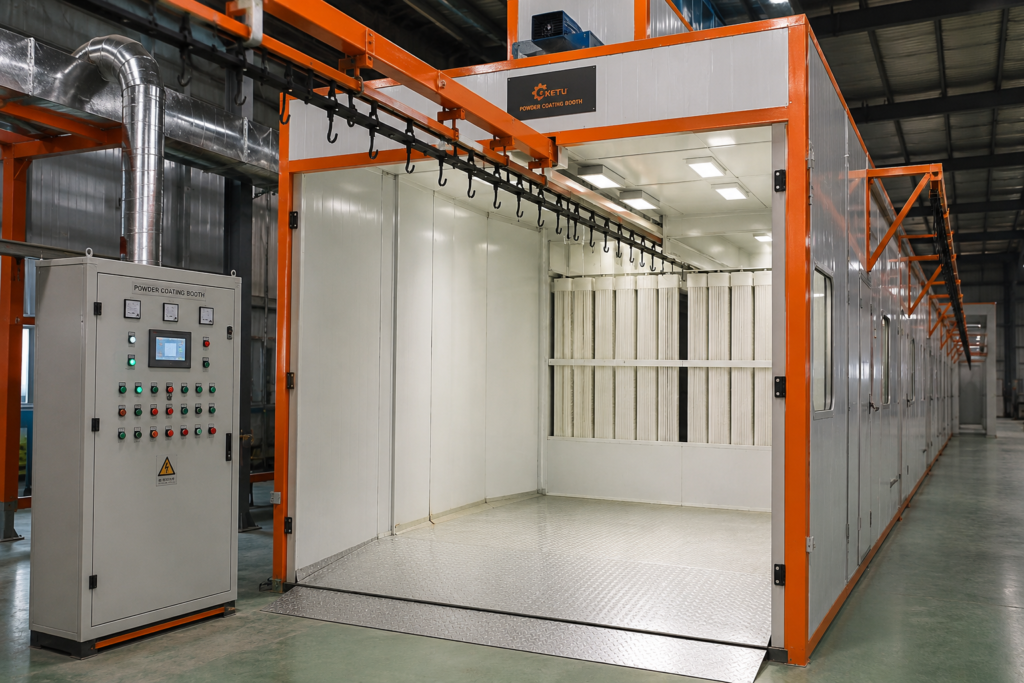
Leveling Spray Booth Design Requirements: Complete Technical Guide
What is a Leveling Spray Booth and Why Does It Matter in Coating Process?
When I work with powder coating manufacturers, one of the most overlooked aspects of production line planning is the leveling spray booth design. Most buyers focus on spray gun models or lò xử lý nhiệt power ratings, but the booth itself—its dimensions, airflow structure, and internal configuration—directly determines whether your final coating will be uniform or inconsistent.
A leveling spray booth is a controlled enclosure where electrostatic powder[^1] particles are sprayed onto workpieces under carefully managed environmental conditions. It's not just a box with guns mounted inside; it's a precision chamber designed to achieve and maintain uniform powder deposition through optimized airflow, spray pattern management, and surface treatment. The "leveling" aspect refers specifically to how the booth design helps the powder settle evenly on the workpiece surface, preventing accumulation in corners, valleys, or edges—a phenomenon we call "Faraday cage effect" in the industry.
From my factory experience, I've seen production lines fail not because the spray guns were poor quality, but because the booth was too small, the airflow was unbalanced, or the internal surfaces were too rough. A badly designed booth creates dead zones, powder accumulation points, and inconsistent surface finishes that no amount of gun adjustment can fix.
Core Design Dimensions: How to Size Your Spray Booth
Determining Chamber Length, Width, and Height
The first temptation is to build a booth "big enough," but oversizing wastes energy and complicates airflow management, while undersizing creates compressed spray patterns and recirculation problems. The correct approach is to design backward from your workpiece dimensions and production requirements.
Chamber length must account for the spray pattern cone. If your workpiece is 1500 mm long, the booth must be at least 200–300 mm longer on each end to capture the full spray angle without overspray hitting the walls. I typically recommend 1800–2000 mm minimum booth length for a 1500 mm workpiece to maintain safety margins and allow the operator consistent spray distance.
Chamber width depends on how many workpieces you spray simultaneously and whether you need multi-angle gun positioning. For single-piece, single-angle spraying, width can be relatively compact (1200–1400 mm). But if you're spraying complex geometry that requires spray guns positioned on both sides, you need at least 2000–2400 mm width to prevent interference and allow adequate operator access.
Chamber height is where most designs fail. The minimum should be 2200–2400 mm from floor to roof. Why? Because powder needs vertical airflow to settle uniformly. If the booth is too low, air recirculates horizontally before the powder can deposit properly, causing uneven coverage on vertical surfaces or edges. Additionally, operators need safe clearance to move and reposition guns without risk of contact with the roof structure.
![powder coating spray booth chamber design]
Calculating Conveyor Opening and Workpiece Passage Space
This is a critical detail often miscalculated. The opening where your conveyor or manual handling system enters and exits the booth must accommodate the workpiece plus mounting hardware, yet it cannot be so large that you lose airflow control.
Standard practice is to size the opening to be 50–100 mm larger than the workpiece on each side. If your workpiece is 1100 mm wide and hangs on a 50 mm hook assembly, your opening should be approximately 1200–1250 mm wide. Anything wider creates air bypass channels; anything tighter risks contact during loading and unloading.
The vertical passage height should provide 300–400 mm clearance above the highest point of your mounted workpiece. This prevents powder accumulation on the booth ceiling and ensures the spray pattern clears the roof structure without deflection. Many production stoppages I've seen were caused by powder buildup on an undersized ceiling opening—it eventually blocks airflow or material falls onto in-process parts.
Internal Structure Design Requirements
Ventilation and Air Flow Organization
This is where booth design becomes a real engineering discipline. From my observation across dozens of production lines, airflow uniformity determines 70% of coating quality problems.
The principle is simple: air should enter horizontally through a perforated inlet panel, travel across the workpiece at controlled velocity (typically 0.5–0.8 m/s), and exit vertically through exhaust ducts. The problem is that if inlet velocity is uneven, or if the booth has internal obstacles, you get turbulence that deflects the powder cloud.
I specify inlet air distribution using a plenum chamber behind a perforated inlet panel. The perforations should be uniformly sized (typically 4–6 mm holes) with consistent spacing (hole pitch 10–15 mm). This ensures that air pressure equalizes across the inlet face, preventing high-velocity jets that over-spray certain areas while starving others.
For exhaust, horizontal airflow at the workpiece level should transition to vertical upward flow at the rear. This means the booth profile should slightly widen toward the rear, and exhaust ducts should be positioned symmetrically at the top corners. Asymmetric exhaust positions create eddy currents that swirl the powder instead of carrying it cleanly out of the booth.
Sound Insulation, Fire Protection, and Lighting Design
Interior walls should incorporate acoustic foam or rock wool[^2] (typically 50–100 mm thickness) to absorb spray gun noise and compress air noise. This serves dual purposes: noise reduction for operators and improved air quality by preventing dust rebound from hard surfaces.
Fire protection is often overlooked but critical. Powder dust in high concentrations can be explosive. The booth must be designed to prevent accumulation by maintaining consistent downward or exhaust air velocity, and interior surfaces should not have crevices where powder settles and becomes a static discharge hazard. All electrical components must be explosion-proof rated[^3] (ATEX or equivalent standards depending on your region).
Lighting should be positioned above the workpiece at 300–500 lux intensity, using sealed LED fixtures to prevent powder ingestion into luminaires. Lights must be washable or replaceable without production downtime. I recommend positioning lights on side walls rather than ceiling to minimize glare and keep operators' sight lines clear.
Surface Material Selection and Treatment Standards
Here's what I learned the hard way: booth interior material directly affects powder recovery efficiency and long-term maintenance cost.
Rough surfaces (bare steel, untreated plywood) cause powder particles to stick instead of sliding back into the collection system. This reduces recovery efficiency from a theoretical 95% to sometimes 60–70%, dramatically increasing material waste and operating cost over the life of the booth.
I specify composite materials or specially treated surfaces. Stainless steel[^4] or PP (polypropylene) coated wall panels reduce adhesion and are easier to clean. For budget-sensitive projects, powdered-epoxy-coated steel with a smooth finish achieves similar results at lower cost.
The floor should be smooth epoxy concrete or include a powder collection trough sloped toward a central drain point
 Vietnamese
  English
  German
  French