
How to Quickly Change Colors in Powder Coating Systems: Methods, Efficiency Gains & Best Practices
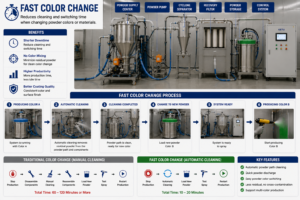
When you're managing a powder coating operation with multiple colors, color changeovers can become a major productivity bottleneck. Every minute spent cleaning residual powder, purging supply lines, and running test sprays is a minute not spent producing parts. From our experience running production facilities and working with dozens of coating line customers, we've learned that most operations can cut changeover time by 40-60% simply by rethinking their approach—not necessarily by investing in expensive equipment.
The core issue isn't always speed of operation; it's poor planning and inadequate cleaning protocols that waste time and create costly defects. In fact, many factories lose more efficiency to contamination problems than to the changeover process itself.
Let us walk you through the real-world factors that slow down color changes, the practical techniques we recommend, the equipment configurations that actually deliver results, and how to decide whether manual or automatic systems make sense for your operation.
Why Color Changes Slow Down Production: Key Factors Affecting Changeover Speed
Color changeovers are deceptively complex. Most operators think the challenge is simply "getting the old color out." In reality, there are four distinct layers of difficulty.
First, residual powder sits in multiple locations—not just the spray gun. Powder settles in the supply hose, the feed line, the spray booth floor, the recovery chamber, even inside the powder hopper itself. If you only clean the gun and miss the hose, the next batch will be contaminated the moment you resume spraying. We've seen this happen repeatedly with clients who thought they were thorough but only focused on the obvious visible spots.
Second, fine powder is much harder to remove than large particles. When you use compressed air to blow out a line, the coarser particles fly out easily. But ultra-fine powder—especially after it's been sitting in a humid booth—can stick to internal surfaces and release unpredictably during the next spray cycle. This is a major reason why test sprays fail and why you need genuine purging, not just a quick blow-through.
Third, some color transitions are inherently risky. Changing from black to white requires roughly 2-3 times more purging effort than changing between similar tones. Dark pigment particles can hide inside corners and micro-crevices, then migrate onto light-colored parts hours later, creating visible specks that force rework. We always advise clients to treat dark-to-light transitions as high-priority changeovers that warrant extra time and scrutiny.
Fourth, the trial-and-error test spray phase often consumes 20-40% of total changeover time. Many factories spray test parts, discover contamination halfway through, and then have to repeat the entire purging cycle. This cascading rework is where changeovers truly spiral out of control. Without a systematic purging verification method, you lose all time savings you might have gained from faster equipment.
In summary: speed without systematic cleaning leads to waste, rework, and false economy. That's why our first recommendation is always on the planning and process side, not the equipment side.
Optimizing Production Scheduling to Minimize Color Changeovers
Here's a principle we emphasize constantly with clients: the best changeover is the one you never have to do. This is where production planning becomes your most powerful tool.
Most factories treat color changeovers as a reactive problem—something that happens when the order says "now switch to blue." But if you step back and look at your weekly or monthly order book as a whole, you can often consolidate related colors into single production windows, eliminating 30-50% of changeovers entirely.
How to Group Similar Colors and Reduce Changeover Frequency
The strategy is straightforward in theory, complex in execution: batch similar colors together.
Start by mapping your typical color palette. Most operations use 8-15 core colors. Group them into color families: light neutrals (white, cream, light gray), dark neutrals (black, charcoal, dark brown), reds and warm tones, blues and cool tones, and specialty colors (metallic, translucent).
When possible, schedule all light-neutral orders in one production block, all dark neutrals in another, and so on. The benefit is compounded: when you finish white parts and switch to cream, you need minimal purging—maybe 5 minutes instead of 20. The residual white powder won't contaminate cream significantly, especially if you do a partial air purge of the supply lines.
From our factory experience, we typically see that organizing production around color families rather than raw delivery dates can cut changeover events by 40-50% without any capital investment.
The operational rule we recommend: establish a weekly color schedule matrix. Monday might be "light neutral day," Tuesday "dark day," Wednesday "reds and oranges," Thursday "blues," Friday "specialty finishes." This discipline requires coordination with sales and logistics, but it pays immediate dividends in production efficiency.
Planning for High-Risk Color Transitions (Dark to Light Colors)
Not all color transitions are equal. Some are straightforward; others are traps.
Dark to light is the highest-risk transition. Black to white is the worst. Dark pigments are aggressive—they stain and cling. Even microscopic residue will show up on white parts as specks or hazing. We always tell clients: if you must switch from black to white, either schedule it at the end of the shift (so any contamination affects fewer parts), or insert a "sacrificial color" in between (e.g., black → gray → white). The gray acts as a buffer, capturing the last of the black particles without destroying an entire batch.
Light to dark is relatively safe. Leftover white powder on a dark part is invisible. You can usually skip extensive purging and just do a 10-minute air blow-through.
Within-family transitions are safest. White to cream, blue to navy, red to burgundy—these transitions require only partial cleaning. A single air purge through supply lines and a quick spray-gun wipe usually suffice.
Our scheduling advice: cluster high-risk transitions early in the week when you have time to handle them properly, not on Friday when people are rushing to meet shift-end goals. And always build extra buffer time into your schedule for dark-to-light changes. If you estimate 15 minutes normally, allocate 30-40 minutes for black-to-white to account for extra purging and test sprays.
Step-by-Step Color Changeover Process: Cleaning and Clearing Powder Residue
This is where theory meets practice. Here's the exact procedure we use in our own facilities and recommend to all customers.
Clearing Large Particles and Fine Powder from Supply Lines
cURL Too many subrequests by single Worker invocation. To configure this limit, refer to https://developers.cloudflare.com/workers/wrangler/configuration/#limits.
cURL Too many subrequests by single Worker invocation. To configure this limit, refer to https://developers.cloudflare.com/workers/wrangler/configuration/#limits.
cURL Too many subrequests by single Worker invocation. To configure this limit, refer to https://developers.cloudflare.com/workers/wrangler/configuration/#limits.
Sử dụng compressed aircURL Too many subrequests by single Worker invocation. To configure this limit, refer to https://developers.cloudflare.com/workers/wrangler/configuration/#limits.
cURL Too many subrequests by single Worker invocation. To configure this limit, refer to https://developers.cloudflare.com/workers/wrangler/configuration/#limits.
cURL Too many subrequests by single Worker invocation. To configure this limit, refer to https://developers.cloudflare.com/workers/wrangler/configuration/#limits.
cURL Too many subrequests by single Worker invocation. To configure this limit, refer to https://developers.cloudflare.com/workers/wrangler/configuration/#limits.
cURL Too many subrequests by single Worker invocation. To configure this limit, refer to https://developers.cloudflare.com/workers/wrangler/configuration/#limits.
cURL Too many subrequests by single Worker invocation. To configure this limit, refer to https://developers.cloudflare.com/workers/wrangler/configuration/#limits.
cURL Too many subrequests by single Worker invocation. To configure this limit, refer to https://developers.cloudflare.com/workers/wrangler/configuration/#limits.
cURL Too many subrequests by single Worker invocation. To configure this limit, refer to https://developers.cloudflare.com/workers/wrangler/configuration/#limits cURL Too many subrequests by single Worker invocation. To configure this limit, refer to https://developers.cloudflare.com/workers/wrangler/configuration/#limits.
cURL Too many subrequests by single Worker invocation. To configure this limit, refer to https://developers.cloudflare.com/workers/wrangler/configuration/#limits
cURL Too many subrequests by single Worker invocation. To configure this limit, refer to https://developers.cloudflare.com/workers/wrangler/configuration/#limits.
cURL Too many subrequests by single Worker invocation. To configure this limit, refer to https://developers.cloudflare.com/workers/wrangler/configuration/#limits. cURL Too many subrequests by single Worker invocation. To configure this limit, refer to https://developers.cloudflare.com/workers/wrangler/configuration/#limits.
cURL Too many subrequests by single Worker invocation. To configure this limit, refer to https://developers.cloudflare.com/workers/wrangler/configuration/#limits
cURL Too many subrequests by single Worker invocation. To configure this limit, refer to https://developers.cloudflare.com/workers/wrangler/configuration/#limits.
cURL Too many subrequests by single Worker invocation. To configure this limit, refer to https://developers.cloudflare.com/workers/wrangler/configuration/#limits cURL Too many subrequests by single Worker invocation. To configure this limit, refer to https://developers.cloudflare.com/workers/wrangler/configuration/#limits cURL Too many subrequests by single Worker invocation. To configure this limit, refer to https://developers.cloudflare.com/workers/wrangler/configuration/#limits[^2]. cURL Too many subrequests by single Worker invocation. To configure this limit, refer to https://developers.cloudflare.com/workers/wrangler/configuration/#limits.
For systems with secondary recovery cabinets (common in higher-end setups): Verify that the filter cartridges are clean. A clogged secondary filter reduces air flow, which causes back-pressure that interferes with powder recovery and spray quality. If the pressure differential is high, clean or replace the cartridge before starting the new color.
Verification Spray and Quality Control Before Production
This is the phase most often rushed, and it's where contamination failures originate.
The test spray procedure is critical. Do not resume full production until you've confirmed powder purity.
cURL Too many subrequests by single Worker invocation. To configure this limit, refer to https://developers.cloudflare.com/workers/wrangler/configuration/#limits
Select a test part—preferably something similar in color sensitivity to your upcoming production run. (If producing white parts, use a white test piece; if black, use black.) Hang it in the spray booth in the same position as production parts will be positioned.
Spray this test part using exactly the same spray parameters you'll use for production: same gun distance, voltage, spray duration, coverage pattern. Spray until you have a complete coating—this takes 30-90 seconds depending on part size and system configuration.
Remove the test part and inspect it under good lighting immediately (within 2-3 minutes, before the powder cures). Look for:
- Color uniformity: Is the shade consistent across the part, or are there lighter or darker streaks?
- Foreign particles: Are there visible specks, grains, or debris embedded in the powder?
- Texture: Is the powder smooth and uniform, or does it have rough spots?

If the test part is clean and uniform, proceed to production. If you see contamination, do not proceed. Instead, repeat the full purge cycle (supply lines, spray gun, booth cleaning) and run another test spray. Yes, this takes time, but the cost of a batch of contaminated parts is far higher than the cost of thorough verification.
From our data: About 60% of color-change failures occur during the test-spray phase because operators either skip it entirely or misinterpret marginal results. Dust or staining on the test part should trigger another purge cycle, not production. Be conservative here.
Equipment Configurations That Accelerate Color Changes
Once your process is optimized, strategic equipment upgrades can further reduce changeover time. Here's what actually works (and what often doesn't).
Quick-Change Fittings and Isolation Valves
Quick-change couplings[^3] on powder supply hoses allow you to disconnect and reconnect the hose from the spray gun in seconds without spillage or residual powder escape. Standard threaded connections take 1-2 minutes to disconnect, often with powder escaping into the booth. Quick-couplings reduce this to 15-30 seconds.
Isolation valves installed between the powder hopper, the powder pump, and the spray gun allow you to "trap" powder in discrete segments. When changing colors, you can isolate the old powder in the hose section, preventing it from draining back into the hopper or forward into the gun. This is particularly valuable in larger systems where hose lengths exceed 10 meters.
From our experience: quick-change fittings and isolation valves together can reduce hands-on changeover time by 5-10 minutes for manual systems. They're inexpensive upgrades (typically $800-2000 USD for a complete retrofit) and have near-immediate payback if you change colors more than 5-10 times per week.
Automatic Reverse-Blow Cleaning Systems
Some mid-to-high-end dây chuyền sơn bộts include automatic reverse-blow modules integrated into the spray booth or supply center. These systems use programmed compressed-air pulses to automatically backflush the spray gun and supply lines at the press of a button or via PLC[^4] control.
How they work: You trigger the reverse-blow sequence, and the system automatically delivers high-pressure air pulses through the gun nozzle from the inside out, dislodging powder and clearing micro-blockages. Combined with a motorized gun rotation (if available), this can accelerate purging significantly.
What we've seen: Reverse-blow systems can reduce the manual spray-gun purging time from 5 minutes to 2 minutes. However, they do require compressed air at higher pressure (8-10 bar vs. standard 4-6 bar), so you need a capable air compressor.
The trade-off: These systems cost $15,000-40,000 USD to install and require regular maintenance. They're justified if your operation performs 20+ color changes per day and labor costs are high. For smaller operations or occasional color changes, the ROI may not materialize within a reasonable timeframe.
Independent Supply Hoppers for Multiple Colors
cURL Too many subrequests by single Worker invocation. To configure this limit, refer to https://developers.cloudflare.com/workers/wrangler/configuration/#limits.
cURL Too many subrequests by single Worker invocation. To configure this limit, refer to https://developers.cloudflare.com/workers/wrangler/configuration/#limits cURL Too many subrequests by single Worker invocation. To configure this limit, refer to https://developers.cloudflare.com/workers/wrangler/configuration/#limits. cURL Too many subrequests by single Worker invocation. To configure this limit, refer to https://developers.cloudflare.com/workers/wrangler/configuration/#limits.
cURL Too many subrequests by single Worker invocation. To configure this limit, refer to https://developers.cloudflare.com/workers/wrangler/configuration/#limits cURL Too many subrequests by single Worker invocation. To configure this limit, refer to https://developers.cloudflare.com/workers/wrangler/configuration/#limits.
cURL Too many subrequests by single Worker invocation. To configure this limit, refer to https://developers.cloudflare.com/workers/wrangler/configuration/#limits
- cURL Too many subrequests by single Worker invocation. To configure this limit, refer to https://developers.cloudflare.com/workers/wrangler/configuration/#limits.
- cURL Too many subrequests by single Worker invocation. To configure this limit, refer to https://developers.cloudflare.com/workers/wrangler/configuration/#limits.
- cURL Too many subrequests by single Worker invocation. To configure this limit, refer to https://developers.cloudflare.com/workers/wrangler/configuration/#limits.
| cURL Too many subrequests by single Worker invocation. To configure this limit, refer to https://developers.cloudflare.com/workers/wrangler/configuration/#limits | Chi phí thiết lập | cURL Too many subrequests by single Worker invocation. To configure this limit, refer to https://developers.cloudflare.com/workers/wrangler/configuration/#limits | Phù hợp nhất cho | Thời gian hoàn vốn |
|---|---|---|---|---|
| cURL Too many subrequests by single Worker invocation. To configure this limit, refer to https://developers.cloudflare.com/workers/wrangler/configuration/#limits | cURL Too many subrequests by single Worker invocation. To configure this limit, refer to https://developers.cloudflare.com/workers/wrangler/configuration/#limits | cURL Too many subrequests by single Worker invocation. To configure this limit, refer to https://developers.cloudflare.com/workers/wrangler/configuration/#limits | cURL Too many subrequests by single Worker invocation. To configure this limit, refer to https://developers.cloudflare.com/workers/wrangler/configuration/#limits | 2–4 tháng |
| cURL Too many subrequests by single Worker invocation. To configure this limit, refer to https://developers.cloudflare.com/workers/wrangler/configuration/#limits | $15.000–$40.000 | cURL Too many subrequests by single Worker invocation. To configure this limit, refer to https://developers.cloudflare.com/workers/wrangler/configuration/#limits | cURL Too many subrequests by single Worker invocation. To configure this limit, refer to https://developers.cloudflare.com/workers/wrangler/configuration/#limits | 12–24 months |
| cURL Too many subrequests by single Worker invocation. To configure this limit, refer to https://developers.cloudflare.com/workers/wrangler/configuration/#limits | cURL Too many subrequests by single Worker invocation. To configure this limit, refer to https://developers.cloudflare.com/workers/wrangler/configuration/#limits | cURL Too many subrequests by single Worker invocation. To configure this limit, refer to https://developers.cloudflare.com/workers/wrangler/configuration/#limits | High-volume, consistent color palette | 6–12 tháng |
| Optimized scheduling alone (no equipment) | $0 | 30–50% reduction in total changeovers | All operations | Immediate |
Managing Powder Contamination and Minimizing Waste During Changeovers
Here's where our judgment differs from many industry conversations: the real cost of color changes is contamination waste, not changeover time. A 20-minute changeover is only a problem if it results in 5 minutes of test sprays that end up as scrap. If those same 20 minutes produce zero waste, it's actually quite efficient.
From our experience managing production floors: the average factory throws away 8-12% of powder during color changes due to incomplete purging, cross-contamination, and test-spray waste. This represents a significant hidden cost—often overlooked because the waste is distributed across multiple batches rather than appearing as a single line item.
Our specific recommendations:
1. Use recovered powder strategically. Most recovery systems collect ~90% of unattached powder during spraying. This powder can be reused, but only within defined color families. Dark-color recovery can be reused for any dark-tone production. Light-color recovery can be reused for light-tone production. Never mix recovered light powder into dark production or vice versa—the color shift will be visible.
2. Implement a color-matching buffer system. For high-risk color transitions, spray a few parts in an "intermediate" shade before resuming full production. This intermediate run consumes any residual contamination without damaging parts intended for customer delivery. These intermediate parts can sometimes be sold as "seconds" or used for internal applications.
3. Track powder waste per changeover. Measure the weight of powder used during test sprays, purging, and failed batches. Over time, you'll identify which color transitions generate the most waste and which operators waste the least powder. Use this data to guide training and process improvements.
4. Consider single-use or sacrificial hose sections for high-risk transitions. For permanent changeovers (e.g., a customer no longer needs black parts, and all future production will be white), it's sometimes more economical to replace the powder supply hose entirely rather than spend hours purging. A replacement hose costs $500-2000 USD; the labor and powder waste to fully purge old residue might cost more.
Manual vs. Automatic Color Changeover Systems: Speed, Cost & ROI
This is where we see the most confusion and misinvestment.
Many factory owners assume that automatic color-changeover systems are always faster and better. They're not. The decision depends entirely on your production pattern, labor costs, and changeover frequency.
Manual color changeoverss (the approach we've been describing) rely on operator procedure: stop spraying, purge lines, clean booth, change powder, test spray, resume production. If done systematically, a manual changeover takes 15-30 minutes from stop to resuming full production. Labor cost: $3-8 per changeover (assuming $12-16 USD/hour wage plus benefits).
Automatic systems range from simple reverse-blow modules (assist manual changeover) to fully automated color-circuit switching systems (completely hands-off). A full automatic system, if well-designed, can achieve changeovers in 5-10 minutes with minimal operator intervention. Labor cost: $0-1 per changeover (just pressing a button), but equipment cost is $40,000-150,000 USD depending on sophistication.
Here's the real calculation:
If you perform 3 color changes per week:
- Manual cost per year: 3 × 50 weeks × $5 average = $750/year in labor
- Automatic system investment: $80,000
- Payback period: >100 years (not viable)
cURL Too many subrequests by single Worker invocation. To configure this limit, refer to https://developers.cloudflare.com/workers/wrangler/configuration/#limits cURL Too many subrequests by single Worker invocation. To configure this limit, refer to https://developers.cloudflare.com/workers/wrangler/configuration/#limits cURL Too many subrequests by single Worker invocation. To configure this limit, refer to https://developers.cloudflare.com/workers/wrangler/configuration/#limits
- cURL Too many subrequests by single Worker invocation. To configure this limit, refer to https://developers.cloudflare.com/workers/wrangler/configuration/#limits cURL Too many subrequests by single Worker invocation. To configure this limit, refer to https://developers.cloudflare.com/workers/wrangler/configuration/#limits in labor
- cURL Too many subrequests by single Worker invocation. To configure this limit, refer to https://developers.cloudflare.com/workers/wrangler/configuration/#limits cURL Too many subrequests by single Worker invocation. To configure this limit, refer to https://developers.cloudflare.com/workers/wrangler/configuration/#limits cURL Too many subrequests by single Worker invocation. To configure this limit, refer to https://developers.cloudflare.com/workers/wrangler/configuration/#limits
- cURL Too many subrequests by single Worker invocation. To configure this limit, refer to https://developers.cloudflare.com/workers/wrangler/configuration/#limits $8,250-12,750
- cURL Too many subrequests by single Worker invocation. To configure this limit, refer to https://developers.cloudflare.com/workers/wrangler/configuration/#limits
cURL Too many subrequests by single Worker invocation. To configure this limit, refer to https://developers.cloudflare.com/workers/wrangler/configuration/#limits cURL Too many subrequests by single Worker invocation. To configure this limit, refer to https://developers.cloudflare.com/workers/wrangler/configuration/#limits.
cURL Too many subrequests by single Worker invocation. To configure this limit, refer to https://developers.cloudflare.com/workers/wrangler/configuration/#limits, cURL Too many subrequests by single Worker invocation. To configure this limit, refer to https://developers.cloudflare.com/workers/wrangler/configuration/#limits. cURL Too many subrequests by single Worker invocation. To configure this limit, refer to https://developers.cloudflare.com/workers/wrangler/configuration/#limits.
cURL Too many subrequests by single Worker invocation. To configure this limit, refer to https://developers.cloudflare.com/workers/wrangler/configuration/#limits
cURL Too many subrequests by single Worker invocation. To configure this limit, refer to https://developers.cloudflare.com/workers/wrangler/configuration/#limits cURL Too many subrequests by single Worker invocation. To configure this limit, refer to https://developers.cloudflare.com/workers/wrangler/configuration/#limits.
cURL Too many subrequests by single Worker invocation. To configure this limit, refer to https://developers.cloudflare.com/workers/wrangler/configuration/#limits cURL Too many subrequests by single Worker invocation. To configure this limit, refer to https://developers.cloudflare.com/workers/wrangler/configuration/#limits.
cURL Too many subrequests by single Worker invocation. To configure this limit, refer to https://developers.cloudflare.com/workers/wrangler/configuration/#limits cURL Too many subrequests by single Worker invocation. To configure this limit, refer to https://developers.cloudflare.com/workers/wrangler/configuration/#limits spray gun[^5] on a compact booth or even a handheld gun in a ventilated cabinet) that runs in parallel with the production line. After a color changeover, while the production line is still running with the old color (or remains idle), you run your test spray at the test station. By the time the test part is cured and inspected (typically 10-15 minutes), you have a clear go/no-go decision. If contamination is detected, you re-purge without affecting the production line schedule.
Practical implementation:
- A small test booth costs $3,000-8,000 USD (can be as simple as a backpack-style spray cabinet with a single manual spray gun).
- Requires a separate, modest powder supply (one small hopper, $500-2000).
- Requires compressed air and power lines (minimal infrastructure, $500-1,000).
- Total investment: $5,000-10,000 USD for most operations.
The return: By uncoupling test sprays from production-line downtime, you eliminate the cascading delays that occur when test spray contamination forces production line shutdown. The average facility we've worked with sees a 2-3 hour reduction in weekly production downtime after installing a test station—equivalent to 8-12 production shifts per year.
From our data: This is one of the highest-ROI investments we recommend. Payback typically occurs within 4-8 months for operations performing 3+ color changes per week.
Các câu hỏi liên quan khác
Can we reduce color-changeover waste by mixing recovered powder?
Only within defined color families. Light-color recovery can be reused for any light tone without visible shift. Dark recovery is safe within dark tones. Never cross-mix light and dark recovery—the resulting off-shade will be visible and unacceptable to most customers.
What's the minimum purging standard before a new color spray?
At minimum: 5 minutes compressed-air purge through supply lines, 2 minutes spray-gun purging, 10-minute manual booth cleanup, and 1 complete test spray on a sacrificial part before production. Anything less than this baseline risks visible contamination.
Is dark-to-light color change truly twice as risky as other transitions?
Yes, empirically. Dark pigment particles are more prone to staining lighter substrates. We typically allocate 1.5-2x the standard purging time for dark-to-light transitions. Black-to-white should receive the highest caution level.
Can we skip test sprays if we've just changed equipment?
No. Test sprays should be mandatory for every color changeover, regardless of equipment newness. Contamination can come from the powder feed[^6], the booth environment, or the recovery system—not just the spray gun itself.
How often should we replace powder supply hoses?
Every 2-3 years or when internal degradation is visible. Powder hoses accumulate residue over time; replacement is sometimes more cost-effective than extended purging for critical high-cleanliness transitions.
Kết luận
Fast color changes in powder coating systems depend fundamentally on three interlocking factors: systematic process discipline, equipment configuration suited to your changeover frequency, and relentless verification that contamination has not occurred.
From our perspective running production facilities, the most common error is treating speed as the primary metric. A 15-minute changeover that produces zero waste is superior to a 10-minute changeover that results in contaminated parts and rework. Similarly, the most cost-effective strategy for most operations is scheduling optimization combined with manual process discipline—not expensive automatic equipment.
The specific path forward depends on your production pattern. If you're changing colors fewer than 10 times per week, focus first on optimizing your color schedule to reduce total changeovers, then systematize your purging and test-spray process. Quick-change fittings and a dedicated test station are the highest-value equipment investments at this volume level.
If you're changing colors 15+ times per day, the equation shifts. Automatic reverse-blow purging systems and independent powder supply systems become justifiable, but only after your baseline process is already optimized.
Either way, the foundation is always the same: clean thoroughly, test rigorously, record data, and iterate. Equipment accelerates a good process; it cannot replace a weak one.
If you'd like to discuss your specific color-change challenges, production volume, or current system configuration, we're here to help. Many of our customers have achieved 30-50% reductions in changeover time and waste through collaborative process review and targeted upgrades. Feel free to reach out to us at WhatsApp: +8618064668879 or Email: ketucoatingline@gmail.com to discuss options tailored to your operation.
[^1]: Pressurized gas used widely in industrial applications for tool operation, cleaning, and pneumatic systems; commonly supplied at 4-10 bar in manufacturing facilities.
[^2]: A mechanical device that separates particles from air streams using centrifugal force; widely used in powder coating recovery systems to collect overspray powder.
[^3]: Coupling mechanisms that allow rapid connection and disconnection of hoses or lines without tools; minimizes spillage and reduces changeover time in coating systems.
[^4]: An industrial computer control system that automates machinery and production processes through programmed logic and sensor inputs.
[^5]: A mechanical device that atomizes and propels liquid or powder coatings onto surfaces using compressed air or electrostatic force.
[^6]: The material supply system that delivers powder coating from the hopper through hoses and nozzles to the spray gun in electrostatic coating applications.
 Vietnamese
  English
  German
  French