

How to Apply cURL Too many subrequests by single Worker invocation. To configure this limit, refer to https://developers.cloudflare.com/workers/wrangler/configuration/#limits Spray Coating Equipment: A Complete Implementation Guide
If you've decided to invest in an electrostatic powder spray coating line, you're already thinking about quality, efficiency, and long-term value. But here's what we see happening most often in the factory: many buyers purchase the equipment, only to discover later that the application isn't quite matching their expectations. The issue isn't always the equipment itself—it's usually about what happens before, during, and after the spraying process.
From our experience, the real success of electrostatic powder coating comes not from the spray gun alone, but from understanding how to apply the entire system correctly to your specific production scenario. This is what separates facilities that see consistent results from those that struggle with defects, rework, and wasted materials.
Electrostatic powder spray coating is applied through a systematic process that includes six key stages: pre-treatment and surface preparation, equipment setup and calibration, operator training and parameter configuration, spray application under controlled conditions, thermal curing in temperature-controlled ovens, and final inspection and quality control. Success requires proper workpiece grounding, clean and dry compressed air systems, and precise integration with your facility's electrical and ventilation infrastructure. The process works only when you match equipment specifications to your product dimensions, production capacity requirements, surface quality standards, and local environmental regulations—making customized system design and professional commissioning critical to achieving uniform coating finish, strong adhesion, and long-term corrosion resistance.
Let's walk through what actually needs to happen on your floor.
Understanding Electrostatic Powder Spray Coating: Basic Principles and Advantages
Phủ bột tĩnh điện[^1] works on a simple principle: charged powder particles are attracted to grounded workpieces under electrical force, creating a uniform coating layer. But simple principle doesn't mean simple execution.
The process begins when powder particles receive an electrical charge in the spray gun. These charged particles are then attracted to your workpiece—which must be reliably grounded. The powder adheres to the surface, and then the workpiece enters a curing oven where heat causes the powder to melt, flow smoothly, and chemically cure into a solid, durable coating.
Why does this matter for your application? Because every step influences the final result. We've seen facilities with excellent equipment produce poor results simply because the preceding step—pre-treatment or grounding—wasn't handled properly. Conversely, we've also seen well-designed systems with average equipment still deliver consistent quality because the fundamentals were right.
The advantages for your manufacturing are real. Compared to traditional liquid spray painting, powder coating offers higher material transfer efficiency[^2] (meaning less waste), zero Phát thải VOC[^3] during spraying, the ability to recover unused powder for reuse, faster production cycles, and superior durability of the final coating. For metal products destined for outdoor use, harsh industrial environments, or where corrosion resistance matters, powder coating typically outperforms conventional methods.
But these advantages only materialize when you apply the technology correctly to your specific products and production conditions.

Assessing Product Suitability: Will Your Workpieces Work with This Technology?
Not every product is equally suited to powder coating. Before you proceed with installation, you need to understand whether this technology genuinely matches your product requirements.
Material and Geometry Requirements for Different Industries
Our customers work with vastly different product types, and each industry has particular demands.
cURL Too many subrequests by single Worker invocation. To configure this limit, refer to https://developers.cloudflare.com/workers/wrangler/configuration/#limits metal cabinets, electrical enclosures, and switchgear, the real requirement is uniform coverage, strong adhesion, and consistent corrosion resistance. These products typically have flat and curved surfaces, which powder coating handles well. The challenge often comes with internal cavities, cable entry points, and corners—areas where electrical field lines struggle to penetrate, creating what's called the Hiệu ứng Faraday[^4]. In our experience, cabinet manufacturers succeed when they understand this limitation upfront and either adjust workpiece orientation or configure the spray guns accordingly.
Nội thất ngoài trời—chairs, tables, frames, structural components—places different demands on the coating. These products need not just adhesion, but true weatherability and aesthetic consistency. A household or hospitality client examining a patio furniture piece will notice if the coating shows orange-peel texture, color variations, or surface unevenness. Powder coating excels here, but only if your equipment is configured for fine atomization and your pre-treatment is rigorous enough to handle manufacturing oils and residues.
Aluminum profiles and extruded sections bring their own challenges. Aluminum oxidizes naturally and has different chemical properties than steel. The pre-treatment must be suited to aluminum (typically involving different chemistry and timing), the electrical grounding must accommodate the geometry of long, thin parts, and the conveyor system must handle weight and balance properly. We've seen aluminum processors struggle simply because they adapted a steel-configured line without adjusting for aluminum's specific needs.
Smaller metal components—brackets, hinges, fasteners, stamped parts—present a different problem: ensuring even coating on complex geometry. When pieces are small and numerous, throughput matters as much as individual piece quality.
Limitations and Incompatible Applications
You should rule out electrostatic powder coating for:
- Rubber, plastics, or composites that cannot withstand curing temperatures (typically 170–220°C)
- Wood or organic materials for the same reason
- Very thin gauge metals where heat distortion becomes a problem
- Products with extremely tight dimensional tolerances where any coating thickness change matters critically
- Specialty surfaces requiring transparent or very thin coatings (powder coating typically builds 40–100+ microns)
cURL Too many subrequests by single Worker invocation. To configure this limit, refer to https://developers.cloudflare.com/workers/wrangler/configuration/#limits.
cURL Too many subrequests by single Worker invocation. To configure this limit, refer to https://developers.cloudflare.com/workers/wrangler/configuration/#limits
cURL Too many subrequests by single Worker invocation. To configure this limit, refer to https://developers.cloudflare.com/workers/wrangler/configuration/#limits.
cURL Too many subrequests by single Worker invocation. To configure this limit, refer to https://developers.cloudflare.com/workers/wrangler/configuration/#limits
cURL Too many subrequests by single Worker invocation. To configure this limit, refer to https://developers.cloudflare.com/workers/wrangler/configuration/#limits
- cURL Too many subrequests by single Worker invocation. To configure this limit, refer to https://developers.cloudflare.com/workers/wrangler/configuration/#limits cURL Too many subrequests by single Worker invocation. To configure this limit, refer to https://developers.cloudflare.com/workers/wrangler/configuration/#limits
- cURL Too many subrequests by single Worker invocation. To configure this limit, refer to https://developers.cloudflare.com/workers/wrangler/configuration/#limits cURL Too many subrequests by single Worker invocation. To configure this limit, refer to https://developers.cloudflare.com/workers/wrangler/configuration/#limits
- cURL Too many subrequests by single Worker invocation. To configure this limit, refer to https://developers.cloudflare.com/workers/wrangler/configuration/#limits cURL Too many subrequests by single Worker invocation. To configure this limit, refer to https://developers.cloudflare.com/workers/wrangler/configuration/#limits
- cURL Too many subrequests by single Worker invocation. To configure this limit, refer to https://developers.cloudflare.com/workers/wrangler/configuration/#limits cURL Too many subrequests by single Worker invocation. To configure this limit, refer to https://developers.cloudflare.com/workers/wrangler/configuration/#limits
- cURL Too many subrequests by single Worker invocation. To configure this limit, refer to https://developers.cloudflare.com/workers/wrangler/configuration/#limits cURL Too many subrequests by single Worker invocation. To configure this limit, refer to https://developers.cloudflare.com/workers/wrangler/configuration/#limits
cURL Too many subrequests by single Worker invocation. To configure this limit, refer to https://developers.cloudflare.com/workers/wrangler/configuration/#limits.
cURL Too many subrequests by single Worker invocation. To configure this limit, refer to https://developers.cloudflare.com/workers/wrangler/configuration/#limits
Không khí néncURL Too many subrequests by single Worker invocation. To configure this limit, refer to https://developers.cloudflare.com/workers/wrangler/configuration/#limits.
cURL Too many subrequests by single Worker invocation. To configure this limit, refer to https://developers.cloudflare.com/workers/wrangler/configuration/#limits
- cURL Too many subrequests by single Worker invocation. To configure this limit, refer to https://developers.cloudflare.com/workers/wrangler/configuration/#limitscURL Too many subrequests by single Worker invocation. To configure this limit, refer to https://developers.cloudflare.com/workers/wrangler/configuration/#limits
- Khô ráocURL Too many subrequests by single Worker invocation. To configure this limit, refer to https://developers.cloudflare.com/workers/wrangler/configuration/#limits
- Vệ sinhcURL Too many subrequests by single Worker invocation. To configure this limit, refer to https://developers.cloudflare.com/workers/wrangler/configuration/#limits
- Volume: Sufficient to supply spray guns, flow controls, and backflush systems simultaneously
From our experience, undersizing the compressor or skipping the drying stage creates persistent problems that only become obvious once production starts.
Electrical requirements depend on equipment configuration but typically include:
- Three-phase power (380V or 220V depending on geography)
- Adequate capacity to handle simultaneous operation (spray booth fans, curing oven heaters, conveyor drives, and control systems)
- Proper grounding system for static control
Nước supply is needed for pre-treatment rinsing. Quality matters—if your water carries high mineral content or contamination, your pre-treatment solution deteriorates quickly.
Ventilation must handle spray booth exhaust efficiently. Inadequate exhaust creates pressure imbalances, poor operator visibility, powder recirculation, and eventual buildup of overspray that reduces efficiency.
Pre-Treatment System Integration
Here's where most projects see real success or real problems: the pre-treatment system.
Pre-treatment—degreasing, rinsing, surface treatment, passivation—determines whether your powder coating will have true adhesion and long-term corrosion resistance. We cannot overstate this. We've seen facilities with excellent spray equipment produce coatings that fail adhesion testing simply because pre-treatment was inadequate.
Your facility needs:
- Bể tẩy dầu (heated, chemical) to remove oils, cutting fluids, residues
- Bể rửa (multiple stages, ideally with water recirculation)
- Xử lý bề mặt (phosphatizing for steel; zirconium or aluminum-specific chemistry for aluminum)
- Drying capability before the workpiece reaches the spray booth
The specific chemistry and sequence depend on your material and product type. Generic pre-treatment won't work; you need pre-treatment matched to steel vs. aluminum vs. stainless steel.
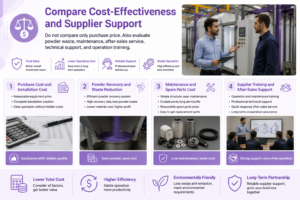
Designing Your Complete Surface Treatment System, Not Just Buying Equipment
This is where our approach differs most from how many companies think about dây chuyền sơn bộts. Most buyers focus on the spray booth and curing oven. They're important, certainly, but they're not the whole story.
We always recommend thinking of the system as pre-treatment → spray → cure → quality control, where each stage is equally critical.
Why Pre-Treatment is the Foundation of Coating Durability
Consider this: if your workpiece surface carries even trace amounts of oil, oxide, or contamination when it enters the spray booth, the powder won't bond properly. Later, when that coating faces humidity, thermal cycling, or chemical exposure, it will fail—peeling, blistering, or corroding from underneath.
Pre-treatment creates the chemical and mechanical foundation for adhesion. A proper conversion coating[^6] (phosphate layer on steel, or zirconium/aluminum-specific coating on aluminum) gives the powder something to anchor to.
In the projects we've consulted on, the facilities that invest in robust pre-treatment see:
- 15–30% improvement in adhesion test results
- Dramatically reduced field failures and warranty claims
- Better salt-spray and corrosion resistance data
- More consistent appearance and gloss levels
Yes, good pre-treatment adds cost—in chemicals, tank maintenance, water management, and space. But it's the only real guarantee of long-term coating performance.
Powder Recovery, Color-Change Efficiency, and Environmental Compliance
The spray booth doesn't just spray; it must also recover unused powder efficiently. Why? Because powder that misses the workpiece and is wasted costs money, and excessive powder release to air violates environmental regulations in most jurisdictions.
A well-designed recovery system (cyclone separator + secondary filtration) can recover 90%+ of overspray. That recovered powder can be reused, reducing material cost significantly over time.
cURL Too many subrequests by single Worker invocation. To configure this limit, refer to https://developers.cloudflare.com/workers/wrangler/configuration/#limits.
cURL Too many subrequests by single Worker invocation. To configure this limit, refer to https://developers.cloudflare.com/workers/wrangler/configuration/#limits.
cURL Too many subrequests by single Worker invocation. To configure this limit, refer to https://developers.cloudflare.com/workers/wrangler/configuration/#limits
cURL Too many subrequests by single Worker invocation. To configure this limit, refer to https://developers.cloudflare.com/workers/wrangler/configuration/#limits
- Visual inspection cURL Too many subrequests by single Worker invocation. To configure this limit, refer to https://developers.cloudflare.com/workers/wrangler/configuration/#limits
- cURL Too many subrequests by single Worker invocation. To configure this limit, refer to https://developers.cloudflare.com/workers/wrangler/configuration/#limits cURL Too many subrequests by single Worker invocation. To configure this limit, refer to https://developers.cloudflare.com/workers/wrangler/configuration/#limits
- Adhesion testing cURL Too many subrequests by single Worker invocation. To configure this limit, refer to https://developers.cloudflare.com/workers/wrangler/configuration/#limits
- cURL Too many subrequests by single Worker invocation. To configure this limit, refer to https://developers.cloudflare.com/workers/wrangler/configuration/#limits
cURL Too many subrequests by single Worker invocation. To configure this limit, refer to https://developers.cloudflare.com/workers/wrangler/configuration/#limits.
cURL Too many subrequests by single Worker invocation. To configure this limit, refer to https://developers.cloudflare.com/workers/wrangler/configuration/#limits
cURL Too many subrequests by single Worker invocation. To configure this limit, refer to https://developers.cloudflare.com/workers/wrangler/configuration/#limits.
cURL Too many subrequests by single Worker invocation. To configure this limit, refer to https://developers.cloudflare.com/workers/wrangler/configuration/#limits
cURL Too many subrequests by single Worker invocation. To configure this limit, refer to https://developers.cloudflare.com/workers/wrangler/configuration/#limits
- cURL Too many subrequests by single Worker invocation. To configure this limit, refer to https://developers.cloudflare.com/workers/wrangler/configuration/#limits cURL Too many subrequests by single Worker invocation. To configure this limit, refer to https://developers.cloudflare.com/workers/wrangler/configuration/#limits
- cURL Too many subrequests by single Worker invocation. To configure this limit, refer to https://developers.cloudflare.com/workers/wrangler/configuration/#limits cURL Too many subrequests by single Worker invocation. To configure this limit, refer to https://developers.cloudflare.com/workers/wrangler/configuration/#limits
- cURL Too many subrequests by single Worker invocation. To configure this limit, refer to https://developers.cloudflare.com/workers/wrangler/configuration/#limits cURL Too many subrequests by single Worker invocation. To configure this limit, refer to https://developers.cloudflare.com/workers/wrangler/configuration/#limits
- cURL Too many subrequests by single Worker invocation. To configure this limit, refer to https://developers.cloudflare.com/workers/wrangler/configuration/#limits cURL Too many subrequests by single Worker invocation. To configure this limit, refer to https://developers.cloudflare.com/workers/wrangler/configuration/#limits
- Quality control (how to recognize defects, when to stop and troubleshoot)
We recommend that operators receive formal training from the equipment manufacturer, not just informal on-the-job training. The difference in consistency and problem-solving speed is significant.
From our experience, a facility that invests in training early sees 30–40% fewer defects and rework in the first year of operation.
Critical Operating Parameters and Site Condition Stability
The parameters that operators adjust daily include:
- Điện áp và dòng điện của súng phun sương (affects powder transfer efficiency and edge coverage)
- Khoảng cách và góc phun sơn (affects uniformity and coating thickness)
- Tốc độ cấp phấn (too high = thick, uneven; too low = thin spots)
- Compressed air pressure and volume (affects atomization and flow)
- cURL Too many subrequests by single Worker invocation. To configure this limit, refer to https://developers.cloudflare.com/workers/wrangler/configuration/#limits (affects cure speed and final coating properties)
- Tốc độ băng chuyền (affects total spray time and oven residence time)
These aren't fire-and-forget settings. Environmental humidity, incoming workpiece cleanliness, oven wear, and seasonal temperature changes all influence optimal parameters.
Facilities that monitor and log these parameters daily are the ones that maintain consistent quality. Those that set parameters once and never adjust them see seasonal drift, operator variability, and progressive quality decline.
Environmental conditions also matter: humidity levels above 65% can cause powder to absorb moisture and lose static charge, reducing transfer efficiency. Extreme cold can slow curing. Dust contamination in the spray booth degrades surface finish. These are solvable problems, but they require active attention.
Preventive Maintenance and Troubleshooting Protocols
cURL Too many subrequests by single Worker invocation. To configure this limit, refer to https://developers.cloudflare.com/workers/wrangler/configuration/#limits
- Hàng ngày: Clean spray booth, inspect spray guns for powder buildup, check filter status
- Hàng tuần: Check conveyor alignment and chain tension, verify oven temperature accuracy, inspect compressed air system for leaks
- Hàng tháng: Replace spray gun electrodes if worn, flush pre-treatment tanks, deep-clean recovery system
- Hàng quý: Full system inspection, filter element replacement, electrical connection checks
Preventive maintenance prevents failures. Reactive maintenance—fixing things only when they break—leads to unexpected downtime, rushed repairs, and quality compromises.
Common problems and quick fixes:
- Poor coverage or edge effects: Usually grounding issue or spray gun distance/angle problem
- Thin coating: Conveyor speed too fast, spray pressure too low, or powder feed insufficient
- Orange-peel texture: Oven temperature too high, excessive powder thickness, or spray atomization not uniform
- Adhesion failures: Pre-treatment inadequate or oven cure time insufficient
Production Performance: Capacity, Quality Standards, and Cost Impact
Let's talk about what this investment actually delivers in terms of real-world numbers.
Throughput Calculation and Line Bottleneck Identification
Theoretical capacity depends on:
- Spray time per piece (how long each workpiece spends under the spray guns)
- Oven residence time (depends on coating thickness, curing temperature, and powder type)
- Workpiece handling time cURL Too many subrequests by single Worker invocation. To configure this limit, refer to https://developers.cloudflare.com/workers/wrangler/configuration/#limits
cURL Too many subrequests by single Worker invocation. To configure this limit, refer to https://developers.cloudflare.com/workers/wrangler/configuration/#limits.
cURL Too many subrequests by single Worker invocation. To configure this limit, refer to https://developers.cloudflare.com/workers/wrangler/configuration/#limits.
cURL Too many subrequests by single Worker invocation. To configure this limit, refer to https://developers.cloudflare.com/workers/wrangler/configuration/#limits
cURL Too many subrequests by single Worker invocation. To configure this limit, refer to https://developers.cloudflare.com/workers/wrangler/configuration/#limits
- Độ dày phimcURL Too many subrequests by single Worker invocation. To configure this limit, refer to https://developers.cloudflare.com/workers/wrangler/configuration/#limits
- DínhcURL Too many subrequests by single Worker invocation. To configure this limit, refer to https://developers.cloudflare.com/workers/wrangler/configuration/#limits
- Sự đồng đều bề mặtcURL Too many subrequests by single Worker invocation. To configure this limit, refer to https://developers.cloudflare.com/workers/wrangler/configuration/#limits
- cURL Too many subrequests by single Worker invocation. To configure this limit, refer to https://developers.cloudflare.com/workers/wrangler/configuration/#limitscURL Too many subrequests by single Worker invocation. To configure this limit, refer to https://developers.cloudflare.com/workers/wrangler/configuration/#limits
- Corrosion resistancecURL Too many subrequests by single Worker invocation. To configure this limit, refer to https://developers.cloudflare.com/workers/wrangler/configuration/#limits
cURL Too many subrequests by single Worker invocation. To configure this limit, refer to https://developers.cloudflare.com/workers/wrangler/configuration/#limits.
cURL Too many subrequests by single Worker invocation. To configure this limit, refer to https://developers.cloudflare.com/workers/wrangler/configuration/#limits
cURL Too many subrequests by single Worker invocation. To configure this limit, refer to https://developers.cloudflare.com/workers/wrangler/configuration/#limits
- Chi phí vật liệucURL Too many subrequests by single Worker invocation. To configure this limit, refer to https://developers.cloudflare.com/workers/wrangler/configuration/#limits
- Labor costcURL Too many subrequests by single Worker invocation. To configure this limit, refer to https://developers.cloudflare.com/workers/wrangler/configuration/#limits
- Chi phí năng lượngcURL Too many subrequests by single Worker invocation. To configure this limit, refer to https://developers.cloudflare.com/workers/wrangler/configuration/#limits
- Maintenance costcURL Too many subrequests by single Worker invocation. To configure this limit, refer to https://developers.cloudflare.com/workers/wrangler/configuration/#limits
cURL Too many subrequests by single Worker invocation. To configure this limit, refer to https://developers.cloudflare.com/workers/wrangler/configuration/#limits.
cURL Too many subrequests by single Worker invocation. To configure this limit, refer to https://developers.cloudflare.com/workers/wrangler/configuration/#limits
cURL Too many subrequests by single Worker invocation. To configure this limit, refer to https://developers.cloudflare.com/workers/wrangler/configuration/#limits.
cURL Too many subrequests by single Worker invocation. To configure this limit, refer to https://developers.cloudflare.com/workers/wrangler/configuration/#limits
When we commission a system, we don't just turn on the equipment and leave. Proper commissioning includes:
- Setting baseline parameters for your specific workpiece and production requirements
- Training your team on daily operation and troubleshooting
- Documenting all parameters and procedures
- Running test production and validating quality against your specifications
- Establishing preventive maintenance protocols specific to your facility
This typically takes 1–2 weeks for a new system. A supplier who rushes this step or provides minimal support is setting you up for problems.
We've also seen situations where a facility buys equipment, tries to commission it themselves without manufacturer support, struggles for months, and then blames the equipment. Often the issue was correctable with proper guidance.
Configuration Mismatches and How to Avoid Them
This is where our view differs most from standard industry practice. Most customers choose equipment based primarily on price and headline specifications. We recommend instead choosing based on match to your specific requirements.
For example:
- A facility processing small metal brackets should not choose the same spray booth as one processing large cabinet frames. Spray gun layout, conveyor speed range, and recovery efficiency are all different.
- An operation needing frequent color changes needs different powder supply and recovery architecture than one running single-color batches.
- A facility requiring very high thickness or complex geometry coverage needs a different gun configuration and spray strategy than one processing flat, simple parts.
Before you specify and purchase, have the supplier conduct a detailed evaluation of your products, volumes, quality requirements, and facility conditions. If they don't ask these questions, be cautious.
We've also seen facilities install equipment that was over-specified—too large, too fast, too automated—for their actual needs. This is wasteful. Conversely, we've seen under-specified equipment that can never deliver required capacity or quality. Right-sizing matters.
Long-Term Performance Optimization and ROI Realization
After the first 3–6 months of operation, you should review:
- Actual throughput vs. projected: Did you hit capacity targets?
- Quality consistency: Are adhesion, thickness, and appearance consistently meeting spec?
- Defect rate and rework rate: What percentage of parts need rework?
- Chi phí mỗi đơn vị: How does actual cost compare to your budget?
- Maintenance requirements: Are you seeing unexpected failures or excessive wear?
If performance is below target, work with your supplier and your internal team to diagnose. Common issues:
- Parameter drift from poor documentation or operator variation
- Equipment wear or degradation requiring adjustment
- Process changes needed based on production learning
- Facility conditions (humidity, temperature, compressed air quality) affecting performance
The ROI from a hệ thống sơn tĩnh điện dạng bột comes from:
- Quality improvement (fewer field failures, higher customer satisfaction)
- Efficiency gain (higher throughput, lower labor per unit)
- Cost reduction (material recovery, energy efficiency, less rework)
cURL Too many subrequests by single Worker invocation. To configure this limit, refer to https://developers.cloudflare.com/workers/wrangler/configuration/#limits.

cURL Too many subrequests by single Worker invocation. To configure this limit, refer to https://developers.cloudflare.com/workers/wrangler/configuration/#limits
cURL Too many subrequests by single Worker invocation. To configure this limit, refer to https://developers.cloudflare.com/workers/wrangler/configuration/#limits.
| Loại hệ thống | cURL Too many subrequests by single Worker invocation. To configure this limit, refer to https://developers.cloudflare.com/workers/wrangler/configuration/#limits | cURL Too many subrequests by single Worker invocation. To configure this limit, refer to https://developers.cloudflare.com/workers/wrangler/configuration/#limits | Độ nhất quán | Thông lượng | Chi phí vốn | Phù hợp nhất cho |
|---|---|---|---|---|---|---|
| cURL Too many subrequests by single Worker invocation. To configure this limit, refer to https://developers.cloudflare.com/workers/wrangler/configuration/#limits | cURL Too many subrequests by single Worker invocation. To configure this limit, refer to https://developers.cloudflare.com/workers/wrangler/configuration/#limits | cURL Too many subrequests by single Worker invocation. To configure this limit, refer to https://developers.cloudflare.com/workers/wrangler/configuration/#limits | cURL Too many subrequests by single Worker invocation. To configure this limit, refer to https://developers.cloudflare.com/workers/wrangler/configuration/#limits | cURL Too many subrequests by single Worker invocation. To configure this limit, refer to https://developers.cloudflare.com/workers/wrangler/configuration/#limits | cURL Too many subrequests by single Worker invocation. To configure this limit, refer to https://developers.cloudflare.com/workers/wrangler/configuration/#limits | cURL Too many subrequests by single Worker invocation. To configure this limit, refer to https://developers.cloudflare.com/workers/wrangler/configuration/#limits |
| cURL Too many subrequests by single Worker invocation. To configure this limit, refer to https://developers.cloudflare.com/workers/wrangler/configuration/#limits | cURL Too many subrequests by single Worker invocation. To configure this limit, refer to https://developers.cloudflare.com/workers/wrangler/configuration/#limits | cURL Too many subrequests by single Worker invocation. To configure this limit, refer to https://developers.cloudflare.com/workers/wrangler/configuration/#limits | cURL Too many subrequests by single Worker invocation. To configure this limit, refer to https://developers.cloudflare.com/workers/wrangler/configuration/#limits | cURL Too many subrequests by single Worker invocation. To configure this limit, refer to https://developers.cloudflare.com/workers/wrangler/configuration/#limits | cURL Too many subrequests by single Worker invocation. To configure this limit, refer to https://developers.cloudflare.com/workers/wrangler/configuration/#limits | cURL Too many subrequests by single Worker invocation. To configure this limit, refer to https://developers.cloudflare.com/workers/wrangler/configuration/#limits |
| cURL Too many subrequests by single Worker invocation. To configure this limit, refer to https://developers.cloudflare.com/workers/wrangler/configuration/#limits | cURL Too many subrequests by single Worker invocation. To configure this limit, refer to https://developers.cloudflare.com/workers/wrangler/configuration/#limits | cURL Too many subrequests by single Worker invocation. To configure this limit, refer to https://developers.cloudflare.com/workers/wrangler/configuration/#limits | cURL Too many subrequests by single Worker invocation. To configure this limit, refer to https://developers.cloudflare.com/workers/wrangler/configuration/#limits | 60–300+ pieces/hour | High ($300K–1M+) | High volume, complex geometry, tight quality spec |
The choice depends on your volume, complexity, quality requirements, and budget. Overautomating a low-volume operation wastes capital. Under-automating a high-volume operation leaves efficiency gains on the table.
Conclusion: Making the Application Work for Your Operation
Applying electrostatic powder spray coating equipment successfully isn't complicated, but it does require attention to detail, proper planning, and realistic expectations about what gets applied when.
The core truth we see consistently: facilities that treat this as a system—pre-treatment + spray + cure + quality + training + maintenance as an integrated whole—succeed. Facilities that treat it as "install the spray booth and hope for the best" struggle.
Before you finalize your purchase, ensure:
- Your products are genuinely suitable for powder coating
- Your facility can meet utility and infrastructure requirements
- Pre-treatment is configured properly for your material type
- Equipment is sized appropriately for your actual volume and geometry
- Your team receives proper training and support
- You have realistic timelines for reaching steady-state performance
The payoff is real: uniform, durable coatings; consistent quality; reduced rework; and long-term cost advantages. But these results come from doing the application right, not just from having good equipment.
If you're evaluating options or have specific questions about whether powder coating fits your operation, we'd welcome a conversation. Our experience across different product types, volumes, and manufacturing environments often reveals possibilities—or barriers—that aren't obvious from specification sheets alone.
Contact us to discuss your specific application:
WhatsApp: +8618064668879
Email: ketucoatingline@gmail.com
We're happy to walk through your products, facility, and requirements to help you determine the right approach.
[^1]: Wikipedia article covering the fundamentals, history, and industrial applications of powder coating technology and processes.
[^2]: ISO 60819 standard specifying measurement and evaluation methods for powder coating transfer efficiency and material utilization rates.
[^3]: Wikipedia entry explaining volatile organic compounds, their environmental impact, and why zero VOC emission during spraying is an advantage of powder coating over liquid methods.
[^4]: Wikipedia explanation of the Faraday cage effect and how electrical field line behavior affects powder coating coverage in enclosed or complex geometries.
[^5]: Wikipedia resource on compressed air systems, quality requirements, production methods, and applications in industrial manufacturing and coating processes.
[^6]: Wikipedia article describing conversion coating processes including phosphatizing and zirconium treatments that form protective chemical layers on metal surfaces before powder coating application.
 Vietnamese
  English
  German
  French