

KetuTechnology After-Sales Support: Systematic Diagnosis and Solutions for Common Electrostatic Spraying Process Issues
When you're running an electrostatic powder When you're running an electrostatic powder coating line, surface defects can appear suddenly and frustrate your entire production schedule. Pinholes, poor adhesion, uneven film thickness, color deviations—these issues look simple on the surface but often reveal deeper system problems. From my experience working with cabinet manufacturers, furniture producers, and aluminum profile makers across multiple countries, I've learned that 70% of visible coating defects actually originate in stages most operators overlook or misdiagnose.
This is where structured troubleshooting becomes critical. Rather than randomly adjusting spray gun voltage or blaming powder quality, I'll walk you through the systematic diagnostic approach we've developed at Ketu—one that helps our after-sales team and client technicians identify root causes quickly and fix them permanently.
Why Pre-Treatment Failures Account for 70% of Electrostatic Spraying Defects
In our after-sales visits across cabinet factories in Algeria, furniture plants in Turkey, and aluminum mills in India, I've observed a consistent pattern: when operators encounter coating problems, their first instinct is usually to adjust the spray gun. But when we dig deeper, nearly 7 out of 10 times the real issue started in the pre-treatment stage.
The Root Cause Reality
Pre-treatment is not just a "preparatory step." It's the foundation on which everything else depends. If this stage fails, no adjustment to spray parameters or curing temperature will reliably restore quality. Here's what typically goes wrong:
| Pre-Treatment Issue | Resulting Defect | Why It's Hard to Spot |
|---|---|---|
| Oil residue on surface | Pinholes, crawling, poor adhesion | Defects appear random; only visible after coating hardens |
| Incomplete rust removal | Spot corrosion, layer separation | Develops over weeks or months; looks fine initially |
| cURL Too many subrequests by single Worker invocation. To configure this limit, refer to https://developers.cloudflare.com/workers/wrangler/configuration/#limits | Blister formation, delamination | Salt is invisible; only shows after exposure |
| cURL Too many subrequests by single Worker invocation. To configure this limit, refer to https://developers.cloudflare.com/workers/wrangler/configuration/#limits | Pinholes, shrinkage, gas bubbles | Moisture evaporates during curing, leaving voids |
| Wrong phosphate thickness | Weak adhesion layer, salt fog failure | Affects long-term performance, not immediate appearance |
What We've Learned
Based on hundreds of line commissionings, when I systematically strengthen pre-treatment control—verifying degreasing concentration, temperature, spray pressure, immersion time, and especially drying completeness—surface defect rates typically drop by 40–60%. This alone often resolves adhesion issues that clients initially attributed to powder quality or electrostatic voltage problems.
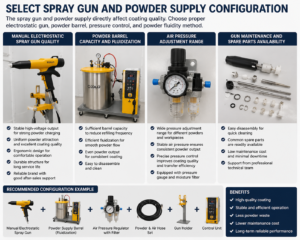
Pre-Treatment Control Checklist
Before you touch spray parameters, verify:
- Degreasing stage: Solution pH within range, temperature stable (typically 50–70°C), spray pressure 2–4 bar, contact time 1–3 minutes minimum
- Rinsing sequence: Each rinse should be visibly clean; if water beads up rather than spreading, incomplete degreasing
- Phosphate/conversion coating: Layer thickness 10–25 g/m² (target your material type); dwell time adequate for reaction
- Xả cuối cùng: Use demineralized or DI water[^1] if possible; tap water minerals can leave residue
- Sấy khô: Measure workpiece surface temperature—it must reach 50°C+ to drive off all moisture. Cold spots = moisture traps
Systematic Troubleshooting: How to Diagnose Surface Defects Like Pinholes, Shrinkage, and Poor Adhesion
I've learned to diagnose coating defects using a structured sequence rather than guessing. This approach works whether you're troubleshooting offline or performing live line diagnostics.
cURL Too many subrequests by single Worker invocation. To configure this limit, refer to https://developers.cloudflare.com/workers/wrangler/configuration/#limits
cURL Too many subrequests by single Worker invocation. To configure this limit, refer to https://developers.cloudflare.com/workers/wrangler/configuration/#limits
cURL Too many subrequests by single Worker invocation. To configure this limit, refer to https://developers.cloudflare.com/workers/wrangler/configuration/#limitscURL Too many subrequests by single Worker invocation. To configure this limit, refer to https://developers.cloudflare.com/workers/wrangler/configuration/#limits.
cURL Too many subrequests by single Worker invocation. To configure this limit, refer to https://developers.cloudflare.com/workers/wrangler/configuration/#limits cURL Too many subrequests by single Worker invocation. To configure this limit, refer to https://developers.cloudflare.com/workers/wrangler/configuration/#limits
- cURL Too many subrequests by single Worker invocation. To configure this limit, refer to https://developers.cloudflare.com/workers/wrangler/configuration/#limits
- cURL Too many subrequests by single Worker invocation. To configure this limit, refer to https://developers.cloudflare.com/workers/wrangler/configuration/#limits compressed aircURL Too many subrequests by single Worker invocation. To configure this limit, refer to https://developers.cloudflare.com/workers/wrangler/configuration/#limits
- cURL Too many subrequests by single Worker invocation. To configure this limit, refer to https://developers.cloudflare.com/workers/wrangler/configuration/#limits
- cURL Too many subrequests by single Worker invocation. To configure this limit, refer to https://developers.cloudflare.com/workers/wrangler/configuration/#limits
cURL Too many subrequests by single Worker invocation. To configure this limit, refer to https://developers.cloudflare.com/workers/wrangler/configuration/#limits:
- cURL Too many subrequests by single Worker invocation. To configure this limit, refer to https://developers.cloudflare.com/workers/wrangler/configuration/#limits
- cURL Too many subrequests by single Worker invocation. To configure this limit, refer to https://developers.cloudflare.com/workers/wrangler/configuration/#limits
- cURL Too many subrequests by single Worker invocation. To configure this limit, refer to https://developers.cloudflare.com/workers/wrangler/configuration/#limits
- cURL Too many subrequests by single Worker invocation. To configure this limit, refer to https://developers.cloudflare.com/workers/wrangler/configuration/#limits
cURL Too many subrequests by single Worker invocation. To configure this limit, refer to https://developers.cloudflare.com/workers/wrangler/configuration/#limits
cURL Too many subrequests by single Worker invocation. To configure this limit, refer to https://developers.cloudflare.com/workers/wrangler/configuration/#limitscURL Too many subrequests by single Worker invocation. To configure this limit, refer to https://developers.cloudflare.com/workers/wrangler/configuration/#limits.
cURL Too many subrequests by single Worker invocation. To configure this limit, refer to https://developers.cloudflare.com/workers/wrangler/configuration/#limits:
- cURL Too many subrequests by single Worker invocation. To configure this limit, refer to https://developers.cloudflare.com/workers/wrangler/configuration/#limits
- cURL Too many subrequests by single Worker invocation. To configure this limit, refer to https://developers.cloudflare.com/workers/wrangler/configuration/#limits
- cURL Too many subrequests by single Worker invocation. To configure this limit, refer to https://developers.cloudflare.com/workers/wrangler/configuration/#limits
- cURL Too many subrequests by single Worker invocation. To configure this limit, refer to https://developers.cloudflare.com/workers/wrangler/configuration/#limits
cURL Too many subrequests by single Worker invocation. To configure this limit, refer to https://developers.cloudflare.com/workers/wrangler/configuration/#limits:
- Wipe test: Clean a sample area with isopropyl alcohol; if defects persist, it's not surface contamination
- Check curing temperature profile—is the workpiece reaching target temperature across all surfaces?
- Inspect spray room air; visible dust clouds indicate air quality issues
- Reduce spray gun voltage slightly; sometimes over-charging causes powder instability
Poor Adhesion and Delamination
cURL Too many subrequests by single Worker invocation. To configure this limit, refer to https://developers.cloudflare.com/workers/wrangler/configuration/#limits: Coating separates from substrate under mechanical stress (tape test, bend test, or spontaneous flaking at edges). Failure typically happens along a clear interface.
cURL Too many subrequests by single Worker invocation. To configure this limit, refer to https://developers.cloudflare.com/workers/wrangler/configuration/#limits:
- Pre-treatment inadequate (most common in our experience)
- Fixturing or electrode contact points corroded or contaminated
- Workpiece grounding intermittent during spray cycle
- Curing incomplete or parameters incorrect
- Substrate contamination after pre-treatment but before coating
cURL Too many subrequests by single Worker invocation. To configure this limit, refer to https://developers.cloudflare.com/workers/wrangler/configuration/#limits:
- Perform pull-off adhesion testing (ASTM D4541[^3] standard): coating should not separate at <5 MPa
- Check grounding path: measure electrical resistance from workpiece to ground—should be <1 ohm
- Inspect electrodes and contact points for oxidation or powder buildup; clean if necessary
- Review pre-treatment parameters; if recently changed, revert and compare results
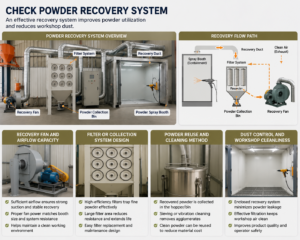
Parameter Adjustment Sequence and Verification Method
Once you've identified the likely defect category, adjust parameters in this specific order. This sequence minimizes trial-and-error and helps isolate which parameter actually caused the improvement.
Step 1: Verify and Correct Grounding
Before changing anything else, confirm workpiece grounding is reliable.
- Clean all contact points (electrode, hanging fixture, product-to-fixture contact)
- Measure grounding resistance; if >1 ohm, improve contact or clean oxidation
- Verify grounding cable is intact and not kinked
Why first? Grounding failures disrupt the entire electrostatic charge transfer. No other adjustment matters if charge can't reach the workpiece.
Step 2: Stabilize Line Speed
Check conveyor speed consistency; even ±10% variation causes membrane thickness fluctuation.
- Run a full cycle with marked workpieces; measure spacing—should be uniform
- Verify timing between workpiece position and spray gun activation—tolerance within 100 ms
- If speed fluctuates, check drive motor, belts, and sensor calibration
Why second? Line speed directly governs spray dwell time and powder transfer time. Inconsistent speed creates coating thickness scatter before spray parameters even factor in.
Step 3: Adjust Spray Gun Parameters (in this order)
3a. Spray Gun Voltage & Current
- Start at manufacturer recommendation (typically 60–90 kV for most systems)
- If film looks thin or uneven, increase voltage incrementally by 5 kV
- Monitor current output; should remain within 10–20 μA range
- If current spikes >20 μA, reduce voltage slightly—indicates overstressing
cURL Too many subrequests by single Worker invocation. To configure this limit, refer to https://developers.cloudflare.com/workers/wrangler/configuration/#limits
- cURL Too many subrequests by single Worker invocation. To configure this limit, refer to https://developers.cloudflare.com/workers/wrangler/configuration/#limits
- cURL Too many subrequests by single Worker invocation. To configure this limit, refer to https://developers.cloudflare.com/workers/wrangler/configuration/#limits
- cURL Too many subrequests by single Worker invocation. To configure this limit, refer to https://developers.cloudflare.com/workers/wrangler/configuration/#limits
- cURL Too many subrequests by single Worker invocation. To configure this limit, refer to https://developers.cloudflare.com/workers/wrangler/configuration/#limits
cURL Too many subrequests by single Worker invocation. To configure this limit, refer to https://developers.cloudflare.com/workers/wrangler/configuration/#limits
- cURL Too many subrequests by single Worker invocation. To configure this limit, refer to https://developers.cloudflare.com/workers/wrangler/configuration/#limits
- cURL Too many subrequests by single Worker invocation. To configure this limit, refer to https://developers.cloudflare.com/workers/wrangler/configuration/#limits
- cURL Too many subrequests by single Worker invocation. To configure this limit, refer to https://developers.cloudflare.com/workers/wrangler/configuration/#limits
cURL Too many subrequests by single Worker invocation. To configure this limit, refer to https://developers.cloudflare.com/workers/wrangler/configuration/#limits
- cURL Too many subrequests by single Worker invocation. To configure this limit, refer to https://developers.cloudflare.com/workers/wrangler/configuration/#limits
- cURL Too many subrequests by single Worker invocation. To configure this limit, refer to https://developers.cloudflare.com/workers/wrangler/configuration/#limits
- cURL Too many subrequests by single Worker invocation. To configure this limit, refer to https://developers.cloudflare.com/workers/wrangler/configuration/#limits
cURL Too many subrequests by single Worker invocation. To configure this limit, refer to https://developers.cloudflare.com/workers/wrangler/configuration/#limitscURL Too many subrequests by single Worker invocation. To configure this limit, refer to https://developers.cloudflare.com/workers/wrangler/configuration/#limits.
cURL Too many subrequests by single Worker invocation. To configure this limit, refer to https://developers.cloudflare.com/workers/wrangler/configuration/#limits
cURL Too many subrequests by single Worker invocation. To configure this limit, refer to https://developers.cloudflare.com/workers/wrangler/configuration/#limits Lồng FaradaycURL Too many subrequests by single Worker invocation. To configure this limit, refer to https://developers.cloudflare.com/workers/wrangler/configuration/#limits.
cURL Too many subrequests by single Worker invocation. To configure this limit, refer to https://developers.cloudflare.com/workers/wrangler/configuration/#limits
cURL Too many subrequests by single Worker invocation. To configure this limit, refer to https://developers.cloudflare.com/workers/wrangler/configuration/#limits.
cURL Too many subrequests by single Worker invocation. To configure this limit, refer to https://developers.cloudflare.com/workers/wrangler/configuration/#limits:
| cURL Too many subrequests by single Worker invocation. To configure this limit, refer to https://developers.cloudflare.com/workers/wrangler/configuration/#limits | Faraday Effect Severity | Typical Under-Coated Area |
|---|---|---|
| Deep boxes, enclosures | Cao | Interior surfaces, recessed edges |
| Channels and slots | Trung bình-Cao | Bottom of slot, internal corners |
| Holes and perforations | Trung bình | Hole interior edges |
| Shallow recesses | Thấp-Trung bình | Recessed floor |
| Flat surfaces | cURL Too many subrequests by single Worker invocation. To configure this limit, refer to https://developers.cloudflare.com/workers/wrangler/configuration/#limits | Không áp dụng |
In our cabinet and aluminum profile projects, the Faraday cage effect typically causes 15–40% film thickness reduction in affected internal areas—enough to compromise adhesion and corrosion resistance.
Low-Voltage Multi-Pass Strategy vs. High-Voltage Single-Pass Trade-Offs
Rather than cranking voltage to compensate (which causes edge overspray and waste), we employ multi-pass or geometry-adapted techniques.
Strategy 1: Lower Voltage + Multi-Pass Spray
Phương pháp:
- Reduce spray gun voltage to 50–60 kV (lower than standard)
- Spray the workpiece once from primary angle
- Rotate workpiece or adjust part position
- Spray again from secondary angle (45° offset or perpendicular)
Ưu điểm:
- Powder settles gently; less bounce-back and waste
- Complex areas receive powder from multiple approach vectors
- More uniform final thickness, including internal surfaces
- Typically 15–25% improvement in internal area coating
Nhược điểm:
- Requires 2x spray time per workpiece
- Reduces line throughput by ~40%
Strategy 2: Single-Pass High Voltage + Geometry Workaround
Phương pháp:
- Maintain standard voltage (70–85 kV)
- Reposition spray gun or workpiece jig to approach cavity from optimal angle
- Example: for a box with deep internal cavity, position gun 30° off-perpendicular to direct powder toward cavity opening
Ưu điểm:
- Single pass; no throughput penalty
- Uses existing line infrastructure
Nhược điểm:
- External edges risk overcoverage and waste
- May not fully penetrate very deep cavities
Our Recommended Hybrid Approach (based on hundreds of line tests):
For workpieces with moderate Faraday cage risk:
- Spray at 65–70 kV (slightly lower than maximum)
- Adjust gun angle or part rotation to favor cavity entry
- cURL Too many subrequests by single Worker invocation. To configure this limit, refer to https://developers.cloudflare.com/workers/wrangler/configuration/#limits
- cURL Too many subrequests by single Worker invocation. To configure this limit, refer to https://developers.cloudflare.com/workers/wrangler/configuration/#limits
cURL Too many subrequests by single Worker invocation. To configure this limit, refer to https://developers.cloudflare.com/workers/wrangler/configuration/#limits.
cURL Too many subrequests by single Worker invocation. To configure this limit, refer to https://developers.cloudflare.com/workers/wrangler/configuration/#limits
cURL Too many subrequests by single Worker invocation. To configure this limit, refer to https://developers.cloudflare.com/workers/wrangler/configuration/#limits.
cURL Too many subrequests by single Worker invocation. To configure this limit, refer to https://developers.cloudflare.com/workers/wrangler/configuration/#limits
cURL Too many subrequests by single Worker invocation. To configure this limit, refer to https://developers.cloudflare.com/workers/wrangler/configuration/#limits cURL Too many subrequests by single Worker invocation. To configure this limit, refer to https://developers.cloudflare.com/workers/wrangler/configuration/#limits
cURL Too many subrequests by single Worker invocation. To configure this limit, refer to https://developers.cloudflare.com/workers/wrangler/configuration/#limitscURL Too many subrequests by single Worker invocation. To configure this limit, refer to https://developers.cloudflare.com/workers/wrangler/configuration/#limits.
cURL Too many subrequests by single Worker invocation. To configure this limit, refer to https://developers.cloudflare.com/workers/wrangler/configuration/#limits:
- cURL Too many subrequests by single Worker invocation. To configure this limit, refer to https://developers.cloudflare.com/workers/wrangler/configuration/#limits
- cURL Too many subrequests by single Worker invocation. To configure this limit, refer to https://developers.cloudflare.com/workers/wrangler/configuration/#limits
- cURL Too many subrequests by single Worker invocation. To configure this limit, refer to https://developers.cloudflare.com/workers/wrangler/configuration/#limits
cURL Too many subrequests by single Worker invocation. To configure this limit, refer to https://developers.cloudflare.com/workers/wrangler/configuration/#limits:
- cURL Too many subrequests by single Worker invocation. To configure this limit, refer to https://developers.cloudflare.com/workers/wrangler/configuration/#limits
- cURL Too many subrequests by single Worker invocation. To configure this limit, refer to https://developers.cloudflare.com/workers/wrangler/configuration/#limits
- cURL Too many subrequests by single Worker invocation. To configure this limit, refer to https://developers.cloudflare.com/workers/wrangler/configuration/#limits
Oil Contamination cURL Too many subrequests by single Worker invocation. To configure this limit, refer to https://developers.cloudflare.com/workers/wrangler/configuration/#limits
cURL Too many subrequests by single Worker invocation. To configure this limit, refer to https://developers.cloudflare.com/workers/wrangler/configuration/#limitscURL Too many subrequests by single Worker invocation. To configure this limit, refer to https://developers.cloudflare.com/workers/wrangler/configuration/#limits.
cURL Too many subrequests by single Worker invocation. To configure this limit, refer to https://developers.cloudflare.com/workers/wrangler/configuration/#limits:
- cURL Too many subrequests by single Worker invocation. To configure this limit, refer to https://developers.cloudflare.com/workers/wrangler/configuration/#limits
- cURL Too many subrequests by single Worker invocation. To configure this limit, refer to https://developers.cloudflare.com/workers/wrangler/configuration/#limits
- If severe, visible greasy sheen on powder before spray
cURL Too many subrequests by single Worker invocation. To configure this limit, refer to https://developers.cloudflare.com/workers/wrangler/configuration/#limits:
- Run compressed air into a clean glass container for 1 minute
- If oily film coats container interior, oil contamination confirmed
Particulate Contamination (Dust and Scale)
cURL Too many subrequests by single Worker invocation. To configure this limit, refer to https://developers.cloudflare.com/workers/wrangler/configuration/#limits: Compressor internal corrosion, pipe scale from rusty lines, or external dust entering through intake.
cURL Too many subrequests by single Worker invocation. To configure this limit, refer to https://developers.cloudflare.com/workers/wrangler/configuration/#limits:
- Visible specks or grit on powder coating
- Powder doesn't flow smoothly; jamming in supply lines
- Supply tube blockages every few shifts
cURL Too many subrequests by single Worker invocation. To configure this limit, refer to https://developers.cloudflare.com/workers/wrangler/configuration/#limits:
- Inspect compressed air outlet with a white tissue; trapped particles visible immediately
Air Treatment System Setup and Maintenance Standards
For reliable electrostatic powder coating, I recommend this three-stage air treatment[^5] architecture:
Stage 1: Moisture Removal
Equipment: Refrigerated dryer or desiccant dryer
Target specification: Dew point -20°C or lower
- Refrigerated dryer: Simpler, lower initial cost; adequate for most production environments
- Desiccant dryer: Better dew point; preferred for high-humidity climates or continuous 24/7 operation
Maintenance: Drain moisture trap daily; check/replace dryer cartridge per manufacturer interval (typically every 6–12 months)
Stage 2: Coarse Filtration
Equipment: Inline particulate filter, 10–25 micron rating
Pressure drop budget: <0.2 bar
Maintenance: Check filter element weekly; replace when pressure differential exceeds manufacturer spec (typically 0.5–1.0 bar). Clogged filters reduce air supply velocity, affecting powder flow consistency.
Stage 3: Fine Filtration + Oil Removal
Equipment: Combination filter, 3–5 micron, with activated carbon or coalescing stage
Pressure drop budget: <0.1 bar
Maintenance: Replace filter cartridge every 3–6 months, depending on shop air quality; inspect monthly.
Maintenance Schedule (Ketu Standard):
| cURL Too many subrequests by single Worker invocation. To configure this limit, refer to https://developers.cloudflare.com/workers/wrangler/configuration/#limits | Tần suất | Who |
|---|---|---|
| Drain moisture trap | Daily (end of shift) | Line operator |
| Visually inspect dryer function | Hàng tuần | Kỹ thuật viên bảo trì |
| Check filter pressure differential | Hàng tuần | Kỹ thuật viên bảo trì |
| Replace coarse filter element | Every 6 months or when ΔP >0.5 bar | Kỹ thuật viên bảo trì |
| cURL Too many subrequests by single Worker invocation. To configure this limit, refer to https://developers.cloudflare.com/workers/wrangler/configuration/#limits | cURL Too many subrequests by single Worker invocation. To configure this limit, refer to https://developers.cloudflare.com/workers/wrangler/configuration/#limits | Kỹ thuật viên bảo trì |
| cURL Too many subrequests by single Worker invocation. To configure this limit, refer to https://developers.cloudflare.com/workers/wrangler/configuration/#limits | cURL Too many subrequests by single Worker invocation. To configure this limit, refer to https://developers.cloudflare.com/workers/wrangler/configuration/#limits | cURL Too many subrequests by single Worker invocation. To configure this limit, refer to https://developers.cloudflare.com/workers/wrangler/configuration/#limits |
Ảnh hưởng thực tếcURL Too many subrequests by single Worker invocation. To configure this limit, refer to https://developers.cloudflare.com/workers/wrangler/configuration/#limits.
cURL Too many subrequests by single Worker invocation. To configure this limit, refer to https://developers.cloudflare.com/workers/wrangler/configuration/#limits
cURL Too many subrequests by single Worker invocation. To configure this limit, refer to https://developers.cloudflare.com/workers/wrangler/configuration/#limits.
cURL Too many subrequests by single Worker invocation. To configure this limit, refer to https://developers.cloudflare.com/workers/wrangler/configuration/#limits
cURL Too many subrequests by single Worker invocation. To configure this limit, refer to https://developers.cloudflare.com/workers/wrangler/configuration/#limits
cURL Too many subrequests by single Worker invocation. To configure this limit, refer to https://developers.cloudflare.com/workers/wrangler/configuration/#limits
- cURL Too many subrequests by single Worker invocation. To configure this limit, refer to https://developers.cloudflare.com/workers/wrangler/configuration/#limits
- cURL Too many subrequests by single Worker invocation. To configure this limit, refer to https://developers.cloudflare.com/workers/wrangler/configuration/#limits
- cURL Too many subrequests by single Worker invocation. To configure this limit, refer to https://developers.cloudflare.com/workers/wrangler/configuration/#limits
cURL Too many subrequests by single Worker invocation. To configure this limit, refer to https://developers.cloudflare.com/workers/wrangler/configuration/#limits
cURL Too many subrequests by single Worker invocation. To configure this limit, refer to https://developers.cloudflare.com/workers/wrangler/configuration/#limits
- cURL Too many subrequests by single Worker invocation. To configure this limit, refer to https://developers.cloudflare.com/workers/wrangler/configuration/#limits
- cURL Too many subrequests by single Worker invocation. To configure this limit, refer to https://developers.cloudflare.com/workers/wrangler/configuration/#limits
- cURL Too many subrequests by single Worker invocation. To configure this limit, refer to https://developers.cloudflare.com/workers/wrangler/configuration/#limits
cURL Too many subrequests by single Worker invocation. To configure this limit, refer to https://developers.cloudflare.com/workers/wrangler/configuration/#limits
cURL Too many subrequests by single Worker invocation. To configure this limit, refer to https://developers.cloudflare.com/workers/wrangler/configuration/#limits
- cURL Too many subrequests by single Worker invocation. To configure this limit, refer to https://developers.cloudflare.com/workers/wrangler/configuration/#limits
- Test with marked samples; mark should be visible on every piece at the same position
- Timing drift >50 ms causes some pieces to receive under-spray, others over-spray
Phase 4: Hanging Density and Geometry Consistency
Workpiece placement affects local spray coverage:
- Ensure pieces hang at identical vertical height; height variance >25 mm can shift effective spray distance
- Confirm pieces don't touch or nest during spray; contact prevents powder access to hidden areas
- Verify jig orientation is consistent; rotated jigs change angle relative to spray direction
Real-Time Monitoring and Quick-Fix Adjustments
Rather than waiting for offline testing, implement live thickness monitoring:
On-Line Measurement Approach:
- Measure every 10th workpiece with a portable coating thickness gauge immediately after spray room exit (before curing)
- Record in simple spreadsheet: Piece #, Center thickness, Corner thickness, Time
- Alert threshold: If any single piece >15 μm or <50 μm from target, stop line and diagnose before next batch
Quick-Fix Decision Tree:
| Observed Pattern | Nguyên nhân có khả năng | Sửa chữa nhanh |
|---|---|---|
| All pieces thin uniformly | Powder supply too low or voltage too low | Increase powder flow by 5–10%; verify supply hopper isn't low |
| All pieces thick uniformly | Powder supply too high | Reduce powder flow; check line speed hasn't slowed |
| Thick at entry, thin at exit | Line speed drifting (accelerating) or gun voltage drifting | Check tachometer; verify PLC spray timing hasn't shifted |
| Thin at corners/edges, thick at center | Spray distance too far or gun angle not optimal | Reduce spray distance 25 mm; adjust gun angle to center corners |
| Sporadic thin spots | Workpiece geometry variance or jig contact issues | Inspect jig fitment; ensure workpieces aren't touching |
Curing Status Diagnosis: Distinguishing Under-Curing from Over-Curing
Curing problems are often mistaken for pre-coating defects. I've seen customers repeatedly adjust spray parameters when the real issue was in the oven. Systematic curing diagnosis saves weeks of frustration.
Visual and Tactile Indicators for Each Condition
Under-Curing Signs:
Quan sát:
- Coating appears dull, lacks gloss
- cURL Too many subrequests by single Worker invocation. To configure this limit, refer to https://developers.cloudflare.com/workers/wrangler/configuration/#limits
- cURL Too many subrequests by single Worker invocation. To configure this limit, refer to https://developers.cloudflare.com/workers/wrangler/configuration/#limits
- Thất bại cURL Too many subrequests by single Worker invocation. To configure this limit, refer to https://developers.cloudflare.com/workers/wrangler/configuration/#limitscURL Too many subrequests by single Worker invocation. To configure this limit, refer to https://developers.cloudflare.com/workers/wrangler/configuration/#limits
cURL Too many subrequests by single Worker invocation. To configure this limit, refer to https://developers.cloudflare.com/workers/wrangler/configuration/#limits
- cURL Too many subrequests by single Worker invocation. To configure this limit, refer to https://developers.cloudflare.com/workers/wrangler/configuration/#limits
- cURL Too many subrequests by single Worker invocation. To configure this limit, refer to https://developers.cloudflare.com/workers/wrangler/configuration/#limits
cURL Too many subrequests by single Worker invocation. To configure this limit, refer to https://developers.cloudflare.com/workers/wrangler/configuration/#limits:
Quan sát:
- cURL Too many subrequests by single Worker invocation. To configure this limit, refer to https://developers.cloudflare.com/workers/wrangler/configuration/#limits
- cURL Too many subrequests by single Worker invocation. To configure this limit, refer to https://developers.cloudflare.com/workers/wrangler/configuration/#limits
- cURL Too many subrequests by single Worker invocation. To configure this limit, refer to https://developers.cloudflare.com/workers/wrangler/configuration/#limits
- cURL Too many subrequests by single Worker invocation. To configure this limit, refer to https://developers.cloudflare.com/workers/wrangler/configuration/#limits
cURL Too many subrequests by single Worker invocation. To configure this limit, refer to https://developers.cloudflare.com/workers/wrangler/configuration/#limits
- cURL Too many subrequests by single Worker invocation. To configure this limit, refer to https://developers.cloudflare.com/workers/wrangler/configuration/#limits
- cURL Too many subrequests by single Worker invocation. To configure this limit, refer to https://developers.cloudflare.com/workers/wrangler/configuration/#limits
cURL Too many subrequests by single Worker invocation. To configure this limit, refer to https://developers.cloudflare.com/workers/wrangler/configuration/#limits
cURL Too many subrequests by single Worker invocation. To configure this limit, refer to https://developers.cloudflare.com/workers/wrangler/configuration/#limits
cURL Too many subrequests by single Worker invocation. To configure this limit, refer to https://developers.cloudflare.com/workers/wrangler/configuration/#limits:
- cURL Too many subrequests by single Worker invocation. To configure this limit, refer to https://developers.cloudflare.com/workers/wrangler/configuration/#limits cURL Too many subrequests by single Worker invocation. To configure this limit, refer to https://developers.cloudflare.com/workers/wrangler/configuration/#limits
- cURL Too many subrequests by single Worker invocation. To configure this limit, refer to https://developers.cloudflare.com/workers/wrangler/configuration/#limits cURL Too many subrequests by single Worker invocation. To configure this limit, refer to https://developers.cloudflare.com/workers/wrangler/configuration/#limits
- cURL Too many subrequests by single Worker invocation. To configure this limit, refer to https://developers.cloudflare.com/workers/wrangler/configuration/#limits (typically 1–2 hours)
- Perform hardness and adhesion testing:
- Pencil hardness (ASTM D3363[^7]): Should reach target (typically H or 2H) by mid-cycle
- MEK rub test: Should pass (no softening) by final-cycle sample
- Bend test: Should withstand 180° bend without cracking
Interpreting Curing Curve Results:
| Sample Position | Observation | Diễn giải |
|---|---|---|
| 0–2 min sample | Completely soft, fails adhesion | Oven temperature too low at entry OR workpiece temperature doesn't match setpoint |
| 4–6 min sample | Still soft, slight hardening trend | Oven temperature profile is sluggish; either temperature setpoint too low or hot air circulation weak |
| 8–10 min sample | Proper hardness, good adhesion | Curing complete; oven parameters correct |
| 10+ min sample (if tested) | Yellowing or brittleness vs. 8 min | Over-curing; reduce residence time or lower final-stage temperature |
Temperature Adjustment Guidance:
- Insufficient hardening by mid-oven: Increase oven setpoint by 5–10°C; retest in 2 hours
- Excessive yellowing: Reduce final oven zone temperature by 5°C or reduce total dwell time by 2–3 minutes
- Color drift between day shift and night shift: Likely thermal inertia; ensure oven reaches steady-state (30+ min preheat) before production
Critical Measurement: Use an infrared thermometer to verify actual workpiece surface temperature, not just air temperature inside the oven. Thick workpieces (>3 mm) may lag 10–20°C behind oven setpoint—this is a common hidden cause of under-curing.
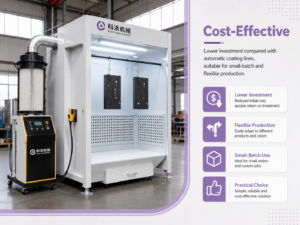
Pre-Production Checklist: Preventing Defects Before the First Spray Cycle
The easiest defects to fix are the ones you prevent. Before running a new product or restarting after a color change, execute this checklist systematically.
Powder Supply and Recovery System Preparation
Powder Hopper & Supply System:
- [ ] Inspect hopper interior for caking or settled powder from previous run; vacuum clean if needed
- cURL Too many subrequests by single Worker invocation. To configure this limit, refer to https://developers.cloudflare.com/workers/wrangler/configuration/#limits
- cURL Too many subrequests by single Worker invocation. To configure this limit, refer to https://developers.cloudflare.com/workers/wrangler/configuration/#limits
- cURL Too many subrequests by single Worker invocation. To configure this limit, refer to https://developers.cloudflare.com/workers/wrangler/configuration/#limits
- cURL Too many subrequests by single Worker invocation. To configure this limit, refer to https://developers.cloudflare.com/workers/wrangler/configuration/#limits
cURL Too many subrequests by single Worker invocation. To configure this limit, refer to https://developers.cloudflare.com/workers/wrangler/configuration/#limits:
- cURL Too many subrequests by single Worker invocation. To configure this limit, refer to https://developers.cloudflare.com/workers/wrangler/configuration/#limits
- cURL Too many subrequests by single Worker invocation. To configure this limit, refer to https://developers.cloudflare.com/workers/wrangler/configuration/#limits
- cURL Too many subrequests by single Worker invocation. To configure this limit, refer to https://developers.cloudflare.com/workers/wrangler/configuration/#limits
- cURL Too many subrequests by single Worker invocation. To configure this limit, refer to https://developers.cloudflare.com/workers/wrangler/configuration/#limits
- cURL Too many subrequests by single Worker invocation. To configure this limit, refer to https://developers.cloudflare.com/workers/wrangler/configuration/#limits
cURL Too many subrequests by single Worker invocation. To configure this limit, refer to https://developers.cloudflare.com/workers/wrangler/configuration/#limits:
- cURL Too many subrequests by single Worker invocation. To configure this limit, refer to https://developers.cloudflare.com/workers/wrangler/configuration/#limits
- cURL Too many subrequests by single Worker invocation. To configure this limit, refer to https://developers.cloudflare.com/workers/wrangler/configuration/#limits
- cURL Too many subrequests by single Worker invocation. To configure this limit, refer to https://developers.cloudflare.com/workers/wrangler/configuration/#limits
- cURL Too many subrequests by single Worker invocation. To configure this limit, refer to https://developers.cloudflare.com/workers/wrangler/configuration/#limits
cURL Too many subrequests by single Worker invocation. To configure this limit, refer to https://developers.cloudflare.com/workers/wrangler/configuration/#limits:
cURL Too many subrequests by single Worker invocation. To configure this limit, refer to https://developers.cloudflare.com/workers/wrangler/configuration/#limits
- cURL Too many subrequests by single Worker invocation. To configure this limit, refer to https://developers.cloudflare.com/workers/wrangler/configuration/#limits
- cURL Too many subrequests by single Worker invocation. To configure this limit, refer to https://developers.cloudflare.com/workers/wrangler/configuration/#limits
- cURL Too many subrequests by single Worker invocation. To configure this limit, refer to https://developers.cloudflare.com/workers/wrangler/configuration/#limits
cURL Too many subrequests by single Worker invocation. To configure this limit, refer to https://developers.cloudflare.com/workers/wrangler/configuration/#limits
cURL Too many subrequests by single Worker invocation. To configure this limit, refer to https://developers.cloudflare.com/workers/wrangler/configuration/#limits:
- [ ] Note the previous color and new color; determine if they are compatible (e.g., don't run white after dark color without thorough purge)
- [ ] Inspect spray gun electrode and tip for caked-on powder from previous color; use nylon brush (not metal) to gently clean
Purging Sequence:
-
Air purge only (3–5 minutes):
- Activate compressed air supply to spray gun
- No powder; just air flowing through gun
- Purpose: blow out loose powder remnants
-
Sacrifice material spray (1–2 minutes):
- Activate spray gun with fresh new-color powder loaded
- Spray onto scrap substrate or recovery chamber (not into trash—powder is recoverable)
- Purpose: flush residual old color from lines and gun
-
Verification spray (1 piece):
- Spray one actual test workpiece
- Inspect for color contamination (old color mixed with new)
- If contamination visible, repeat step 2
-
Restart production:
- If verification piece passes, begin production
- Hold first 5 pieces for color verification before shipping
System Purging Standards:
| Thông số kỹ thuật | Tiêu chuẩn | Phạm vi chấp nhận được |
|---|---|---|
| Air purge duration | 5 phút | 3–7 min depending on powder type |
| Sacrifice material quantity | 0.5–1.0 kg | Up to 1.5 kg if previous color very different |
| Verification pieces | 1–3 | Up to 5 if switching to white or light colors |
| Time from first sacrifice spray to first production piece | <30 min | <60 min in emergency; beyond 60 min, risk powder settling and re-contamination |
How to Choose the Right Diagnostic Sequence for Your Line
Not every defect requires full diagnostic protocol. Use this decision tree to prioritize:
Quick Filter Questions:
-
Is the defect appearing on ALL pieces consistently?
- Yes → Focus on pre-treatment, oven parameters, or air quality
- cURL Too many subrequests by single Worker invocation. To configure this limit, refer to https://developers.cloudflare.com/workers/wrangler/configuration/#limits
-
cURL Too many subrequests by single Worker invocation. To configure this limit, refer to https://developers.cloudflare.com/workers/wrangler/configuration/#limits
- cURL Too many subrequests by single Worker invocation. To configure this limit, refer to https://developers.cloudflare.com/workers/wrangler/configuration/#limits
- cURL Too many subrequests by single Worker invocation. To configure this limit, refer to https://developers.cloudflare.com/workers/wrangler/configuration/#limits
-
cURL Too many subrequests by single Worker invocation. To configure this limit, refer to https://developers.cloudflare.com/workers/wrangler/configuration/#limits
- cURL Too many subrequests by single Worker invocation. To configure this limit, refer to https://developers.cloudflare.com/workers/wrangler/configuration/#limits
- cURL Too many subrequests by single Worker invocation. To configure this limit, refer to https://developers.cloudflare.com/workers/wrangler/configuration/#limits
- cURL Too many subrequests by single Worker invocation. To configure this limit, refer to https://developers.cloudflare.com/workers/wrangler/configuration/#limits
cURL Too many subrequests by single Worker invocation. To configure this limit, refer to https://developers.cloudflare.com/workers/wrangler/configuration/#limits
After supporting electrostatic dây chuyền sơn bộts for cabinet makers in Algeria, furniture manufacturers in Turkey, and aluminum mills in India, I can confirm that the most successful plants aren't necessarily those with the newest equipment—they're the ones that use diagnostic discipline.
cURL Too many subrequests by single Worker invocation. To configure this limit, refer to https://developers.cloudflare.com/workers/wrangler/configuration/#limits
- cURL Too many subrequests by single Worker invocation. To configure this limit, refer to https://developers.cloudflare.com/workers/wrangler/configuration/#limits cURL Too many subrequests by single Worker invocation. To configure this limit, refer to https://developers.cloudflare.com/workers/wrangler/configuration/#limits
- cURL Too many subrequests by single Worker invocation. To configure this limit, refer to https://developers.cloudflare.com/workers/wrangler/configuration/#limits cURL Too many subrequests by single Worker invocation. To configure this limit, refer to https://developers.cloudflare.com/workers/wrangler/configuration/#limits
- cURL Too many subrequests by single Worker invocation. To configure this limit, refer to https://developers.cloudflare.com/workers/wrangler/configuration/#limits cURL Too many subrequests by single Worker invocation. To configure this limit, refer to https://developers.cloudflare.com/workers/wrangler/configuration/#limits
- cURL Too many subrequests by single Worker invocation. To configure this limit, refer to https://developers.cloudflare.com/workers/wrangler/configuration/#limits cURL Too many subrequests by single Worker invocation. To configure this limit, refer to https://developers.cloudflare.com/workers/wrangler/configuration/#limits
- cURL Too many subrequests by single Worker invocation. To configure this limit, refer to https://developers.cloudflare.com/workers/wrangler/configuration/#limits cURL Too many subrequests by single Worker invocation. To configure this limit, refer to https://developers.cloudflare.com/workers/wrangler/configuration/#limits
- cURL Too many subrequests by single Worker invocation. To configure this limit, refer to https://developers.cloudflare.com/workers/wrangler/configuration/#limits (over or under-curing distorts final appearance and performance)
The systematic approach I've outlined here—starting with pre-treatment verification, moving through compressed air quality checks, confirming grounding, then adjusting spray parameters in sequence—eliminates guesswork and cuts troubleshooting time by 60–70% compared to random parameter tweaking.
If your team is experiencing recurring surface defects or inconsistent quality, I recommend implementing the pre-production checklist and the real-time thickness monitoring protocol outlined above. Both are low-cost interventions that typically pay for themselves within weeks by reducing scrap and rework.
What's your most pressing coating challenge right now? Whether it's pinholes on aluminum profiles, adhesion issues on cabinet bodies, or color inconsistency on furniture, the diagnostic frameworks in this article provide a clear path forward.
If you'd like to discuss your specific situation or explore how our after-sales support and technical consultation can help your operation, I'm available to connect directly. You can reach our team at WhatsApp: +8618925987762 hoặc email ketucoatingline@gmail.com to arrange a technical consultation or on-site diagnostics session.
Stable, predictable coating quality is achievable—and it starts with systematic diagnosis, not random adjustment.
[^1]: Process and benefits of removing mineral ions from water for precision applications in coating pre-treatment systems.
[^2]: Gas at pressure greater than atmospheric pressure, used in coating processes for air supply, atomization, and powder feed systems.
[^3]: Standard test method for measuring adhesion strength of coatings using a pull-off tester to determine interface failure loads.
[^4]: Shielding effect where conductive surfaces block electric field penetration into enclosed cavities, reducing powder deposition on interior surfaces.
[^5]: International standards framework for air treatment quality specifications including moisture removal, filtration, and contamination control requirements.
[^6]: Volatile organic solvent used in rub tests to assess curing completeness and cross-linking density of powder coating finishes.
[^7]: Standard test method for determining pencil hardness of coatings by resistance to scratching with calibrated pencil grades.
 Vietnamese
  English
  German
  French