
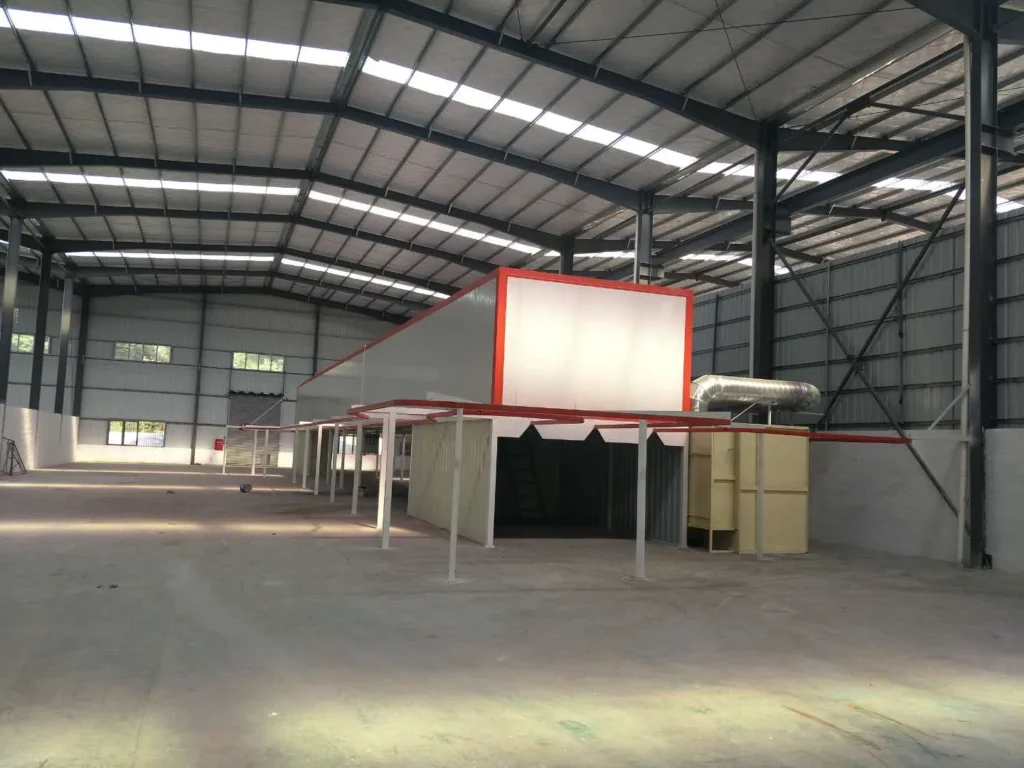
Spray Booth: Functions, Types & How to Choose the Right One for Your Production Line
When we talk about electrostatic powder coating, most people focus on the spray gun or the curing oven. But I've learned from years of working on production lines that the spray booth itself—the chamber where powder actually meets the workpiece—is often the silent bottleneck that determines whether your entire line runs smoothly or becomes a source of endless headaches.
A spray booth is the core chamber in which electrostatic powder coating is applied to workpieces. It serves to contain powder mist, ensure uniform coating coverage, and recover unused powder for reuse. Spray booths are typically classified by recovery system type (cyclone, backpack filter, or secondary recovery cabinet), automation level (manual, semi-automatic, or fully automatic), and application mode (manual gun operation or automated gun array). Selection depends on workpiece size, production volume, surface quality requirements, and budget—smaller batches with frequent color changes often suit backpack-type booths, while high-volume production favors large cyclone systems with secondary recovery for better powder utilization and environmental compliance.
The choice of spray booth type is not about picking the fanciest equipment. It's about matching your actual production reality to the right chamber design. From our experience, this is where most projects start to either succeed or struggle.
What Is a Spray Booth and Why It Matters in Powder Coating
A spray booth is the work chamber where electrostatic powder coating happens. It's where charged powder particles meet grounded workpieces, where the air currents carry powder to the part surface, and where excess powder gets captured and recycled. Think of it as the "heart" of your production line—if this chamber isn't designed right for your specific products and processes, no amount of fancy automation or high-end curing will fix the problems downstream.
In practical terms, the spray booth does four critical jobs at once:
It creates a controlled environment for powder to atomize and travel to the workpiece surface without being lost to the surrounding air. It manages airflow in a way that supports electrostatic charge effectiveness—if the air turbulence is wrong, the powder won't stick properly, no matter how high your gun voltage is. It recovers the powder that doesn't land on the part so you can reuse it and minimize waste. And it contains the dust hazard so your operators don't breathe in excessive powder and your facility stays compliant with local environmental regulations.
The spray booth is where the real test of your coating system happens. A well-designed booth for your specific product shape, size, and production speed can cut your defect rate by 30–40%. A poorly matched booth will frustrate you with uneven coverage, high powder waste, slow color changes, and operator complaints about air quality.

Core Functions of a Spray Booth in Your Coating Line
From our standpoint building and optimizing these systems, every spray booth must perform these five non-negotiable functions:
1. Contain and Direct Airflow
The booth isn't just an empty box. Its internal walls, baffles, and inlet/outlet design create specific airflow patterns. The air needs to move consistently toward the exhaust, carrying powder toward the workpiece and drawing excess powder away from the breathing zone. If airflow is chaotic or uneven, powder settles in corners, accumulates on surfaces, and creates color contamination during the next shift.
2. Support Consistent Electrostatic Deposition
The powder booth environment affects how well the electrostatic field works. Air speed that's too high can blow charged particles away from the part before they land. Air speed that's too slow leaves powder hanging in the air too long, and it starts to lose charge and drift. The booth design must balance air velocity with dwell time so the powder has the best chance of reaching the part surface.
3. Recover and Sort Unused Powder
Every booth is paired with a recovery system. As powder-laden air exits the booth, some powder particles have not attached to the workpiece. These need to be separated from the exhaust stream so they can be collected, screened, and reused. Recovery efficiency directly affects your material cost and how often you buy fresh powder.
4. Filter the Exhaust Air
Before air leaves the booth system and goes outside, it must pass through a filtration stage. This removes ultra-fine powder particles that would otherwise escape into the factory air or the atmosphere. This is both an environmental requirement and an operator safety issue.
5. Enable Quick Color Changes with Minimal Contamination
When you need to switch from red to white powder, or from a metallic to a solid color, the booth interior must be easy to clean and must have minimal areas where old powder can hide. A booth with poor design will have you spending 30+ minutes cleaning between colors and still risk color bleeding.
From our experience, clients who ignore function #5 often regret their booth choice within the first year of operation. If you're running a multi-color production environment, color-change speed becomes a production bottleneck faster than you'd expect.

Main Classification Dimensions for Spray Booths
Spray booths are categorized along three main axes. Understanding these helps you narrow down your options quickly.
By Récupération de poudre Méthode
How the booth captures unused powder is the first and most visible distinction.
Large Cyclone Booths use centrifugal force to separate powder from the exhaust air stream. Powder-laden air enters a large conical chamber, spins at high speed, and heavier powder particles are forced to the outside wall by centrifugal force, then fall into a collection hopper. Clean air exits from the top. Cyclone recovery rates can reach 95%+, which is excellent for powder reuse. However, the chamber is large, takes up significant floor space, and can be louder due to the high-speed rotation. Cyclone booths are ideal for high-volume production where powder recovery efficiency matters more than space efficiency or color-change frequency.
Backpack Filter Booths use one or more replaceable filter cartridges mounted inside or on the back of the booth. As powder-laden air passes through the filter, powder particles get trapped on the filter surface while clean air passes through. When powder accumulation increases the pressure difference across the filter, an automatic or manual backflush system blows compressed air backward through the filter to dislodge the powder. Backpack systems are compact, easy to clean, and very fast at color changes—you just replace the filter cartridge or backflush, and you're done in minutes. Recovery rates are typically 80–90%, slightly lower than cyclone but still very respectable. Backpack booths suit small to medium production runs and frequent color changes.
Secondary Recovery Cabinet Booths use a two-stage system. The first stage is a cyclone or primary separation chamber inside the booth. The second stage is a separate cabinet with fine filter cartridges that captures ultra-fine powder particles that the cyclone missed. This approach gives you the high recovery efficiency of cyclone (95%+) plus the super-clean exhaust air of a fine filtration system. Secondary recovery cabinets are larger and more complex to maintain, but they're the choice when you need both maximum powder recovery AND compliance with strict environmental discharge limits.
By Automation Level
How much of the spray process is automated versus manual.
cURL Too many subrequests by single Worker invocation. To configure this limit, refer to https://developers.cloudflare.com/workers/wrangler/configuration/#limits have one or more spray gun positions, but operators hold and aim the guns by hand. The operator controls spray pattern, gun distance, and timing. This approach is flexible—you can handle odd-shaped parts and adjust on the fly. Labor cost is high, quality consistency depends on operator skill, and throughput is limited by how fast a person can work. Manual booths are common in job shops, low-volume custom work, and very small businesses.
Semi-Automatic Spray Booths cURL Too many subrequests by single Worker invocation. To configure this limit, refer to https://developers.cloudflare.com/workers/wrangler/configuration/#limits.
cURL Too many subrequests by single Worker invocation. To configure this limit, refer to https://developers.cloudflare.com/workers/wrangler/configuration/#limits cURL Too many subrequests by single Worker invocation. To configure this limit, refer to https://developers.cloudflare.com/workers/wrangler/configuration/#limits.
cURL Too many subrequests by single Worker invocation. To configure this limit, refer to https://developers.cloudflare.com/workers/wrangler/configuration/#limits
cURL Too many subrequests by single Worker invocation. To configure this limit, refer to https://developers.cloudflare.com/workers/wrangler/configuration/#limits.
cURL Too many subrequests by single Worker invocation. To configure this limit, refer to https://developers.cloudflare.com/workers/wrangler/configuration/#limits cURL Too many subrequests by single Worker invocation. To configure this limit, refer to https://developers.cloudflare.com/workers/wrangler/configuration/#limits.
cURL Too many subrequests by single Worker invocation. To configure this limit, refer to https://developers.cloudflare.com/workers/wrangler/configuration/#limits cURL Too many subrequests by single Worker invocation. To configure this limit, refer to https://developers.cloudflare.com/workers/wrangler/configuration/#limits.
cURL Too many subrequests by single Worker invocation. To configure this limit, refer to https://developers.cloudflare.com/workers/wrangler/configuration/#limits cURL Too many subrequests by single Worker invocation. To configure this limit, refer to https://developers.cloudflare.com/workers/wrangler/configuration/#limits.
cURL Too many subrequests by single Worker invocation. To configure this limit, refer to https://developers.cloudflare.com/workers/wrangler/configuration/#limits cURL Too many subrequests by single Worker invocation. To configure this limit, refer to https://developers.cloudflare.com/workers/wrangler/configuration/#limits.
cURL Too many subrequests by single Worker invocation. To configure this limit, refer to https://developers.cloudflare.com/workers/wrangler/configuration/#limits.
cURL Too many subrequests by single Worker invocation. To configure this limit, refer to https://developers.cloudflare.com/workers/wrangler/configuration/#limits
cURL Too many subrequests by single Worker invocation. To configure this limit, refer to https://developers.cloudflare.com/workers/wrangler/configuration/#limits.
cURL Too many subrequests by single Worker invocation. To configure this limit, refer to https://developers.cloudflare.com/workers/wrangler/configuration/#limits
cURL Too many subrequests by single Worker invocation. To configure this limit, refer to https://developers.cloudflare.com/workers/wrangler/configuration/#limits.
Fonctionnement : cURL Too many subrequests by single Worker invocation. To configure this limit, refer to https://developers.cloudflare.com/workers/wrangler/configuration/#limits.
Avantages :
- cURL Too many subrequests by single Worker invocation. To configure this limit, refer to https://developers.cloudflare.com/workers/wrangler/configuration/#limits
- cURL Too many subrequests by single Worker invocation. To configure this limit, refer to https://developers.cloudflare.com/workers/wrangler/configuration/#limits
- cURL Too many subrequests by single Worker invocation. To configure this limit, refer to https://developers.cloudflare.com/workers/wrangler/configuration/#limits
- Relatively simple maintenance—no complex filter cartridges to replace regularly
- Suitable for very high production volumes
Inconvénients :
- Large footprint (the cyclone takes up significant space)
- Longer color-change time (30–45 minutes) because you must thoroughly clean the internal surfaces to avoid color bleed
- Higher noise level during operation
- Powder exits at the bottom in a cloud, which can affect nearby air quality unless well-contained
- Initial capital cost is moderate to high
Idéal pour : Cabinet manufacturers, metal furniture producers, structural steel coating, appliance housing producers—any operation with high volume, moderate color variety, and strong emphasis on powder cost efficiency.
Secondary Recovery Cabinet Spray Booths
These are the refined choice when you want maximum recovery efficiency AND clean exhaust compliance. The booth itself is compact (similar size to cyclone, 3–5 meters long), but instead of a standalone cyclone, the recovery system is a separate cabinet with internal filter cartridges.
Fonctionnement : Powder-laden air exits the spray chamber into the secondary recovery cabinet. The first stage might be a small cyclone or baffle system that removes most large particles. The second stage is a set of 12–20 pleated filter cartridges (typically 320mm diameter × 600mm height) that capture fine particles. A pulsed-jet backflush system periodically sends compressed air backward through each cartridge to dislodge accumulated powder. Collected powder falls into a hopper at the bottom and is screw-conveyed back into the powder supply system.
Avantages :
- Recovery rate approaches 98%+ (accounting for minimal filter bypass)
- Exhaust air is extremely clean (meets strict environmental discharge standards)
- Color change is moderately fast (15–25 minutes) because the booth itself is simpler, with fewer internal surfaces than a large cyclone booth
- Compact footprint compared to standalone cyclone systems
- Filter cartridges are replaceable and relatively inexpensive to maintain
- Works well in facilities with tight environmental regulations
Inconvénients :
- More complex than a simple cyclone booth
- Filter cartridges degrade over time and eventually need replacement (typically 18–24 months depending on powder volume and quality)
- Backflush system requires reliable compressed air supply
- Initial capital cost is higher than cyclone
- If filter cartridges are neglected, pressure drop increases and air quality suffers
Idéal pour : Facilities in environmentally strict regions, multi-color production where consistent color purity matters, aluminum extrusion companies, and manufacturers where powder waste directly impacts profitability and sustainability goals.
Manual vs. Automatic Spray Booths
This distinction cuts across booth type—you can have a manual cyclone booth or an automatic one, a manual backpack booth or an automatic one. But the labor and consistency implications are so significant that they deserve their own section.
Manual Booths keep an operator in the spray chamber (with PPE) holding spray guns and aiming at the workpiece. The operator controls spray trigger timing, gun distance, and spray pattern angle. Workpieces typically move through on a conveyor at a slow, predictable pace, or the operator sprays parts that are stationary or hand-presented.
Manual spray work is genuinely skilled. A good spray operator understands how to adjust for part geometry, how to avoid dry spray, how to manage powder overlap to prevent orange peel, and how to maintain consistent distance and angle. This is why some job shops and custom coaters still prefer manual spray—it's flexible.
But manual spray has significant downsides: labor is the biggest operating cost; consistency depends on operator fatigue, mood, and skill; throughput is limited; and OSHA regulations now require better respiratory protection in spray booths, which adds to the operational burden.
Automatic Booths remove the operator from the spray chamber. Guns move on programmed paths, timing is controlled by PLC, and the operator monitors from outside, usually from a control station. For a given workpiece design, automatic spray delivers much higher consistency—every part gets the same gun sequence, same distances, same timing. Throughput is higher because the conveyor moves at optimized speed and doesn't wait for human reaction times.
Automatic spray setup is more involved—you have to program gun movements, test, and optimize spray patterns for each product. But once dialed in, automatic spray is a stability engine. Defect rates drop, material consumption becomes predictable, and labor costs per unit decline sharply.
The tradeoff: automatic booths have higher capital cost and less flexibility for product variations. You can't easily spray a different part shape without reprogramming.
From our experience, the break-even point for automatic spray is around 50,000–100,000 parts per year of a standardized design. Below that, manual is often more practical. Above that, automatic almost always wins on ROI.
How to Match Spray Booth Type to Your Product and Production Needs
This is where real judgment matters. I've seen companies buy the wrong booth type and regret it for years. Here's how we think through the selection.
Considering Workpiece Size and Shape
Workpiece dimensions are the first hard constraint. If your part is 1.5 meters long and 1.1 meters wide, your booth interior must accommodate that length plus some clearance. If your part is 0.5 meters but has complex internal cavities, you need gun angles that can reach inside—which might require overhead guns or reciprocating geometry.
cURL Too many subrequests by single Worker invocation. To configure this limit, refer to https://developers.cloudflare.com/workers/wrangler/configuration/#limits cURL Too many subrequests by single Worker invocation. To configure this limit, refer to https://developers.cloudflare.com/workers/wrangler/configuration/#limits cURL Too many subrequests by single Worker invocation. To configure this limit, refer to https://developers.cloudflare.com/workers/wrangler/configuration/#limits.
cURL Too many subrequests by single Worker invocation. To configure this limit, refer to https://developers.cloudflare.com/workers/wrangler/configuration/#limits cURL Too many subrequests by single Worker invocation. To configure this limit, refer to https://developers.cloudflare.com/workers/wrangler/configuration/#limits cURL Too many subrequests by single Worker invocation. To configure this limit, refer to https://developers.cloudflare.com/workers/wrangler/configuration/#limits.
cURL Too many subrequests by single Worker invocation. To configure this limit, refer to https://developers.cloudflare.com/workers/wrangler/configuration/#limits cURL Too many subrequests by single Worker invocation. To configure this limit, refer to https://developers.cloudflare.com/workers/wrangler/configuration/#limits cURL Too many subrequests by single Worker invocation. To configure this limit, refer to https://developers.cloudflare.com/workers/wrangler/configuration/#limits.
cURL Too many subrequests by single Worker invocation. To configure this limit, refer to https://developers.cloudflare.com/workers/wrangler/configuration/#limits cURL Too many subrequests by single Worker invocation. To configure this limit, refer to https://developers.cloudflare.com/workers/wrangler/configuration/#limits cURL Too many subrequests by single Worker invocation. To configure this limit, refer to https://developers.cloudflare.com/workers/wrangler/configuration/#limits.
cURL Too many subrequests by single Worker invocation. To configure this limit, refer to https://developers.cloudflare.com/workers/wrangler/configuration/#limits
cURL Too many subrequests by single Worker invocation. To configure this limit, refer to https://developers.cloudflare.com/workers/wrangler/configuration/#limits.
cURL Too many subrequests by single Worker invocation. To configure this limit, refer to https://developers.cloudflare.com/workers/wrangler/configuration/#limits. cURL Too many subrequests by single Worker invocation. To configure this limit, refer to https://developers.cloudflare.com/workers/wrangler/configuration/#limits.
cURL Too many subrequests by single Worker invocation. To configure this limit, refer to https://developers.cloudflare.com/workers/wrangler/configuration/#limits cURL Too many subrequests by single Worker invocation. To configure this limit, refer to https://developers.cloudflare.com/workers/wrangler/configuration/#limits.
cURL Too many subrequests by single Worker invocation. To configure this limit, refer to https://developers.cloudflare.com/workers/wrangler/configuration/#limits. cURL Too many subrequests by single Worker invocation. To configure this limit, refer to https://developers.cloudflare.com/workers/wrangler/configuration/#limits.
cURL Too many subrequests by single Worker invocation. To configure this limit, refer to https://developers.cloudflare.com/workers/wrangler/configuration/#limits.
cURL Too many subrequests by single Worker invocation. To configure this limit, refer to https://developers.cloudflare.com/workers/wrangler/configuration/#limits
cURL Too many subrequests by single Worker invocation. To configure this limit, refer to https://developers.cloudflare.com/workers/wrangler/configuration/#limits.
cURL Too many subrequests by single Worker invocation. To configure this limit, refer to https://developers.cloudflare.com/workers/wrangler/configuration/#limits.
cURL Too many subrequests by single Worker invocation. To configure this limit, refer to https://developers.cloudflare.com/workers/wrangler/configuration/#limits.
Also consider line cycle time. If your front-to-back time (from entry to booth exit) is 2 minutes, the booth must be designed so powder has time to hit and stick. If the booth is too short for the conveyor speed, powder spray time becomes too brief, and you risk dry spots or thin coverage.
From our experience, booth length should typically allow 60–90 seconds of spray time for manual gun work, and 45–60 seconds for automatic gun systems (because automatic guns are precise and don't need as much dwell time).
Cost and Maintenance Differences Across Spray Booth Types
Booth choice has profound financial implications beyond the purchase price.
| Booth Type | Coût en capital | Annual Powder Cost | Maintenance annuelle | Temps de changement de couleur | Footprint | Conformité environnementale |
|---|---|---|---|---|---|---|
| Large Cyclone | Moderate–High | Low (95%+ recovery) | Low–Moderate | 30–45 min | Large | Bon |
| Backpack Filter | Low–Moderate | Moderate (80–90% recovery) | Low (filter cartridge replacement) | 5–10 min | Small–Moderate | Modéré |
| Armoire de récupération secondaire | Élevé | Very Low (98%+ recovery) | Moderate (filter cartridge + backflush system) | 15–25 min | Moderate–Large | Excellent |
Powder cost often dominates the picture. If you run 1,000 kg of powder per month, the difference between 80% recovery (backpack) and 95% recovery (cyclone) is 150 kg of waste powder per month. At typical powder prices of $15–30 per kg, that's $2,250–$4,500 per month in additional material cost. Over a year, that's $27,000–$54,000. A secondary recovery cabinet might cost an extra $30,000 upfront but pay for itself in 6–12 months through superior recovery efficiency alone.
Entretien also varies. Cyclone booths are relatively simple—regular cleaning and occasional wear-plate replacement. Backpack filter booths need new cartridges every 1.5–2 years. Secondary recovery cabinets need new filter cartridges plus backflush system servicing.
Operator labor depends on automation level. Manual spray requires 1–2 operators per shift. Automatic spray requires monitoring staff but can often be supervised by one person across multiple lines.
From a true cost-of-ownership standpoint, the cheapest booth upfront is rarely the cheapest booth to operate over 5 years. A secondary recovery cabinet that costs more at purchase often has the lowest total cost because of superior powder recovery and environmental compliance (no penalties or retrofitting required).
How to Select the Right Spray Booth: A Decision Framework
Here's how we walk through booth selection with a client.
Step 1: Gather Core Product Data
- Workpiece dimensions (length, width, height)
- Workpiece complexity (flat, complex, internal cavities?)
- Material (steel, aluminum, composite?)
- Target coating film thickness (microns)
- Surface finish requirement (smooth, matte, textured?)
Step 2: Define Production Requirements
- Annual production volume (units per year)
- Batch size (how many of the same color in a row?)
- Color variety (how many different colors in a year?)
- Color-change frequency (how often do you switch?)
- cURL Too many subrequests by single Worker invocation. To configure this limit, refer to https://developers.cloudflare.com/workers/wrangler/configuration/#limits
cURL Too many subrequests by single Worker invocation. To configure this limit, refer to https://developers.cloudflare.com/workers/wrangler/configuration/#limits
- cURL Too many subrequests by single Worker invocation. To configure this limit, refer to https://developers.cloudflare.com/workers/wrangler/configuration/#limits
- Ceiling height
- cURL Too many subrequests by single Worker invocation. To configure this limit, refer to https://developers.cloudflare.com/workers/wrangler/configuration/#limits
- cURL Too many subrequests by single Worker invocation. To configure this limit, refer to https://developers.cloudflare.com/workers/wrangler/configuration/#limits
- cURL Too many subrequests by single Worker invocation. To configure this limit, refer to https://developers.cloudflare.com/workers/wrangler/configuration/#limits
- cURL Too many subrequests by single Worker invocation. To configure this limit, refer to https://developers.cloudflare.com/workers/wrangler/configuration/#limits
cURL Too many subrequests by single Worker invocation. To configure this limit, refer to https://developers.cloudflare.com/workers/wrangler/configuration/#limits
- cURL Too many subrequests by single Worker invocation. To configure this limit, refer to https://developers.cloudflare.com/workers/wrangler/configuration/#limits
- cURL Too many subrequests by single Worker invocation. To configure this limit, refer to https://developers.cloudflare.com/workers/wrangler/configuration/#limits
- cURL Too many subrequests by single Worker invocation. To configure this limit, refer to https://developers.cloudflare.com/workers/wrangler/configuration/#limits
- cURL Too many subrequests by single Worker invocation. To configure this limit, refer to https://developers.cloudflare.com/workers/wrangler/configuration/#limits
cURL Too many subrequests by single Worker invocation. To configure this limit, refer to https://developers.cloudflare.com/workers/wrangler/configuration/#limits
- cURL Too many subrequests by single Worker invocation. To configure this limit, refer to https://developers.cloudflare.com/workers/wrangler/configuration/#limits
- cURL Too many subrequests by single Worker invocation. To configure this limit, refer to https://developers.cloudflare.com/workers/wrangler/configuration/#limits
- cURL Too many subrequests by single Worker invocation. To configure this limit, refer to https://developers.cloudflare.com/workers/wrangler/configuration/#limits
- cURL Too many subrequests by single Worker invocation. To configure this limit, refer to https://developers.cloudflare.com/workers/wrangler/configuration/#limits
cURL Too many subrequests by single Worker invocation. To configure this limit, refer to https://developers.cloudflare.com/workers/wrangler/configuration/#limits
cURL Too many subrequests by single Worker invocation. To configure this limit, refer to https://developers.cloudflare.com/workers/wrangler/configuration/#limits cURL Too many subrequests by single Worker invocation. To configure this limit, refer to https://developers.cloudflare.com/workers/wrangler/configuration/#limits cURL Too many subrequests by single Worker invocation. To configure this limit, refer to https://developers.cloudflare.com/workers/wrangler/configuration/#limits
- cURL Too many subrequests by single Worker invocation. To configure this limit, refer to https://developers.cloudflare.com/workers/wrangler/configuration/#limits
- You're in a region with strict environmental regulations
- You run multiple colors and waste powder cost is a major concern
- You can afford the higher upfront capital investment
Backpack filter booths are best when:
- You're in a job shop or low-to-medium volume environment (<50,000 parts/year)
- You run frequent color changes and setup time matters more than material efficiency
- You have limited floor space
- Simplicity and fast maintenance are priorities
Large cyclone booths are best when:
- You have very high volume and can tolerate longer color-change times
- Your facility space is adequate
- You want the simplicity of a proven, established technology
- Powder recovery efficiency is critical but you're not in a strict environmental zone
And frankly, we've encountered far too many situations where a client buys based on initial purchase price alone and ends up frustrated within the first year. I always recommend calculating the 5-year total cost of ownership before deciding, not just the booth purchase price.
Questions connexes supplémentaires
Q: What's the difference between a spray booth and a spray chamber?
In practice, the terms are used interchangeably. A "spray chamber" is the box where spraying happens. A "spray booth" usually refers to the complete system including the chamber plus recovery and filtration. The distinction is more linguistic than technical.
Q: Can I retrofit my existing spray booth with a secondary recovery cabinet?
Yes, in most cases. If you have a cyclone booth, you can disconnect it and replace it with a secondary recovery cabinet, provided you have adequate floor space and your exhaust ducting can handle the airflow. This is often more cost-effective than buying an entirely new booth.
Q: How often should spray booth filters be replaced?
Backpack and secondary recovery filter cartridges typically last 18–24 months under normal conditions. Frequency depends on powder volume, powder particle size, and air quality entering the booth. If your shop air is dusty, cartridges degrade faster. We recommend inspecting cartridges every 6 months.
Q: Does spray booth size affect coating quality?
Yes, indirectly. A booth that's too small for the workpiece or too fast for the conveyor speed doesn't allow adequate spray time, resulting in thin, uneven coverage. A booth that's well-sized to your product geometry and line speed allows powder more time to reach the part surface and build proper film thickness.
Conclusion
The spray booth is not a commodity choice. It's a core component that influences your coating quality, production efficiency, powder costs, environmental compliance, and overall profitability. Taking time to match booth type to your actual product and production needs—rather than defaulting to what competitors use or what sounds trendy—will pay dividends for years.
From our experience building and optimizing hundreds of coating lines, we've seen that the most successful operations are those where the booth choice is deliberate, not accidental. A well-matched spray booth becomes transparent to your process—you focus on product flow, quality, and cost, not on managing booth limitations.
If you're evaluating spray booth options for your production line, we'd encourage you to gather the data points we've outlined, think through both near-term and long-term costs, and if possible, visit working facilities where similar booth types are in operation. Seeing a booth run in production—watching color changes happen, observing how operators interact with it, understanding real maintenance rhythm—is worth far more than reading a spec sheet.
If you'd like to discuss spray booth selection for your specific production needs, or if you want to explore how a customized booth configuration could improve your coating efficiency, I'd be happy to walk through your requirements. You can reach us at +8618064668879 (WhatsApp) or ketumachinery@gmail.com. We also welcome facility visits so you can see spray booth systems in real production, which often clarifies technical questions much faster than any written explanation.
 French
  English
  German
  Vietnamese