
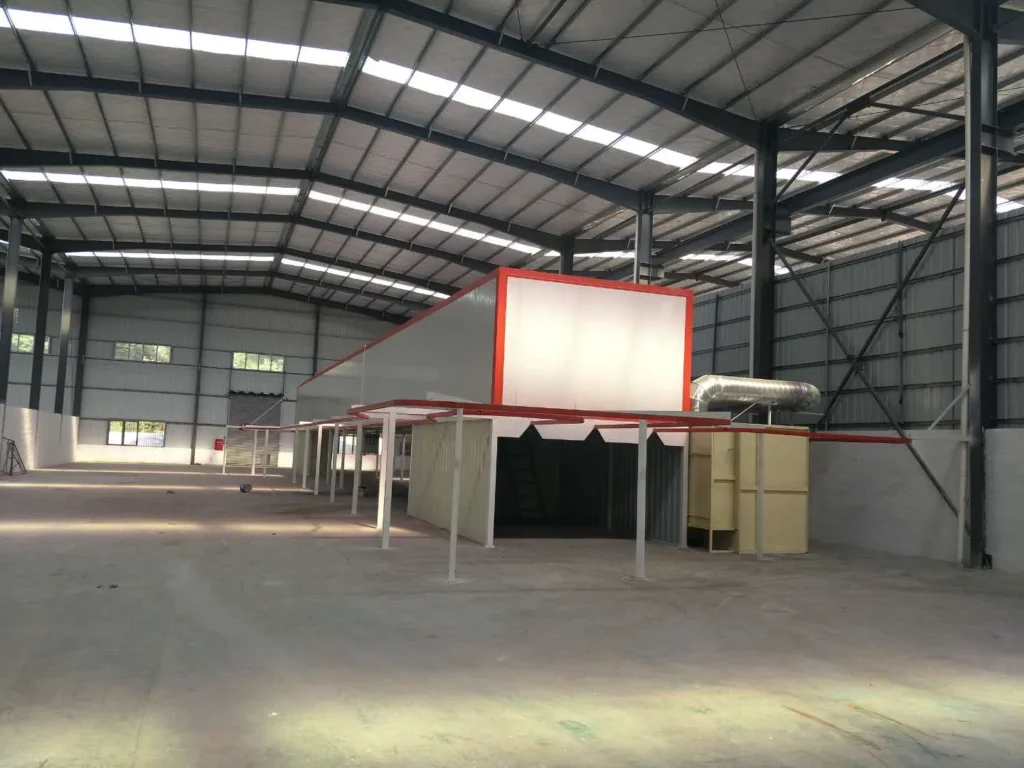
Ketu Technology Installation Technical Dialogue Record: Conveyor Chain Verticality Issue in Ligne de poudrages
Suggested Article Title
Ketu Powder Coating Conveyor Chain Verticality Diagnosis and Adjustment Guide: From On-Site Identification to Preventive Maintenance
At first glance, conveyor chain verticality may seem like a small issue in the conveying system. But in reality, it can quietly reduce the capacity and coating quality of the entire powder coating line. We have diagnosed many customer sites where coating defects, film thickness fluctuation, and production capacity loss were finally traced back to one overlooked problem: the conveyor chain was no longer truly vertical.
The impact of conveyor chain verticality deviation is far more serious than it appears. Uneven film thickness, partial missed spraying, workpiece jamming, unstable line rhythm, and even shorter equipment service life can all be related to conveyor chain verticality. More importantly, this problem usually builds up slowly. By the time it clearly affects production capacity, the issue is often already serious. Based on our experience, if verticality inspection is established during commissioning, checked once a week, and adjusted immediately once the deviation exceeds 2 mm, around 80% of later conveyor chain maintenance problems can be reduced.
This article is based on our real operation and maintenance experience with electrostatic powder coating lines. It covers quick on-site diagnosis, root cause analysis, step-by-step adjustment methods, and preventive maintenance systems. The goal is to help you solve conveyor chain verticality problems properly, instead of only making temporary adjustments.
How Conveyor Chain Verticality Deviation Affects Coating Quality and Production Capacity
Coating Defects Caused by Verticality Problems
Conveyor chain verticality deviation first appears in the coating result, but many people cannot identify the source at the beginning.
Film thickness fluctuation is the most obvious symptom. When the chain begins to tilt, the distance and angle between the workpiece and the spray gun change with the horizontal offset. You may find that the film thickness of the same batch of workpieces varies by 5-10 microns or even more at different positions. In the early stage, this difference is not very obvious. One or two products may still look acceptable. But over time, uneven adhesion, salt spray resistance differences, and local sagging will gradually appear.
Partial missed spraying may also become normal. After the chain deviates, some workpiece positions may enter the “dead zone” of the spray gun. This is especially common for workpieces with grooves, deep holes, and inner corners. Areas that could previously be covered may no longer receive powder properly. This is not necessarily a spray gun configuration problem. The real reason is that the workpiece position relative to the spray gun has changed.
The workpiece may swing or slightly jam on the chain. If the conveyor chain verticality deviation exceeds 3 mm, the hanger may create friction or interference with the guide rail or other structures. This leads to louder operating noise. In some cases, operators may even need to push the workpiece manually to keep it moving. From the user’s perspective, the equipment starts to feel “less smooth.”
Color difference and surface defects increase. Because film thickness and leveling become uneven, the coating appearance is also affected. For products that are sensitive to color difference, such as automotive parts, high-end furniture, and consumer electronics, this small film thickness fluctuation may lead to visible color difference.
Chain Reactions Affecting Whole-Line Capacity and Equipment Life
The influence of verticality problems on production capacity is hidden at first, but it eventually becomes obvious.
Based on our actual measurement data, when conveyor chain verticality deviation exceeds 3 mm, the whole-line rhythm can silently drop by 5-8%. This does not mean that the line speed has become slower. Instead, the conveying system is “correcting itself.” The chain wastes operating time through slight jamming, and the automatic spraying system may also need extra compensation. As a result, the actual capacity of the whole line decreases. For a customer who originally expected 500 pieces per day, the final output may only reach 460-475 pieces.
Equipment wear becomes faster. When the chain runs for a long time under incorrect force conditions, the tension distribution becomes uneven and wear accelerates. The contact between the hanger and the rail also changes from ideal line contact to uneven point contact. This causes the guide rail, wheels, and bearings to age faster. We have seen cases where hangers and rails had to be replaced within two years because the conveyor chain verticality was ignored for a long time. If this issue had been controlled from the beginning, the equipment could have operated for 5-7 years.
The curing oven and powder booth load become uneven. When the workpiece position on the chain is unstable, its posture changes when it enters different process sections. This directly affects heat flow distribution inside the curing oven. Some workpieces may be overheated, while others may receive insufficient heat. The final result is inconsistent curing. Some products become too hard and brittle, while others are under-cured.
The failure rate increases. Once the chain starts to deviate, other parts may also develop problems. For example, the powder recovery system may lose efficiency because the workpiece position has changed. The air inlet of the secondary recovery cabinet may become blocked. Even the air pressure stability of the whole system may be affected. These problems are often misdiagnosed as “one separate component failure,” but the real root cause may still be the chain.
How to Quickly Judge Whether the Conveyor Chain Has a Verticality Problem
Quick On-Site Diagnosis by Visual Observation
During production, you do not need to use tools for every inspection. Some quick observation methods can help you identify problems quickly.
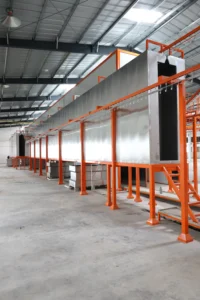
Check the gap between the chain and the guide rail. Let the chain run empty inside the powder booth, without any workpieces hanging on it. Carefully observe the gap between the hanger and both sides of the rail. If the gap is uneven, with one side tight and the other side loose, or one end tight and the other end loose, the verticality may already have shifted. Under normal conditions, this gap should remain consistent along the full length of the rail.
Observe the workpiece condition when entering and leaving each process section. If you notice that workpieces swing differently when entering the powder booth, or some workpieces slightly “catch” before entering the curing oven, these are signals of verticality deviation. This becomes especially obvious for large workpieces whose width is close to the internal rail space.
Listen to the operating sound. A normally running chain should make a smooth, low-frequency operating sound. If you hear friction sounds, clicking sounds, or irregular interference noise, it means some positions already have contact and friction. This usually indicates a verticality problem.
cURL Too many subrequests by single Worker invocation. To configure this limit, refer to https://developers.cloudflare.com/workers/wrangler/configuration/#limits. cURL Too many subrequests by single Worker invocation. To configure this limit, refer to https://developers.cloudflare.com/workers/wrangler/configuration/#limits.
cURL Too many subrequests by single Worker invocation. To configure this limit, refer to https://developers.cloudflare.com/workers/wrangler/configuration/#limits. cURL Too many subrequests by single Worker invocation. To configure this limit, refer to https://developers.cloudflare.com/workers/wrangler/configuration/#limits.
cURL Too many subrequests by single Worker invocation. To configure this limit, refer to https://developers.cloudflare.com/workers/wrangler/configuration/#limits
cURL Too many subrequests by single Worker invocation. To configure this limit, refer to https://developers.cloudflare.com/workers/wrangler/configuration/#limits.
cURL Too many subrequests by single Worker invocation. To configure this limit, refer to https://developers.cloudflare.com/workers/wrangler/configuration/#limits. cURL Too many subrequests by single Worker invocation. To configure this limit, refer to https://developers.cloudflare.com/workers/wrangler/configuration/#limits.
cURL Too many subrequests by single Worker invocation. To configure this limit, refer to https://developers.cloudflare.com/workers/wrangler/configuration/#limits. cURL Too many subrequests by single Worker invocation. To configure this limit, refer to https://developers.cloudflare.com/workers/wrangler/configuration/#limits cURL Too many subrequests by single Worker invocation. To configure this limit, refer to https://developers.cloudflare.com/workers/wrangler/configuration/#limits. cURL Too many subrequests by single Worker invocation. To configure this limit, refer to https://developers.cloudflare.com/workers/wrangler/configuration/#limits.
cURL Too many subrequests by single Worker invocation. To configure this limit, refer to https://developers.cloudflare.com/workers/wrangler/configuration/#limits. cURL Too many subrequests by single Worker invocation. To configure this limit, refer to https://developers.cloudflare.com/workers/wrangler/configuration/#limits.
cURL Too many subrequests by single Worker invocation. To configure this limit, refer to https://developers.cloudflare.com/workers/wrangler/configuration/#limits. cURL Too many subrequests by single Worker invocation. To configure this limit, refer to https://developers.cloudflare.com/workers/wrangler/configuration/#limits.
cURL Too many subrequests by single Worker invocation. To configure this limit, refer to https://developers.cloudflare.com/workers/wrangler/configuration/#limits. cURL Too many subrequests by single Worker invocation. To configure this limit, refer to https://developers.cloudflare.com/workers/wrangler/configuration/#limits.
cURL Too many subrequests by single Worker invocation. To configure this limit, refer to https://developers.cloudflare.com/workers/wrangler/configuration/#limits
cURL Too many subrequests by single Worker invocation. To configure this limit, refer to https://developers.cloudflare.com/workers/wrangler/configuration/#limits.
cURL Too many subrequests by single Worker invocation. To configure this limit, refer to https://developers.cloudflare.com/workers/wrangler/configuration/#limits
cURL Too many subrequests by single Worker invocation. To configure this limit, refer to https://developers.cloudflare.com/workers/wrangler/configuration/#limits.
The rail was not completely level during installation. This usually happens when the factory building foundation or steel structure is not precise enough. Beams in steel-structure workshops often have slight deformation or unevenness. If the rail is not adjusted section by section with a level during installation, it will be installed according to the uneven beam surface. The rail may look installed, but it is actually already tilted.
Civil foundation settlement causes the rail to gradually tilt. In some older factories or areas with unstable ground conditions, the rail may be level during initial installation. But over time, uneven foundation settlement causes the rail to deform. This is especially obvious in long-span rail systems, where the middle section may settle more than both ends.
The support frame is not strong enough and deforms after long-term loading. We pay special attention to this issue during design. If the wall thickness and model of the support frame are not strong enough to carry the total load of the whole line, including the chain, workpieces, and suspension system, the support frame will bend downward over time. As a result, height differences appear between the two ends and the middle section of the rail.
Our experience is that strictly checking rail flatness with a level during equipment acceptance is the most effective way to reduce later problems. This one-time effort can reduce around 80% of later conveyor chain maintenance issues. If the rail itself is not level, adjusting the chain and support foot shims alone will not fundamentally solve the problem.

Support Frame Deformation and Load-Bearing Design Defects
The support frame is the “skeleton” of the entire conveying system. Its strength and rigidity directly determine whether the rail can remain flat.
Original design is insufficient. When we design a customized solution, support frame strength depends on several factors: the span of the full rail, workpiece weight, and automation level. A higher automation level usually means additional load from spray gun groups, reciprocators, and related equipment. If these conditions are not accurately evaluated during design, the support frame may be too weak. For example, for customers with daily output above 500 pieces, we recommend using a reinforced 100×100 square tube support frame instead of a cheaper 80×80 option. The cost difference may only be a few thousand yuan, but in the long term, it determines whether the whole line can still run stably after three or five years.
Welding defects reduce support frame strength. The support frame is welded from square tubes, I-beams, and other steel parts. If the welding process is poor, such as false welding, pores, or slag inclusions, the rigidity of the whole structure will be greatly reduced. This is more common in old equipment or when subcontracted fabrication quality is unstable.
The support frame is not firmly fixed to the floor. Even if the support frame itself is rigid enough, loose anchor bolts, deformed shims, or floor settlement can still cause the whole support frame to shake and shift. This causes the rail position to change over time.
Hanger Connector Wear and Accumulated Deviation
The chain system consists of many hangers, and each hanger contacts the rail. When some hangers are worn or connectors become loose, the accumulated effect becomes visible.
Wear of hanger wheels. Hangers use wheels to contact the rail. These wheels gradually wear under long-term friction. Uneven wear is the most common situation. One wheel may wear faster while another wears more slowly, causing different hanger heights. Along the whole chain, hundreds or thousands of these small differences can accumulate into obvious verticality deviation.
Increased bearing clearance. After bearings age, the clearance between the wheel and the shaft increases. The hanger no longer runs tightly along the rail but begins to shake. This causes unstable actual running height of the hanger and leads to verticality fluctuation of the whole chain.
Loosening of connectors such as bolts, pins, and chain links. The hanger is fixed to the chain through connectors. If these bolts or pins become loose, the hanger may tilt or shift slightly in the vertical direction. During long-term operation, vibration and impact accelerate this looseness.
Our finding is that the essence of conveyor chain verticality problems is often not the chain itself, but the early-stage whole-line layout and foundation load-bearing design. Many customers focus only on coating performance when purchasing a powder coating line. They ignore the support frame, rail installation, and hanger connection system. As a result, the chain begins to deviate after only a few months. At that stage, adjustment becomes time-consuming and the problem can easily return.
Correct Step-by-Step Method for Adjusting Conveyor Chain Verticality On Site
Check the Rail First, Then Adjust the Hangers and Chain
The adjustment sequence is very important. Many people only adjust the support foot shims, which makes the situation more complicated. The correct logic should be from bottom to top: rail, support frame, hanger, and chain.
Step 1: Fully check rail flatness. Use a level to measure the height from one end of the rail to the other, about every 1 meter, and record all data. If the rail height difference exceeds 2 mm, you need to consider local rail adjustment or shim compensation before adjusting the support foot shims or hangers.
If the rail itself has a problem, such as middle settlement caused by foundation settlement, shims can be added at key support frame positions for compensation. But this is a passive adjustment. The ideal approach is to ensure that the rail is fully level during installation.
Step 2: Check the four anchor points of the support frame. Place the level at the top of the support frame, under the rail, and check the height of the four corners. If they are uneven, the anchor points are not properly contacting the floor, or the floor is uneven. At this stage, you should adjust the anchor shims rather than the rail.
Step 3: Adjust the support foot shims. Place suitable shims under the four anchor points so that the top of the support frame becomes level. Usually, we first adjust one position properly, then adjust the other three positions one by one. After each adjustment, the level must be used again for verification.
Step 4: Adjust the hangers and chain only after that. cURL Too many subrequests by single Worker invocation. To configure this limit, refer to https://developers.cloudflare.com/workers/wrangler/configuration/#limits.
cURL Too many subrequests by single Worker invocation. To configure this limit, refer to https://developers.cloudflare.com/workers/wrangler/configuration/#limits
cURL Too many subrequests by single Worker invocation. To configure this limit, refer to https://developers.cloudflare.com/workers/wrangler/configuration/#limits.
cURL Too many subrequests by single Worker invocation. To configure this limit, refer to https://developers.cloudflare.com/workers/wrangler/configuration/#limits cURL Too many subrequests by single Worker invocation. To configure this limit, refer to https://developers.cloudflare.com/workers/wrangler/configuration/#limits.
cURL Too many subrequests by single Worker invocation. To configure this limit, refer to https://developers.cloudflare.com/workers/wrangler/configuration/#limits. cURL Too many subrequests by single Worker invocation. To configure this limit, refer to https://developers.cloudflare.com/workers/wrangler/configuration/#limits.
cURL Too many subrequests by single Worker invocation. To configure this limit, refer to https://developers.cloudflare.com/workers/wrangler/configuration/#limits. cURL Too many subrequests by single Worker invocation. To configure this limit, refer to https://developers.cloudflare.com/workers/wrangler/configuration/#limits.
cURL Too many subrequests by single Worker invocation. To configure this limit, refer to https://developers.cloudflare.com/workers/wrangler/configuration/#limits. cURL Too many subrequests by single Worker invocation. To configure this limit, refer to https://developers.cloudflare.com/workers/wrangler/configuration/#limits.
cURL Too many subrequests by single Worker invocation. To configure this limit, refer to https://developers.cloudflare.com/workers/wrangler/configuration/#limits. cURL Too many subrequests by single Worker invocation. To configure this limit, refer to https://developers.cloudflare.com/workers/wrangler/configuration/#limits.
cURL Too many subrequests by single Worker invocation. To configure this limit, refer to https://developers.cloudflare.com/workers/wrangler/configuration/#limits. cURL Too many subrequests by single Worker invocation. To configure this limit, refer to https://developers.cloudflare.com/workers/wrangler/configuration/#limits.
cURL Too many subrequests by single Worker invocation. To configure this limit, refer to https://developers.cloudflare.com/workers/wrangler/configuration/#limits
cURL Too many subrequests by single Worker invocation. To configure this limit, refer to https://developers.cloudflare.com/workers/wrangler/configuration/#limits
cURL Too many subrequests by single Worker invocation. To configure this limit, refer to https://developers.cloudflare.com/workers/wrangler/configuration/#limits. cURL Too many subrequests by single Worker invocation. To configure this limit, refer to https://developers.cloudflare.com/workers/wrangler/configuration/#limits.
cURL Too many subrequests by single Worker invocation. To configure this limit, refer to https://developers.cloudflare.com/workers/wrangler/configuration/#limits. cURL Too many subrequests by single Worker invocation. To configure this limit, refer to https://developers.cloudflare.com/workers/wrangler/configuration/#limits.
cURL Too many subrequests by single Worker invocation. To configure this limit, refer to https://developers.cloudflare.com/workers/wrangler/configuration/#limits. If a flat panel workpiece is hung on the chain and a level is placed on its surface, the tilt should not exceed 1 mm.
The chain should have no obvious friction noise or jamming during empty running. If there is still noise or jamming, some interference remains and further adjustment is needed.
Film thickness testing. After adjustment, test 10-15 products for film thickness. The film thickness dispersion at the same position should return to within ±5 microns. If it is still ±15 microns or more, other problems may exist, such as spray gun parameters, grounding, or pretreatment issues.

Building a Preventive Maintenance Process for Conveyor Chain Verticality
Adjusting the chain only after problems appear is always passive. The professional approach is to prevent problems in advance.
Specific Contents of Weekly Checks, Monthly Checks, and Quarterly Calibration
Weekly check. Before production each week or after weekend production, spend 30 minutes on a simple chain inspection. The specific contents include:
- Run the chain empty and listen for abnormal sounds.
- Visually check whether the gap between the hanger and the rail is even.
- Touch the chain during operation and feel whether the vibration is stable.
- Randomly check the film thickness of 3-5 products to see whether there is abnormal fluctuation.
- Visually inspect the anchor shims and bolts at the bottom of the support frame to see whether there is obvious displacement or looseness.
Monthly check. A detailed inspection should be carried out at least once a month, and tools should be used this time. The specific contents include:
- Use a level to measure rail flatness at least at three points.
- Use a feeler gauge to check the gap between the hanger and the rail in four directions.
- Measure the height difference between both ends of the hanger.
- Check several hanger wheels for obvious wear.
- Tighten all accessible bolts, including anchor bolts, support frame bolts, and hanger connection bolts.
- For highly automated systems, also check whether automatic spray guns and reciprocators are firmly fixed.
Quarterly calibration. A full calibration and optimization should be carried out every three months. This inspection should be deeper. The specific contents include:
- Remove at least one hanger and check wheel wear to judge whether replacement is needed.
- Check whether bearings have jamming or abnormal noise.
- Fully inspect chain connectors, including bolts, pins, and chain links.
- If some hangers exceed the verticality limit locally, consider individual adjustment or repair.
- Estimate remaining operating time based on wear condition and purchase replacement parts in advance.
- Carry out another accurate verticality measurement and record the data to build trend records.
Early Warning Indicators and Timing for Intervention
Increase in film thickness dispersion. If film thickness changes from the original ±5 microns to ±10 microns, this is an early warning signal. Do not wait until it becomes ±20 microns. Once this trend appears, conveyor chain verticality should be checked immediately.
Increase in coating defect rate. If missed spraying, sagging, pinholes, or other defects increase over a recent period, conveyor chain verticality should be considered as a possible cause.
Change in equipment noise. If the chain sound changes from smooth operation to slight friction noise, it means some positions may already have interference. Do not ignore this signal.
cURL Too many subrequests by single Worker invocation. To configure this limit, refer to https://developers.cloudflare.com/workers/wrangler/configuration/#limits. cURL Too many subrequests by single Worker invocation. To configure this limit, refer to https://developers.cloudflare.com/workers/wrangler/configuration/#limits.
cURL Too many subrequests by single Worker invocation. To configure this limit, refer to https://developers.cloudflare.com/workers/wrangler/configuration/#limits cURL Too many subrequests by single Worker invocation. To configure this limit, refer to https://developers.cloudflare.com/workers/wrangler/configuration/#limits cURL Too many subrequests by single Worker invocation. To configure this limit, refer to https://developers.cloudflare.com/workers/wrangler/configuration/#limits. cURL Too many subrequests by single Worker invocation. To configure this limit, refer to https://developers.cloudflare.com/workers/wrangler/configuration/#limits.
cURL Too many subrequests by single Worker invocation. To configure this limit, refer to https://developers.cloudflare.com/workers/wrangler/configuration/#limits
cURL Too many subrequests by single Worker invocation. To configure this limit, refer to https://developers.cloudflare.com/workers/wrangler/configuration/#limits. cURL Too many subrequests by single Worker invocation. To configure this limit, refer to https://developers.cloudflare.com/workers/wrangler/configuration/#limits.
cURL Too many subrequests by single Worker invocation. To configure this limit, refer to https://developers.cloudflare.com/workers/wrangler/configuration/#limits. cURL Too many subrequests by single Worker invocation. To configure this limit, refer to https://developers.cloudflare.com/workers/wrangler/configuration/#limits
- cURL Too many subrequests by single Worker invocation. To configure this limit, refer to https://developers.cloudflare.com/workers/wrangler/configuration/#limits
- cURL Too many subrequests by single Worker invocation. To configure this limit, refer to https://developers.cloudflare.com/workers/wrangler/configuration/#limits
- cURL Too many subrequests by single Worker invocation. To configure this limit, refer to https://developers.cloudflare.com/workers/wrangler/configuration/#limits
- cURL Too many subrequests by single Worker invocation. To configure this limit, refer to https://developers.cloudflare.com/workers/wrangler/configuration/#limits
- cURL Too many subrequests by single Worker invocation. To configure this limit, refer to https://developers.cloudflare.com/workers/wrangler/configuration/#limits
- cURL Too many subrequests by single Worker invocation. To configure this limit, refer to https://developers.cloudflare.com/workers/wrangler/configuration/#limits
cURL Too many subrequests by single Worker invocation. To configure this limit, refer to https://developers.cloudflare.com/workers/wrangler/configuration/#limits. cURL Too many subrequests by single Worker invocation. To configure this limit, refer to https://developers.cloudflare.com/workers/wrangler/configuration/#limits
cURL Too many subrequests by single Worker invocation. To configure this limit, refer to https://developers.cloudflare.com/workers/wrangler/configuration/#limits. cURL Too many subrequests by single Worker invocation. To configure this limit, refer to https://developers.cloudflare.com/workers/wrangler/configuration/#limits.
cURL Too many subrequests by single Worker invocation. To configure this limit, refer to https://developers.cloudflare.com/workers/wrangler/configuration/#limits.
Ketu Equipment Chain System Design and Stability Assurance
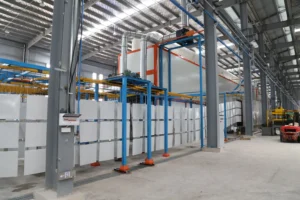
From our design philosophy, conveyor chain verticality problems can actually be prevented from the source.
Selection Logic for Support Frame Strength and Rail Model
The cheapest support frame is not always the best choice. When we prepare a quotation, customers often ask whether we can use a cheaper solution. Our answer is: yes, but what is the cost of that choice? If the customer produces 200 pieces per day, an 80×80 square tube may be enough. But if the customer produces 500 pieces per day, a 100×100 or even larger square tube is necessary. The price difference may only be a few thousand yuan, but in the long term, it determines whether the whole line can still run stably after three or five years.
Rail selection also requires careful consideration. The rail’s cross-sectional area, moment of inertia, and bending resistance all determine its deflection under its own weight and product load. For systems with large spans, heavy workpieces, and high automation levels, the rail model must be upgraded. Our standard is that rail deflection should not exceed L/1000, where L is the rail span. This requirement affects both material and rail model selection.
Control of welding process. The final strength of the support frame depends on welding quality. During manufacturing, we use welding procedure qualification and non-destructive testing to ensure that welds have no defects. This increases cost, but it guarantees long-term equipment reliability.
Rigidity Design Differences Under Different Capacity Levels
Our capacity classification and corresponding design logic are as follows.
Low capacity level, 100-200 pieces per day: The support frame uses 80×80 or 80×60 square tubes. The rail uses a standard model. The hanger can use single-wheel or double-wheel design. This level of system is relatively simple, but rail flatness must still meet the required standard during installation.
Medium capacity level, 200-500 pieces per day: The support frame is upgraded to 100×100 square tubes. The rail uses a reinforced model with a larger cross-section. The hanger uses double-wheel or multi-wheel design. At this level, conveyor chain verticality already has a clear impact on production capacity, so rigidity and stability are strongly emphasized in the design.
High capacity level, above 500 pieces per day: The support frame uses 120×120 or even larger square tubes. The rail uses special profiles or multi-rail parallel design. The hanger combines multi-wheel and guide wheel structures. At this level, every detail of the system is optimized for stability.
Standard configuration comparison under different capacity levels:
| Capacity Level | Support Frame Profile | Rail Model | Hanger Design | Anchor Shim Accuracy | Acceptance Verticality Requirement |
|---|---|---|---|---|---|
| 100-200 pieces/day | 80×80 square tube | Standard model | Single/double wheel | ±1 mm | ±2.5 mm |
| 200-500 pieces/day | 100×100 square tube | Reinforced model | Double wheel + guide | ±0.5 mm | ±2 mm |
| Above 500 pieces/day | 120×120 square tube | cURL Too many subrequests by single Worker invocation. To configure this limit, refer to https://developers.cloudflare.com/workers/wrangler/configuration/#limits | cURL Too many subrequests by single Worker invocation. To configure this limit, refer to https://developers.cloudflare.com/workers/wrangler/configuration/#limits | cURL Too many subrequests by single Worker invocation. To configure this limit, refer to https://developers.cloudflare.com/workers/wrangler/configuration/#limits | cURL Too many subrequests by single Worker invocation. To configure this limit, refer to https://developers.cloudflare.com/workers/wrangler/configuration/#limits |
cURL Too many subrequests by single Worker invocation. To configure this limit, refer to https://developers.cloudflare.com/workers/wrangler/configuration/#limits
cURL Too many subrequests by single Worker invocation. To configure this limit, refer to https://developers.cloudflare.com/workers/wrangler/configuration/#limits.
cURL Too many subrequests by single Worker invocation. To configure this limit, refer to https://developers.cloudflare.com/workers/wrangler/configuration/#limits. cURL Too many subrequests by single Worker invocation. To configure this limit, refer to https://developers.cloudflare.com/workers/wrangler/configuration/#limits.
cURL Too many subrequests by single Worker invocation. To configure this limit, refer to https://developers.cloudflare.com/workers/wrangler/configuration/#limits. cURL Too many subrequests by single Worker invocation. To configure this limit, refer to https://developers.cloudflare.com/workers/wrangler/configuration/#limits.
cURL Too many subrequests by single Worker invocation. To configure this limit, refer to https://developers.cloudflare.com/workers/wrangler/configuration/#limits. cURL Too many subrequests by single Worker invocation. To configure this limit, refer to https://developers.cloudflare.com/workers/wrangler/configuration/#limits.
cURL Too many subrequests by single Worker invocation. To configure this limit, refer to https://developers.cloudflare.com/workers/wrangler/configuration/#limits. cURL Too many subrequests by single Worker invocation. To configure this limit, refer to https://developers.cloudflare.com/workers/wrangler/configuration/#limits.
cURL Too many subrequests by single Worker invocation. To configure this limit, refer to https://developers.cloudflare.com/workers/wrangler/configuration/#limits. cURL Too many subrequests by single Worker invocation. To configure this limit, refer to https://developers.cloudflare.com/workers/wrangler/configuration/#limits.
cURL Too many subrequests by single Worker invocation. To configure this limit, refer to https://developers.cloudflare.com/workers/wrangler/configuration/#limits. cURL Too many subrequests by single Worker invocation. To configure this limit, refer to https://developers.cloudflare.com/workers/wrangler/configuration/#limits.
cURL Too many subrequests by single Worker invocation. To configure this limit, refer to https://developers.cloudflare.com/workers/wrangler/configuration/#limits
cURL Too many subrequests by single Worker invocation. To configure this limit, refer to https://developers.cloudflare.com/workers/wrangler/configuration/#limits
cURL Too many subrequests by single Worker invocation. To configure this limit, refer to https://developers.cloudflare.com/workers/wrangler/configuration/#limits. cURL Too many subrequests by single Worker invocation. To configure this limit, refer to https://developers.cloudflare.com/workers/wrangler/configuration/#limits.
- You cannot measure accurately because the level cannot be used properly during movement.
- The adjustment process may cause chain jamming and damage the equipment.
- If a hanger happens to pass through the adjustment area, unexpected interference may occur.
The correct method is to stop the equipment for adjustment. After shutdown, make a complete adjustment, confirm acceptance, and then restart the system. This is the only way to ensure adjustment accuracy and safety. If the chain problem is so urgent that you feel forced to adjust it while running, it means the previous maintenance system has already failed and should be reviewed.
How Soon Should the System Be Rechecked After Adjustment?
There is no absolute answer. It depends on the operating intensity and maintenance condition of the equipment.
In general:
- For a newly adjusted system, carry out a quick check after one week of operation. This helps confirm whether the adjustment has caused any unexpected change.
- After that, check once a month to confirm that the verticality has not rebounded. For high-intensity systems, verticality deviation may return quickly.
- If there is no obvious change within three months, the inspection frequency can be changed to quarterly. But this should be the minimum frequency.
- Once abnormal film thickness or production capacity is found, check conveyor chain verticality immediately. Do not wait until the next scheduled inspection.
Successful Customer Site Maintenance Case
Case 1: A sheet metal company in Guangzhou
This company manufactures switchgear cabinets. They originally used an older powder coating line with a production capacity of only 200 pieces per day. We helped them create an upgrade plan and configured a high-strength support frame and reinforced rail.
After the line was put into production, we paid special attention to conveyor chain verticality inspection during the first month. Weekly and monthly inspections were both carried out carefully. As a result, we found that the original rail installation had around 3-4 mm of settlement. We compensated with shims in advance and prevented the issue from affecting production.
 French
  English
  German
  Vietnamese