
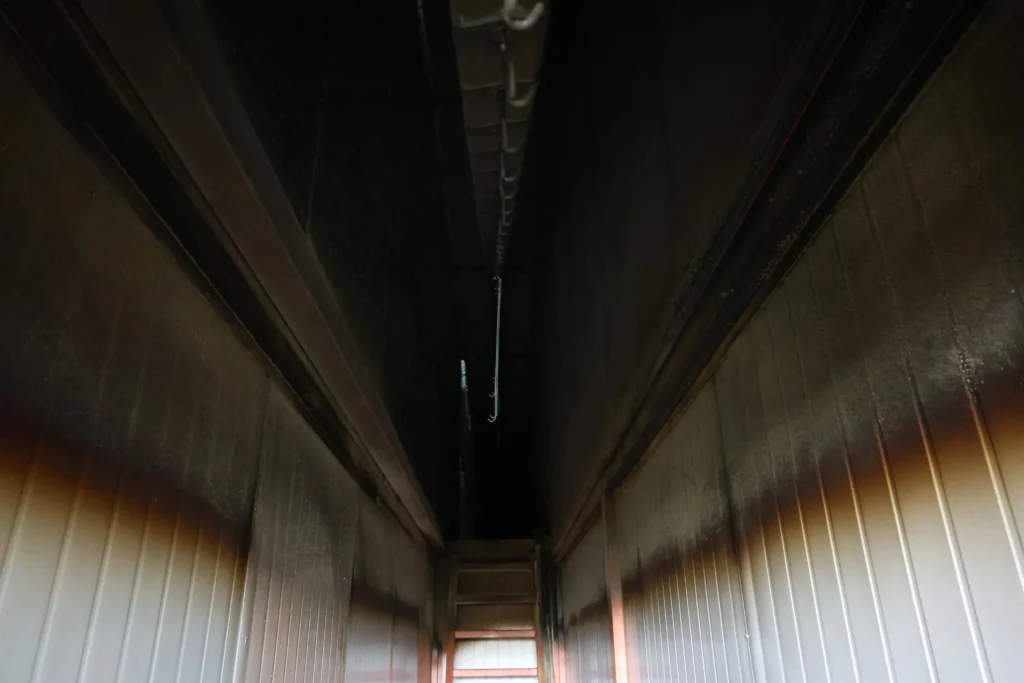
The Environmental Advantages of Pulvérisation de poudre Booths in Industrial Coating Systems
When we talk about making manufacturing more sustainable, powder spray booths consistently emerge as one of the most impactful tools available. I've spent years working with clients across cabinet manufacturing, furniture production, and aluminum extrusion, and I can tell you that the environmental case for powder coating isn't just about compliance—it's about fundamentally rethinking how we handle material waste and emissions.
Most people assume that "environmental benefits" means simply producing less pollution than liquid paint. That's only half the story. The real advantage of a powder spray booth lies in its ability to recover and recycle unused powder, turning what would be waste into reusable material. This isn't environmental protection through reduction; it's environmental protection through elimination of waste itself.
This article breaks down the authentic environmental advantages that powder spray booths deliver, how they actually work to achieve those results, and what system configuration you genuinely need to meet modern environmental standards across different markets.
Table des matières
- Traditional Spray Methods vs. Powder Coating: Why Environmental Standards Matter
- Core Environmental Advantages of Powder Spray Booths
- How Récupération de poudre Systems Work: The Key to Environmental Performance
- Complete System Configuration Required for Environmental Compliance
- Cost Benefits Beyond Environmental Compliance
- Meeting Global Environmental Standards Across Different Markets
- Quality and Environmental Performance: Why They Work Together, Not Against Each Other
- How to Choose the Right Powder Spray Booth Configuration
Traditional Spray Methods vs. Powder Coating: Why Environmental Standards Matter
Before discussing powder spray booths specifically, it's essential to understand why they represent such a significant shift from conventional approaches.
Liquid paint systems—whether solvent-based or water-based—operate on a fundamentally different principle. Spray guns atomize liquid paint, and only a portion adheres to the workpiece surface. The rest becomes airborne mist or falls to the floor. This overspray requires capture through water curtains, dry collectors, or ventilation systems. More critically, the solvent in liquid paints evaporates regardless of whether it reaches the workpiece, creating des composés organiques volatils[^1] (VOC) emissions that require expensive air filtration and treatment.
Post-spray cleanup adds another layer of waste. Cleaning equipment, hoses, and guns requires solvent or water-based cleaning solutions, generating liquid waste streams that demand treatment before discharge. Waste paint itself must be disposed of as hazardous material. The cumulative environmental footprint extends far beyond the spray booth itself.
Powder coating operates differently from the ground up. Because powder doesn't contain solvents, there are no VOC emissions during application. The material is already in solid form—it either adheres to the workpiece through electrostatic[^2] attraction or falls to the booth floor. This fundamental difference cascades into every advantage that follows.
Core Environmental Advantages of Powder Spray Booths
Zero Liquid Waste and Solvent Emissions
This is the most straightforward environmental benefit, yet it's often underestimated in scope.
When powder spray booths operate correctly, they produce no liquid waste during the coating process. There are no dirty mop buckets, no contaminated water disposal, no hazardous waste streams from cleaning agents. Because powder doesn't require mixing with solvents or thinners, there's no inventory of flammable liquids sitting in your facility.
The absence of solvent evaporation means zero VOC emissions from the coating material itself. Regulatory agencies across Europe, North America, and increasingly in Asia have set strict VOC limits for manufacturing facilities. Powder coating allows you to operate without hitting these caps, even in regions with increasingly stringent air quality regulations.
From my experience working with customers in different markets, this single advantage often provides immediate relief from regulatory compliance pressure. A cabinet manufacturer in the EU facing strict emission limits found that switching to powder coating eliminated the need for expensive VOC recovery systems entirely. The installation cost savings alone funded a substantial portion of the booth equipment.
High Material Recovery Efficiency and Reduced Waste
Here's where powder spray booths truly excel environmentally: material recovery rates that would be impossible to achieve with liquid systems.
In a properly configured powder spray booth, 90%+ of unused powder is mechanically separated from the exhaust air and returned to the supply system for reuse. This isn't theoretical. This is based on how cURL Too many subrequests by single Worker invocation. To configure this limit, refer to https://developers.cloudflare.com/workers/wrangler/configuration/#limits[^3] separation and secondary filtration systems actually perform in production.
By contrast, liquid paint overspray becomes waste. Even with excellent capture systems, liquid paint mist that falls into water curtains or accumulates in filter media cannot be recovered for reuse. It becomes sludge requiring disposal.
The powder recovery advantage compounds over time. On a 50-unit production run with typical spray efficiency rates, the material cost difference between liquid and powder approaches 15–20% in powder's favor, purely from eliminated waste. Over a year of continuous production, this translates to hundreds or thousands of kilograms of material staying in your production cycle instead of entering the waste stream.
I worked with an aluminum extrusion company that was shocked by this calculation. They had assumed powder coating would cost more due to equipment investment. When they modeled actual material usage—accounting for liquid paint waste, cleanup solvent costs, and powder recovery—powder coating showed lower consumable costs within 18 months.
| Facteur environnemental | Pulvérisation de peinture liquide | Cabine de pulvérisation de poudre |
|---|---|---|
| Émissions VOC | cURL Too many subrequests by single Worker invocation. To configure this limit, refer to https://developers.cloudflare.com/workers/wrangler/configuration/#limits | Zero (no solvents) |
| Déchets de matériau | 20–30% lost to overspray | 5–10% lost (rest recovered) |
| Liquid Waste | Significant (water + paint sludge) | None (all powder or air) |
| Hazardous Waste Classification | Yes (solvent and paint residue) | cURL Too many subrequests by single Worker invocation. To configure this limit, refer to https://developers.cloudflare.com/workers/wrangler/configuration/#limits |
| cURL Too many subrequests by single Worker invocation. To configure this limit, refer to https://developers.cloudflare.com/workers/wrangler/configuration/#limits | cURL Too many subrequests by single Worker invocation. To configure this limit, refer to https://developers.cloudflare.com/workers/wrangler/configuration/#limits | cURL Too many subrequests by single Worker invocation. To configure this limit, refer to https://developers.cloudflare.com/workers/wrangler/configuration/#limits |
| cURL Too many subrequests by single Worker invocation. To configure this limit, refer to https://developers.cloudflare.com/workers/wrangler/configuration/#limits | cURL Too many subrequests by single Worker invocation. To configure this limit, refer to https://developers.cloudflare.com/workers/wrangler/configuration/#limits | cURL Too many subrequests by single Worker invocation. To configure this limit, refer to https://developers.cloudflare.com/workers/wrangler/configuration/#limits |
| cURL Too many subrequests by single Worker invocation. To configure this limit, refer to https://developers.cloudflare.com/workers/wrangler/configuration/#limits | Minimale | Récupération de poudre 90%+ |
How Powder Recovery Systems Work: The Key to Environmental Performance
cURL Too many subrequests by single Worker invocation. To configure this limit, refer to https://developers.cloudflare.com/workers/wrangler/configuration/#limits.
cURL Too many subrequests by single Worker invocation. To configure this limit, refer to https://developers.cloudflare.com/workers/wrangler/configuration/#limits
cURL Too many subrequests by single Worker invocation. To configure this limit, refer to https://developers.cloudflare.com/workers/wrangler/configuration/#limits cURL Too many subrequests by single Worker invocation. To configure this limit, refer to https://developers.cloudflare.com/workers/wrangler/configuration/#limitscURL Too many subrequests by single Worker invocation. To configure this limit, refer to https://developers.cloudflare.com/workers/wrangler/configuration/#limits.
cURL Too many subrequests by single Worker invocation. To configure this limit, refer to https://developers.cloudflare.com/workers/wrangler/configuration/#limits.
cURL Too many subrequests by single Worker invocation. To configure this limit, refer to https://developers.cloudflare.com/workers/wrangler/configuration/#limits.
cURL Too many subrequests by single Worker invocation. To configure this limit, refer to https://developers.cloudflare.com/workers/wrangler/configuration/#limits.
cURL Too many subrequests by single Worker invocation. To configure this limit, refer to https://developers.cloudflare.com/workers/wrangler/configuration/#limits
cURL Too many subrequests by single Worker invocation. To configure this limit, refer to https://developers.cloudflare.com/workers/wrangler/configuration/#limits.
cURL Too many subrequests by single Worker invocation. To configure this limit, refer to https://developers.cloudflare.com/workers/wrangler/configuration/#limits.
cURL Too many subrequests by single Worker invocation. To configure this limit, refer to https://developers.cloudflare.com/workers/wrangler/configuration/#limits.
cURL Too many subrequests by single Worker invocation. To configure this limit, refer to https://developers.cloudflare.com/workers/wrangler/configuration/#limits.
Complete System Configuration Required for Environmental Compliance
cURL Too many subrequests by single Worker invocation. To configure this limit, refer to https://developers.cloudflare.com/workers/wrangler/configuration/#limits.
Filtration and Air Handling Systems
Many operators assume that powder recovery and environmental compliance are the same thing. They're not. Environmental compliance also requires that the air exiting your facility meets local emission standards.
After primary cyclone recovery and secondary cabinet filtration, the air still contains some fine particulate matter. In regions with strict air quality standards—particularly in Europe, parts of Asia, and increasingly in North America—this exhaust air must meet specific particulate emission limits before leaving the facility.
This typically requires a third-stage filtration system or integration with your facility's main air handling. The filtration media must have sufficient surface area to capture particles while maintaining reasonable pressure drop (otherwise your exhaust fan consumes excessive energy).
Filter maintenance is where many facilities fail environmentally. Filter elements clogged with powder dust increase backpressure, forcing the exhaust fan to work harder and consume more energy. They also eventually fail to capture fine particles, allowing them to escape. Regular monitoring and element replacement on a defined schedule is essential—not optional.
I've walked through facilities with 10-year-old filter elements still in secondary recovery cabinets. The operator had "forgotten" they needed changing because they "didn't look that dirty." The environmental and energy waste from that neglect was substantial.
Explosion Prevention and Compressed Air Management
Environmental performance also encompasses safety systems that prevent catastrophic failures, which would obviously be environmentally damaging.
Powder suspended in air can form an explosive atmosphere under certain conditions. Preventing powder dust explosions requires:
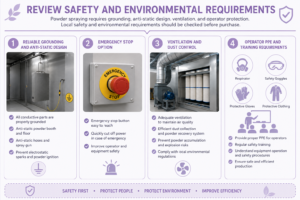
Proper grounding: All conductive components must be bonded and grounded to prevent static electricity[^5] accumulation. Poor grounding not only increases explosion risk—it also degrades spray efficiency and coating quality, leading to increased material waste.
cURL Too many subrequests by single Worker invocation. To configure this limit, refer to https://developers.cloudflare.com/workers/wrangler/configuration/#limits: Maintaining airflow velocity through the spray booth above minimum thresholds prevents powder concentration from reaching explosive levels. This is a safety requirement that coincidentally also ensures optimal spray and recovery performance.
Qualité de l'air comprimé: The air used for powder atomization and system operation must be clean and dry. Compressed air containing water or oil contamination can cause powder to clump, reducing spray efficiency and increasing material waste. It can also compromise filter performance in the recovery system.
From an environmental perspective, compressed air quality is often overlooked but significant. A leaking air compressor system or inadequate drying can waste enormous amounts of energy while simultaneously degrading powder utilization rates. Facilities that properly maintain air treatment systems typically see 10–15% improvement in powder efficiency.
Cost Benefits Beyond Environmental Compliance
Here's something that surprises many facility managers: the environmental advantages of powder spray booths directly translate to operational cost reductions that often exceed the equipment investment.
Reduced Operating Costs Through Material Efficiency
Material costs in powder coating typically represent 40–50% of total coating process expenses. With 90%+ powder recovery rates, your actual powder consumption drops dramatically compared to liquid systems.
Consider a production facility spraying 500 units weekly at 2 kg of coating per unit (1,000 kg total weekly coating per unit). With liquid paint systems showing typical 20–30% waste, you're purchasing 1,200–1,300 kg of paint weekly. With powder spray showing 90% recovery, you're purchasing only 1,100 kg of powder weekly (accounting for 10% loss through agglomeration, filter retention, and incomplete recovery).
That 100–200 kg weekly difference represents $400–1,200 in material cost savings depending on powder price. Over a year, that's $20,000–60,000 in pure material cost reduction—with zero additional effort from your team.
Material efficiency benefits compound when you factor in powder color changes. Liquid systems require extensive cleaning between colors, consuming solvent and generating waste. Powder spray booths require dry cleaning with compressed air only. The cost and environmental impact difference is substantial.
Lower Maintenance and Staff Health Benefits
Powder spray booths reduce maintenance burden and create healthier working conditions for your operators.
Liquid paint systems require daily equipment cleaning, filter replacement, water disposal, and sludge management. Powder systems require dry cleanup—compressed air to dislodge powder, collection into containers for recovery or disposal. This takes less time and requires no hazardous materials handling.
From a health perspective, powder coating eliminates operator exposure to organic solvents. While powder itself requires respiratory protection (as do all industrial dusts), it poses none of the systemic toxicity risks associated with solvent vapors. OSHA[^6] recordable incidents related to solvent exposure typically disappear entirely after switching to powder coating.
I worked with a cabinet manufacturing facility that saw a measurable reduction in respiratory complaints and headaches from operators after switching to powder spray booths. Beyond the humanitarian benefit, this translated to fewer lost workdays and lower workers' compensation costs.
The environmental benefit extends to facility air quality. Solvent vapor accumulation in and around spray areas creates visible haze in the air. Powder coating, with proper recovery and filtration, leaves the air visibly cleaner. This isn't just environmental—it's a quality-of-life improvement your operators will immediately notice.
| Catégorie de coût | Liquid Paint System | Cabine de pulvérisation de poudre | Annual Savings |
|---|---|---|---|
| Material (accounting for waste) | Higher due to 20–30% overspray loss | Lower due to 90%+ recovery | $20,000–60,000 |
| Cleaning agents & solvents | $5,000–15,000/year | cURL Too many subrequests by single Worker invocation. To configure this limit, refer to https://developers.cloudflare.com/workers/wrangler/configuration/#limits | cURL Too many subrequests by single Worker invocation. To configure this limit, refer to https://developers.cloudflare.com/workers/wrangler/configuration/#limits |
| cURL Too many subrequests by single Worker invocation. To configure this limit, refer to https://developers.cloudflare.com/workers/wrangler/configuration/#limits | cURL Too many subrequests by single Worker invocation. To configure this limit, refer to https://developers.cloudflare.com/workers/wrangler/configuration/#limits | Minimale | cURL Too many subrequests by single Worker invocation. To configure this limit, refer to https://developers.cloudflare.com/workers/wrangler/configuration/#limits |
| cURL Too many subrequests by single Worker invocation. To configure this limit, refer to https://developers.cloudflare.com/workers/wrangler/configuration/#limits | cURL Too many subrequests by single Worker invocation. To configure this limit, refer to https://developers.cloudflare.com/workers/wrangler/configuration/#limits | cURL Too many subrequests by single Worker invocation. To configure this limit, refer to https://developers.cloudflare.com/workers/wrangler/configuration/#limits | cURL Too many subrequests by single Worker invocation. To configure this limit, refer to https://developers.cloudflare.com/workers/wrangler/configuration/#limits |
| cURL Too many subrequests by single Worker invocation. To configure this limit, refer to https://developers.cloudflare.com/workers/wrangler/configuration/#limits | cURL Too many subrequests by single Worker invocation. To configure this limit, refer to https://developers.cloudflare.com/workers/wrangler/configuration/#limits | cURL Too many subrequests by single Worker invocation. To configure this limit, refer to https://developers.cloudflare.com/workers/wrangler/configuration/#limits | cURL Too many subrequests by single Worker invocation. To configure this limit, refer to https://developers.cloudflare.com/workers/wrangler/configuration/#limits |
| cURL Too many subrequests by single Worker invocation. To configure this limit, refer to https://developers.cloudflare.com/workers/wrangler/configuration/#limits | Ligne de base | cURL Too many subrequests by single Worker invocation. To configure this limit, refer to https://developers.cloudflare.com/workers/wrangler/configuration/#limits | cURL Too many subrequests by single Worker invocation. To configure this limit, refer to https://developers.cloudflare.com/workers/wrangler/configuration/#limits |
Meeting Global Environmental Standards Across Different Markets
cURL Too many subrequests by single Worker invocation. To configure this limit, refer to https://developers.cloudflare.com/workers/wrangler/configuration/#limits.
cURL Too many subrequests by single Worker invocation. To configure this limit, refer to https://developers.cloudflare.com/workers/wrangler/configuration/#limits
cURL Too many subrequests by single Worker invocation. To configure this limit, refer to https://developers.cloudflare.com/workers/wrangler/configuration/#limits: cURL Too many subrequests by single Worker invocation. To configure this limit, refer to https://developers.cloudflare.com/workers/wrangler/configuration/#limitscURL Too many subrequests by single Worker invocation. To configure this limit, refer to https://developers.cloudflare.com/workers/wrangler/configuration/#limits.
cURL Too many subrequests by single Worker invocation. To configure this limit, refer to https://developers.cloudflare.com/workers/wrangler/configuration/#limits: EPA regulations focus on VOC emissions and hazardous air pollutant control. Regulations vary by state and local jurisdiction, with California imposing particularly strict standards. Standards are less prescriptive than EU regulations—they specify outcome (emission limits) but allow flexibility in how to achieve them.
Asia-Pacific: Regulations vary significantly by country. China has been rapidly tightening environmental standards in recent years, particularly for industrial facilities. India and Southeast Asian countries are increasingly adopting emission limits similar to (but slightly less stringent than) EU standards. Japan maintains exceptionally strict standards comparable to the EU.
The practical implication: a powder spray booth designed for the EU market may not meet Chinese standards without modification. Conversely, a booth designed for North American standards might be over-engineered for some Asian markets, adding unnecessary cost.
Equipment Configuration for International Requirements
Environmental compliance isn't just about powder recovery efficiency—it's about matching system configuration to specific regional requirements.
EU compliance typically requires:
- Primary cyclone recovery to at least 80% efficiency
- Secondary filtration with high-efficiency filter elements (filtration to at least PM2.5 level)
- Continuous emissions monitoring capability or regular third-party testing
- Comprehensive documentation of maintenance and compliance
North American compliance typically emphasizes:
- VOC emission control (essentially eliminated through powder coating vs. liquid)
- Hazardous air pollutant management (also eliminated)
- Secondary recovery or tertiary filtration, but less stringent particulate limits than EU
Asian market configurations:
- China increasingly requires similar standards to EU for large facilities
- India and Southeast Asia currently accept North American-level standards but moving toward EU-level
- Japan requires EU-equivalent performance
From my experience, the cost difference between a "North American standard" powder booth and a "EU-compliant" booth is typically 15–25%, concentrated in secondary filtration quality and monitoring systems. For companies operating across multiple regions, it often makes sense to over-engineer for the strictest market and achieve compliance everywhere.
Quality and Environmental Performance: Why They Work Together, Not Against Each Other
This is perhaps the most important point I want to emphasize: environmental performance and coating quality are not competing objectives in powder spray booths. They're aligned.
The same system features that minimize environmental impact also maximize coating consistency:
High recovery efficiency means powder that reaches the workpiece is being precisely atomized and efficiently transferred. Overspray represents not just material waste but also uncontrolled deposition—the enemy of uniform appearance.
Proper airflow and booth design that supports environmental compliance also creates ideal conditions for powder adhesion. Turbulent airflow patterns that reduce recovery efficiency also create surface defects and uneven coating.
Clean compressed air required for system operation also ensures consistent electrostatic charging and atomization. Water or oil contamination that would compromise environmental compliance simultaneously compromises coating quality.
Effective filtration systems that minimize environmental emissions also prevent powder contamination in the booth, protecting appearance and adhesion.
I've never encountered a facility with exceptional environmental performance from its powder spray booth that simultaneously had quality problems. The reverse is equally true—facilities with visible environmental issues (dust emissions, visible overspray, dirty exhaust air) consistently show quality defects.
This alignment means that investing in environmental compliance through powder spray booth optimization is simultaneously investing in quality improvement. Facility managers who approach it from this perspective—"what system improvements will give me better environmental AND quality performance?"—make the best decisions.

How to Choose the Right Powder Spray Booth Configuration
If you're evaluating powder spray booths for environmental performance, here's what actually matters in the selection process:
Understand your regulatory environment first. Don't assume your booth design. Contact your local environmental agency and determine specific particulate emission limits, VOC requirements, and monitoring obligations. This is your baseline.
Evaluate recovery system efficiency independently. Ask manufacturers for third-party test data on cyclone separation rates and secondary filtration performance. Generic claims like "efficient recovery" are meaningless. Actual recovery percentages matter.
Assess compressed air quality requirements. cURL Too many subrequests by single Worker invocation. To configure this limit, refer to https://developers.cloudflare.com/workers/wrangler/configuration/#limits.
cURL Too many subrequests by single Worker invocation. To configure this limit, refer to https://developers.cloudflare.com/workers/wrangler/configuration/#limits. cURL Too many subrequests by single Worker invocation. To configure this limit, refer to https://developers.cloudflare.com/workers/wrangler/configuration/#limits.
cURL Too many subrequests by single Worker invocation. To configure this limit, refer to https://developers.cloudflare.com/workers/wrangler/configuration/#limits. cURL Too many subrequests by single Worker invocation. To configure this limit, refer to https://developers.cloudflare.com/workers/wrangler/configuration/#limits.
cURL Too many subrequests by single Worker invocation. To configure this limit, refer to https://developers.cloudflare.com/workers/wrangler/configuration/#limits. cURL Too many subrequests by single Worker invocation. To configure this limit, refer to https://developers.cloudflare.com/workers/wrangler/configuration/#limits.
cURL Too many subrequests by single Worker invocation. To configure this limit, refer to https://developers.cloudflare.com/workers/wrangler/configuration/#limits.
Conclusion
cURL Too many subrequests by single Worker invocation. To configure this limit, refer to https://developers.cloudflare.com/workers/wrangler/configuration/#limits.
cURL Too many subrequests by single Worker invocation. To configure this limit, refer to https://developers.cloudflare.com/workers/wrangler/configuration/#limits.
cURL Too many subrequests by single Worker invocation. To configure this limit, refer to https://developers.cloudflare.com/workers/wrangler/configuration/#limits.
cURL Too many subrequests by single Worker invocation. To configure this limit, refer to https://developers.cloudflare.com/workers/wrangler/configuration/#limits.
cURL Too many subrequests by single Worker invocation. To configure this limit, refer to https://developers.cloudflare.com/workers/wrangler/configuration/#limits cURL Too many subrequests by single Worker invocation. To configure this limit, refer to https://developers.cloudflare.com/workers/wrangler/configuration/#limits.
Contact us through WhatsApp at +8618064668879 or email ketucoatingline@gmail.com to discuss your specific coating requirements and environmental objectives. We're here to help you move from compliance checkbox to genuine operational advantage.
cURL Too many subrequests by single Worker invocation. To configure this limit, refer to https://developers.cloudflare.com/workers/wrangler/configuration/#limits.
cURL Too many subrequests by single Worker invocation. To configure this limit, refer to https://developers.cloudflare.com/workers/wrangler/configuration/#limits.
cURL Too many subrequests by single Worker invocation. To configure this limit, refer to https://developers.cloudflare.com/workers/wrangler/configuration/#limits.
cURL Too many subrequests by single Worker invocation. To configure this limit, refer to https://developers.cloudflare.com/workers/wrangler/configuration/#limits.
cURL Too many subrequests by single Worker invocation. To configure this limit, refer to https://developers.cloudflare.com/workers/wrangler/configuration/#limits.
cURL Too many subrequests by single Worker invocation. To configure this limit, refer to https://developers.cloudflare.com/workers/wrangler/configuration/#limits.
cURL Too many subrequests by single Worker invocation. To configure this limit, refer to https://developers.cloudflare.com/workers/wrangler/configuration/#limits.
 French
  English
  German
  Vietnamese